question on watchmaker standard

Posts
122
Likes
64
hello members,

today I had a discussion with a watchmaker on the result of different services that he performed on different watches. I had noticed, that while some models are running on 1-3 seconds per day accurate after service, some differ about 15 seconds per day and some even 40 seconds per day. I was wondering why the results of the services (which were all priced similarly at around 400 euro) are so much apart.

he explained that the quality of the service mainly depends on the quality of the watch he has on the table. for instance, when he works on an "unworn" 90ties speedmaster the outcome will be a lot better than if he works on a 50ties bumper that got neglected by the previous owners. it also depends on the amount of spare parts he needs to change during the service and consequently the price.

do you guys think that a time deviation of 40 seconds per day is acceptable after a fresh service or is he fooling me?

 
Posts
18,095
Likes
27,413
hello members,

today I had a discussion with a watchmaker on the result of different services that he performed on different watches. I had noticed, that while some models are running on 1-3 seconds per day accurate after service, some differ about 15 seconds per day and some even 40 seconds per day. I was wondering why the results of the services (which were all priced similarly at around 400 euro) are so much apart.

he explained that the quality of the service mainly depends on the quality of the watch he has on the table. for instance, when he works on an "unworn" 90ties speedmaster the outcome will be a lot better than if he works on a 50ties bumper that got neglected by the previous owners. it also depends on the amount of spare parts he needs to change during the service and consequently the price.

do you guys think that a time deviation of 40 seconds per day is acceptable after a fresh service or is he fooling me?

what is the watch in question?
 
Posts
122
Likes
64
do you guys think that a time deviation of 40 seconds per day is acceptable after a fresh service or is he fooling me?
was the question - and also if the explanation he gives is valid 😀
 
Posts
15,221
Likes
44,698
If some of the watches he services for you, run within 1 to 3 seconds per day, he sounds to me to be quite capable. Now, let’s discuss the capabilities of the watches that aren’t quite so accurate. Accuracy of 1 to 3 seconds per day was likely built in when the watch was made. Likewise, perhaps the factory considered one minute variation per day to be adequate. And it can be tough to bring a watch like that to a higher standard.
 
Posts
1,534
Likes
3,234
some older watches also have quite a bit of variation between positions. I have had different results for different watches with the same watchmaker due to wear and tear on old parts that are difficult to source on some of my watches.
 
Posts
13,477
Likes
31,751
do you guys think that a time deviation of 40 seconds per day is acceptable after a fresh service or is he fooling me?
was the question - and also if the explanation he gives is valid 😀

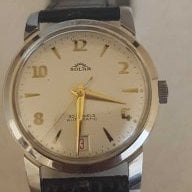
The question to the question is WHAT SPECIFIC reference(s) are we discussing.
 
Posts
23,324
Likes
51,929
The number of seconds error per day is not the "result" of the service IMO. The main result of the service is that the movement is clean and properly lubricated, which is the most important thing in the long run. The timekeeping adjustment is only a small piece of the service, and will obviously depend greatly on things like positional variation and the overall condition of the movement, which may depend as much upon its quality and past service history than anything done by the watchmaker.

The explanation that he gave you sounds quite accurate to me.
Edited:
 
Posts
250
Likes
713
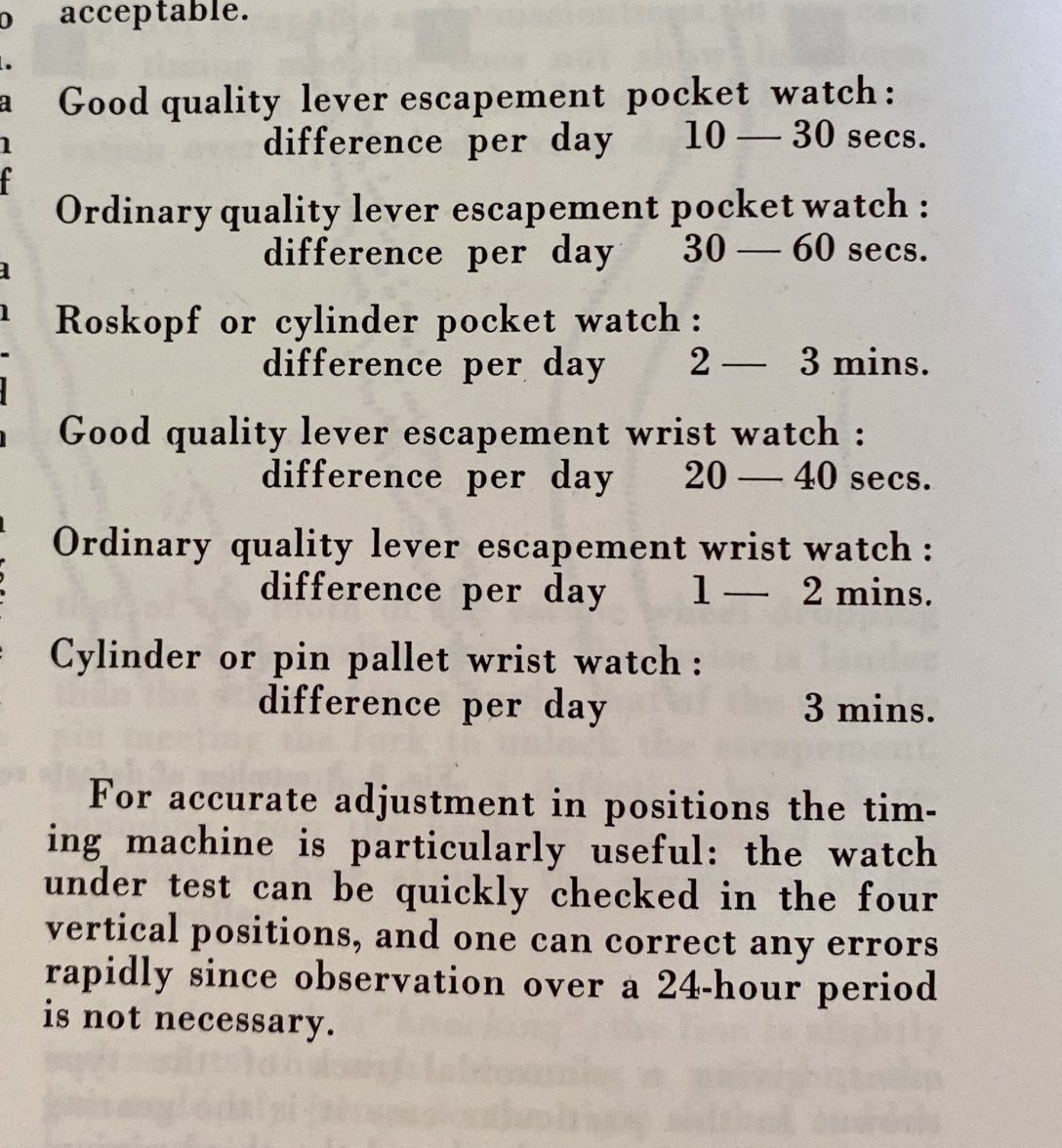
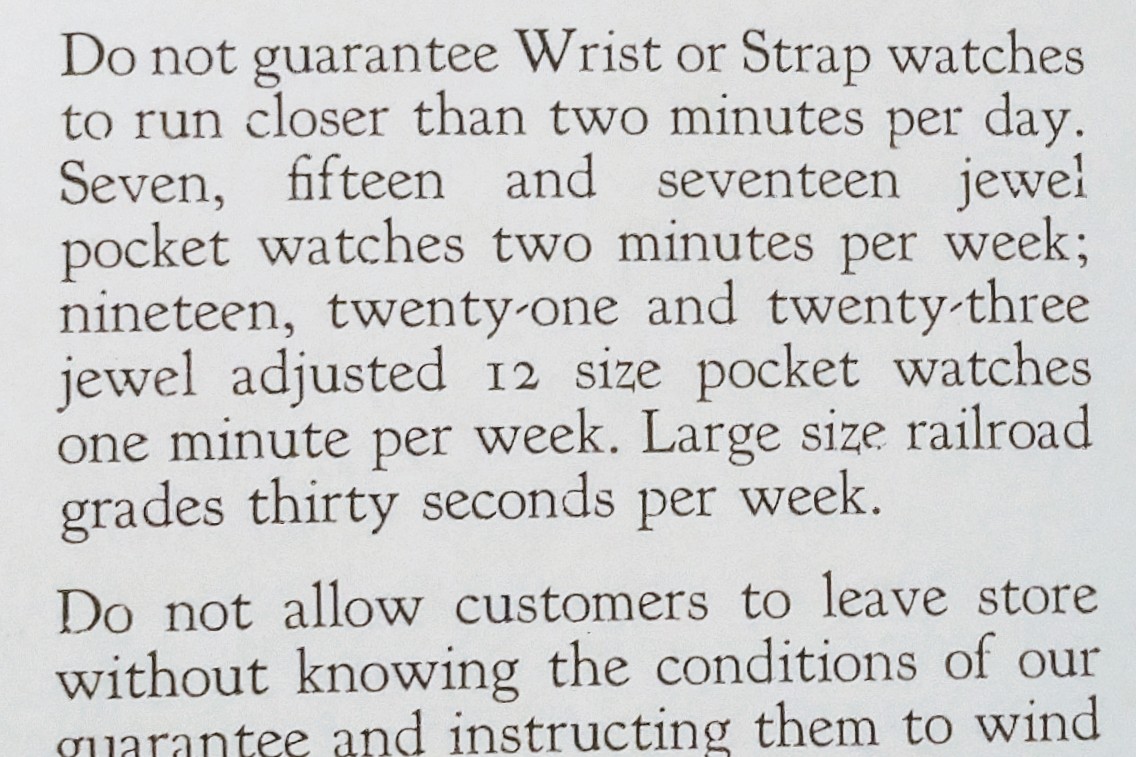
I have included an extract from The Swiss Watch Repairers Manual by Jendritzki. It’s considered to be one of the best resource books out there. Note the timing specifics.

I think that the average consumer today is bamboozled by marketing and just remember that not all watches are created equal.

You also have to remember that if you want a vintage watch that’s in a ‘shagged out’ condition to be brought to COSC timing results, be prepared to get the check book out as it’s going to need a lot of work.

You would also be quite surprised at some of the timing requirements set out by Omega. I used to have paperwork on this but it got lost in my moves. I’m sure Al, or someone else with a Swatch account can testify to that fact.
 
Posts
5,636
Likes
5,800
He is 100% telling you the truth, and it is a hard lesson to learn!

I have an Omega caliber 355 that I am going to ask my watchmaker to service and I bought a bunch of parts for that already.

If you want one of those 40 seconds a day watches to run better, your watchmaker might be able to adjust them closer... but more adjustment and regulation means more time spent, which means pay the watchmaker more money. This is something I choose to do and my watchmaker is willing to do it when the movement can be adjustef further. Some cannot.
 
Posts
5,636
Likes
5,800
You would also be quite surprised at some of the timing requirements set out by Omega.

By memory, caliber 1861, tested in three positions, -0 to +15 per day.

Here's a quote for ya: "Seiko claims that the accuracy of caliber 4R36 is between +45 / -35 seconds per day. This rating is based on normal daily wear on the wrist in temperatures between 5 ºC and 35 ºC. When testing your watch for timekeeping, make sure it is fully wound."
 
Posts
16,307
Likes
44,981
I have a few 7 jewel military watches where the original spec was +/-1 minute per day. We forget that COCS was a big deal back in the day, now we can get a cheap Seiko to run that well.
In term of service performed, as said above, assuming your watchmaker is working with 100% perfect factory fresh parts on a watch that was designed to run COCS, sure- he can get it within a few seconds. But jf the parts are NLA and replacements not obtainable, he has to work with what he’s got and either just clean and lube and get it as close as he can, or hunt down donors and hope those parts are in better shape.
 
Posts
1,372
Likes
2,000
I'm sure Al will correct me, but I believe even the current Omega service manual says that movements like the 561, 564, 751, etc (which held COSC when new) are considered within standard once they're +25/-30spd or so.
 
Posts
1,616
Likes
3,857
I'm sure Al will correct me, but I believe even the current Omega service manual says that movements like the 561, 564, 751, etc (which held COSC when new) are considered within standard once they're +25/-30spd or so.

After letting them unwind for 24h if my memory works OK... if it is +30spd at full wind, there is a problem or it has not been serviced. Remember, they are auto movements, so they mostly are fully wound during the day, and you don't sleep for 24h. When they are not completely shagged, with a hairspring not tampered with, they can hold a minute a week or less in real life (meaning : you put it on in the morning at 8am; you leave it on the table at 9pm; you don't fiddle with it).
 
Posts
7,635
Likes
21,906
A vintage movement which wasn’t serviced regularly may have some parts that have been worn. I would be happy with the explanation your watchmaker gave you.
Mine (who’s very good) told me that a watch I just bought and which is running 5 minutes fast might still have the same problem after a service as it is from the late 20s. (It’s a very rare movement as far as I know).
I must admit my watchmaker was probably biased because it’s a amall movement of a size he absolutely hates so he was probably hoping I would give up on getting the watch taken care of.
 
Posts
2,219
Likes
4,946
do you guys think that a time deviation of 40 seconds per day is acceptable after a fresh service or is he fooling me?

was the question - and also if the explanation he gives is valid 😀
Yes, this can be acceptable and the explanation is reasonable although I doubt it was exactly as you wrote. As noted by others, it depends on the calibre. It also depends on which wrist you wear the watch on. Again, is it an auto, as autos tend to be close to full charge for 12 hours or so per day.

Many of the good quality vintage calibres that were chronometers are no longer specified to chronometer requirements, as @connieseamaster notes. So, like non chronometer calibres, they are specified as 25-35 seconds/day variation at full charge (plus 30 minutes) over 3 positions: Dial up; 9H; 6H. It depends on the calibre.

If you wear your watch on the outside of your left wrist, these correspond to:
Sitting at a desk.
Walking along with your arm by your side.
Driving with hands either side of the wheel.

That allowance typically increases by 10 or 15 seconds after the watch has been rested. The 861 (for example) has closer tolerances as do some others.

There is no requirement in these cases to check 3H or Dial down as these are not typical positions for most people. Of course, if you wear your watch on the other wrist or on the inside, then these positions come into play. I have never seen 12H specified. The manufacturer is covering the positions that the watch will be in most of the time and saying that when it's in other positions it will be for a short time and so doesn't affect the daily rate.

So, for a fifties bumper, full charge performance of:
DU : +5
9H : + 40
6H: +40
Could be acceptable This means it will run positive all the time (desirable but it's set a bit fast in this example). So, walk about all day and this watch might run +40 seconds.

That could change to have a greater variation after the watch has run down for 24 hours. Still acceptable.

As @Dan S implied, the most important part of the service is preservation of the watch. You can spend a lot of time on old movements trying to make adjustments (balance poise, hairspring shape, regulator pins etc) to even out all the running positions and some of these watches, as @Canuck and @ATracyWatches have mentioned, were never designed and built with sufficient quality to achieve the best performance.

There is no easy answer to your question but, you do need to explain a little more to have any chance of a real answer. I'm not going to look up lots of specifications to hope that I guess the calibre you have and I doubt anyone else will.

The only thing I would say is that the watchmaker doesn't know how you will use and wear the watch so, if it is consistently +40 seconds each day, go back and ask them to regulate it slower - this is a fairly quick job. If it is +30 one day and -30 the next, then you can't regulate it, it needs adjustment and that is significant work.

Cheers, Chris
 
Posts
29,186
Likes
75,420
How well a vintage watch will run after service will depend on a number of factors...

What was the original watch movement capable of?

How well was the watch maintained over it's lifetime?

How much wear is present?

Are replacement parts still available?

What is the skill level of the watchmaker who will service the watch, and their willingness to keep at it until it's right?

How much are you willing to spend to get the watch back to top performance?
 
Posts
4,593
Likes
10,805
As @Dan S implied, the most important part of the service is preservation of the watch.

Yes I fully agree. Cleaning and lubing should be #1 goal so at least the thing can be worn sometimes without grinding things apart inside. However I agree with the expert watch makers on this site that anything more than cleaning and lubing is going to require time and probably parts, which is gonna cost on older stuff.
 
Posts
137
Likes
640
In 1929, here's what Gruen suggested the timing standards were for various sizes of movements.

 
Posts
2,219
Likes
4,946
However I agree with the expert watch makers on this site...
I could read that as a none too subtle criticism...🤔

Cheers, Chris🙁