Here is the blurb on both watches…
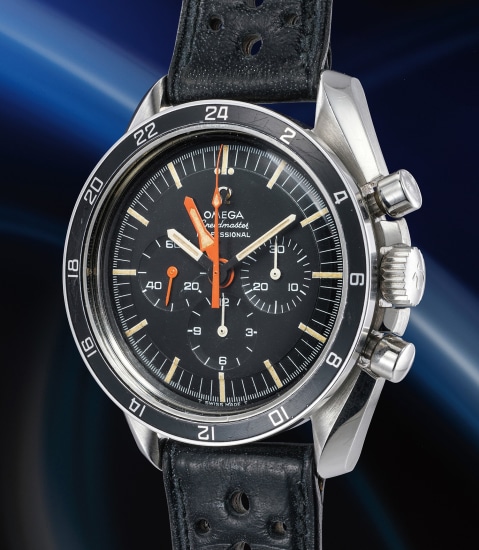
Ref. 145012-68SP
The present piece is without a doubt one of the most fascinating and important Omega finds of recent years, a true “first hand” representative of the ongoing R&D process that was happening at Omega in the 1960s, and the earliest known conceptualisation of what will eventually become the Omega Flightmaster.
While at first glance it would appear to be that of a standard Speedmaster 145012, the additional 24-hour hand (and matching bezel) as well as the case construction immediately categorise the piece as a mystery for the Omega connoisseur.
Thankfully, with the invaluable assistance of the Omega Archive, we were able to solve such a mystery and provide a detailed account of the genesis of the present timepiece.
During the 1960s, the collaboration between NASA and Omega was at its apex. In fact, a number of requests were made from NASA to Omega. Some of these requests were tested on “Alaska” pieces, some were employed in the Flightmaster (launched in 1969) and some other remained as either pure concepts or were made only in prototype pieces. The present watch is indeed a representative of the latter group. In fact, a 24-hour bezel (along with a 12-hour and a 5-minute ones as well) is, according to Omega, a documented NASA request.
As an added layer of intrigue, Omega has discovered that the mind behind the design of this piece is no other than Frederic Robert. Active since the 1950s in the watch industry (in fact the 1958 Aquastar, one of the very first diver watches, was deigned by Mr. Robert), in the 1960 he became an Omega consultant for professional and maritime watches. It is during this tenure that he designed the present prototype, of which the original sketch was gracefully provided to us by Omega. Mr. Robert’s hand is indeed the same which also designed the Flightmaster of which this watch represents a very early iteration. While maintaining the Speedmaster case and not being a dual-time piece (the central hand is purely a 24-hour hand), one of the principal design elements of the Flightmaster (the large central hand) is already present on this prototype. Mr. Robert will eventually modify the NASA-suggested 24-hour hand in a 12-hour additional timezone hand (thanks to the outer adjustable 12-hour ring) and will case the piece in a futuristic architecture miles away from the one of the Speedmaster.
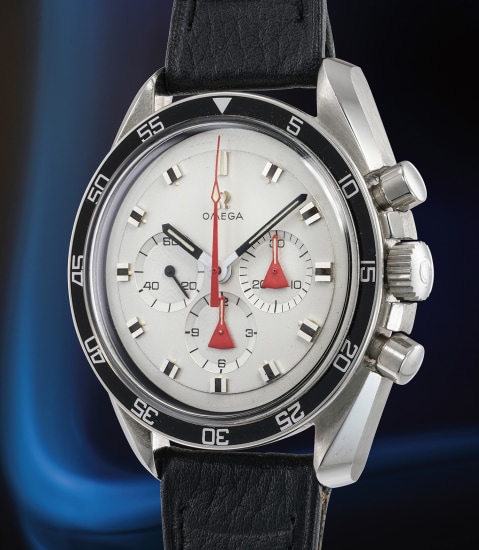
Ref. 145.022
It is by now common knowledge that Omega undertook a series of secret projects for Nasa. Codenamed “Alaska” (I to IV), the name had nothing to do with geography, rather was randomly selected according to Omega’s internal rule that demanded new watch projects would be code-named after a city or State (such as the somewhat ominously sounding “Manhattan Project” for the Constellation) while movement projects would be code-named after birds (such as “Albatross” for the Chrono-quartz)
The present piece is indeed part of this restricted and extremely specific output. According to information received from the Omega Museum, the present piece appears to be a intermediate effort to be placed between the Alaska I (1969) and Alaska II (1970) projects. In fact, while this cannot be 100% confirmed, the Museum thinks this watch might mark “the beginning of said “Alaska II” series of projects.”. It is unnecessary to point out the peculiarity of such a timepiece, even in the already highly uncommon panorama of the Alaska Project pieces.
The collaboration between Omega and Nasa dates back to before NASA’s most famous Apollo 11 moon landing mission. Since then, OMEGA would go on to produce a series of test-watches, all of which were proposed to NASA in a project that would span many years.
Following the cancellation of the Apollo missions after Apollo 17 (missions 18 through 22), there was no immediate use for the ALASKA Project’s test-watches, so the project was temporarily terminated, though remarkable progress had been made. This first phase of the development can be called “ALASKA I”.
Beginning in 1971, Omega began work on a continuation of its secret project, now internally titled “ALASKA II”, which involved several studies and prototypes. The present lot is as mentioned one of the earliest “ALASKA II” prototypes, and is closely related to the production Speedmaster Professional, featuring more similarities to it than Alaska I iterations. At the time, it paired most of the tested technologies of “ALASKA I” (the white dial and a new, red anodized aluminum outer protective case just to name a few) with the trusted and legendary Speedmaster “Moonwatch” case of the (then) current reference ST 145.022.
The “ALASKA II” test-watches were delivered to Houston in the beginning of 1972. While once again considerable progress had been made, since the Apollo Program had come to an end by the end of 1972, the “ALASKA II” test-watches were not retained by the program office and the series of OMEGA’s Alaska Projects came to a halt once more.
As it happens for some Alaska I and Alaska II pieces, the watch comes accompanied with an additional very large, red anodized aluminium case originally intended as a protective heat shield. While highly unlikely it will serve its original function during everyday usage, it adds incredible character to the piece and tremendously highlight its ethos of “space watch”.
Other distinguishing characteristic of the piece are, most notaby, its matte white dial with black racing hands and “Apollo” style register red hands. The dial was made white to better reflect light and radiation in general (polar opposite the the standard Speedmaster’s black dial which would absorb radiation with the consequent risk of overheating). Additionally, the dial was coated with zinc oxide, a material known for being highly resistant to solar radiation. These “ALASKA” project prototype watches were, notably, the first Speedmasters ever to be fitted with white dials.
As if these rare elements weren’t enough, it’s fitted with one of the most uncommon bezels to be found on an Alska timepiece, featuring simple 5-minutes markers. It is easy to understand how Nasa eventually demanded a tachometer scale on the bezel (as seen on virtually all other Alaska models), which makes this prototype even more uncommon.
Scholarship suggests this is one of only three examples of the “ALASKA II” project watch with the original red protective case - one residing permanently in the Omega Museum and the other in a prominent private collection. These prototype watches are therefore amongst the rarest of all Speedmasters. The present lot’s rarity, well-preserved condition, and vibrant aesthetic make it one of the most exciting examples of a Speedmaster to appear on the market. The ultimate in rarity and exclusivity, it is a trophy watch deserving of a prominent place in any collection of important and rare sports watches.