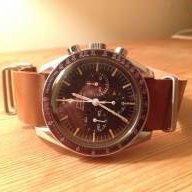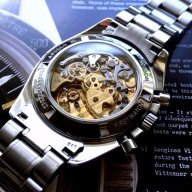
- Posts
- 32
- Likes
- 134
787Geoff
·This is a restoration I did about 3 years ago and posted at another web site. I have reworked the posting and thought it should be here.
Now there are some purists out there who might say don’t touch the watch, and sourcing original period parts is almost impossible these days, but it had to be done!
- the watch arrived with a non movable bezel. The bezel luminous had turned a nice deep rust brown but was it rust or age that turned it brown? I will let you be the judge ;-)
- crystal was really scratched up.
- hands had been BADLY resumed.
- case back was deeply attacked by pliers.
- dial lume completely oxidized.
- the hermetic case did its job and as a result the movement was in perfect un-oxidized condition
So other than a watch movement service what to do? Well it is for me so I secured the following:
- New stock bezel, bezel retaining spring, three bearing springs, three sapphire bearings, case back. New bracelet and crown. Of course all new gaskets.
The dial was sent for a redial however, it turns out that only the lume was in bad condition. A new process was applied to the dial and the lume was removed leaving the dial in its original condition. Only the lume has been replaced, not the silk screened script or indices . Turns out that the Seamaster dial of the period, as with other high end dials were not painted black. They were chemically treated to become black wherever the font screening was not applied. Black paint of the time suffered from UV degradation and pealed, sort of like K cars from the 80’s!
So on the dial what you see is the original black dial which is re-lumed in an antique luminova with the hands lumed to match.
All original case parts were kept. The crystal was polished using 600 grit, 1200 grit and 2400 grit wet dry ()using wet soap solution) finished with a plastic polish and is original. The hands were polished and there was corrosion therefore I nickle plated and polished them before lume was added to match the dial.
So to the pictures:
Before picture as it arrived ($400 USd):

The bezel required pliers and a flat case knife to remove! It was not salvageable but I still have it.

The new bezel unfortunately it does not come with an aged patina, but beggars can’t be choosers and this was all that was available:

Case with bezel removed, note the notched rust. This is actually the remnants of the bezel retaining spring which rust welded the bezel to the case:

Once the bezel was removed I de-rusted mechanically and with chemicals; exposing the three holes used for the springs and sapphire bearings. The holes were drilled out and only one spring was found:

New springs and sapphire bearings:

New bezel retaining spring:

Case was resurfaced by hand trying to maintain the sharp edges. Not all the nicks were removed as that would have involved too much material being removed. The object was to make the watch look 50 years old but cared for:

Case back with plier marks:

I tried to resurface the original case back but ended up securing a NOS replacement:

Movement removed showing luminous oxidization and badly lumed hands:

Hands showing corrosion and bad water based lumpy lume:

All the new parts:

Here is the crystal after polishing, the omega symbol is there and the scratches are dust on the crystal. It is perfect and being a Seamaster 300 it was very thick allowing for a good resurfacing and polishing:

The case restored and awaiting for the movement:


And now the before and after:


Please ignore the Seiko placard 😉


So there you go, I finally got a Seamaster 300 on my wrist!
Hope you enjoy
Geoff
Now there are some purists out there who might say don’t touch the watch, and sourcing original period parts is almost impossible these days, but it had to be done!
- the watch arrived with a non movable bezel. The bezel luminous had turned a nice deep rust brown but was it rust or age that turned it brown? I will let you be the judge ;-)
- crystal was really scratched up.
- hands had been BADLY resumed.
- case back was deeply attacked by pliers.
- dial lume completely oxidized.
- the hermetic case did its job and as a result the movement was in perfect un-oxidized condition
So other than a watch movement service what to do? Well it is for me so I secured the following:
- New stock bezel, bezel retaining spring, three bearing springs, three sapphire bearings, case back. New bracelet and crown. Of course all new gaskets.
The dial was sent for a redial however, it turns out that only the lume was in bad condition. A new process was applied to the dial and the lume was removed leaving the dial in its original condition. Only the lume has been replaced, not the silk screened script or indices . Turns out that the Seamaster dial of the period, as with other high end dials were not painted black. They were chemically treated to become black wherever the font screening was not applied. Black paint of the time suffered from UV degradation and pealed, sort of like K cars from the 80’s!
So on the dial what you see is the original black dial which is re-lumed in an antique luminova with the hands lumed to match.
All original case parts were kept. The crystal was polished using 600 grit, 1200 grit and 2400 grit wet dry ()using wet soap solution) finished with a plastic polish and is original. The hands were polished and there was corrosion therefore I nickle plated and polished them before lume was added to match the dial.
So to the pictures:
Before picture as it arrived ($400 USd):
The bezel required pliers and a flat case knife to remove! It was not salvageable but I still have it.
The new bezel unfortunately it does not come with an aged patina, but beggars can’t be choosers and this was all that was available:
Case with bezel removed, note the notched rust. This is actually the remnants of the bezel retaining spring which rust welded the bezel to the case:
Once the bezel was removed I de-rusted mechanically and with chemicals; exposing the three holes used for the springs and sapphire bearings. The holes were drilled out and only one spring was found:
New springs and sapphire bearings:
New bezel retaining spring:
Case was resurfaced by hand trying to maintain the sharp edges. Not all the nicks were removed as that would have involved too much material being removed. The object was to make the watch look 50 years old but cared for:
Case back with plier marks:
I tried to resurface the original case back but ended up securing a NOS replacement:
Movement removed showing luminous oxidization and badly lumed hands:
Hands showing corrosion and bad water based lumpy lume:
All the new parts:
Here is the crystal after polishing, the omega symbol is there and the scratches are dust on the crystal. It is perfect and being a Seamaster 300 it was very thick allowing for a good resurfacing and polishing:
The case restored and awaiting for the movement:
And now the before and after:
Please ignore the Seiko placard 😉
So there you go, I finally got a Seamaster 300 on my wrist!
Hope you enjoy
Geoff
Edited: