- Posts
- 5,103
- Likes
- 15,802
eugeneandresson
·Firstly I would like to sincerely thank @Uncle Seiko and @Forstnerbands for expanding our options by (as of writing) seven stunning new bracelets for our watches:
- Uncle Seiko BOR
- Uncle Seiko Holzer
- Uncle Seiko 1171
- Uncle Seiko 1035
- Forstner Bands JB Champion
- Forstner Bands Bonklip
- Forstner Bands Flatlink (like the 1035)
Tons of pictures and working combinations can be found here and here.
As the title suggests, this is a pictorial review of the the flatlinks, being a mint/like-NOS Omega 1035/506 versus the Uncle Seiko 1035 versus the Forstnerbands flatlink, as well as a small section on the 1039 vs the Uncle Seiko vs the Forstnerbands. Both Uncle Seiko and Forstnerbands made a single bracelet with optional endlinks to cover both 1035/1039 uses. This is great! Omega could have done the same. I did not go into the same depth with the 1039 as the 1035, as they are much alike, just slightly wider.
As an owner of all three(four!) I have gained some hands-on experience, and I have met some collectors with both Uncle Seiko and Forstnerbands flatlinks and discussed them, so I will add some thoughts, but a picture is worth a thousand words (or so 'they' say). I will not pick a favourite of the two third parties : both Forstnerbands and Uncle Seiko are fantastic, both are similar (Forstnerbands has the addition of stretchable links) with a similar form, with slightly different end-link profiles and construction and thus are better suited to different watches depending on ones taste. Both are well worth their cost (and both should be had at that). It also appears that the Forstnerbands and Uncle Seiko are much more solidly made than the vintage Omega. There appear to be less parts and their construction is better...however we will only truly know in about 50 years ... when these are as old as most 1035's on the market today (and still functioning). Despite that : I'm a pedant, so will say upfront that the Omega wins hands down for me (on my 60th Anniversary Speedy, which fully deserves it), but it took me some years to complete that set, and those parts are like hens teeth to find in such condition, and cost a small fortune, thus not a realistic option for most. I add it here as this is the bracelet that both parties are helping us get onto our watches : what better than to compare to the original?
Personally I would not be able to wear any of the new bracelets (or the 1035) on a vintage watch, as the character of the bracelets (new and shiny shiny) just do not match the character of 99.99% of vintage watches...but again, thats just me.
Why get a 1035/506 in mint condition you may ask? Well, when I put it together, there was no other option...and then a month or so later Uncle Seiko and then Forstnerbands announced their flatlinks. Thanks again guys 😁
Without further a do, lets take a look at the same sized bracelets...the 1035s...
(clicking the pictures yields super high res images)
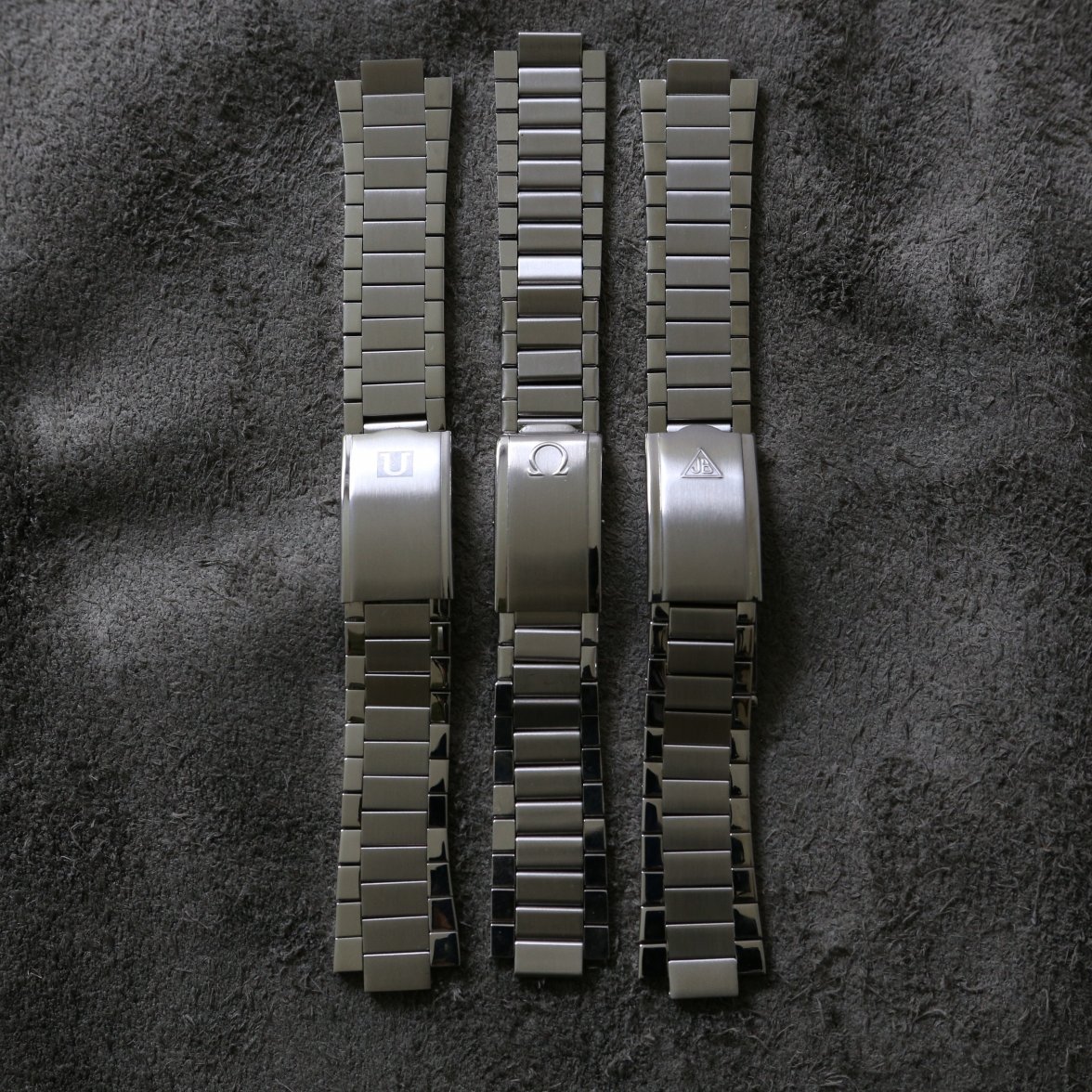
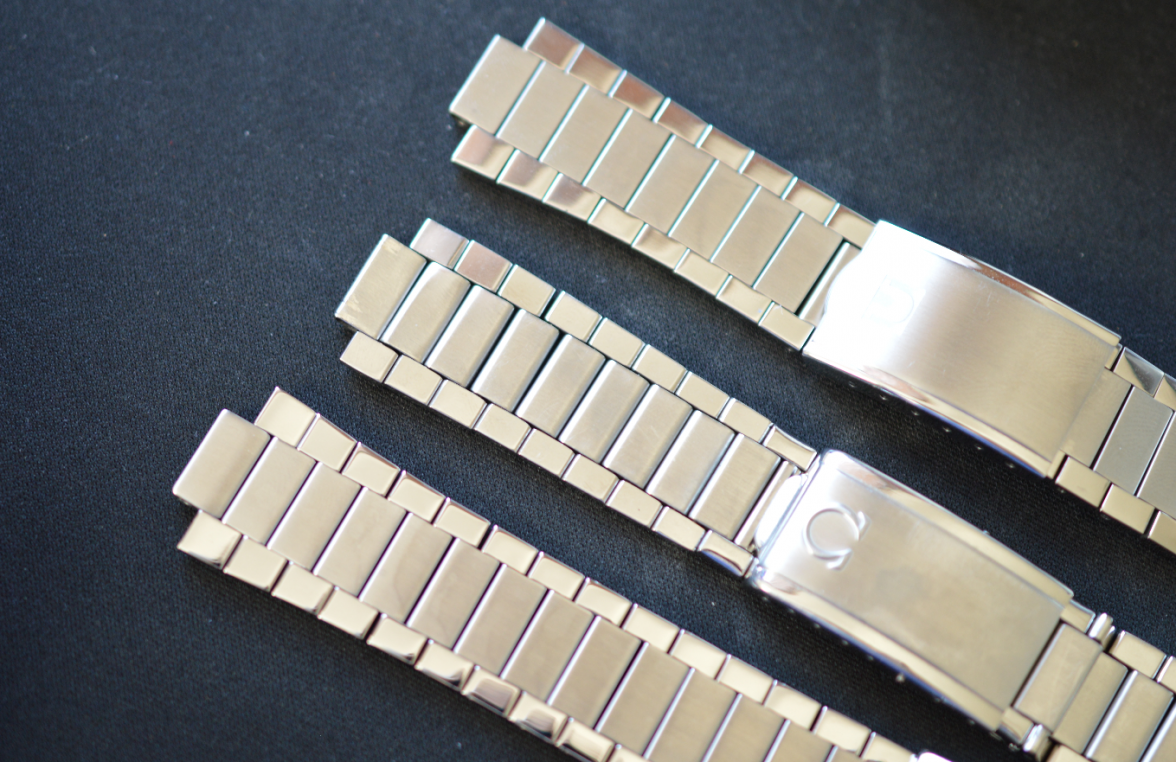
The first distinguishing characteristic of the US/FB flatlinks verses the Omega, are how the links form the taper of the bracelet as a whole. Its clear to see that the Omega has more links making the taper then either of the other two (almost by double). This gives the Omega a more gradual, almost linear taper, whereas the other two form a curved taper ... and an almost identical one at that.
Also worth noting : the Omega links are very tight in this condition (but, unlike the other two, don't look it) ... this can be seen by how some of them do not fall flat (i.e. between 4/5th central link above the clasp on the Omega). The US/FB are better integrated from new.
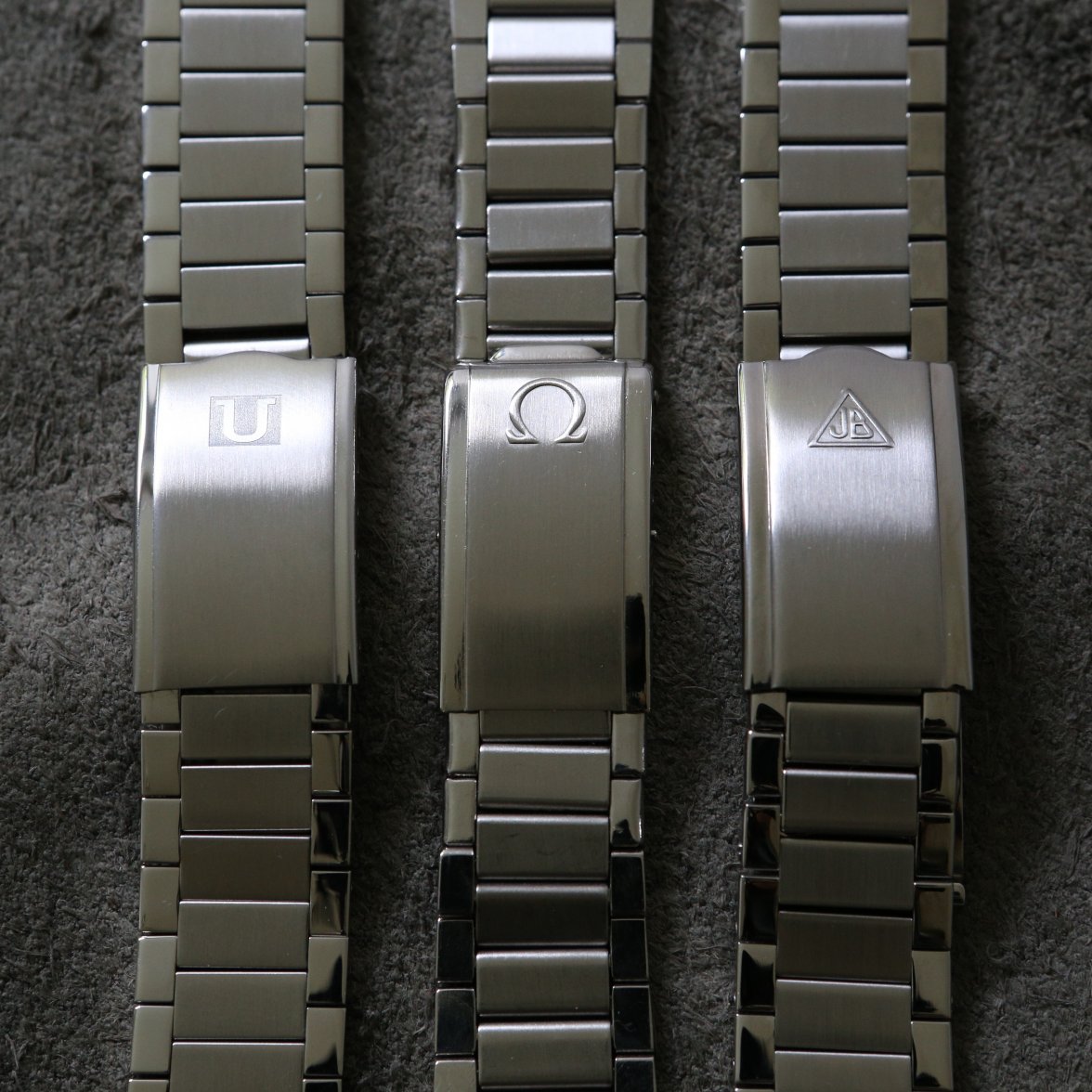
The clasps are very similar. All are tight and close solidly with a nice 'click' sound (and feel) and are great.
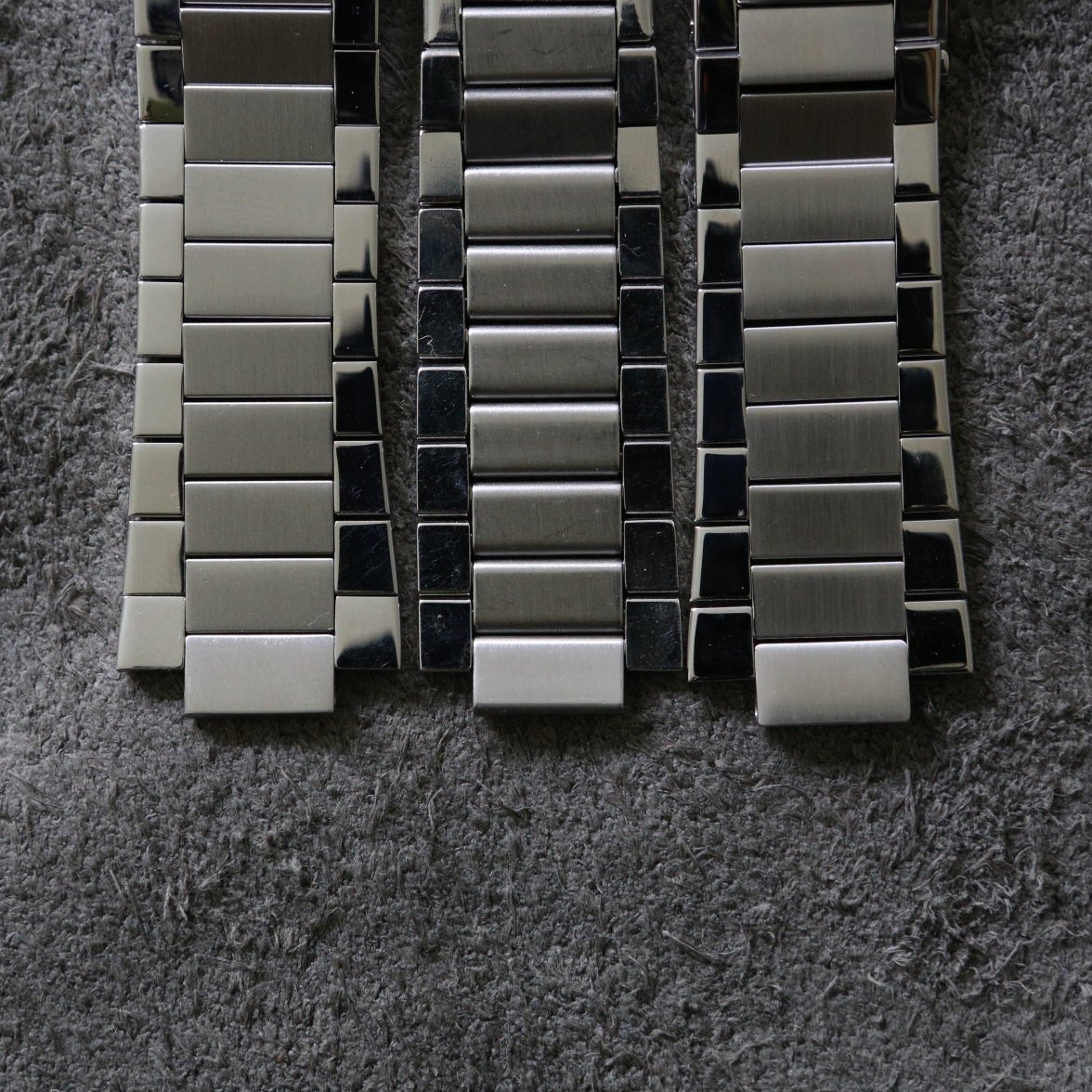 (Left : US, Center : Omega, Right : FB)
The thing which stands out in the above picture is that the central links of the US/FB have the same width, but are slightly longer than the Omega. Plus the Omega central links are more rounded at their corners (horizontally in the above pic) than either alternative.
Again, notice the similarity in taper of the US/FB vs the Omega ... the curved contours of the US/FB and the straight-line-almost-to-the-clasp of the Omega are clearer to see in this shot. Again worth noting : the US/FB are almost indistinguishable.
Someone mentioned that the last-link that attaches to the end-link of the Forstnerbands is tight when installed, and doesn't flatten easily, and may stick as a result : I can verify that the Omega last link when attached to the end-link has the exact same issue (in this condition). And as Forstnerbands mentioned, when bent correctly, this creates a nice 'drape' over the wrist. From experience of vintage bracelets, this will most likely even out over time and with use.
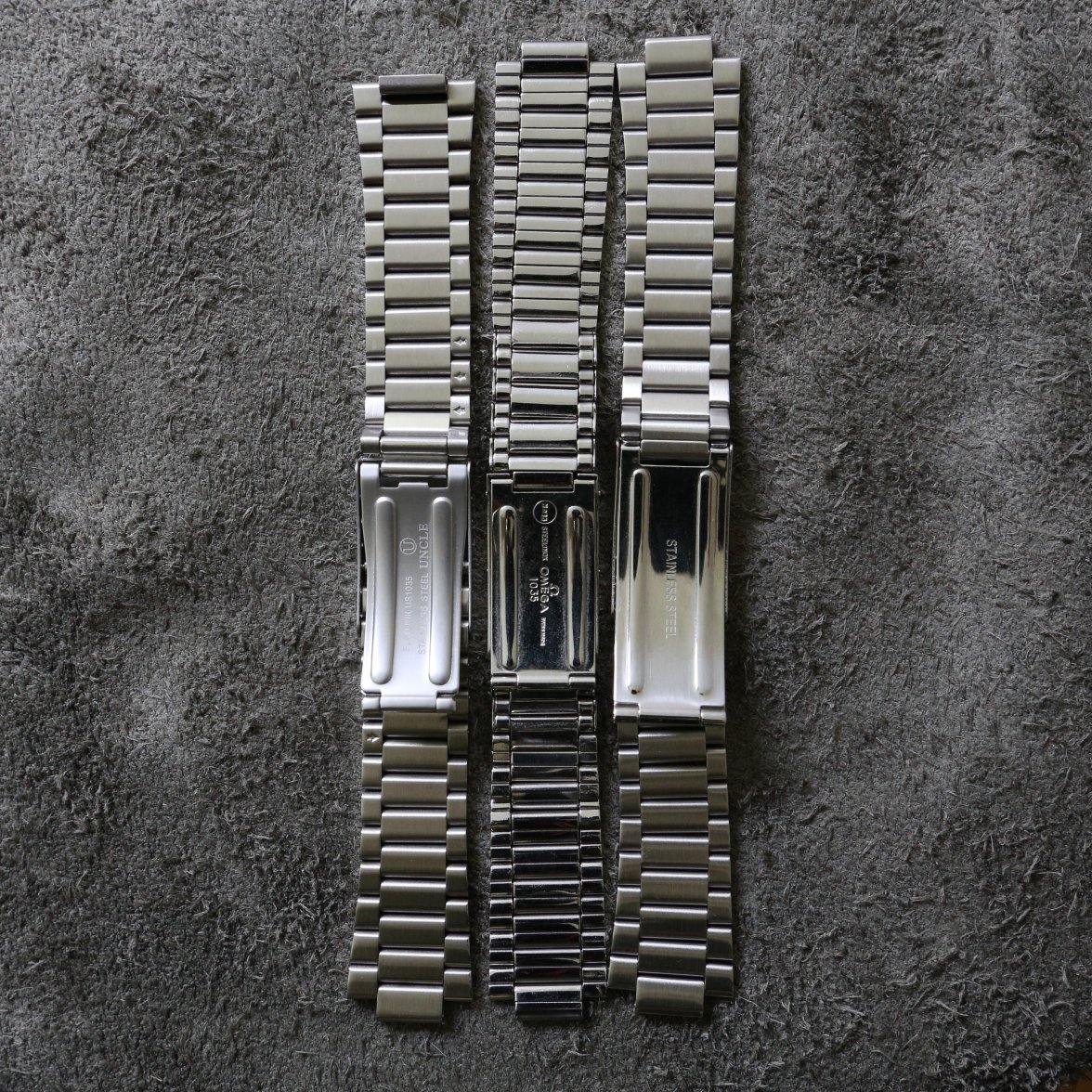 (Left : US, Center : Omega, Right : FB)
Next up : the back. Both US/FB are brushed, whilst the Omega is polished. Also the back of the clasps (or the 'folding part') differ in size between all three, with Omega being the smallest of the lot, whilst Fortnerbands is the largest.
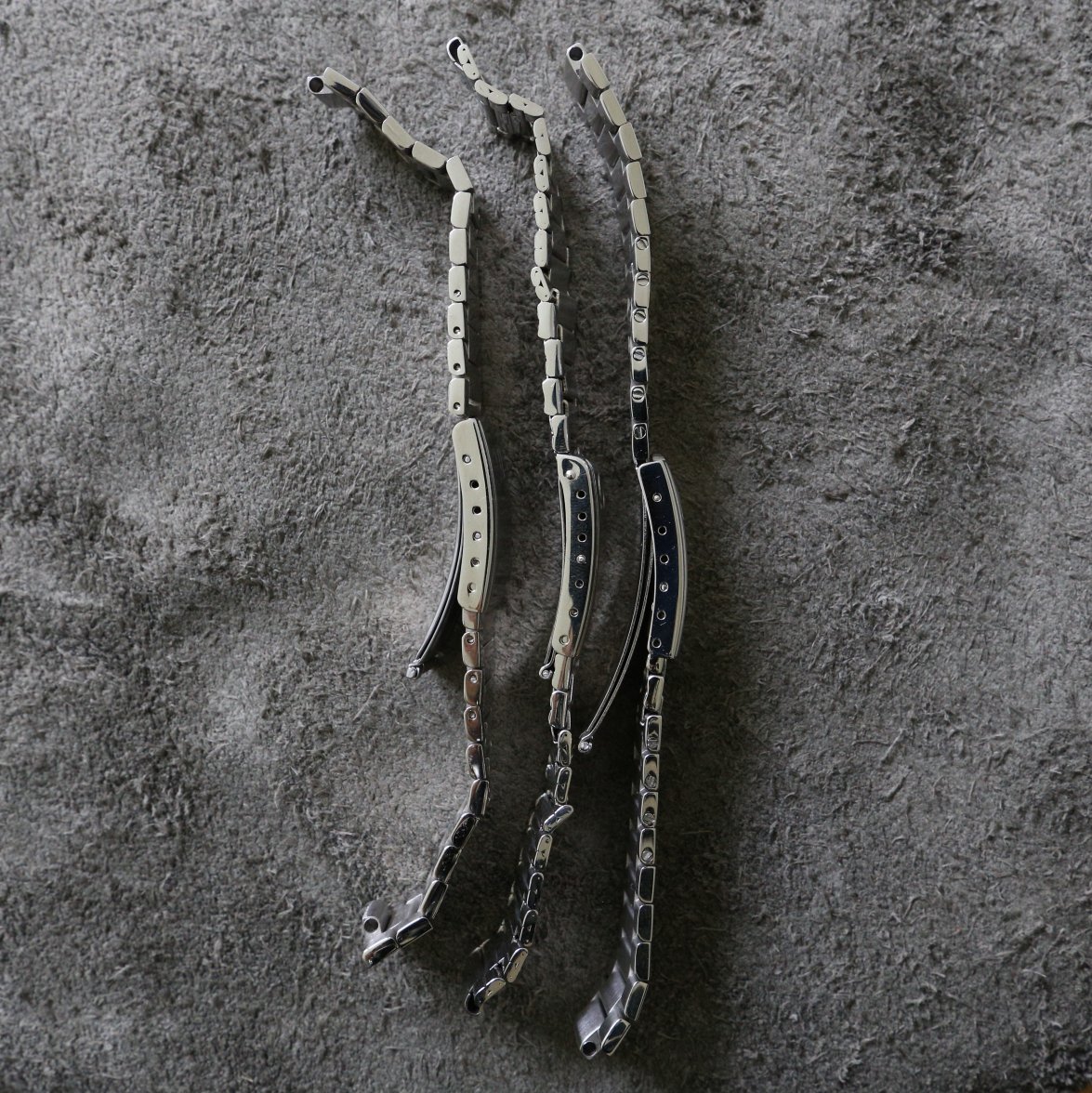 (Left : US, Center : Omega, Right : FB)
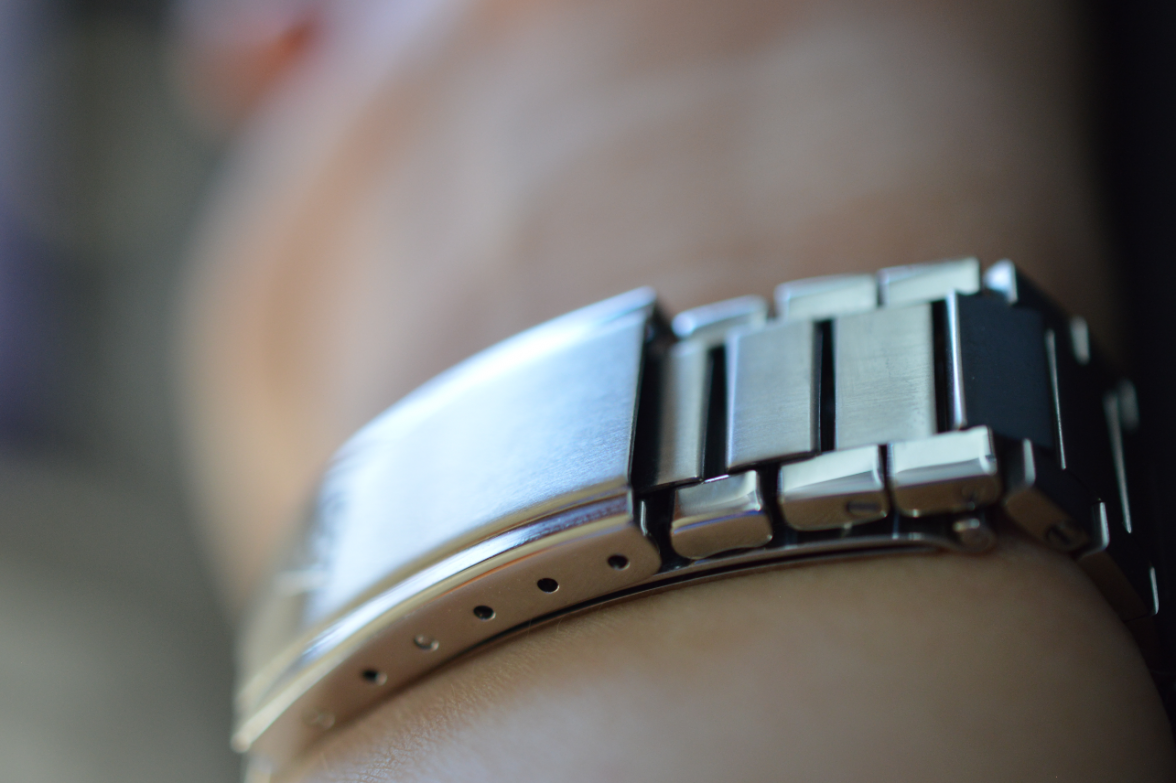
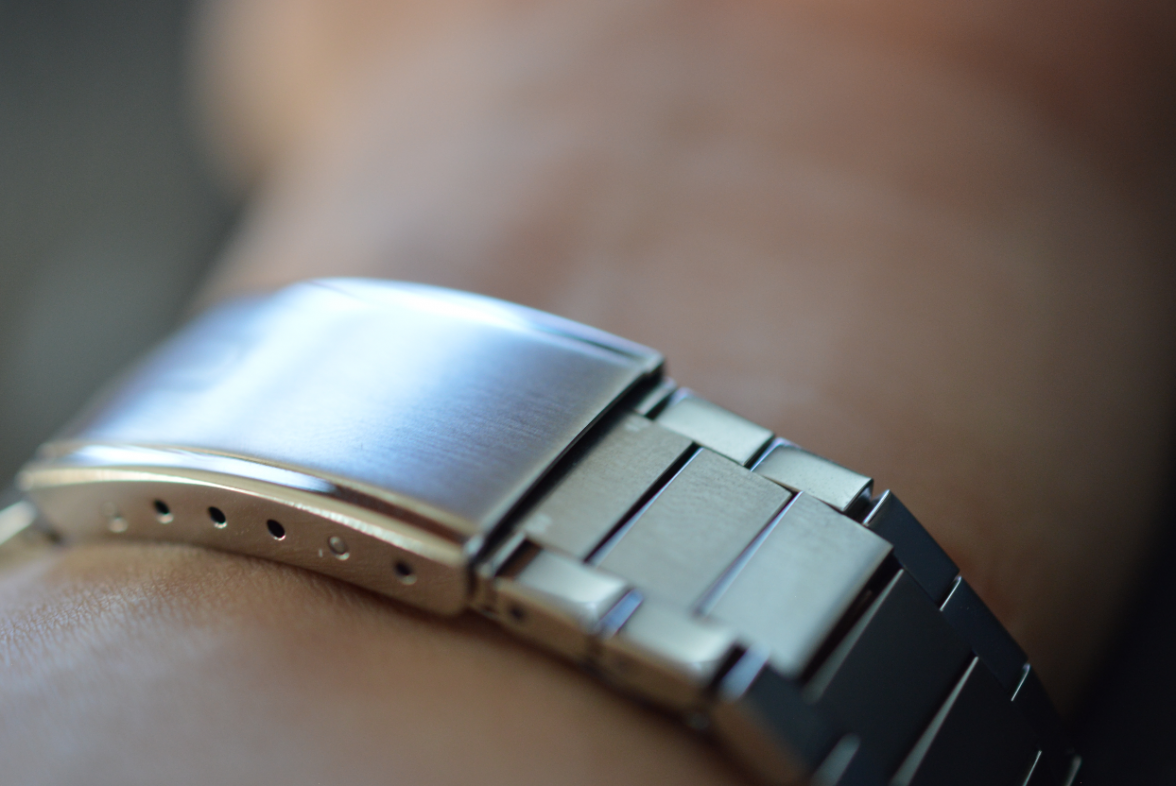
Side-on view of the clasps and links. Biggest difference to be seen here is the mechism by which the bracelets can be resized : US uses pins, Omega uses those funky disassemblable links (which are very easy to disassemble and reassemble once you know how), and FB uses a secure and independant screw system. Its much clearer to see in this shot the 'tightness' of the Omega, and how without tension some of the links are automatically rotated by an angle.
At this point its worth mentioning the stretch-links of the Forstnerbands.
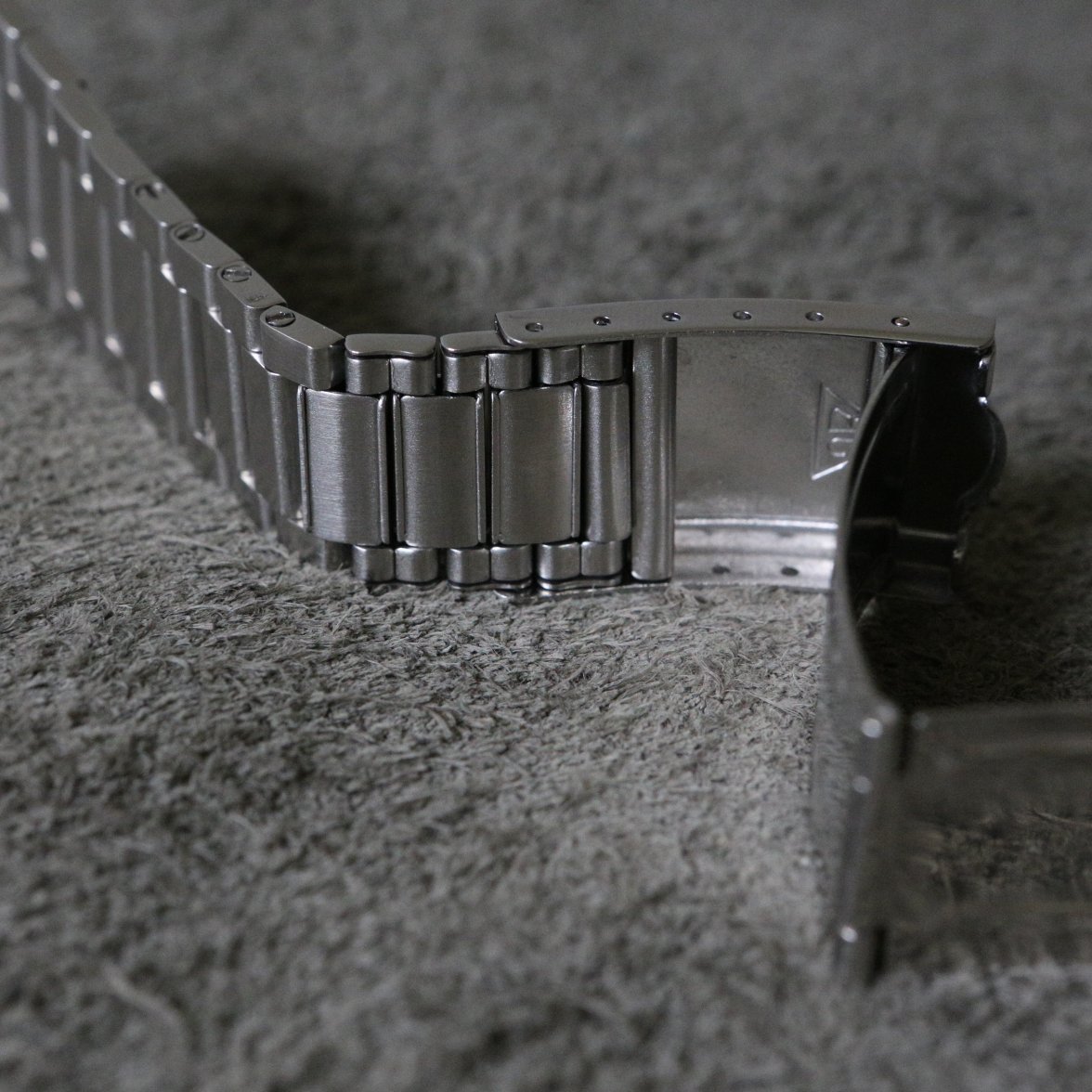
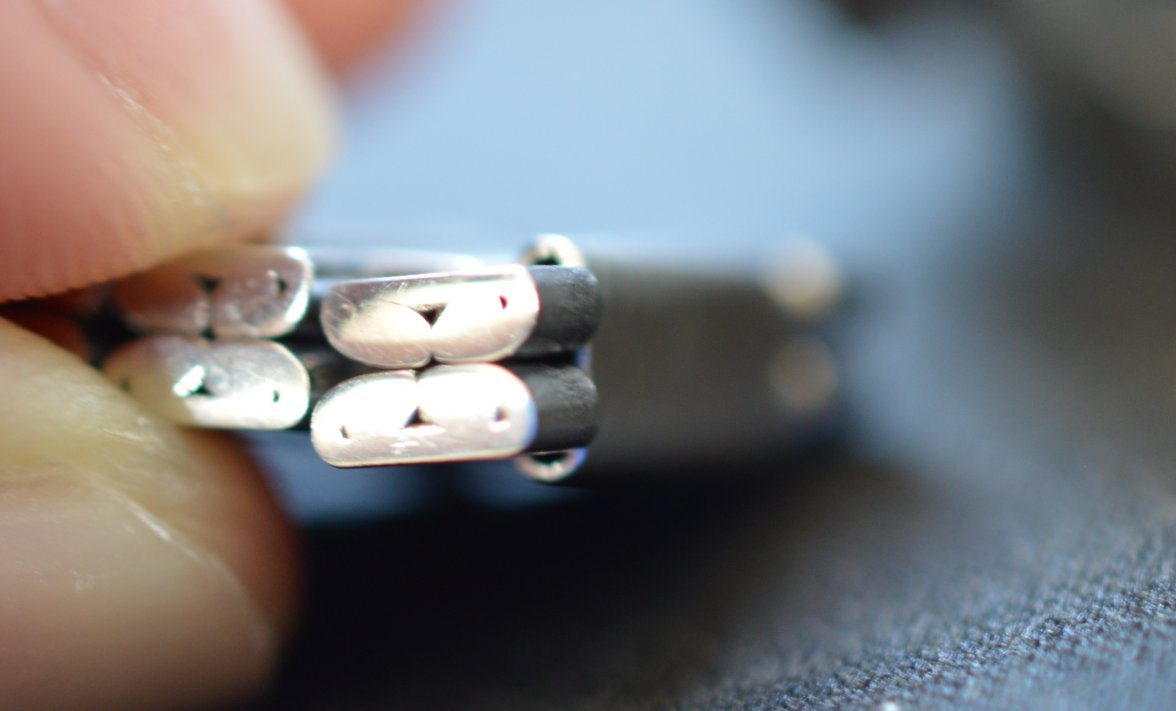
(Forstnerbands stretch-links ... almost identical looking to Omega)
These work fantastically and very similar to the Omega. They appear to be similar in construction and assembly to the removable/stretchable parts of the Omega 103Xs, albeit installed only on one side of the clasp : the side on the outside (the body side being inside) of the wrist. I did not try to disassemble them to verify their functionality, but they look identical to my eye. Personally (and with my few vintage Omega 103X's), I never size the bracelet so tightly that these are stretched when on my wrist ... but they do work wonders when fitting ones hand through the bracelet when putting on the watch.
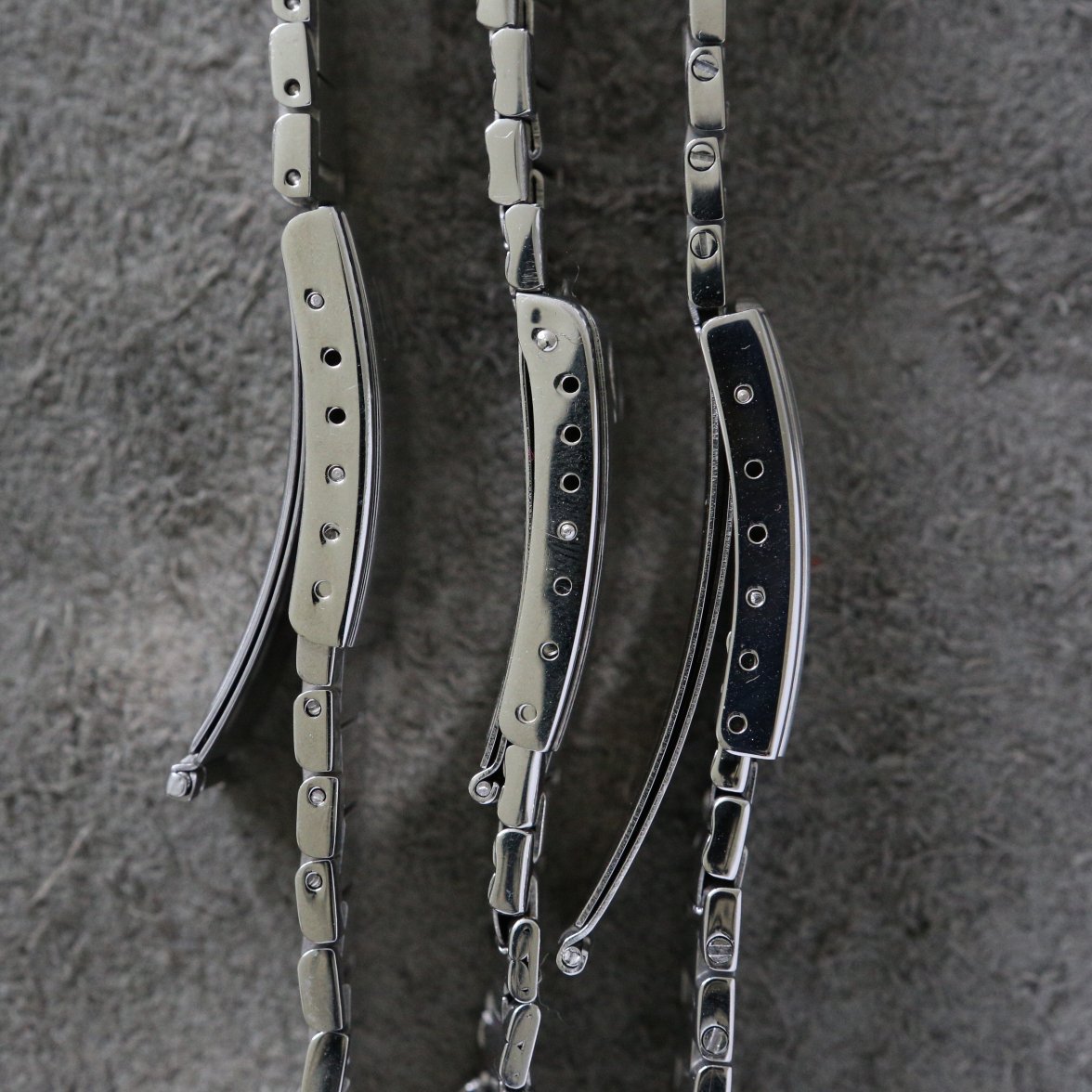
(Left : US, Center : Omega, Right : FB)
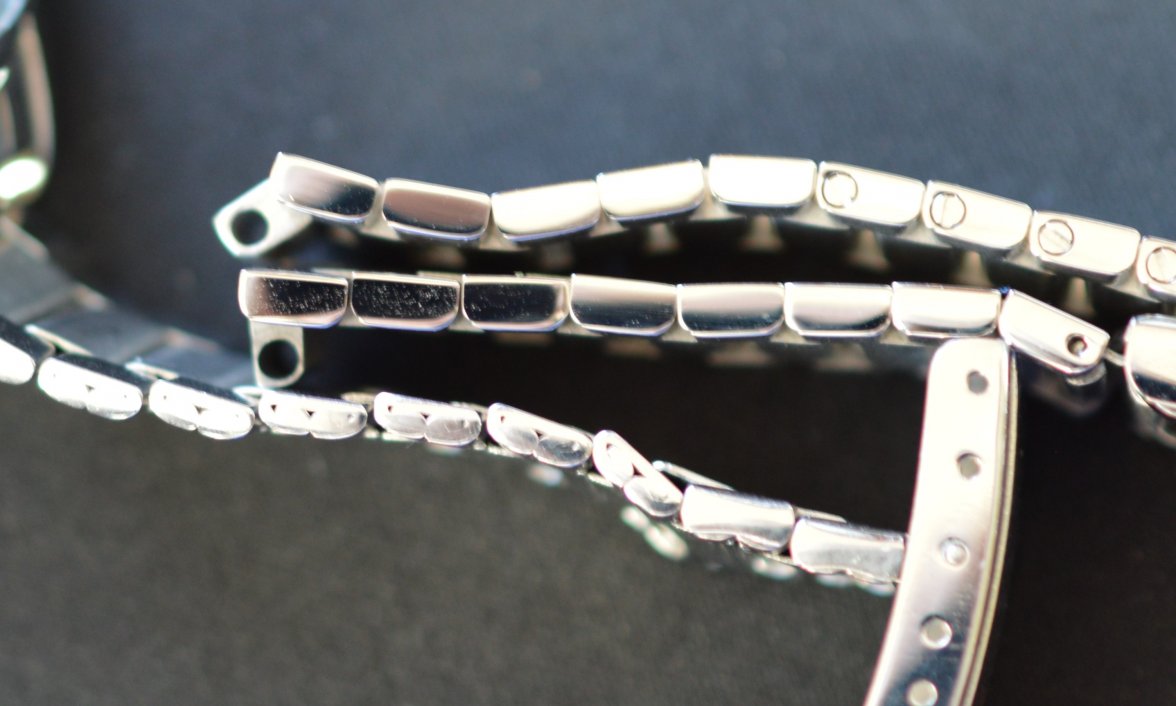
A closer side on view ... this nicely highlights the difference in construction between the folded metal of the Omega vs the solid links of the other two.
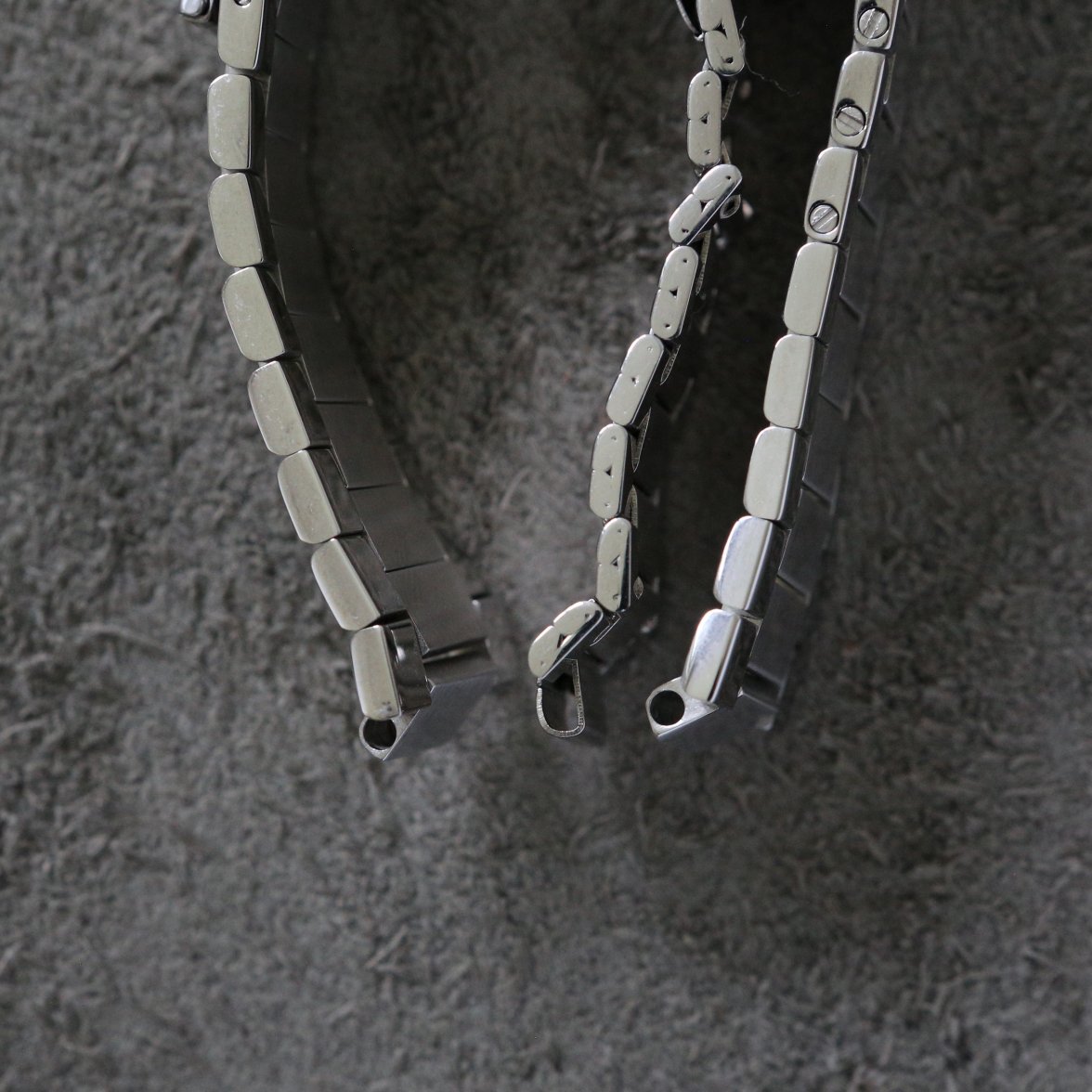
(Left : US, Center : Omega, Right : FB)
A close up of the last links, as well as bracelet. Some major differences in the shapes of all links between all bracelets can be seen. The central links being solid on the US/FB implies that they will most likely age better then the Omega 1035's with regards to stretch. Its clear to see how I abused the screw-heads of the FB. Resizing this bracelet was the most difficult operation I have had to perform on a watch related object. I required the help of my better half, as most of the screws were extremely tight. Given the reasons for this (a more secure way for keeping links attached to each other such that motion over time will not detach them) I feel it’s worth the effort if one doesn’t have the correct tools specifically for this, and thankfully its a once-off job, and won't need to be performed again.
Onto the end-links.
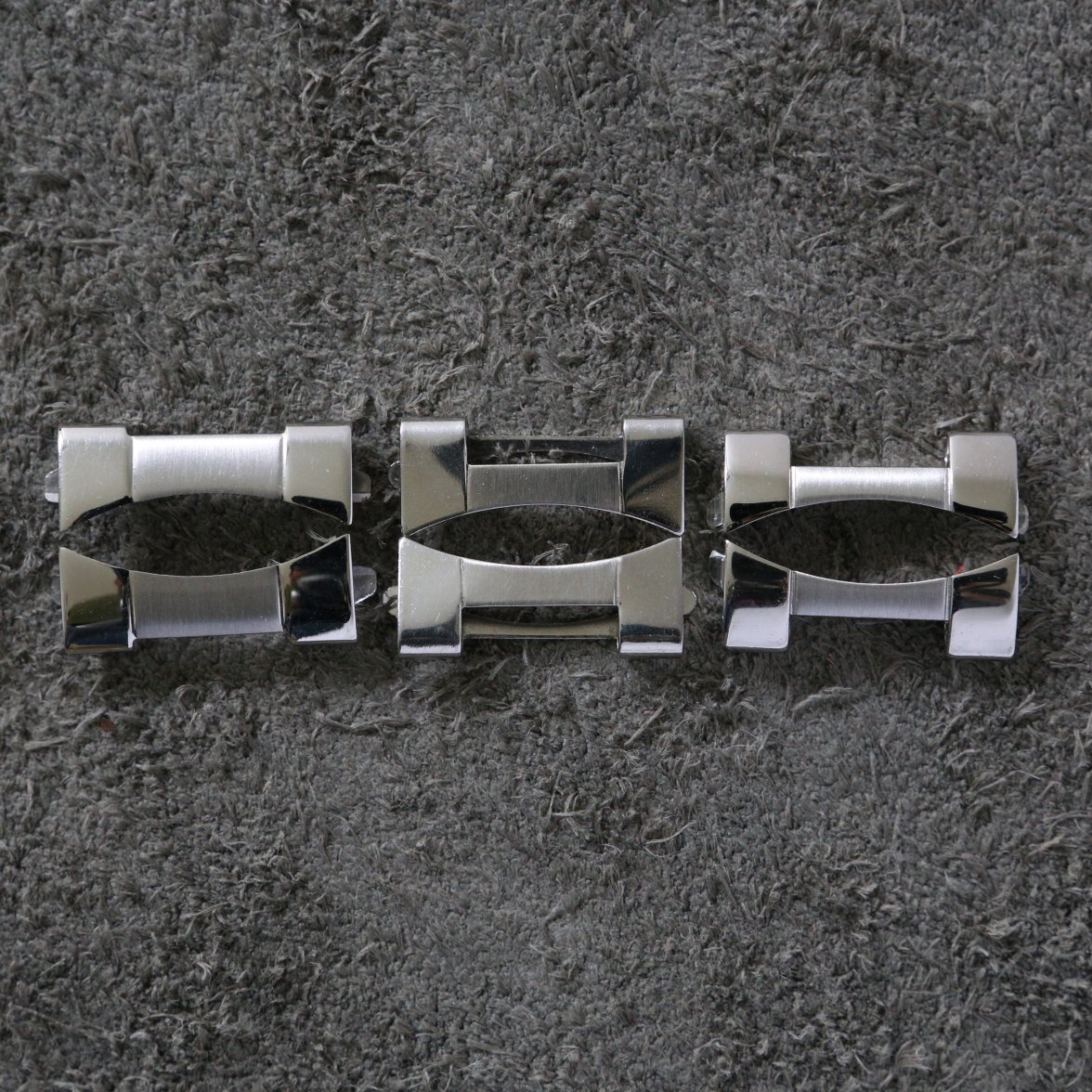
(Left : US, Center : Omega, Right : FB)
Again, some differences here. Omega appear to be the least polished. The brushing is very similar. What I can add, thanks to @Adri, is that the FB/US endlinks are interchangable with the braclets...so should one wish to mix and match, it works just fine. I actually saw a watch of his this evening with a mix of bracelet parts that gave him the look and fit he was after ... and it looked great.
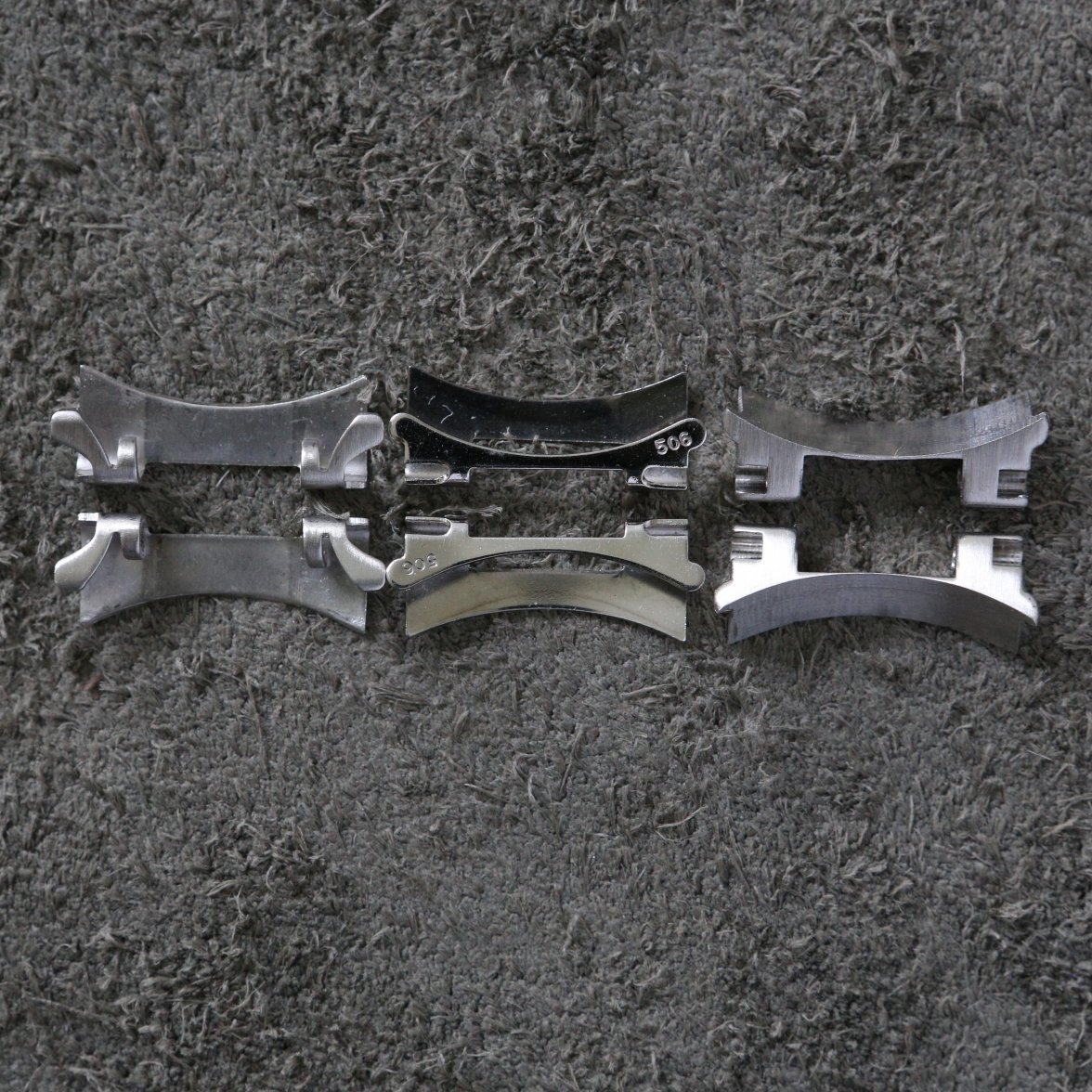
(Left : US, Center : Omega, Right : FB)
From the back the differences are much larger. US and Omega are hollow 'flimsy' bent metal, both with slightly different holding mechism to the back of the watch, whilst the FB is a solid endlink with some small feet to keep it in place. The only potential problem with the solid endlink is the different placement of holes in the different cases (however, this too will make the bent end-links have a different fit). What it will fit has to be figured out by trial and error (or combing OmegaForums).
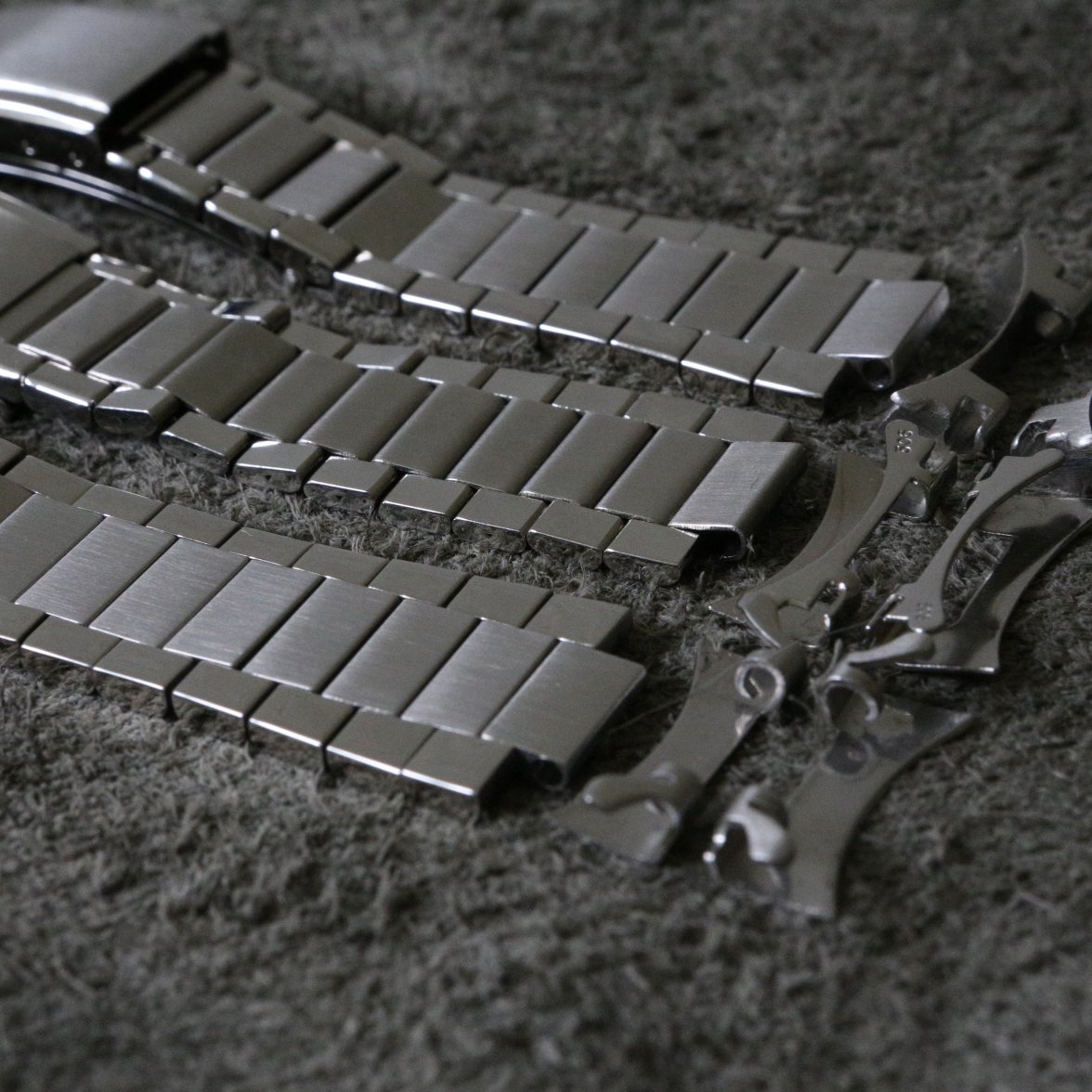
(Front : US, Center : Omega, Back : FB)
A side profile.
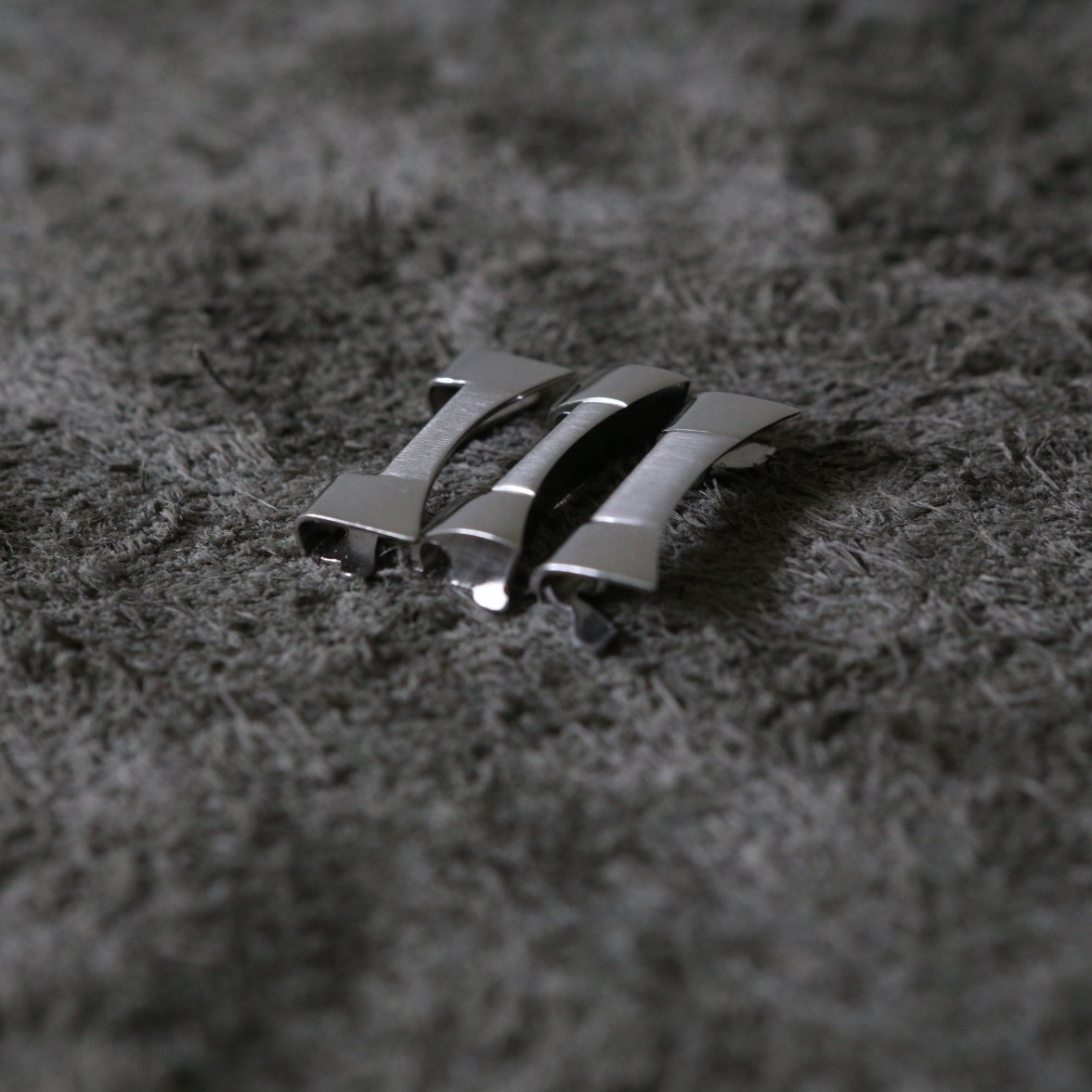
(Left : Omega, Center : FB, Right : US)
The endlink side profile tells a different story. Its clear to see that the US endlinks match the Omega 506 profile the closest, have a flat-ish top, wheras the FB endlink is fully rounded. Now depending on the watch, this may be desirable or not. Personally, I do not like how the curved end-link sits above the inside of the lyre-lugs of the Speedmaster professional cases. However, I think it looks fantastic on the straight-lug cases. The US endlinks also sit higher than the Omega’s (but lower than the FB), as the bend radius of the metal is greater (on these) which may be noticed upon installation. As mentioned earlier, US/FB parts are interchangable, and spares are readily available, and well priced.
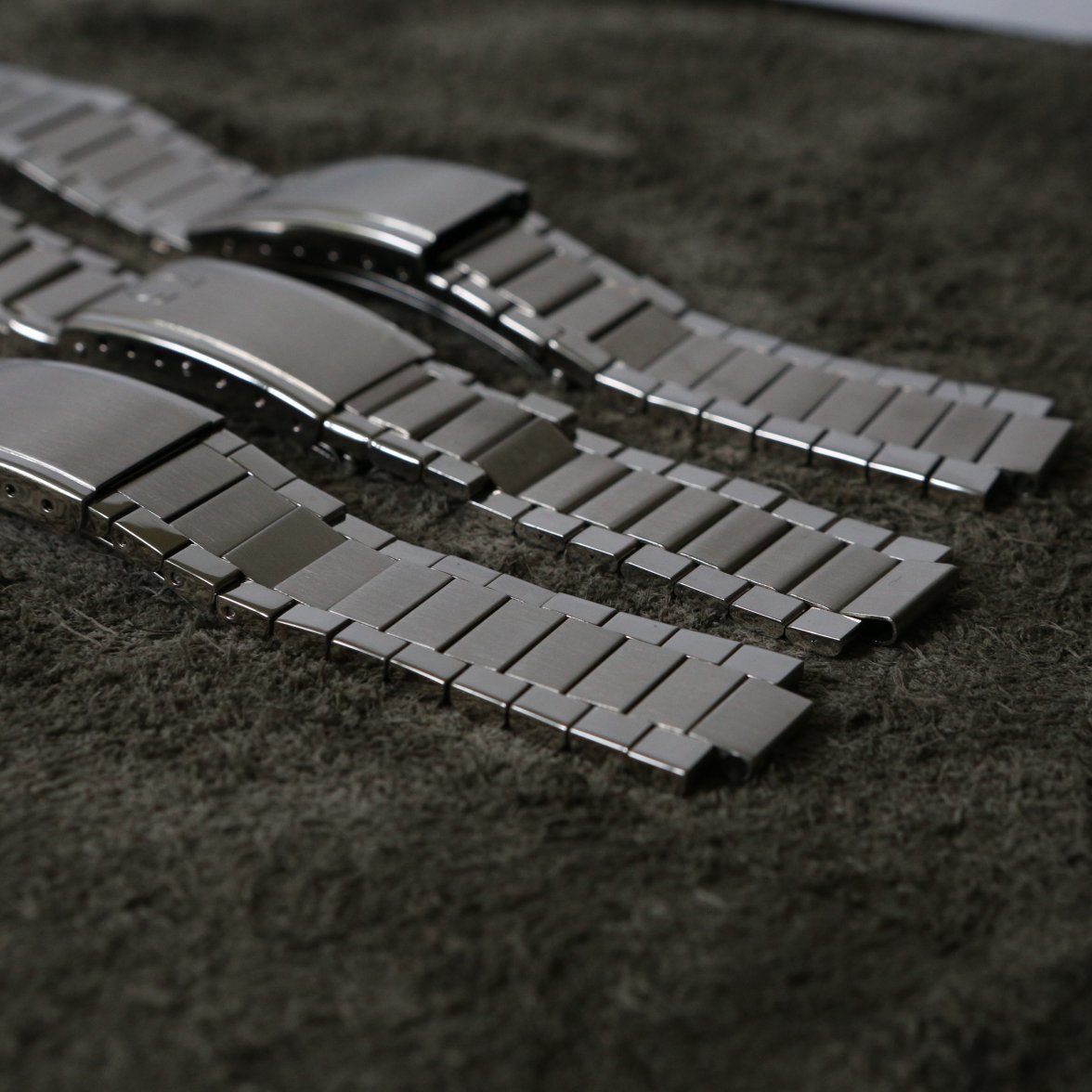
(Front : US, Center : Omega, Back : FB)
Again the tight Omega 1035 pulling central links up with no tension...FB/US look fab.
Lets see what it looks like on the 60th Anniversary Speedmaster.
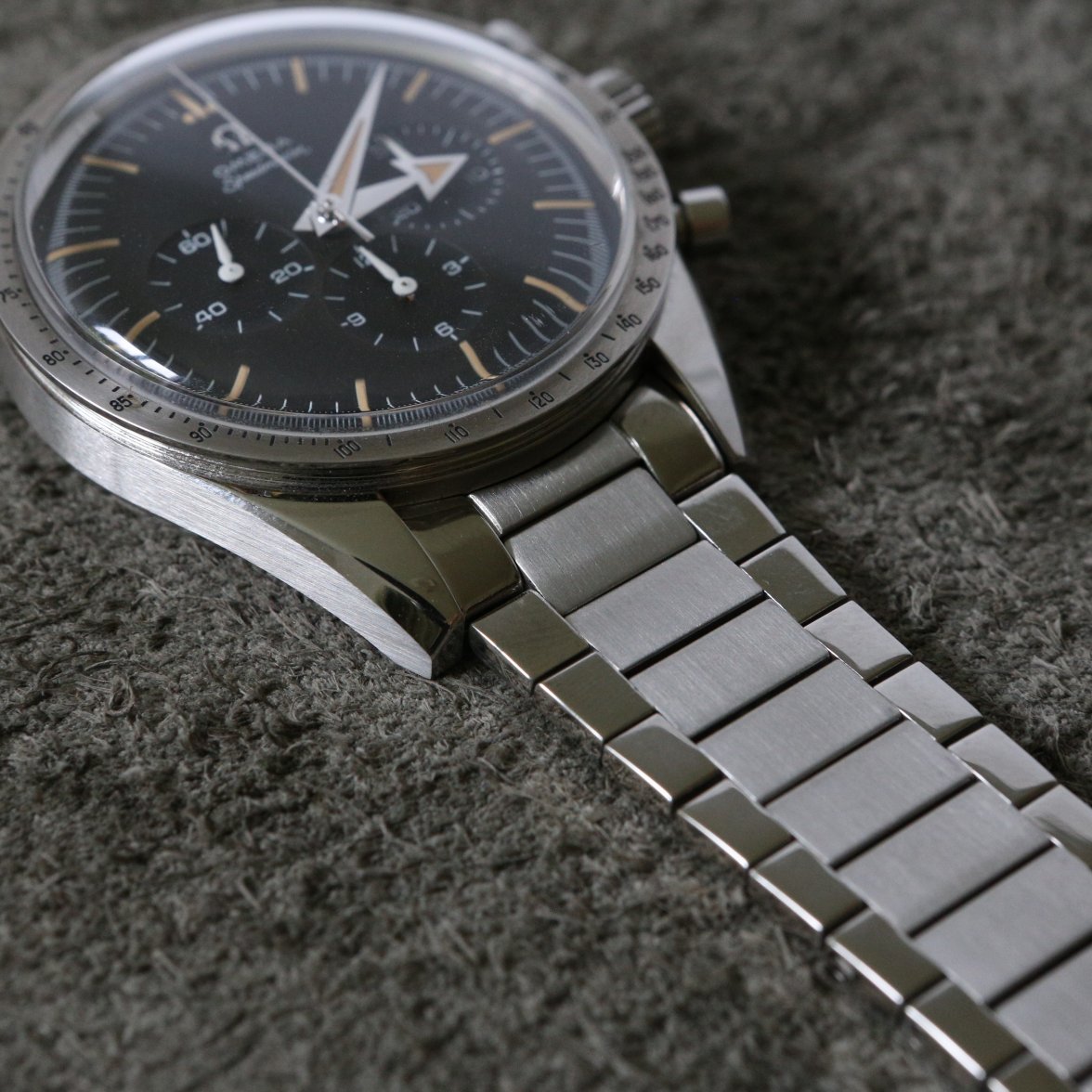
The Forstnerbands curved profile looks fantastic on this watch ... totally matches the case. However, the springbar hole placement of the 60th Anniversary is different to the First Omega in Space (what was used in developement of these endlinks I beleive) and so there is a gap and some play (it wiggles) in the endlink, as is evident in the next picture.
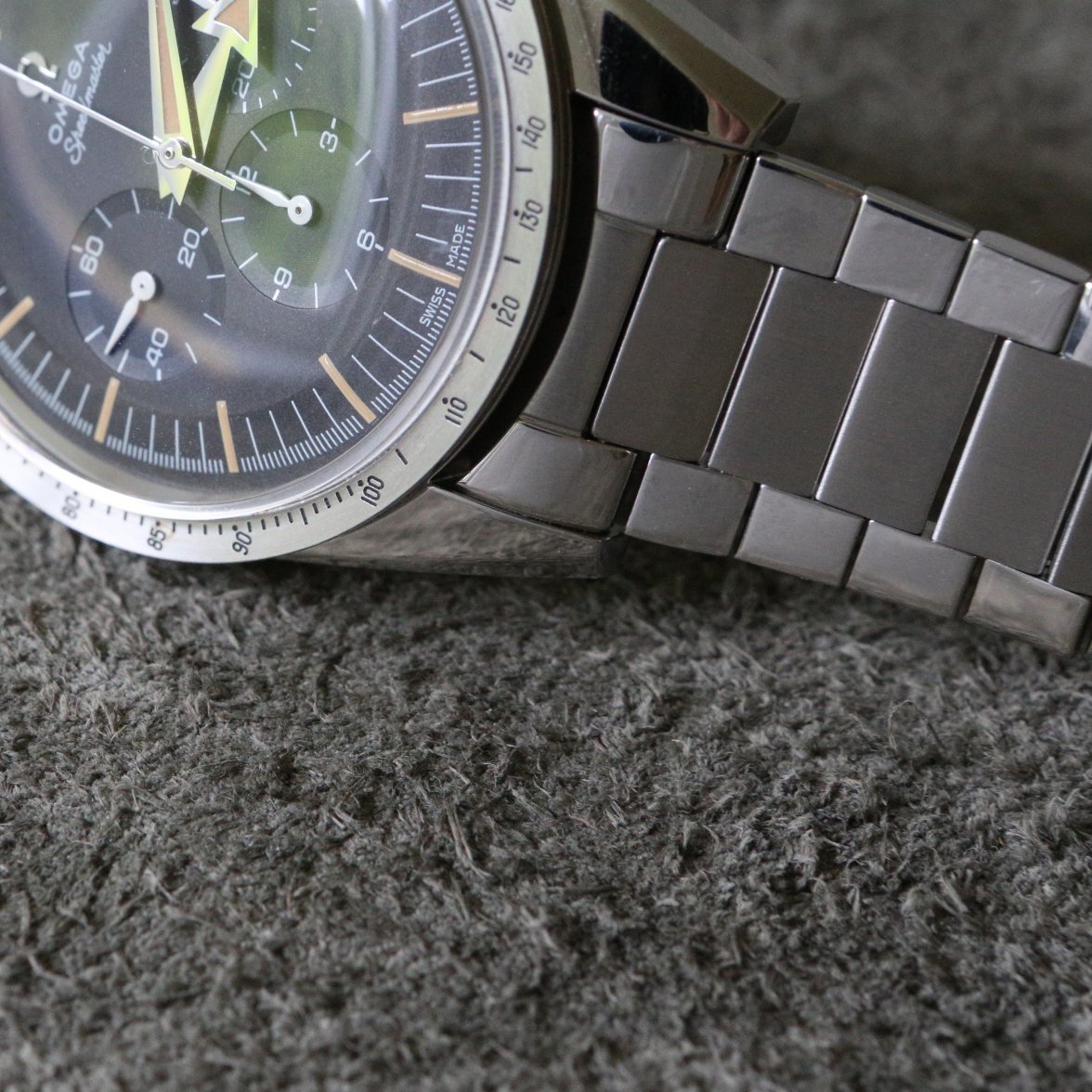
Next up the Uncle Seiko.
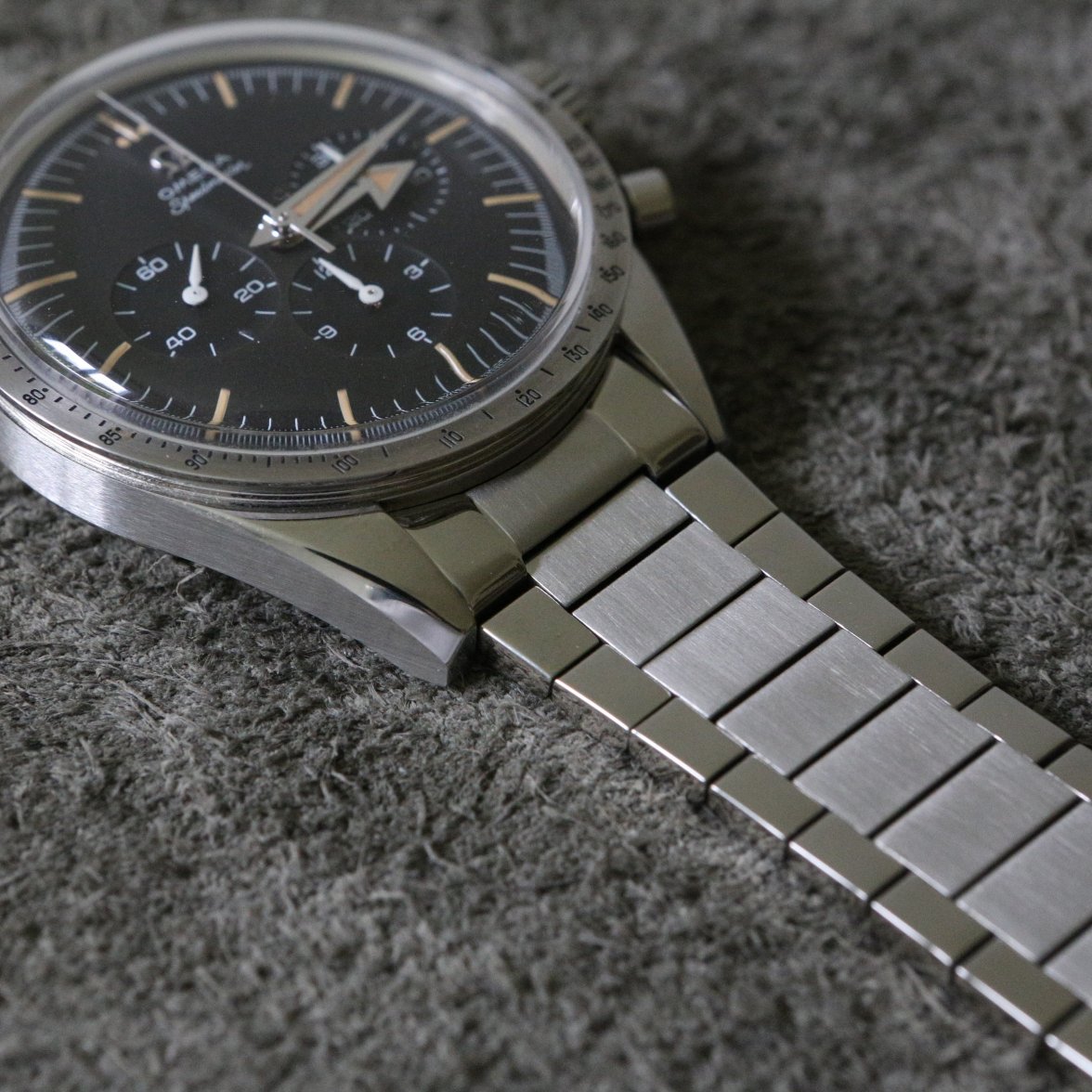
This also looks great and fits tight without play, however, the bend of the endlink (around the springbar) sits a bit too high on this watch for my liking. Perhaps it could be bent to fit better on this watch. I'd rather not ... it looks great on my Seamaster.
And here we have small-fortune-aesthetic-perfection 😁 ... Omega 1035/506 on the 60th. Sits tight, no play, looks great...
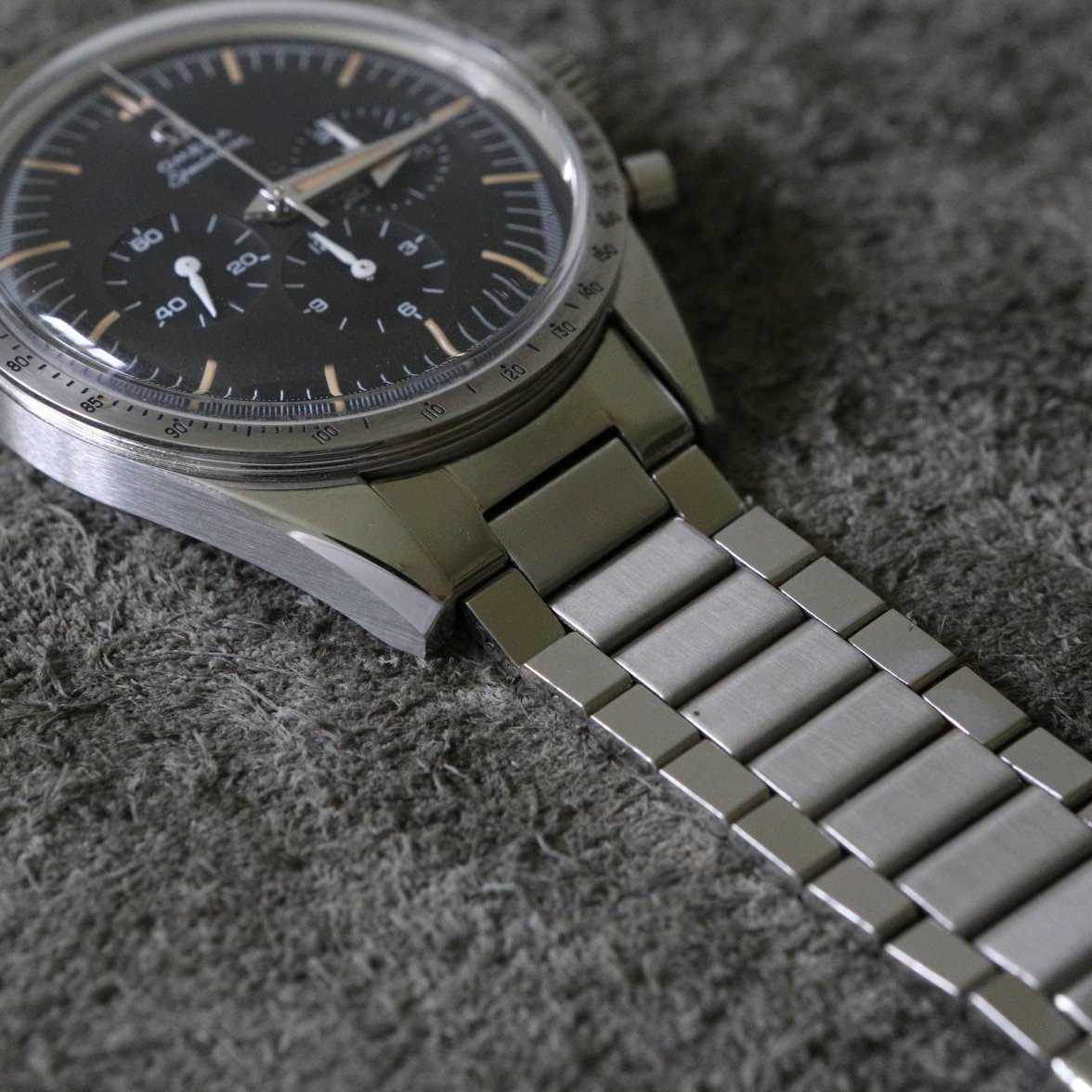
1039
Much of a muchness with the 1035 ... the 1039 is just a bit wider in the taper targeted to 20mm lugs. Upon inspection It would appear that the last link of the Omega is 1mm wider on the 1039 than both the US and FB.
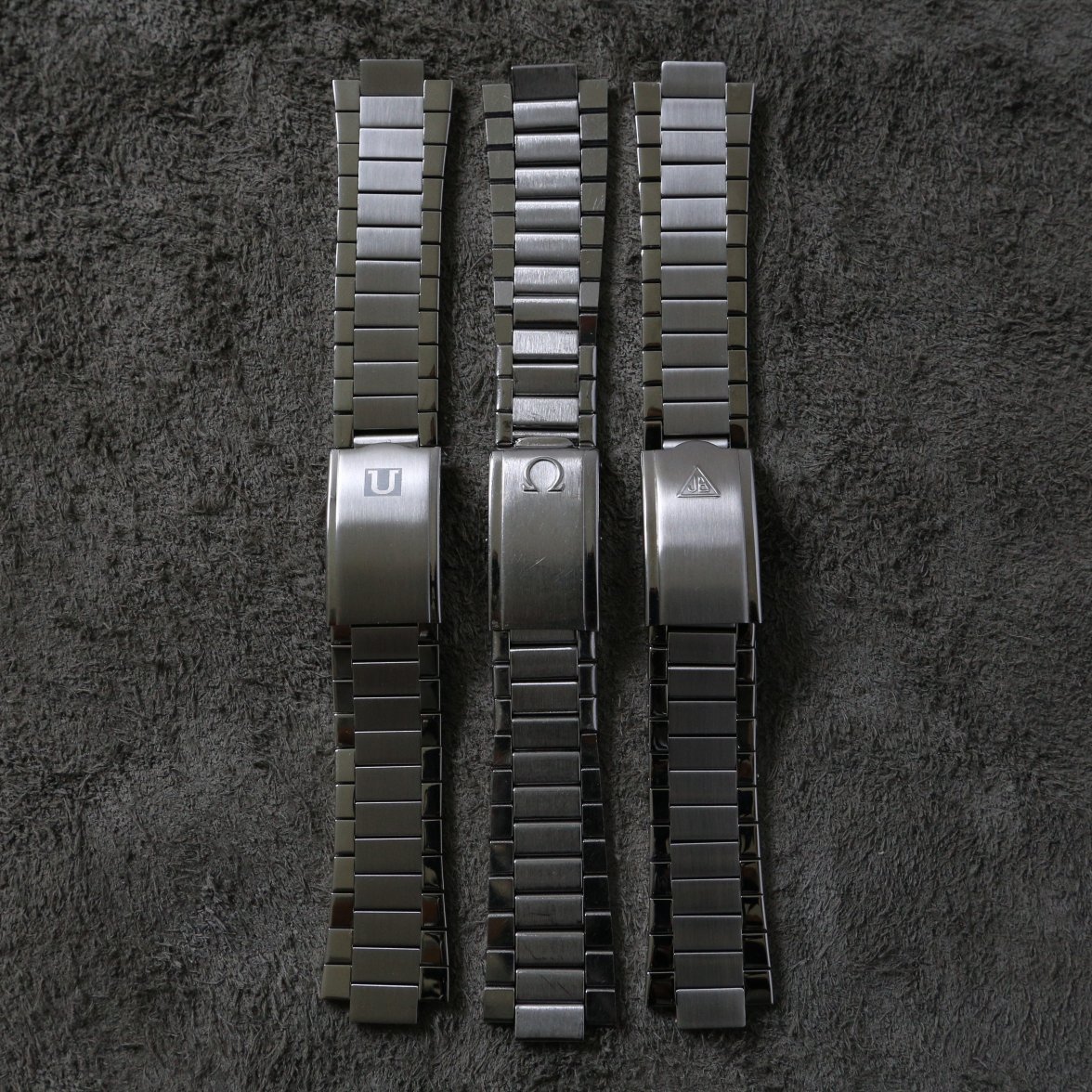
From the back its similar.
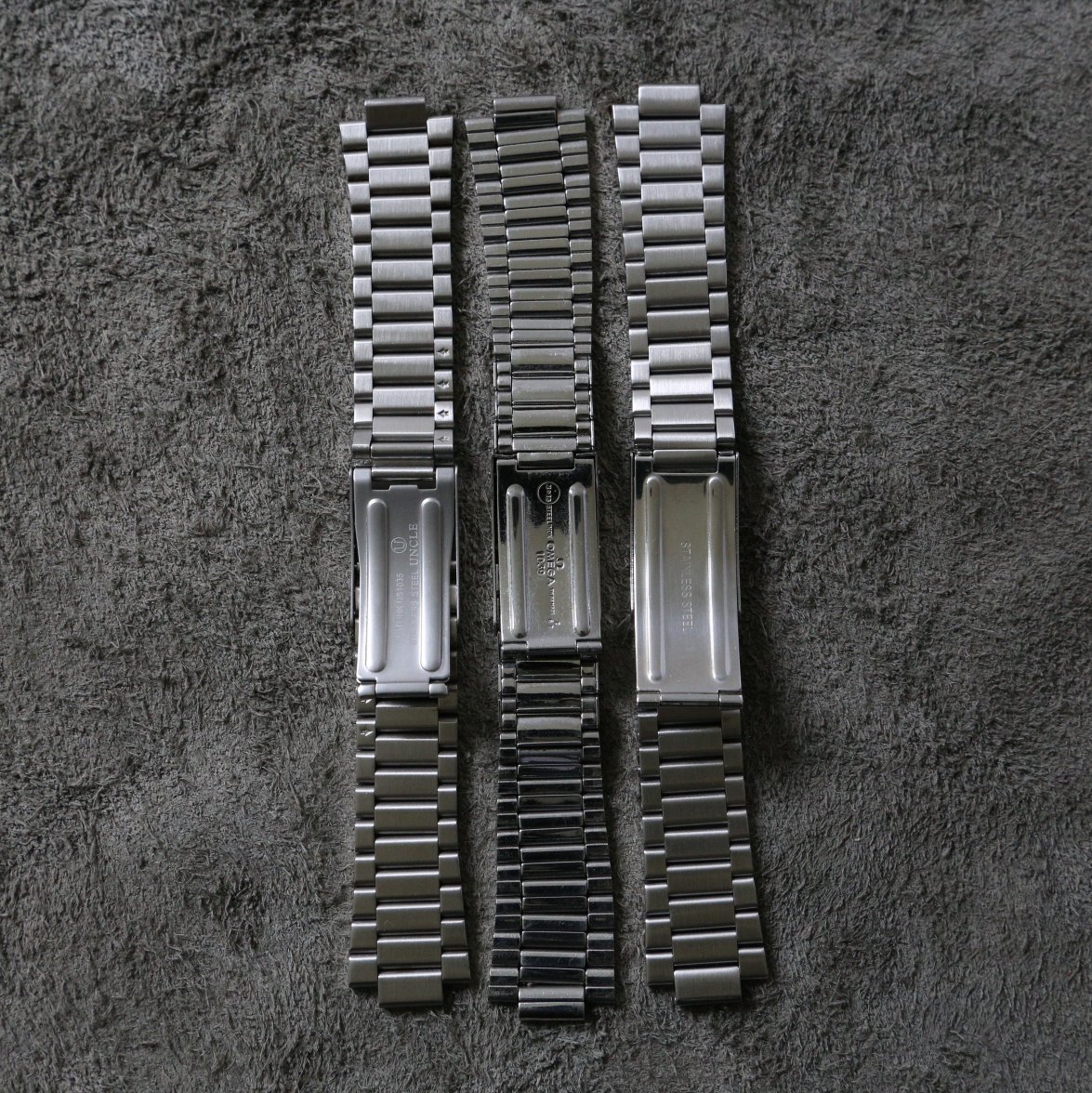 (Left : US, Center : Omega, Right : FB)
A quick test on a transitional 3570.50:
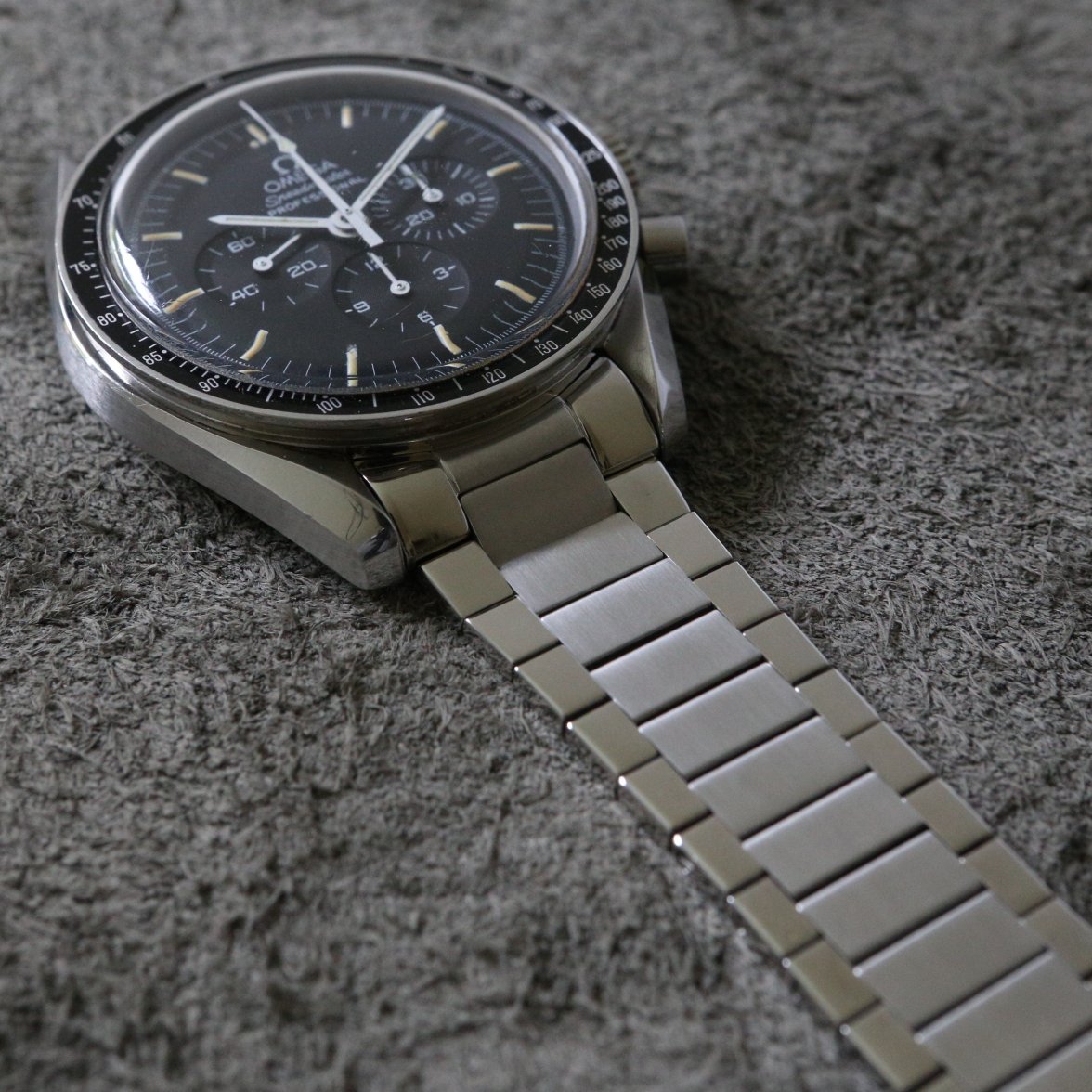
The Forstnerbands looks great...however the only thing that bothers me is the superior height of the endlink to the inside of the lyre lugs. Its very slight here, but looks much more on the Tintin pictured below. Its also worth noting that the last link is slightly narrower than the end-link (which I think looks great).
Unfortunately (as of writing) I do not yet have a 20mm Uncle Seiko endlink set to do this test...will rectify that soon.
And here the Omega 1039/516.
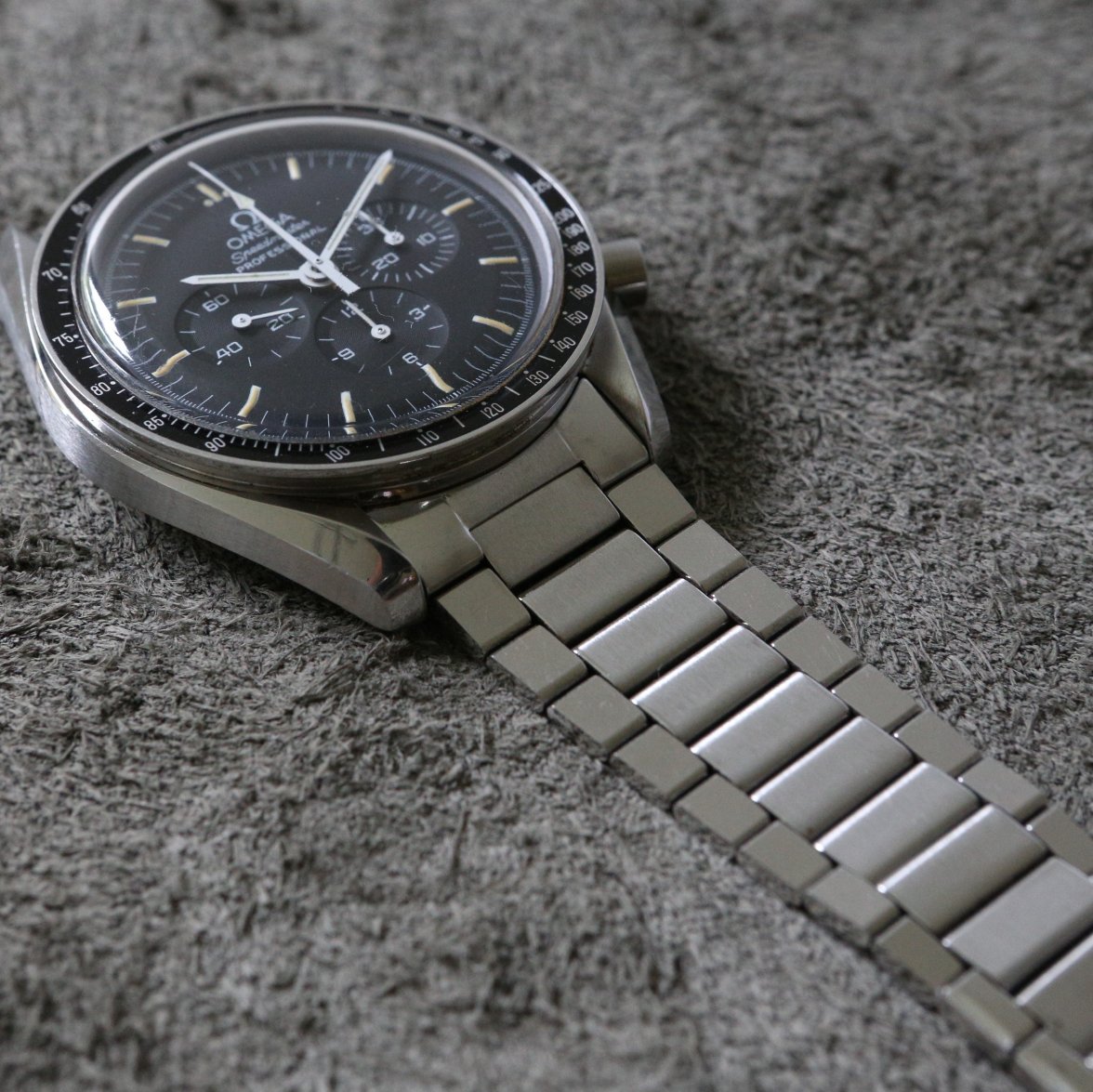
Here it can be seen that the last link closest to the endlink is roughly the same width as the endlink.
Interchange of end-links between Forstnerbands and Uncle Seiko
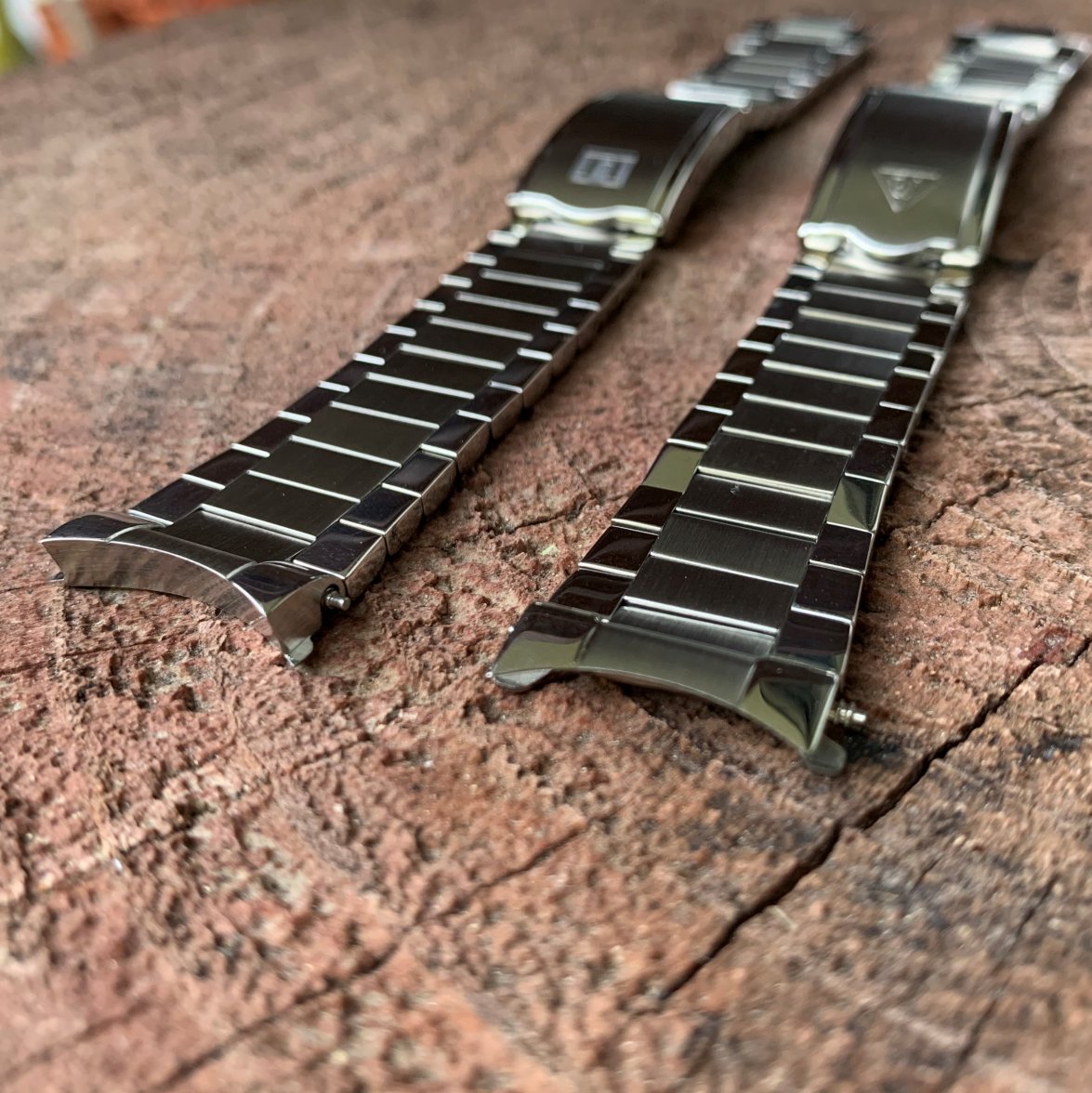
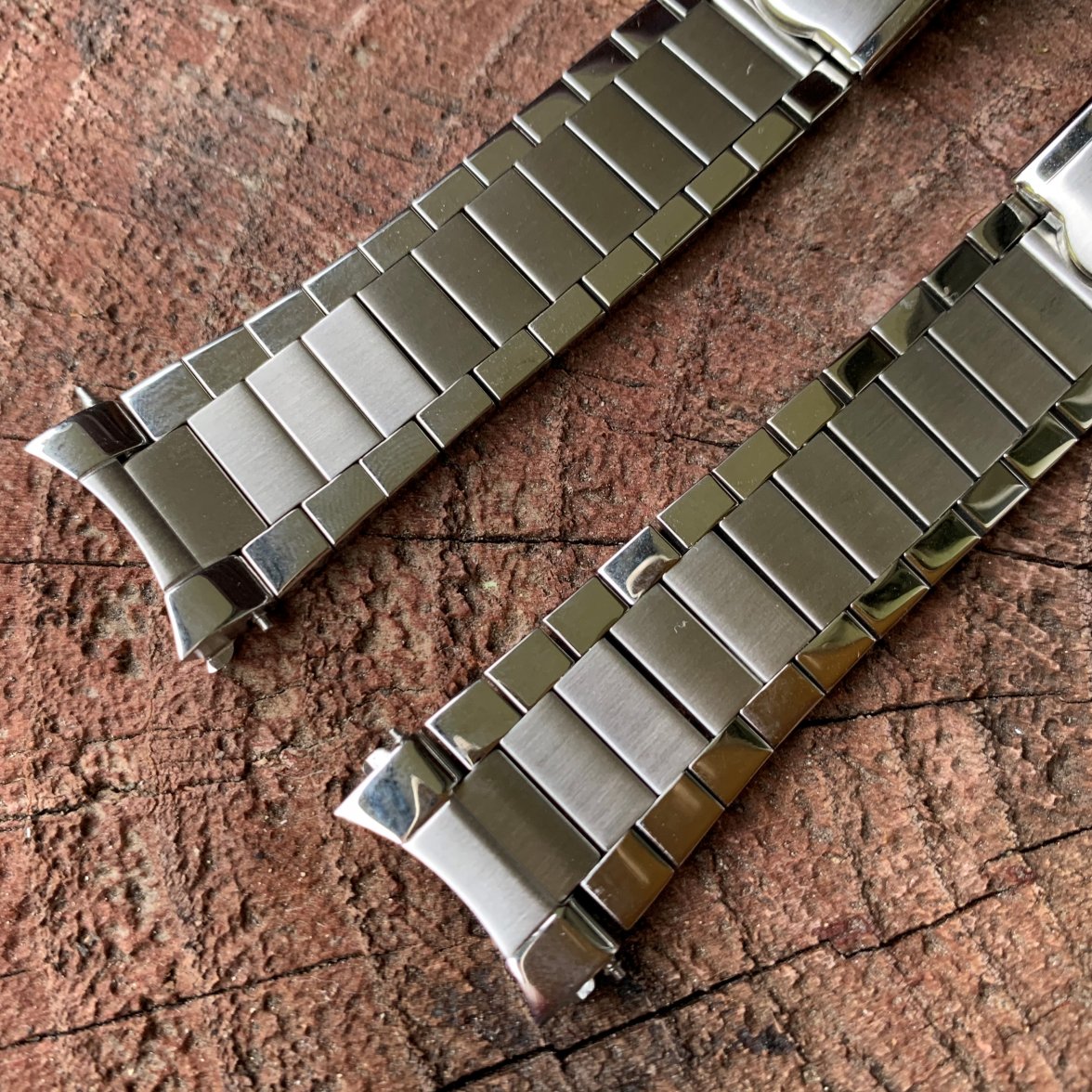
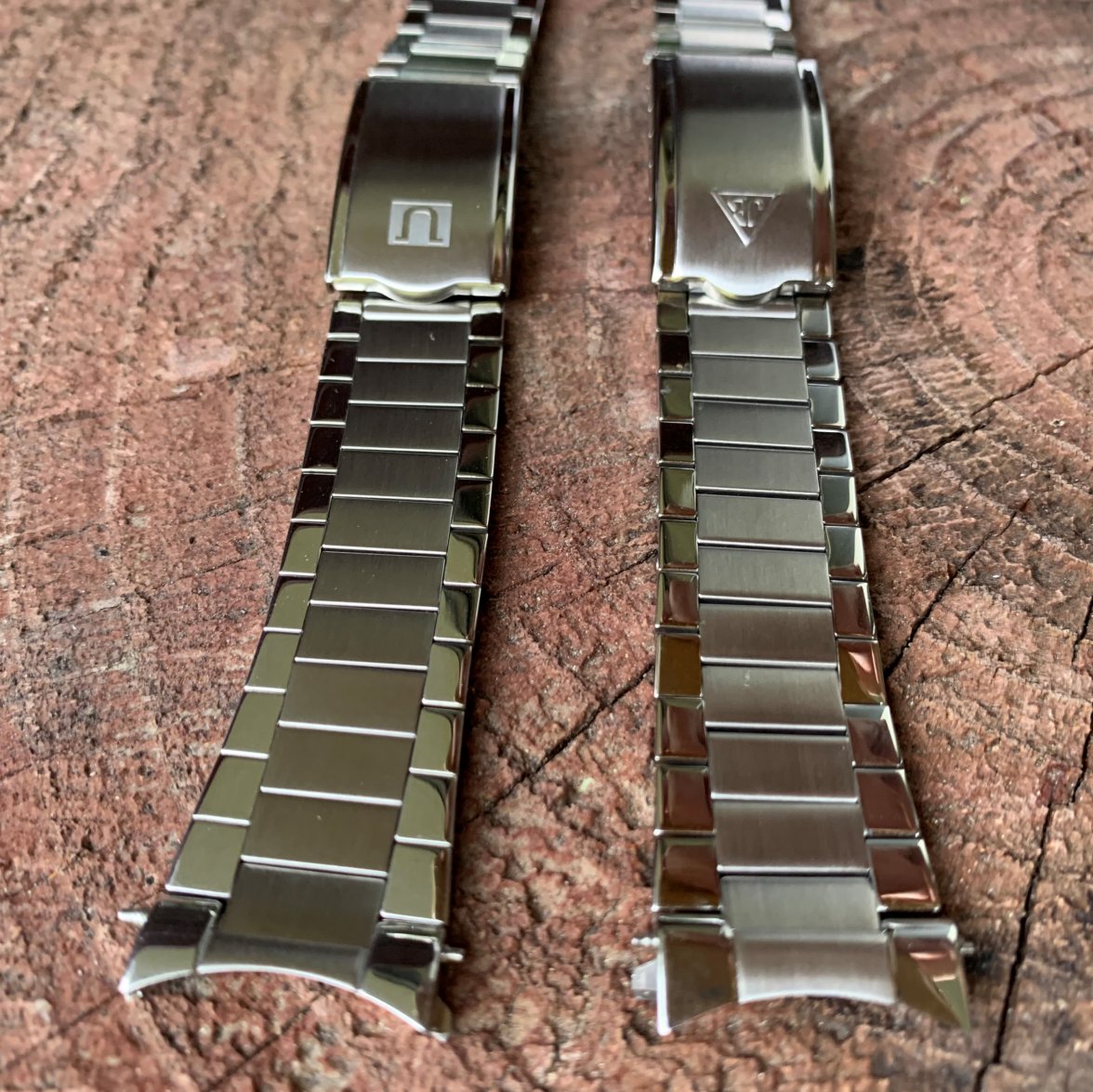
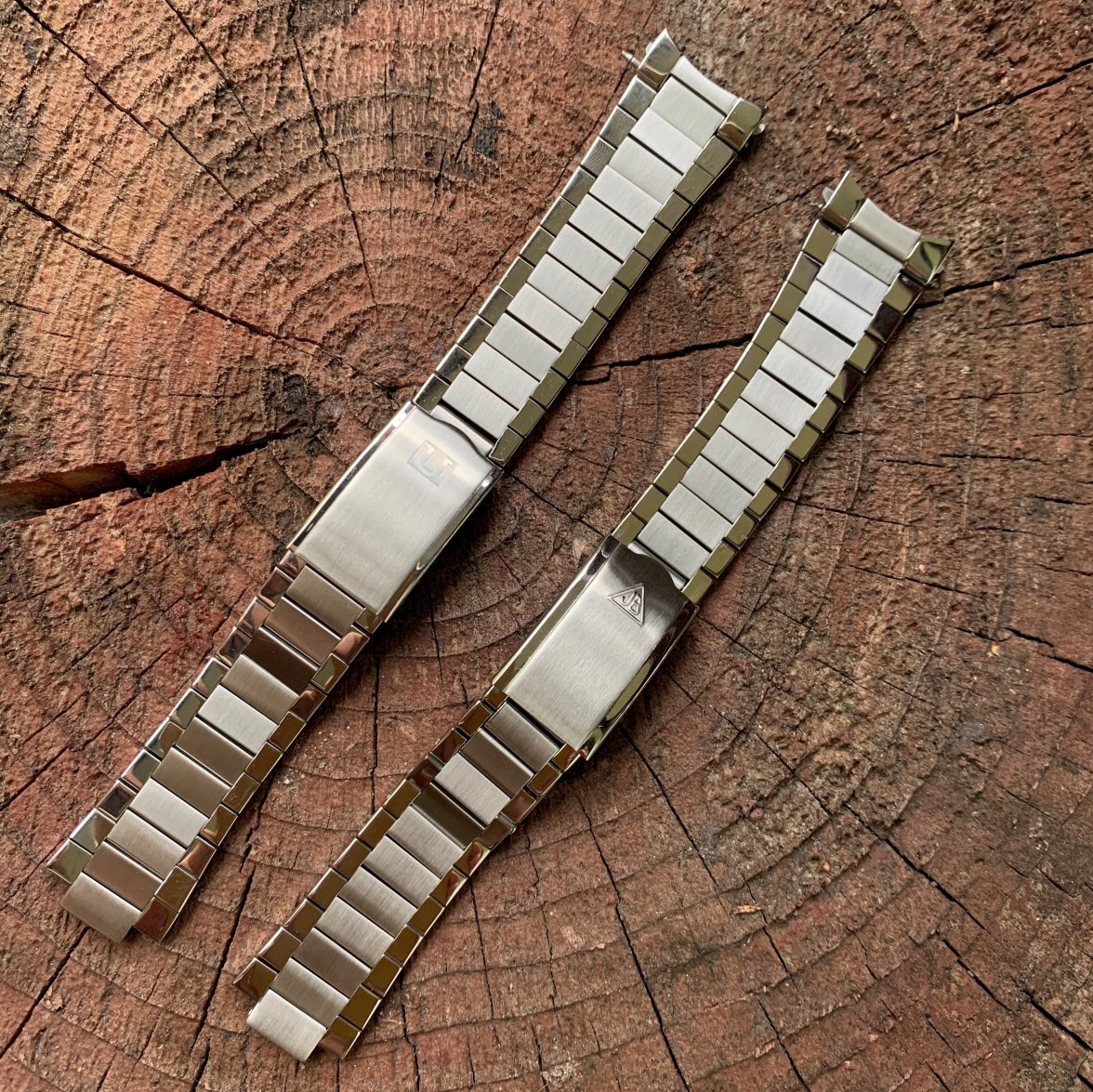
Some random pics to illustrate some of the points made earlier.
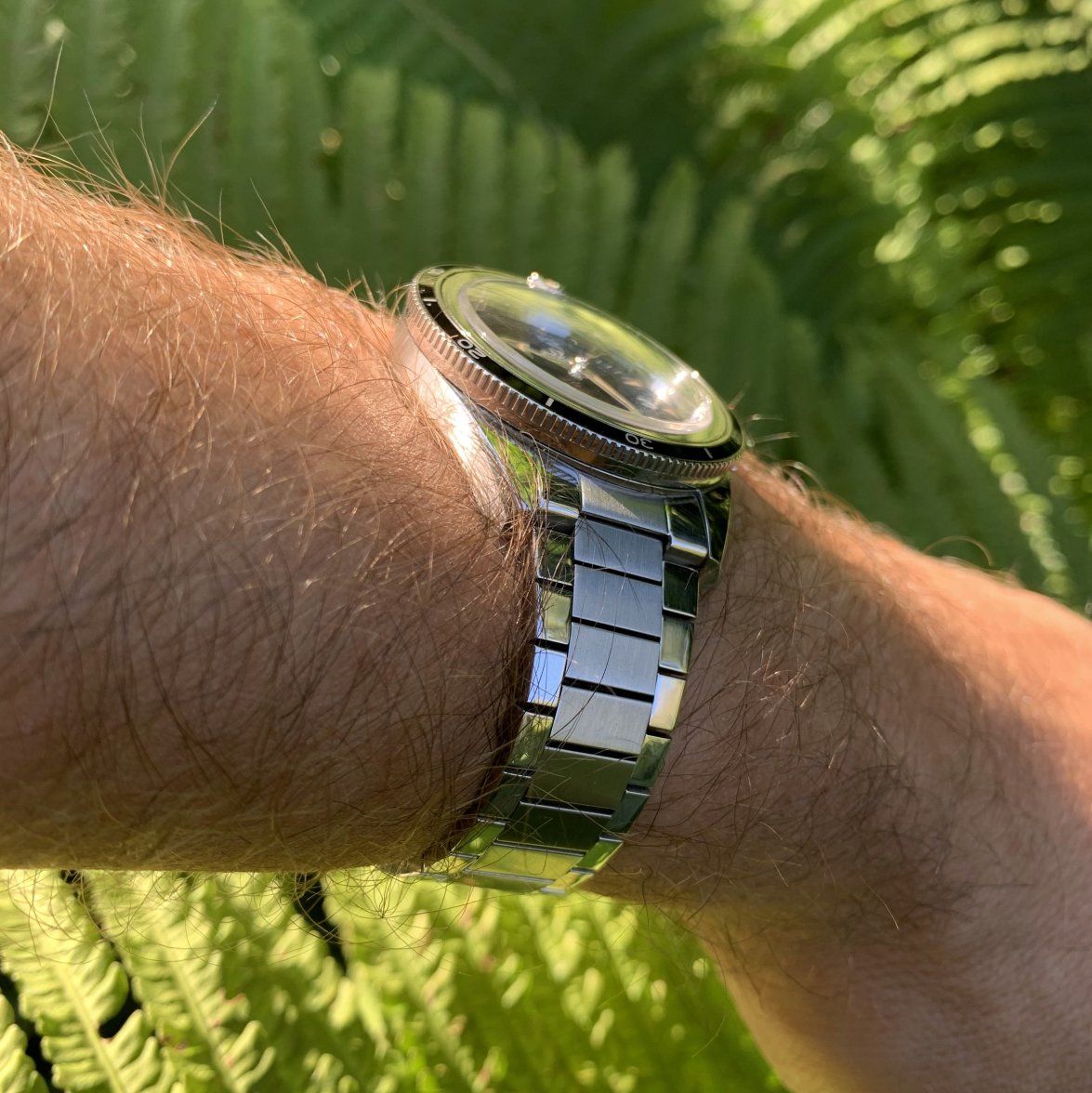
US does not fit the Speedmaster 60th as well as the Seamaster 60th (I guess difference in lug-hole positions)...
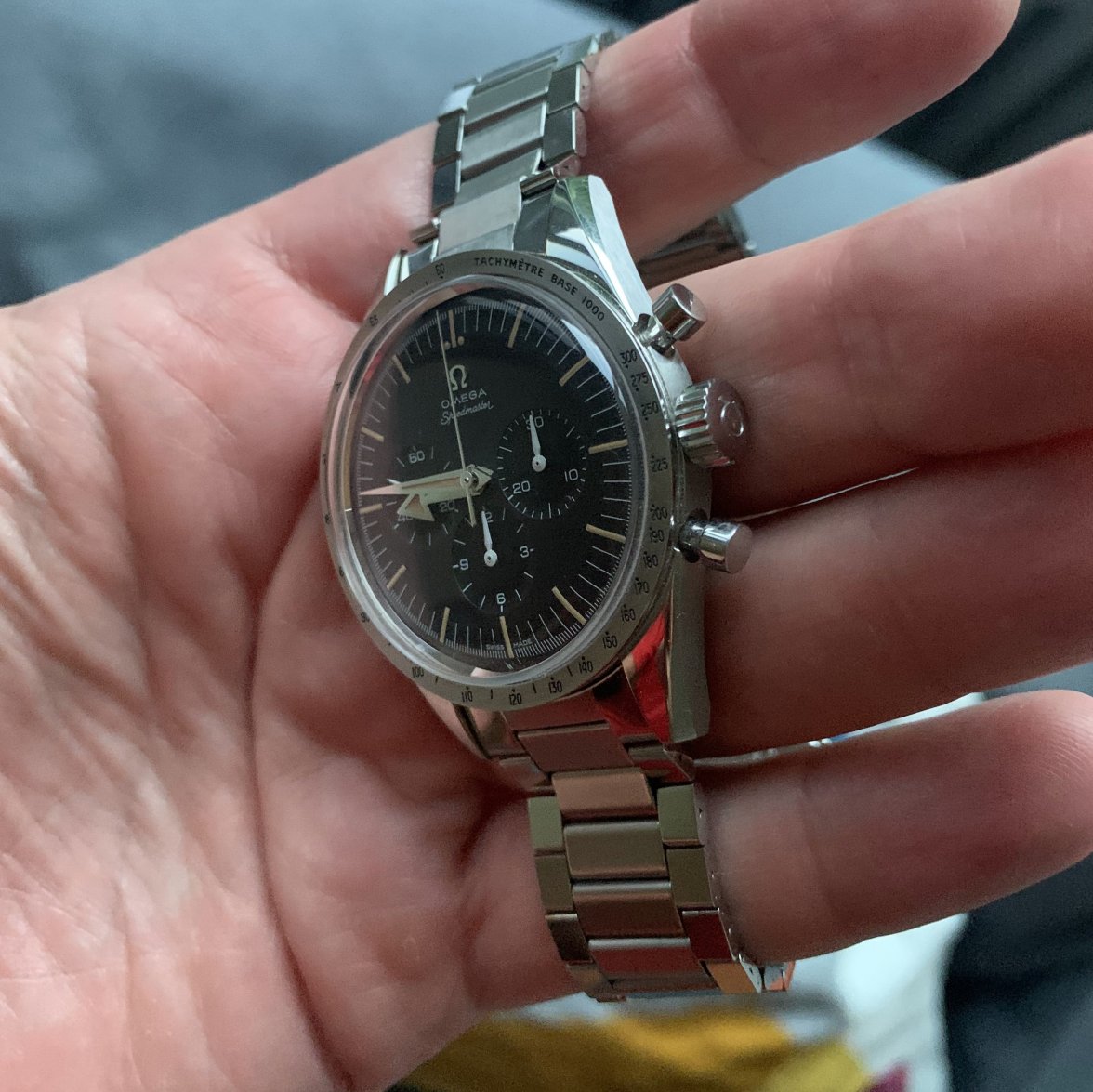
Strange tighness of the last links of the mint 1035 when installed (I beleive there were people saying FB does this as well).
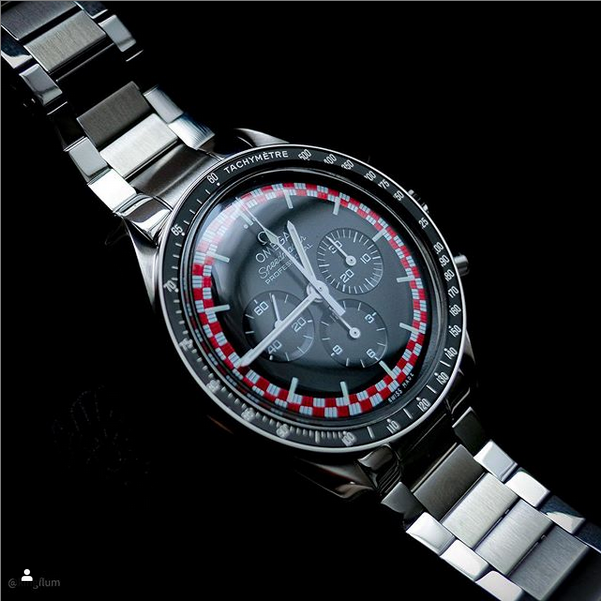
(Photo courtesy of Kingflum)
The FB endlinks coming up higher than the lugs (on the Tin-Tin ... could be different with different year Professional Speedmaster cases!)...this looks much more pronounced than on the 3570.50 ... I dont think its the photography, but rather a slight difference in case. I noticed something similar on @Adri 's 145.022-78 with US end-links, but not as pronounced (us pedantic folk 🤦)
(More pics/watches to come).
- Uncle Seiko BOR
- Uncle Seiko Holzer
- Uncle Seiko 1171
- Uncle Seiko 1035
- Forstner Bands JB Champion
- Forstner Bands Bonklip
- Forstner Bands Flatlink (like the 1035)
Tons of pictures and working combinations can be found here and here.
As the title suggests, this is a pictorial review of the the flatlinks, being a mint/like-NOS Omega 1035/506 versus the Uncle Seiko 1035 versus the Forstnerbands flatlink, as well as a small section on the 1039 vs the Uncle Seiko vs the Forstnerbands. Both Uncle Seiko and Forstnerbands made a single bracelet with optional endlinks to cover both 1035/1039 uses. This is great! Omega could have done the same. I did not go into the same depth with the 1039 as the 1035, as they are much alike, just slightly wider.
As an owner of all three(four!) I have gained some hands-on experience, and I have met some collectors with both Uncle Seiko and Forstnerbands flatlinks and discussed them, so I will add some thoughts, but a picture is worth a thousand words (or so 'they' say). I will not pick a favourite of the two third parties : both Forstnerbands and Uncle Seiko are fantastic, both are similar (Forstnerbands has the addition of stretchable links) with a similar form, with slightly different end-link profiles and construction and thus are better suited to different watches depending on ones taste. Both are well worth their cost (and both should be had at that). It also appears that the Forstnerbands and Uncle Seiko are much more solidly made than the vintage Omega. There appear to be less parts and their construction is better...however we will only truly know in about 50 years ... when these are as old as most 1035's on the market today (and still functioning). Despite that : I'm a pedant, so will say upfront that the Omega wins hands down for me (on my 60th Anniversary Speedy, which fully deserves it), but it took me some years to complete that set, and those parts are like hens teeth to find in such condition, and cost a small fortune, thus not a realistic option for most. I add it here as this is the bracelet that both parties are helping us get onto our watches : what better than to compare to the original?
Personally I would not be able to wear any of the new bracelets (or the 1035) on a vintage watch, as the character of the bracelets (new and shiny shiny) just do not match the character of 99.99% of vintage watches...but again, thats just me.
Why get a 1035/506 in mint condition you may ask? Well, when I put it together, there was no other option...and then a month or so later Uncle Seiko and then Forstnerbands announced their flatlinks. Thanks again guys 😁
Without further a do, lets take a look at the same sized bracelets...the 1035s...
(clicking the pictures yields super high res images)
The first distinguishing characteristic of the US/FB flatlinks verses the Omega, are how the links form the taper of the bracelet as a whole. Its clear to see that the Omega has more links making the taper then either of the other two (almost by double). This gives the Omega a more gradual, almost linear taper, whereas the other two form a curved taper ... and an almost identical one at that.
Also worth noting : the Omega links are very tight in this condition (but, unlike the other two, don't look it) ... this can be seen by how some of them do not fall flat (i.e. between 4/5th central link above the clasp on the Omega). The US/FB are better integrated from new.
The clasps are very similar. All are tight and close solidly with a nice 'click' sound (and feel) and are great.
The thing which stands out in the above picture is that the central links of the US/FB have the same width, but are slightly longer than the Omega. Plus the Omega central links are more rounded at their corners (horizontally in the above pic) than either alternative.
Again, notice the similarity in taper of the US/FB vs the Omega ... the curved contours of the US/FB and the straight-line-almost-to-the-clasp of the Omega are clearer to see in this shot. Again worth noting : the US/FB are almost indistinguishable.
Someone mentioned that the last-link that attaches to the end-link of the Forstnerbands is tight when installed, and doesn't flatten easily, and may stick as a result : I can verify that the Omega last link when attached to the end-link has the exact same issue (in this condition). And as Forstnerbands mentioned, when bent correctly, this creates a nice 'drape' over the wrist. From experience of vintage bracelets, this will most likely even out over time and with use.
Next up : the back. Both US/FB are brushed, whilst the Omega is polished. Also the back of the clasps (or the 'folding part') differ in size between all three, with Omega being the smallest of the lot, whilst Fortnerbands is the largest.
Side-on view of the clasps and links. Biggest difference to be seen here is the mechism by which the bracelets can be resized : US uses pins, Omega uses those funky disassemblable links (which are very easy to disassemble and reassemble once you know how), and FB uses a secure and independant screw system. Its much clearer to see in this shot the 'tightness' of the Omega, and how without tension some of the links are automatically rotated by an angle.
At this point its worth mentioning the stretch-links of the Forstnerbands.
(Forstnerbands stretch-links ... almost identical looking to Omega)
These work fantastically and very similar to the Omega. They appear to be similar in construction and assembly to the removable/stretchable parts of the Omega 103Xs, albeit installed only on one side of the clasp : the side on the outside (the body side being inside) of the wrist. I did not try to disassemble them to verify their functionality, but they look identical to my eye. Personally (and with my few vintage Omega 103X's), I never size the bracelet so tightly that these are stretched when on my wrist ... but they do work wonders when fitting ones hand through the bracelet when putting on the watch.
(Left : US, Center : Omega, Right : FB)
A closer side on view ... this nicely highlights the difference in construction between the folded metal of the Omega vs the solid links of the other two.
(Left : US, Center : Omega, Right : FB)
A close up of the last links, as well as bracelet. Some major differences in the shapes of all links between all bracelets can be seen. The central links being solid on the US/FB implies that they will most likely age better then the Omega 1035's with regards to stretch. Its clear to see how I abused the screw-heads of the FB. Resizing this bracelet was the most difficult operation I have had to perform on a watch related object. I required the help of my better half, as most of the screws were extremely tight. Given the reasons for this (a more secure way for keeping links attached to each other such that motion over time will not detach them) I feel it’s worth the effort if one doesn’t have the correct tools specifically for this, and thankfully its a once-off job, and won't need to be performed again.
Onto the end-links.
(Left : US, Center : Omega, Right : FB)
Again, some differences here. Omega appear to be the least polished. The brushing is very similar. What I can add, thanks to @Adri, is that the FB/US endlinks are interchangable with the braclets...so should one wish to mix and match, it works just fine. I actually saw a watch of his this evening with a mix of bracelet parts that gave him the look and fit he was after ... and it looked great.
(Left : US, Center : Omega, Right : FB)
From the back the differences are much larger. US and Omega are hollow 'flimsy' bent metal, both with slightly different holding mechism to the back of the watch, whilst the FB is a solid endlink with some small feet to keep it in place. The only potential problem with the solid endlink is the different placement of holes in the different cases (however, this too will make the bent end-links have a different fit). What it will fit has to be figured out by trial and error (or combing OmegaForums).
(Front : US, Center : Omega, Back : FB)
A side profile.
(Left : Omega, Center : FB, Right : US)
The endlink side profile tells a different story. Its clear to see that the US endlinks match the Omega 506 profile the closest, have a flat-ish top, wheras the FB endlink is fully rounded. Now depending on the watch, this may be desirable or not. Personally, I do not like how the curved end-link sits above the inside of the lyre-lugs of the Speedmaster professional cases. However, I think it looks fantastic on the straight-lug cases. The US endlinks also sit higher than the Omega’s (but lower than the FB), as the bend radius of the metal is greater (on these) which may be noticed upon installation. As mentioned earlier, US/FB parts are interchangable, and spares are readily available, and well priced.
(Front : US, Center : Omega, Back : FB)
Again the tight Omega 1035 pulling central links up with no tension...FB/US look fab.
Lets see what it looks like on the 60th Anniversary Speedmaster.
The Forstnerbands curved profile looks fantastic on this watch ... totally matches the case. However, the springbar hole placement of the 60th Anniversary is different to the First Omega in Space (what was used in developement of these endlinks I beleive) and so there is a gap and some play (it wiggles) in the endlink, as is evident in the next picture.
Next up the Uncle Seiko.
This also looks great and fits tight without play, however, the bend of the endlink (around the springbar) sits a bit too high on this watch for my liking. Perhaps it could be bent to fit better on this watch. I'd rather not ... it looks great on my Seamaster.
And here we have small-fortune-aesthetic-perfection 😁 ... Omega 1035/506 on the 60th. Sits tight, no play, looks great...
1039
Much of a muchness with the 1035 ... the 1039 is just a bit wider in the taper targeted to 20mm lugs. Upon inspection It would appear that the last link of the Omega is 1mm wider on the 1039 than both the US and FB.
From the back its similar.
A quick test on a transitional 3570.50:
The Forstnerbands looks great...however the only thing that bothers me is the superior height of the endlink to the inside of the lyre lugs. Its very slight here, but looks much more on the Tintin pictured below. Its also worth noting that the last link is slightly narrower than the end-link (which I think looks great).
Unfortunately (as of writing) I do not yet have a 20mm Uncle Seiko endlink set to do this test...will rectify that soon.
And here the Omega 1039/516.
Here it can be seen that the last link closest to the endlink is roughly the same width as the endlink.
Interchange of end-links between Forstnerbands and Uncle Seiko
Some random pics to illustrate some of the points made earlier.
US does not fit the Speedmaster 60th as well as the Seamaster 60th (I guess difference in lug-hole positions)...
Strange tighness of the last links of the mint 1035 when installed (I beleive there were people saying FB does this as well).
(Photo courtesy of Kingflum)
The FB endlinks coming up higher than the lugs (on the Tin-Tin ... could be different with different year Professional Speedmaster cases!)...this looks much more pronounced than on the 3570.50 ... I dont think its the photography, but rather a slight difference in case. I noticed something similar on @Adri 's 145.022-78 with US end-links, but not as pronounced (us pedantic folk 🤦)
(More pics/watches to come).
Edited: