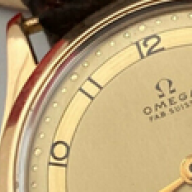
Old Omega speedmaster identification and advices

Posts
298
Likes
532
A forum member recently recommended @SpeedTar in Paris. He is a professional watchmaker and a member of this forum as well. Gonna to be very busy those days I presume ! Let us know about your watch!
 
Posts
203
Likes
321
I didn't open it (and I wouldn't dare😀) so I don't have any picture of the movement.
What could be the greenish part near the pushers ? corrosion ?
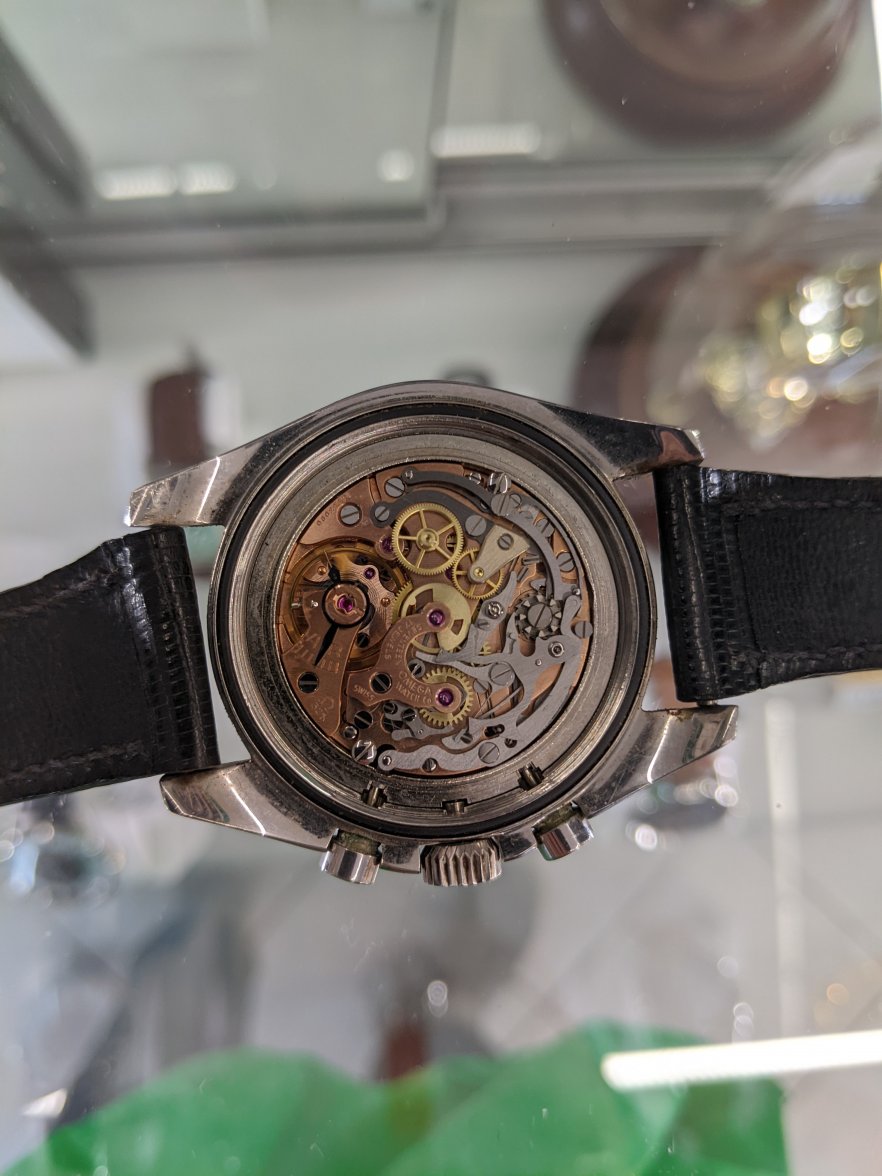

Some collectors look for that dust..
 
Posts
34
Likes
78
I went to someone near Paris but the price was steep (800 euros) ans he said that the pushers needed to be replaced (without any possible repair). So I decided to consult someone else (delepine in Amboise)

I took a picture of the mouvement, it seems very clean for such an old one without service for 30 years
 
Posts
1,554
Likes
3,651
I know many may disagree but if the watch runs properly (the movement seems really clean), I would not service it.

 
Posts
29,218
Likes
75,506
I know many may disagree but if the watch runs properly (the movement seems really clean), I would not service it.


Horrible advice in my view. Unless a watchmaker has looked and told you that it's fine, I wouldn't run it until you get it serviced. Parts for these can be very expensive, so you want to preserve them as much as possible.
 
Posts
7,106
Likes
23,082
I know many may disagree but if the watch runs properly (the movement seems really clean), I would not service it.

I see by your statement that you are aware of the dissenting opinions, such as the one above. So I ask this with complete neutrality, with no motivation other than curiosity - what generates your point of view? I know you are in the field of science, so genuinely interested.
 
Posts
447
Likes
1,983
I know many may disagree but if the watch runs properly (the movement seems really clean), I would not service it.

Would you give the same advice regarding a vintage car? Just wondering.
 
Posts
2,293
Likes
4,579
I've been in your shoes, I inherited a 1967 Speedmaster from my grandfather before I really knew much about watches and I suspect you've gone through a range of emotions; one being shock at the cost of servicing a timepiece like this. I'm sure its not exactly what you had planned. The best decision I ever made (well 2 decisions actually) was biting the bullet and budgeting the money to get my 1967 Speedmaster serviced properly after taking ownership, and choosing a top watchmaker to do the work ( not just sending it off to Omega for service). In my case I sent my watch to @Archer and he did an AMAZING job. It was worth every penny and the watch has been preserved for years and years to come. I wear it, enjoy it and do not have any fear that it will operate correctly as intended. These watches are meant to be worn and enjoyed, that's what I hope you can do with yours.

That watch appears to have been worked on at some point, as Archer said, the caseback had signs of being opened, and that rubber gasket is in surprisingly good condition. If it was original - normally those completely disintegrate over 50 years, or at the least, get flattened and dry. Either way though, that watch needs a service, so spend the money (I'm good at spending other peoples money lol). You'll thank me later.
 
Posts
23,389
Likes
52,016
I know many may disagree but if the watch runs properly (the movement seems really clean), I would not service it.
Horrible advice in my view. Unless a watchmaker has looked and told you that it's fine, I wouldn't run it until you get it serviced. Parts for these can be very expensive, so you want to preserve them as much as possible.

I see it as a risk/benefit analysis and for me, it depends how I expect to use the watch. If it will mainly sit in a drawer and be used once or twice a year, I probably wouldn't bother servicing it as long as it's running well. Just not worth the cost, or the risk that some incidental damage could occur during servicing. The risk is small for a good watchmaker, but the incremental wear and tear associated with running the watch occasionally is also not that great. If I plan to wear the watch once a month or so, I would definitely service it.
 
Posts
1,554
Likes
3,651
I see it as a risk/benefit analysis and for me, it depends how I expect to use the watch. If it will mainly sit in a drawer and be used once or twice a year, I probably wouldn't bother servicing it as long as it's running well. Just not worth the cost, or the risk that some incidental damage could occur during servicing. The risk is small for a good watchmaker, but the incremental wear and tear associated with running the watch occasionally is also not that great. If I plan to wear the watch once a month or so, I would definitely service it.

I was aware that many would disagree.
My point of view was exactly how @Dan S and @befobe explained better than me. Sometimes, the risk of collateral damages is not be neglected depending on the watchmaker (I'm not blaming anyone here).

I was talking about this particular watch. As it's an heirloom, it's sentimental value is priceless (I'm not talking about monerary value here, even if high in the present case). This makes this watch unique, irreplaceable. This is my point.

Obviously the OP asks here some advice on known watchmakers and it's a (very) wise choice!
If the objective of OP is to wear this very nice and priceless watch on an everyday basis then yes, it needs to be serviced properly.
On my side, I have inherited 20 years ago an amazing watch from my grand-father and had it serviced (the crystal was lighlty scracthed then I thought at the time that a service was mandatory). The watch run well back then. I wanted to wear it a couple of times a year for special occasions and thus brought the watch to a famous watchmaker close to where I used to live back then. At the time, I was not a watch guy yet, I was thushappy with the result. After a few years (and maybe after have worn the watch about 5-10 times), and after being morefamiliar with the world of vintage watches, I've checked again the watch and noticed the dial edge was damaged/chipped (and it was not before, as confirmed by my parents). I did not notice it back in the past and trust me, I'm mad (still now) of it and wished to have have kept the watch as it came to me. Changing the dial would be possible (even if it would be a nightmare to source one), but it would loose (for me) its "original" touch. It wouldn't look exactly like the watch my grand-father used to wear. And this is precisely what I want in such a case: enjoying the very same watch of my grand-father.

So, my point is that, in this specific case of inherited watch (priceless/irrepleceable), beyond giving you the time, this is a real souvenir that you can keep close to you and will make you think of your family everytime you will look at it. Having the dial scratched, the hands bent or some damage on the lume would, personally, make me mad.
I don't know, maybe I'm too sentimental...

My only advise is: finding a first-class watchmaker is key and will limit the risks. As said by others, in your area @SpeedTar is the guy you need 👍.

And for those who wonder, yes, I service my watches regularly. I send them to ABMT (Mérignac, France).
Edited:
 
Posts
7,106
Likes
23,082
I was aware that many would disagree.
My point of view was exactly how @Dan S and @befobe explained better than me. Sometimes, the risk of collateral damages is not be neglected depending on the watchmaker (I'm not blaming anyone here).

I was talking about this particular watch. As it's an heirloom, it's sentimental value is priceless (I'm not talking about monerary value here, even if high in the present case). This makes this watch unique, irreplaceable. This is my point.

Obviously the OP asks here some advice on known watchmakers and it's a (very) wise choice!
If the objective of OP is to wear this very nice and priceless watch on an everyday basis then yes, it needs to be serviced properly.

On my side, I have inherited 20 years ago an amazing watch from my grand-father and had it serviced (the crystal was lighlty scracthed then I thought at the time that a service was mandatory). The watch run well back then. I wanted to wear it a couple of times a year for special occasions and thus brought the watch to a famous watchmaker close to where I used to live back then. At the time, I was not a watch guy yet, I was thushappy with the result. After a few years (and maybe after have worn the watch about 5-10 times), and after being morefamiliar with the world of vintage watches, I've checked again the watch and noticed the dial edge was damaged/chipped (and it was not before, as confirmed by my parents). I did not notice it back in the past and trust me, I'm mad (still now) of it and wished to have have kept the watch as it came to me. Changing the dial would be possible (even if it would be a nightmare to source one), but it would loose (for me) its "original" touch. It wouldn't look exactly like the watch my grand-father used to wear. And this is precisely what I want in such a case: enjoying the very same watch of my grand-father.

So, my point is that, in this specific case of inherited watch (priceless/irrepleceable), beyond giving you the time, this is a real souvenir that you can keep close to you and will make you think of your family everytime you will look at it. Having the dial scratched, the hands bent or some damage on the lume would, personally, make me mad.
I don't know, maybe I'm too sentimental...

My only advise is: finding a first-class watchmaker is key and will limit the risks. As said by others, in your area @SpeedTar is the guy you need 👍.

And for those who wonder, yes, I service my watches regularly. I send them to ABMT (Mérignac, France).

Nicely explained by you, Dan, and Archer.
 
Posts
29,218
Likes
75,506
I see it as a risk/benefit analysis and for me, it depends how I expect to use the watch. If it will mainly sit in a drawer and be used once or twice a year, I probably wouldn't bother servicing it as long as it's running well. Just not worth the cost, or the risk that some incidental damage could occur during servicing. The risk is small for a good watchmaker, but the incremental wear and tear associated with running the watch occasionally is also not that great. If I plan to wear the watch once a month or so, I would definitely service it.

Well, the watch apparently hasn't been serviced in 30 years according to the owner. Any oil that was there is long gone...running it will damage parts, and in this case the parts are not always easy to find, and are expensive when you do find them.

I guess part of the issue is defining when a watch is "running well" and I suspect that for you and Seaborg this means that it keeps time reasonably well. That of course can mean very different things to different people. I've had someone hand me a watch for service, telling me it was running well, and only losing about a minute a day. Without defining what is meant by vague terms like this, it's difficult for anyone to know what they really mean, especially someone who is new to watches and vintage watches.

I've said this many times before, but the movement looking clean and keeping time, doesn't reflect it's actual condition. To make any sort of real assessment, it would require checking amplitudes, and also a visual inspection under a microscope to determine what oils might be left - you can't see all the jewels in these because of the chronograph parts, but you can see enough to determine if the movement is dry. Timekeeping alone just isn't enough information.

I was talking about this particular watch. As it's an heirloom, it's sentimental value is priceless (I'm not talking about monerary value here, even if high in the present case). This makes this watch unique, irreplaceable. This is my point.

Obviously the OP asks here some advice on known watchmakers and it's a (very) wise choice!
If the objective of OP is to wear this very nice and priceless watch on an everyday basis then yes, it needs to be serviced properly.

I can understand if people have had a bad experience with a watchmaker, they may be shy about recommending a service for a watch like this. But I generally think the risk from servicing as noted by both you and Dan is overstated. Yes, mistakes and damage can happen - watchmakers are human after all (I doubt anyone here is prefect at their job and has never made a mistake), but if you choose a watchmaker carefully, the risk will be very very small. Most watchmakers I know treat the watches they service as if they were their own watches - things may be different in a larger business with many watchmakers, but I'm referring to people who generally work on their own, like several of the watchmakers on this forum.

If people choose to not service their watches that's absolutely fine with me (before someone says it I'm not looking for more work in giving the advice I do - I've got plenty of work). However giving this advice to do the same to someone who is brand new at this, without giving the potential risks is not a good way to go about it. At least take the time to explain the pros and cons of servicing and not servicing - turns out that has happened anyway, which is a good thing.

I'll just say when we all give advice to help, let's try to give the person asking the best chance at making an well informed decision.

Cheers, Al
 
Posts
1,554
Likes
3,651
Hi @Archer .
I think (hope) we finally converged 👍.
The OP is now free to do what he feels to be better for his (very nice) Speedy.

Cheers

R.
 
Posts
34
Likes
78
The watch is currently in revision in Alain Delepine shop in Amboise. Price is 480 euros so quite reasonable compared to Omega.
 
Posts
116
Likes
1,063
The watch is currently in revision in Alain Delepine shop in Amboise. Price is 480 euros so quite reasonable compared to Omega.

Congrats with a very nice heirloom, I wish my granddad had the same good tast.
I think you made a good choice here.
You will not be able to recognize the watch once it returns from Omega. They will most likely change the dial, hands, pushers and the crown and that's not what you want.