New Speedmaster pro, running a bit slow, question about accuracy range of speedy

Posts
15
Likes
31
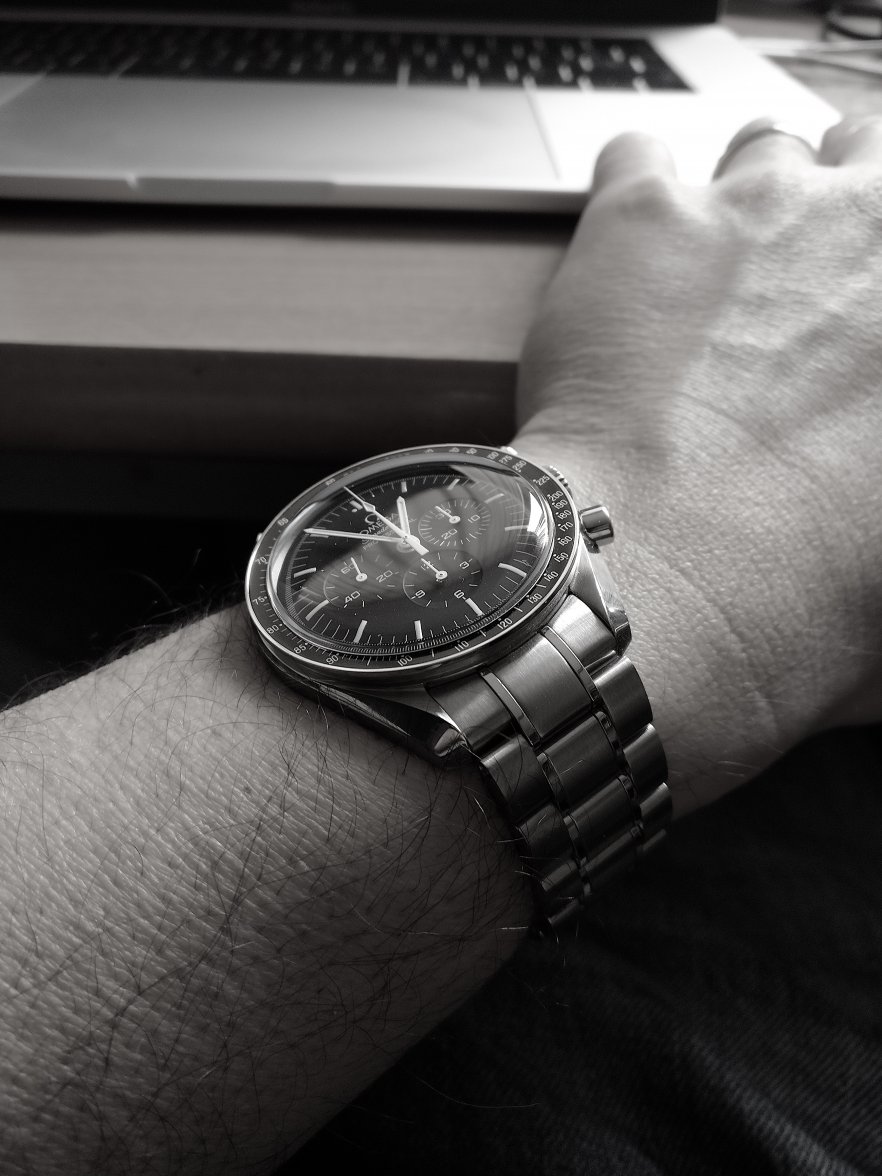
I have a new Speedmaster pro, I am a very new forum member, and I have a question about accuracy.

My new speedy loses about 4s a day. I just wanted to ask two things

1) why Omega has a target of -1/+12s why the range is not symmetrical in relation to 0?
2) is -4s a day acceptable, I understand that it is essentially out of the range but would it be reasonable for me to get it back to Omega?

Obligatory photo attached
 
Posts
15,221
Likes
44,696
Perhaps better you should give an indication as to what sort of accuracy you would find acceptable, and ask for an expert opinion as to whether that standard is even achievable with a Speedmaster.
 
Posts
1,642
Likes
5,110
That is normal. I think mine is similar. It's running +5 sec. Does not really matter. Could be regulated though.
I guess how the watch runs depends on how you wear it, what position it has, how it sits at night etc.
Enjoy it!
 
Posts
15
Likes
31
Thank you for the answers. -4 sec is acceptable to me, however I am wondering why omega thinks it is not. Is there a reason that the acceptable range for Omega is -1 to +11s?
 
Posts
3,854
Likes
6,557
Probably because it’s easier to hack a fast running watch to bring it in time, than to wait 55 seconds and advance the minute hand.
 
Posts
333
Likes
784
Probably because it’s easier to hack a fast running watch to bring it in time, than to wait 55 seconds and advance the minute hand.
Their opinion is that they prefer a watch running fast because you would be rather early and not late to an appointment. Their METAS specification also reflects this 0 / +5 seconds.
 
Posts
29,186
Likes
75,418
Thank you for the answers. -4 sec is acceptable to me, however I am wondering why omega thinks it is not. Is there a reason that the acceptable range for Omega is -1 to +11s?

Please read this thread, as it will shed light on how the timing tolerances work, and why your watch is likely fine even though it's running less than -1:

https://omegaforums.net/threads/tim...-understand-how-they-work.87293/#post-1128576

Regarding why the tolerance is asymmetrical, it's because people will accept a watch that is a few seconds fast, but generally not one that runs slow. I see this all the time with my customers preferences, and it's not particularly rational from a pure math point of view, because if a watch runs +6 seconds per day, or -6 seconds per day, it has the same accuracy, but people will be much more concerned about it running slow.

Cheers, Al
 
Posts
2,254
Likes
11,374
Please read this thread, as it will shed light on how the timing tolerances work, and why your watch is likely fine even though it's running less than -1:

https://omegaforums.net/threads/tim...-understand-how-they-work.87293/#post-1128576

Regarding why the tolerance is asymmetrical, it's because people will accept a watch that is a few seconds fast, but generally not one that runs slow. I see this all the time with my customers preferences, and it's not particularly rational from a pure math point of view, because if a watch runs +6 seconds per day, or -6 seconds per day, it has the same accuracy, but people will be much more concerned about it running slow.

Cheers, Al

Because you'd rather be 6s early to catch your plane, than miss it by 6s I guess...

Even though if you're probably this close to missing your flight, the watch probably isn't really your main organizational problem 😁
 
Posts
29,186
Likes
75,418
Because you'd rather be 6s early to catch your plane, than miss it by 6s I guess...

Even though if you're probably this close to missing your flight, the watch probably isn't really your main organizational problem 😁

As I said, from a pure math standpoint it doesn't make any sense. From a practical standpoint, well it doesn't make any sense either. 😉
 
Posts
3,800
Likes
22,723
I'm still dumbfounded by those that have the expectation to have Quartz accuracy with their new mechanical timepieces?!

I understand that mechanical watches, in general are much more expensive than their much more accurate Quartz cousins and that those new to mechanical timepieces would expect the same level of accuracy, but I think that it's quite amazing that many mechanicals, old and new, can and still achieve such accuracy as -4 secs per day.

I wouldn't worry a second (or 4!) with a rate of -4 secs per day...it's astounding performance just short of perfect!

Cheers,
 
Posts
849
Likes
1,748
At least with a watch that has hackable seconds running fast is preferable because if you want to sync to a standard you can just hack the seconds and wait for a while before re-engaing. If your watch is running slow, you also have to adjust the minute hand to sync it. If like me you have an irrational need to sync to the atomic clock every week or two, then running fast makes that easier to do. If you are less irrational, you're fine either way.
 
Posts
3,800
Likes
22,723
Btw, I set my slow watches 30 seconds fast every week and my fast watches 30 seconds slow...that's how you get perfect! 😉
 
Posts
2,254
Likes
11,374
I'm still dumbfounded by those that have the expectation to have Quartz accuracy with their new mechanical timepieces?!

I understand that mechanical watches, in general are much more expensive than their much more accurate Quartz cousins and that those new to mechanical timepieces would expect the same level of accuracy, but I think that it's quite amazing that many mechanicals, old and new, can and still achieve such accuracy as -4 secs per day.

I wouldn't worry a second (or 4!) with a rate of -4 secs per day...it's astounding performance just short of perfect!

Cheers,

Indeed... I think we tend to lose sight of this...

4s/d is like 4.5cm per kilometer... it's crazy accurate...
 
Posts
622
Likes
2,841
I bought a speedy pro last year and it runs about -2 / -4

Then if I swap watches mid week and then put it back on after starting it back up it can run absolutely dead on and perhaps loose just -1 overnight

What bothers me most is the inconsistency.

Either way, it’s super accurate
 
Posts
18,095
Likes
27,413
I bought a speedy pro last year and it runs about -2 / -4

Then if I swap watches mid week and then put it back on after starting it back up it can run absolutely dead on and perhaps loose just -1 overnight

What bothers me most is the inconsistency.

Either way, it’s super accurate

Yes amount of wind on the main spring, the orientation of the watch to gravity... all effect timing. Try leaving the watch in a different position over night.
 
Posts
15
Likes
31
Thanks for all the illuminating answers especially the one about how a watch can appear outside tolerance without actually be outside tolerances. Yes you are right -4s is absolutely fine for me, measuring the accuracy is part of the honeymoon with the watch. Especially with a manual wind watch I am more forgiving about accuracy, with the speedmaster actually I take 30s to wind it every day and if it needs to I can correct the time. I have though found with automatics that I forget them and after wearing a watch for months I suddenly am surprised one day that I am off by a whole 5 or 10min.
One thing that I was wondering about the asymmetric tolerance is that if as a watch gets older and the oil dries up it tends to run slower rather than faster then it would make sense to have an asymmetric tolerance? I do not know I am just making a hypothesis
 
Posts
622
Likes
2,841
Yes amount of wind on the main spring, the orientation of the watch to gravity... all effect timing. Try leaving the watch in a different position over night.

Thank you; I've found dial down looses the least amount. Its leather deployant, so hard to try dial up which i suspect may be better.

All my other speedy's, ST, CK's etc, they need crown down as they are all +3 / +5
 
Posts
2,443
Likes
4,231
As I said, from a pure math standpoint it doesn't make any sense. From a practical standpoint, well it doesn't make any sense either. 😉
It makes perfect sense from a psychological viewpoint. Things that are running fast give the impression of good health and great energy. Things that are running slow give the impression of aging, clogged mechanism, grinding to a halt. Most things tend to slow down as death approaches, not speed up.
 
Posts
29,186
Likes
75,418
Most things tend to slow down as death approaches, not speed up.

I suppose if you don't know anything about watches, isochronism, etc. it makes sense.
 
Posts
2,443
Likes
4,231
I suppose if you don't know anything about watches, isochronism, etc. it makes sense.
I know about watches, isochronism, etc. If you read carefully what I wrote, I used the words "psychological," "give the impression," and "most things."