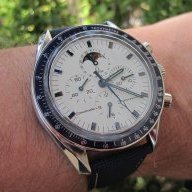
New Speedmaster pro, running a bit slow, question about accuracy range of speedy

Posts
29,186
Likes
75,420
I know about watches, isochronism, etc. If you read carefully what I wrote, I used the words "psychological," "give the impression," and "most things."

Not sure why you think I didn't read it carefully, and I'm not sure why you think I was referring to you personally...relax bud...
 
Posts
2,443
Likes
4,231
Not sure why you think I didn't read it carefully, and I'm not sure why you think I was referring to you personally...relax bud...
I'm relaxed. I predict you'll respond to this because you need to get the last word in.
 
Posts
29,186
Likes
75,420
I'm relaxed. I predict you'll respond to this because you need to get the last word in.

::facepalm1::

I was actually agreeing with you, but the chip on your shoulder must be so large you can't see the screen properly...

And I predict you'll respond to this because you like to get the last word in. Or not - I don't care really.
 
Posts
2,443
Likes
4,231
::facepalm1::

I was actually agreeing with you, but the chip on your shoulder must be so large you can't see the screen properly...

And I predict you'll respond to this because you like to get the last word in. Or not - I don't care really.
HaHaHaHaHaHaHaHaHaHaHaHaHaHaHaHaHaHaHaHaHaHaHaHaHaHaHaHaHaHaHaHaHaHaHaHaHaHaHaHaHaHaHaHaHaHaHaHaHaHaHaHaHaHaHaHaHaHaHaHaHaHaHaHaHaHaHaHaHaHaHaHaHaHaHaHaHaHaHaHaHaHaHaHaHaHaHaHaHaHaHaHaHaHaHaHa
 
Posts
218
Likes
187
Most things tend to slow down as death approaches, not speed up.

I have found my Speedmaster to run faster in hours 24 - 36 (since fullly winding).

I figured it would slow down under "common sense" of less power = slower. And then I could almost hear Archer telling me "you know nothing about how watches work" 😀
 
Posts
29,186
Likes
75,420
I have found my Speedmaster to run faster in hours 24 - 36 (since fullly winding).

I figured it would slow down under "common sense" of less power = slower. And then I could almost hear Archer telling me "you know nothing about how watches work" 😀

It seems counterintuitive at first, but if you think of a pendulum swinging in a spring powered clock when it has more power behind it, it will swing more to each side, and covering that distance takes a specific amount of time. As the spring runs down, the pendulum is not receiving the same power, so it swings less. The shorter swing doesn’t take as long, so this means the clock runs faster.

In watches that are not isochronous, the same thing happens to the balance. As the power runs down, the balance amplitude decreases, the time needed for the balance cycle (tick and tick) decreases, and the watch runs faster.

Watch companies take great pains to minimize this effect. But depending on what the specific setup of the watch is, it can still run fast as the watch runs down just like your Speedmaster does.

Based on the number of times I’ve explained this to watch collectors and enthusiasts over the years, it’s not common knowledge. Again I understand why people think the way they do about this topic, as most would not have the background to think of it this way, but if you think about it as a pendulum it does make “common sense” that a shorter swing takes a shorter duration.

Cheers, Al

 
Posts
38
Likes
25
It seems counterintuitive at first, but if you think of a pendulum swinging in a spring powered clock when it has more power behind it, it will swing more to each side, and covering that distance takes a specific amount of time. As the spring runs down, the pendulum is not receiving the same power, so it swings less. The shorter swing doesn’t take as long, so this means the clock runs faster.

In watches that are not isochronous, the same thing happens to the balance. As the power runs down, the balance amplitude decreases, the time needed for the balance cycle (tick and tick) decreases, and the watch runs faster.

Watch companies take great pains to minimize this effect. But depending on what the specific setup of the watch is, it can still run fast as the watch runs down just like your Speedmaster does.

Based on the number of times I’ve explained this to watch collectors and enthusiasts over the years, it’s not common knowledge. Again I understand why people think the way they do about this topic, as most would not have the background to think of it this way, but if you think about it as a pendulum it does make “common sense” that a shorter swing takes a shorter duration.

Cheers, Al

Al,

Thank you for such informative posts!

Specific to the 1861: Is this watch particularly sensitive when it comes to regulation? Is the movement more intolerant to shock than similar calibers?

I have a new Speedmaster Pro that was running ~+17spd (as high as +19spd) right out of the box. The watch is a mere three weeks old (in use). The very-accommodating watchmaker at my AD regulated the watch to within 1spd very easily, but commented that he barely touched the regulating device and got an immediate 10spd reduction while making the adjustment. In any case, he has nailed the regulation and I'm hoping that it will be reasonably stable.

Thanks again,

180
 
Posts
218
Likes
187
It seems counterintuitive at first, but if you think of a pendulum swinging in a spring powered clock when it has more power behind it, it will swing more to each side, and covering that distance takes a specific amount of time.

Oh wow, grade 11 or 12 physics...it's all coming back!
 
Posts
622
Likes
2,841
Anyway

So after a day on the wrist that ran at +/- 0 I tried dial up overnight.

-7

Oh dear. Considering dial down was and usually is -2

I just hope I don’t have a problem movement in this one. It’s so temperamental
 
Posts
15
Likes
31
Very interesting discussion. If I may add in the case that mostly we solve in university Physics the length of oscillation is not important as we are using small angle approximations (or small spring displacement) and the resonant frequency is only dependent by the length of the pendulum or spring constant. The deviations that we are talking about here, on the balance wheel oscillation I think they are too complicated to solve analytically. Not my subject exactly but I am doing research in Physics so I have a bit of knowledge on the general subject.
Anyway, very happy with the Speedmaster, amazing watch. I have the Fortis cosmonauts as well but I love the speedmaster and I think that the Fortis may go. I have to say that I love manual wind watches.
 
Posts
9,521
Likes
52,423
Well within the expected range for a Speedy Pro. My 861 gains about 1.2 seconds/day. I think a little fast is preferable to a little slow, but I wouldn’t be concerned about your watch’s performance.
 
Posts
16,854
Likes
47,854
I'm still dumbfounded by those that have the expectation to have Quartz accuracy with their new mechanical timepieces?!

I understand that mechanical watches, in general are much more expensive than their much more accurate Quartz cousins and that those new to mechanical timepieces would expect the same level of accuracy, but I think that it's quite amazing that many mechanicals, old and new, can and still achieve such accuracy as -4 secs per day.

I wouldn't worry a second (or 4!) with a rate of -4 secs per day...it's astounding performance just short of perfect!

Cheers,

I’m with you man.
86400 seconds in a day and the time worried about 5 or 10 😉
 
Posts
2,675
Likes
7,487
I have a new Speedmaster pro, I am a very new forum member, and I have a question about accuracy.

My new speedy loses about 4s a day.
Hi, and welcome to the Forum.

Some questions for you:

1. How did you measure the accuracy of your watch?

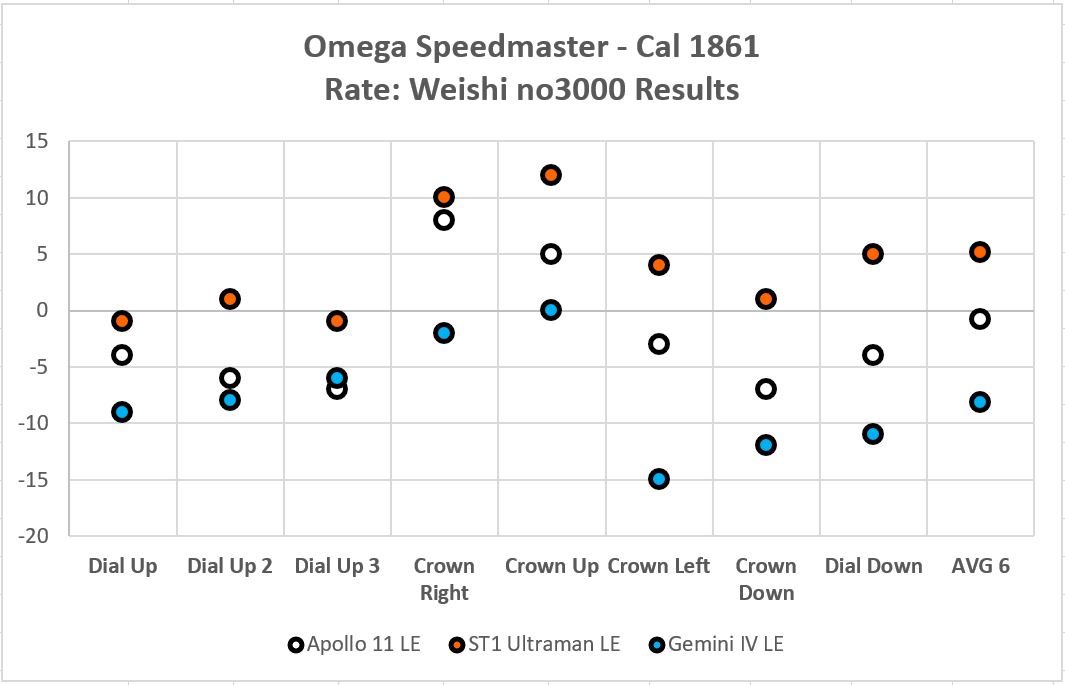
2. Are you aware just how much the timing varies by position? I recently bought a low-end timing machine and have had fun taking measurements. While I don’t put too much faith in any particular value, I do believe the general outcome across positions. With what I’ve seen, I am much less concerned about the particular “accuracy” as I know it is subject to quite a bit of measurement error and positional variation. (Lots of fun to measure though!).

I have 3 modern cal 1861 Speedmasters and recorded measurements for each as seen in the below graph. I took 3 separate readings for dial up (most common position when I wear them) and you can see that variation exists simply from one measurement to the next. The 3 dial up readings for a particular watch tend to be close to each other, but not exactly the same. Best to take any individual accuracy reading with a healthy dose of perspective...

 
Posts
15
Likes
31
Hi, and welcome to the Forum.

Some questions for you:

1. How did you measure the accuracy of your watch?

2. Are you aware just how much the timing varies by position? I recently bought a low-end timing machine and have had fun taking measurements. While I don’t put too much faith in any particular value, I do believe the general outcome across positions. With what I’ve seen, I am much less concerned about the particular “accuracy” as I know it is subject to quite a bit of measurement error and positional variation. (Lots of fun to measure though!).

I have 3 modern cal 1861 Speedmasters and recorded measurements for each as seen in the below graph. I took 3 separate readings for dial up (most common position when I wear them) and you can see that variation exists simply from one measurement to the next. The 3 dial up readings for a particular watch tend to be close to each other, but not exactly the same. Best to take any individual accuracy reading with a healthy dose of perspective...


Hi, thank you for the welcome, It is very interesting to see your measurements, they show that there is common trend in all the 1861s you tested so it maybe can be used as a guideline. As I do not have a timing machine I doubt that I can do these kind of measurements with any kind of accuracy. I just did an average measurement over some days without taking notice of position, although I suppose during the night it would be a dial up. I am not concerned really for the watch, 4s per day is amazing, anything below 10 for me is acceptable. I was just more interested to understand why the accuracy range of Omega is not symmetrical to 0.
 
Posts
7,557
Likes
13,953
Leave it alone, any time a watch is opened you have the potential for other issues to be introduced. This includes scratches.
 
Posts
2,675
Likes
7,487
Hi, thank you for the welcome, It is very interesting to see your measurements, they show that there is common trend in all the 1861s you tested so it maybe can be used as a guideline. As I do not have a timing machine I doubt that I can do these kind of measurements with any kind of accuracy. I just did an average measurement over some days without taking notice of position, although I suppose during the night it would be a dial up. I am not concerned really for the watch, 4s per day is amazing, anything below 10 for me is acceptable. I was just more interested to understand why the accuracy range of Omega is not symmetrical to 0.
I noticed the pattern as well. When you know the rate at each position, it’s possible to set the watch overnight so that it somehow cancels out any other variation.

Since crown up and crown right were the highest for each of my 3 Speedmasters, you may improve your overall accuracy by keeping it in that position every night. Good to hear you’re not too concerned, but might still help a bit.
 
Posts
29,186
Likes
75,420
Specific to the 1861: Is this watch particularly sensitive when it comes to regulation? Is the movement more intolerant to shock than similar calibers?

No, and no. This is getting into the weeds a bit, but with watches equipped with regulators that act on the balance spring like the 1861 has, the amount of movement of the regulator for a given change in timekeeping is variable, and depends in part on the spacing of the regulator pins on that specific watch.

If the regulator pins are spaced very wide, then a given movement of the regulator will have less impact on the rate then if the regulating pins are spaced very closely together. The spacing of those pins is determined through the positional adjustment portion of the timing process.

Cheers, Al
 
Posts
15
Likes
31
Maybe it's just my brain that is getting old, but wrt pendulums, I thought that the amplitude (unless very small or large) did not affect the frequency which is a function of the length of the pendulum. For example as explained here https://sciencing.com/affects-swing-rate-pendulum-8113160.html 😒

You are very correct from an undergraduate Physics perspective. In Physics we solve pendula assuming that we have small angles to simplify the problem. This is correct for small angles, even up to 15 degrees, you still keep more than 99% accuracy. However in the case of a watch that we are interested in understanding behaviour of a balance that has an accuracy of 4 secs in a day (1 to 10000) we cannot use this assumption and still get valid results.