
- Posts
- 175
- Likes
- 164
ZWD
·Hello OF!
Excited to share a little shake-up our understanding of early Speedmaster Bezels.
I have worked in metrology and various forms of composite digital imaging over the last decade and have now started pointing that knowledge toward the Bezels and Dials of vintage Speedmasters. Recently while working on some new homography tools, I analyzed hundreds of early bezels spanning past auctions, current sales, our favorite books & websites dedicated to the Speedmaster, etc.. -- and I've noticed some interesting variations appearing when focusing on 2998's.
Turns out the Bezel we know as the "B1" appears to be a family of 3 different bezels. (who knows, maybe more to come😀
We have a bit of a naming convention problem here that might cause confusion, so for clarity, I will refer to them as B1 MK1, B1 MK2 & B1 MK3 (B1 MK3 being the later bezel most commonly associated with "B1").
There is of course a gradient of when/where these bezels appear/disappear. If we had a large sample pool of known, untouched examples we could likely see clearer trends, but we are looking at relics of the past all with their own history's, forgotten, misremembered, serviced, improved, unimproved etc..
It is a bit easier to demonstrate and describe these 2 bezels in relation to the most common B1 MK3 bezel.
I'm still putting together and refining a timeline for these bezels, so please take this with a grain of salt for the moment, especially the phase out periods.

B1 MK1

primarily associated with 2998-3 to 2998-4
Transitioning Out from 2998-5 through 2998-6
(typically associated with the Green bezels seen in this range).
-line between 100 & 110 biased toward 110.
-200 biased towards outer edge
-190 biased towards 180.
B1 MK2
 primarily associated with 2998-5 to 2998-62
Transitioning Out from 2998-62 through 105.002-62
-line centered between 100 & 110
-200 biased towards outer edge
B1 MK3
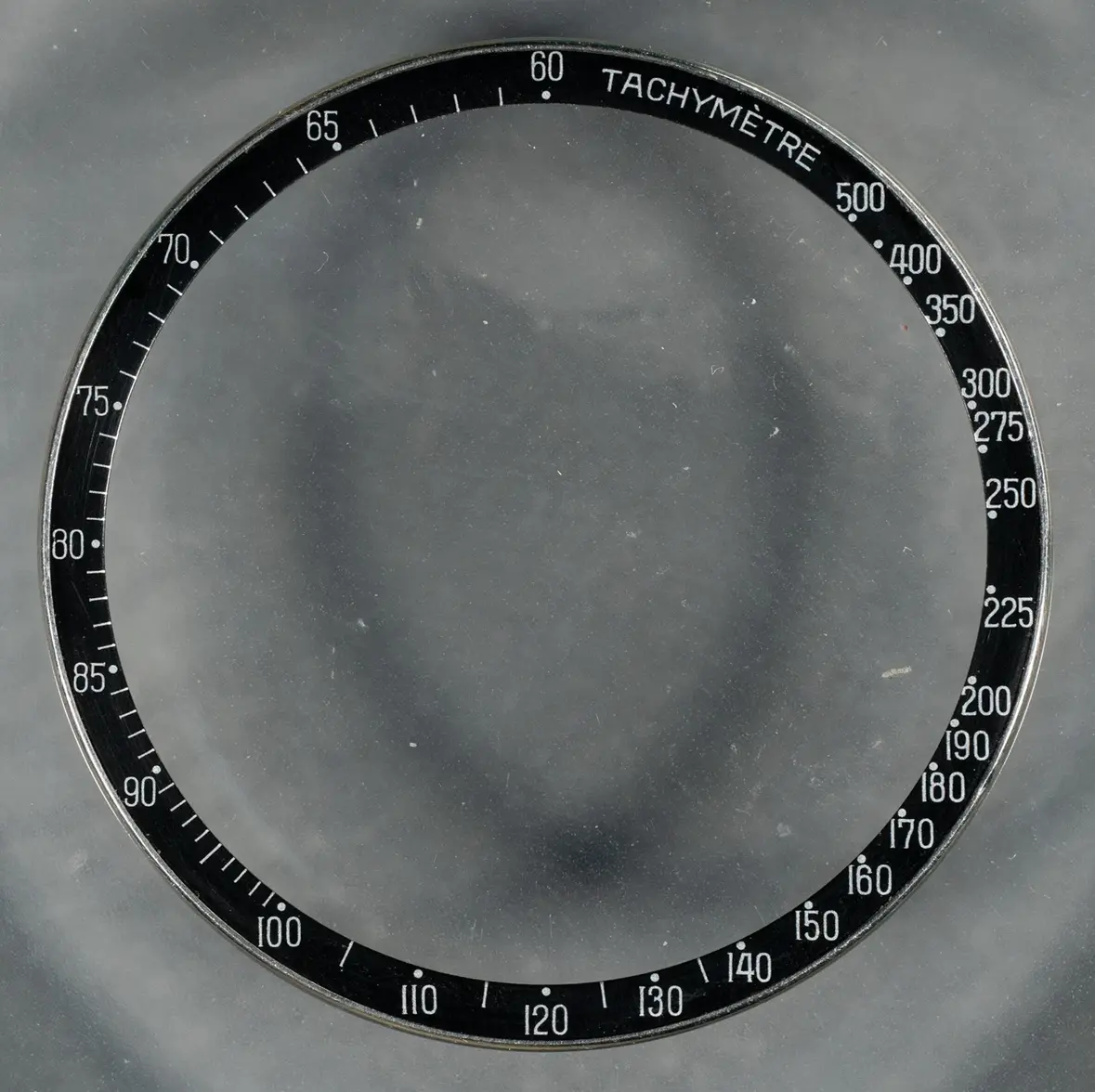
primarily associated with 105.002 to 145.022-68
Transitioning Out during 145.022-69
-line centered between 100 & 110
-200 is closer to inner edge.
There are quite a few minute transformations throughout the bezels that I'm tracking and leaving out of this post (Serifs, edge proximity, thickness and additional feature shifts). For now the above key features are the largest tells that can help differentiate them quickly. I am very much still working out details so take this as a first draft. More to come and don't go switching out those early 2998 bezels out with Mk3's 😉
Cheers,
ZWD
Excited to share a little shake-up our understanding of early Speedmaster Bezels.
I have worked in metrology and various forms of composite digital imaging over the last decade and have now started pointing that knowledge toward the Bezels and Dials of vintage Speedmasters. Recently while working on some new homography tools, I analyzed hundreds of early bezels spanning past auctions, current sales, our favorite books & websites dedicated to the Speedmaster, etc.. -- and I've noticed some interesting variations appearing when focusing on 2998's.
Turns out the Bezel we know as the "B1" appears to be a family of 3 different bezels. (who knows, maybe more to come😀
We have a bit of a naming convention problem here that might cause confusion, so for clarity, I will refer to them as B1 MK1, B1 MK2 & B1 MK3 (B1 MK3 being the later bezel most commonly associated with "B1").
There is of course a gradient of when/where these bezels appear/disappear. If we had a large sample pool of known, untouched examples we could likely see clearer trends, but we are looking at relics of the past all with their own history's, forgotten, misremembered, serviced, improved, unimproved etc..
It is a bit easier to demonstrate and describe these 2 bezels in relation to the most common B1 MK3 bezel.
I'm still putting together and refining a timeline for these bezels, so please take this with a grain of salt for the moment, especially the phase out periods.
B1 MK1
primarily associated with 2998-3 to 2998-4
Transitioning Out from 2998-5 through 2998-6
(typically associated with the Green bezels seen in this range).
-line between 100 & 110 biased toward 110.
-200 biased towards outer edge
-190 biased towards 180.
B1 MK2
Transitioning Out from 2998-62 through 105.002-62
-line centered between 100 & 110
-200 biased towards outer edge
B1 MK3
primarily associated with 105.002 to 145.022-68
Transitioning Out during 145.022-69
-line centered between 100 & 110
-200 is closer to inner edge.
There are quite a few minute transformations throughout the bezels that I'm tracking and leaving out of this post (Serifs, edge proximity, thickness and additional feature shifts). For now the above key features are the largest tells that can help differentiate them quickly. I am very much still working out details so take this as a first draft. More to come and don't go switching out those early 2998 bezels out with Mk3's 😉
Cheers,
ZWD