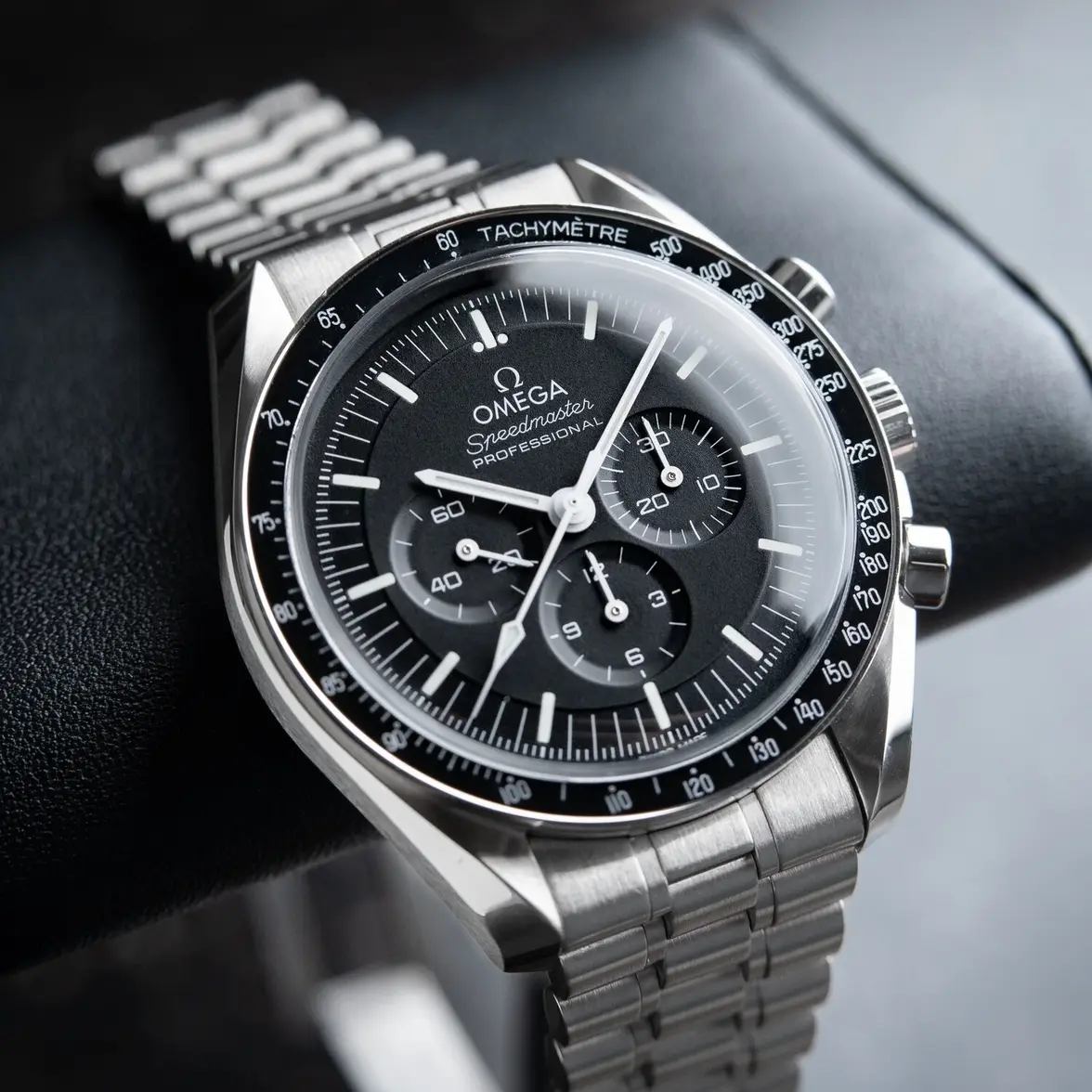
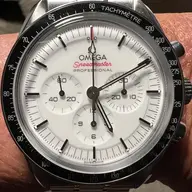
New 3861 runs in the negative

Posts
1,985
Likes
8,459
Do you use the timegrapher feature of that app, or compare to the Atomic clock function? I ask, because I would suspect an iPhone based timegrapher function is not that accurate (especially since it likely assumes a lift angle).

Best (and cheapest method) is to use time.gov. Take a photo of your watch next to the screen THEN compare times for the offset. This is more accurate than trying to judge the time offset visually by your eyes looking back and forth between the watch and the screen.
That's a good idea, I never thought of doing that. I do use time.gov to set mine. But I don't stress about the plus/minus.
 
Posts
24,237
Likes
53,973
I compare to atomic clock. Over a term of 3 weeks, it went 12 seconds behind from atomic time that I synced to when i first got the watch.
Why not try using the atomic clock to measure the timekeeping for three weeks in each of 6 positions, then come back and report. Once you know those rates, we will help you work out a system where you leave it in a "fast" position overnight to get the timekeeping absolutely perfect.
 
Posts
26
Likes
5
Why not try using the atomic clock to measure the timekeeping for three weeks in each of 6 positions, then come back and report.
I am not going to run experiments. I am using the watch the way I do and I measure its accuracy to see if it fulfills the promised specs. -0.5 daily is impressive, but this is slightly out of the promised specs.
 
Posts
9,732
Likes
54,420
OP, I’m just curious. You have mentioned that your 3861 is running at a -0.5 daily average. Assuming that your 3861 was running within the “standard” of 0 to +5, and then assuming that your daily average was anywhere between +0.6 to +5, wouldn’t that be LESS accurate than what you currently already have at -0.5? In other words, are you really concerned about ANY negative loss of time? It seems to me that your watch is very accurate.
Edited:
 
Posts
24,237
Likes
53,973
I am not going to run experiments. I am using the watch the way I do and I measure its accuracy to see if it fulfills the promised specs. -0.5 daily is impressive, but this is slightly out of the promised specs.
Have you been reading the posts at all? You asked a question, and it has been answered. Or maybe you just don't like to hear that you are wrong.

The METAS specs are for a particular way of calculating the average of 6 positions. That does not cover your particular daily use. If you want to claim that your watch is out of spec, you would need to "run an experiment." It will take a bit of concentration, but I bet you can do it.

Overall, I would seriously suggest that you consider a quartz watch.
 
Posts
26
Likes
5
I do not like loss of time.
OP, I’m just curious. You have mentioned that your 3861 is running at a -0.5 daily average. Assuming that your 3861 was running within the “standard” of 0 to +5, and then assume that your daily average was anywhere between +0.6 to +5, wouldn’t that be LESS accurate than what you currently already have at -0.5? In other words, are you really concerned about ANY negative loss of time? It seems to me that your watch is very accurate
 
Posts
26
Likes
5
Have you been reading the posts at all? You asked a question, and it has been answered. Or maybe you just don't like to hear that you are wrong.

The METAS specs are for a particular way of calculating the average of 6 positions. That does not cover your particular daily use. If you want to claim that your watch is out of spec, you would need to "run an experiment." It will take a bit of concentration, but I bet you can do it.

Overall, I would seriously suggest that you consider a quartz watch.
What is the value of reporting specs running 0 to +5 to consumers? Which suggests it is better than Rolex specs of -2 to +2.
 
Posts
3,948
Likes
11,021
You cannot expect quartz accuracy out of a mechanical watch, it just isn't going to happen. -0.5 sec/day is phenomenal time keeping on the wrist and it far outpaces the +5 on the outside of the METAS spec.

Testing your watch across positions against an atomic clock over six weeks (one week per position) is the only way you are going to be able to test your watch against the METAS spec.
 
Posts
1,477
Likes
2,999
If it continues to operate as precisely as you've apparently observed, you could set it one minute ahead and not touch it again except to wind it for months. Your watch is running great. Accept it, complain to Omega or just get rid of it.
 
Posts
5,980
Likes
28,596
You cannot expect quartz accuracy out of a mechanical watch, it just isn't going to happen. -0.5 sec/day is phenomenal time keeping on the wrist and it far outpaces the +5 on the outside of the METAS spec.

Testing your watch across positions against an atomic clock over six weeks (one week per position) is the only way you are going to be able to test your watch against the METAS spec.
I do a 24h test in every position so after 6 days already know the gain/loss.
 
Posts
29,668
Likes
76,825
What do you think resting positions that make it run a bit fast? Or maybe every watch is different
Every watch is different - you can test it to find out by fully winding the watch each day, letting it rest in a specific position, then checking the timing change. Do that 6 times to find out what each position does to the timing.
 
Posts
29,668
Likes
76,825
I am not going to run experiments. I am using the watch the way I do and I measure its accuracy to see if it fulfills the promised specs. -0.5 daily is impressive, but this is slightly out of the promised specs.
This is a common mistake noobs make, assuming that the 0-5 seconds is some sort of hard limit that the watch cannot run outside of. That is not the case at all.
 
Posts
1,414
Likes
6,605
I do not like loss of time.
There are 86,400 seconds in a day. 0.5/day x 365 and you’ve maybe lost 3 minutes in a year. A year! Yet that is still 0.00000578% accuracy. I’d still consider your watch a fabulously accurate mechanical instrument.

My 2023 Aqua Terra is METAS certified. It consistently loses 2 seconds per day. Sure, given all the ‘mine runs 0 to +2 seconds!’ chatter I see, it is a bit annoying. Yet it’s always the same so I attribute it to my wearing pattern. Indeed, all of my watches, COSC or METAS, sit between 0 to -3. Out of spec? Maybe. Am I losing sleep? Fack no.

(On the troll note: a friendly nudge to be mindful that you recently joined a community whose members are to be valued for their contributions and expertise. Many share a long history with one another on this and other forums. Put down the dukes and extend a hand. Even after my 8.5 years here, I’m a lightweight and still pay humble respect to the experts whose knowledge and experience I benefit from. Just saying.)
 
Posts
10,438
Likes
16,317
There are 86,400 seconds in a day. 0.5/day x 365 and you’ve maybe lost 3 minutes in a year. A year! Yet that is still 0.00000578% accuracy. I’d still consider your watch a fabulously accurate mechanical instrument.

My 2023 Aqua Terra is METAS certified. It consistently loses 2 seconds per day. Sure, given all the ‘mine runs 0 to +2 seconds!’ chatter I see, it is a bit annoying. Yet it’s always the same so I attribute it to my wearing pattern. Indeed, all of my watches, COSC or METAS, sit between 0 to -3. Out of spec? Maybe. Am I losing sleep? Fack no.

(On the troll note: a friendly nudge to be mindful that you recently joined a community whose members are to be valued for their contributions and expertise. Many share a long history with one another on this and other forums. Put down the dukes and extend a hand. Even after my 8.5 years here, I’m a lightweight and still pay humble respect to the experts whose knowledge and experience I benefit from. Just saying.)
I'll go further. Umar, you are new. Read the room, try not to come across as a dick.
 
Posts
2,702
Likes
3,599
To be fair, I was where the OP was 25 years ago when I bought my first chronometer-certified Omega Seamaster brand new from an AD. I obsessively timed it, and worried when it was just out of spec. I even had the AD’s watchmaker (who was certified for Omega warranty work back then) regulate it several times under warranty to try to get it “just right.”

I’m sure many of us have similar stories from our journey. We’ve all moved past it, but it’s good to remember where we started.
 
Posts
4,810
Likes
12,179
I am not going to run experiments. I am using the watch the way I do and I measure its accuracy to see if it fulfills the promised specs. -0.5 daily is impressive, but this is slightly out of the promised specs.
The promised specs are under experimental conditions, so you can't conclude that it is out of the promised specs unless you run the experiment.
 
Posts
13,192
Likes
22,933
What do you think resting positions that make it run a bit fast? Or maybe every watch is different
I think dial down and crown down are the fastest positions.

Suggest you re-read some of the answers here though as it answers your concerns. As far as I’m aware Rolex’s -2 to +2 is subject to the same
 
Posts
29,668
Likes
76,825
I think dial down and crown down are the fastest positions.

Suggest you re-read some of the answers here though as it answers your concerns. As far as I’m aware Rolex’s -2 to +2 is subject to the same
There is no universal answer to what positions run fastest - the only way to tell for sure is to test it.

Yes, Rolex specs are the same, as are every other watch brand's specs.