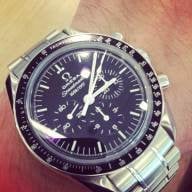
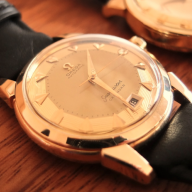
Do you guys think the time will ever come when it would be worth reproducing some of the out of stock parts that commonly wear on say a Cal 321 to keep them running? With CNC technology it should be possible to make exact replica parts and once set up correctly it's possible to make any amount of them. I have a friend who is an engineer with his own workshop who races vintage bikes including a few Manx Nortons and he makes most of what he needs that can't be bought anymore in his spare time. Just a crazy thought
😁
Not quite as easy as you make it sound...not picking on you but I see this sort of thought put out on forums occasionally, and it really isn't all that practical, so if you will allow me to expand on this idea for a few minutes...
Some parts could easily be reproduced using CNC (you don't say if he has a CNC lathe, mill, or both). Some parts would be much more difficult to reproduce using CNC machines, and some impossible (for example a balance spring).
Also, working on the scale of watches is a bit different than working on the scale of normal engines, etc. For example cutting gear teeth for train wheels - the size of the cutters needed are not what you find in gears in the transmission of a car for example. Now you can make cutters using your CNC, machinery, but still you have to know the correct tooth forms.
One other thing with say a simple train wheel - although if I buy a new one is it considered one part, it's actually an assembly of two parts. Here is an example - this photo is of the automatic winding system from a Cal. 552.

You can see 4 gears or wheels there. The two very small ones would be relatively easy to reproduce if you had the right tools, because they are one piece, made of steel, etc.
The 2 larger gears are a little bit more complicated - the one on the right, which is under the one on the left, is a typical wheel with a steel pinion and brass wheel staked to it, so 2 pieces are needed to make this wheel. This is what most train wheels look like, and they are quite simple compared to others parts, like that wheel on the left that looks "solid". That wheel is the winding wheel, or what today would be called a reversing wheel. It is a complex assembly of parts that looks simple, but really isn't.
Here is a photo of that wheel (or one like it) disassembled:

As you can see it is made of several small parts. So let's look at what it would take to make this part:
1 - You would need one as an example (one that is not worn out ideally), measurements would have to be taken and drawing with tolerances generated for each of the 7 parts in this wheel.
2 - To do the above, you need a full understanding of how the part works, and what the limitations of each part would be in terms of tolerances.
3 - You would have to identify the materials used with some degree of accuracy - this seems simple, but there are many types of steel and brass available, and choosing the wrong type could affect the function and lifespan of your reproduced part. In addition, you would have to determine if any post processing is needed such as thermal treatment - hardening of the steel parts for example, which I can tell you has been done on these pieces.
4 - Generate code for the CNC machine from your drawing/3D model, or do it the old fashioned way that I learned using G-codes.
5 - Make the part and try a trial fit, adjust from there, maybe run one in a watch for a year to see if it actually performs and holds up.
This is just for one single part of one watch....
Now try to make this reversing wheel:

Can you get the jewels from someone, or are you going to make those too? Okay this one is a modern one and readily available, so it's maybe an unfair example, but I think the point is that there is a lot more to some of these parts than meets the eye.
Even a simple part like a winding pinion has a lot going on:

It has complex teeth on the face and more teeth on the diameter. Also this thing is maybe 3 mm in diameter total. Your average machine shop is not equipped to make parts at this scale.
Or how about this chronograph runner with vertical clutch:

There is a lot going on here in this single part...
Now just before you say I'm stacking the deck with parts that are from automatic watches, here is a part from the Cal. 321 you mentioned in your post - this is the main chronograph runner that the chronograph seconds hand mounts to:


Once again it is an assembly, made up of the main post or shaft, the large wheel (when I say large it's 6 mm in diameter, and as you can maybe see has very fine teeth on it), the dart or finger that trips the minute counter, the cam, and then the screw holding the cam on, so 5 individual parts.
I know from my former life as a project engineer, and have worked with some very talented machinists, tool and die makers, EDM people, etc. over the years - even the simple parts are not something you can get done without specialized machinery.
There has been a lot of talk on some forums about 3D printing, but as you can for complex assemblies, that also has some serious limitations.
Not saying it can't be done, but the money invested to make one part would be huge, and may well exceed the value of the watch you are making it for - machine shop time is expensive.
Anyway, not to be the doom and gloom guy, but just showing the realities of doing this.
Cheers, Al