
- Posts
- 2,827
- Likes
- 4,722
dennisthemenace
·Oh dear, a newb arguing with Al.
Please consider donating to help offset our high running costs.
Oh dear, a newb arguing with Al.

I’m not arguing with anyone, those are the official Omega tolerances (0-14 seconds). It’s on the paperwork and Omega website. He says it’s 12 seconds, and after proven otherwise, called it an “internal” tolerance (i.e., an undisclosed tolerance).
If anything, it’s him against Omega.
The tolerances I'm referring to are in Omega Work Instruction 28. In there is lists the Delta at full wind over 6 positions must be 12 seconds max. for this movement. This is a document for Omega service centers and Omega certified watchmakers (like me).
It's not unusual at all for companies to have tighter internal
The tolerances I'm referring to are in Omega Work Instruction 28. In there is lists the Delta at full wind over 6 positions must be 12 seconds max. for this movement. This is a document for Omega service centers and Omega certified watchmakers (like me).
It's not unusual at all for companies to have tighter internal tolerances than whatever the certification system is that they use. Omega has been that way for decades. When COSC required average daily rates fall between -4 and +6 seconds per day, Omega's tolerance was from -1 to +6, so a tighter range.
Are we discussing two different issues? The first issue being the synchronization of the minute hand and the hour hand. If the hands are not correctly synchronized the minute hand reads fast, or slow, when the hour hand shows the correct time. If the hands are correctly synchronized, the minute and hour hand will line up perfectly at noon or 12 midnight. The second issue is accuracy. For example, my 300M was reset on March 21 to accommodate daylight savings. I haven't reset it since, and it is running 40 seconds fast. Remarkable in my view. Moreover, the second and minute hand both are exactly together at noon and 12 midnight. In conclusion, a watch can be synchronized but not accurate or accurate but not synchronized. With the price of our watches we should have both.
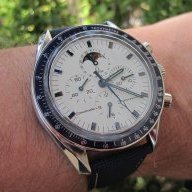
You can always box it up and send it to a service center yourself and ask them to readjust the hands. Unless the misalignment is obvious during normal time reading, and it's not in this case, I would leave it. I've collected long enough to realize, and accept, that none of these hand assembled gizmos are ever perfect. You can always find something NQR (not quite right).

I would just have it fixed at the next service. You can still tell the time with it. Based on the the small complaints that get aired on the forum, it's pretty clear that these are mass-produced commodity items, and expectations may need to be adjusted.
Update: I took the watch to the Omega Service Center and was told that the misalignment is within their tolerance. The watchmaker there said it’s simply slight gear slack and a non-issue. Not sure what to make of this information, but I’m definitely not satisfied.
Moral of the story: add “hands alignment” to the long checklist of common QC issues when buying a modern Omega watch.
What part of "within tolerance" don't you understand?
The Omega certified watchmaker told me misalignments of a few minutes are common on Omegas, and gear slack make it impossible to get a perfect alignment.
Well, that’s nonsense. Likely just not interested in opening it up for a potentially “picky” customer.

More like a “never again” customer. Last modern Omega I’ll ever buy. I’ll stick to vintage, and other brands where they either get it right, or make it right (through customer service).
Also, this is not the first QC issue with the watch. I may start another thread with the other issues I’ve encountered with this same piece. Thanks.


