Longines Case Numbers: An Introduction

Posts
1,439
Likes
4,191
Is the number you called the "iteration number" the one sometimes stamped on the back of a lug?

The individual number is often stamped below the order number on the generation of watches after serial numbers on cases is discontinued.

The numbers on the lugs is not used until removable casebacks are used on later watches. And I believe they are also the individual number.

The individual number is the unique number assigned to the watch for an order.
 
Posts
2,820
Likes
4,923
Is the number you called the "iteration number" the one sometimes stamped on the back of a lug?
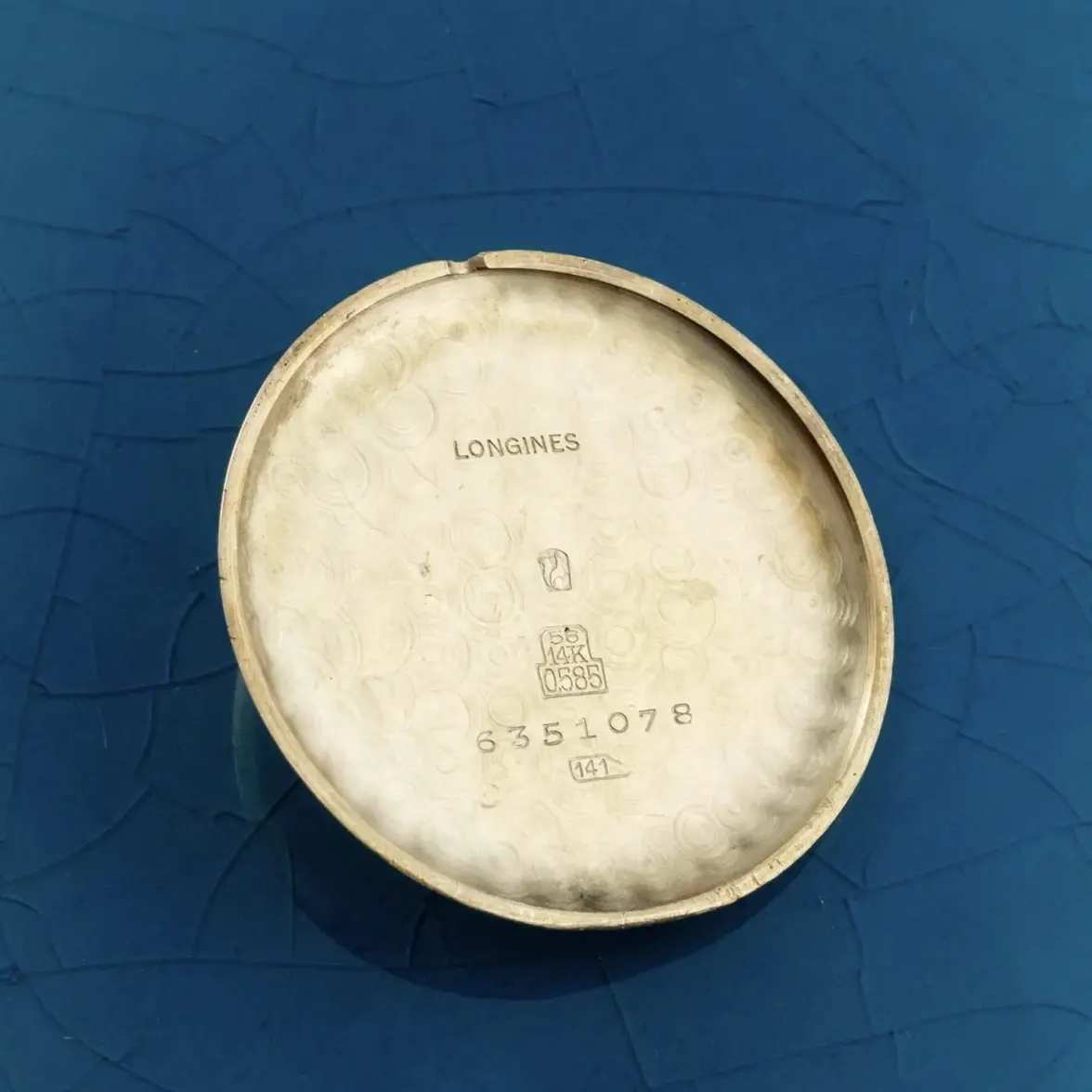
No. As far as I know, the numbers that appear on lugs are individual numbers within an order or iteration. Below are two examples. I added labels for clarity.

Source: https://www.marcelswatch.com/en/product/vintage-longines-6242-sei-tacche-1951/

SAM23242.jpg
SAM23382.jpg
MARCELS-MALL2-10.jpg

Source: https://www.ebay.com/itm/1344317539...b&brand=Longines&_trksid=p2047675.c101224.m-1
 
This website may earn commission from Ebay sales.
Posts
24,230
Likes
53,961
This website may earn commission from Ebay sales.
Posts
3
Likes
0
@DirtyDozen12 thank you so much for the info. I have a question, is it the case serial number always should match the movement serial number? See below example:

This is the same watch, but case back “serial number” doesn’t match movement serial number. Is this concern for watch’s originality? Thanks.

 
Posts
209
Likes
837
@DirtyDozen12 thank you so much for the info. I have a question, is it the case serial number always should match the movement serial number? See below example:

This is the same watch, but case back “serial number” doesn’t match movement serial number. Is this concern for watch’s originality? Thanks.


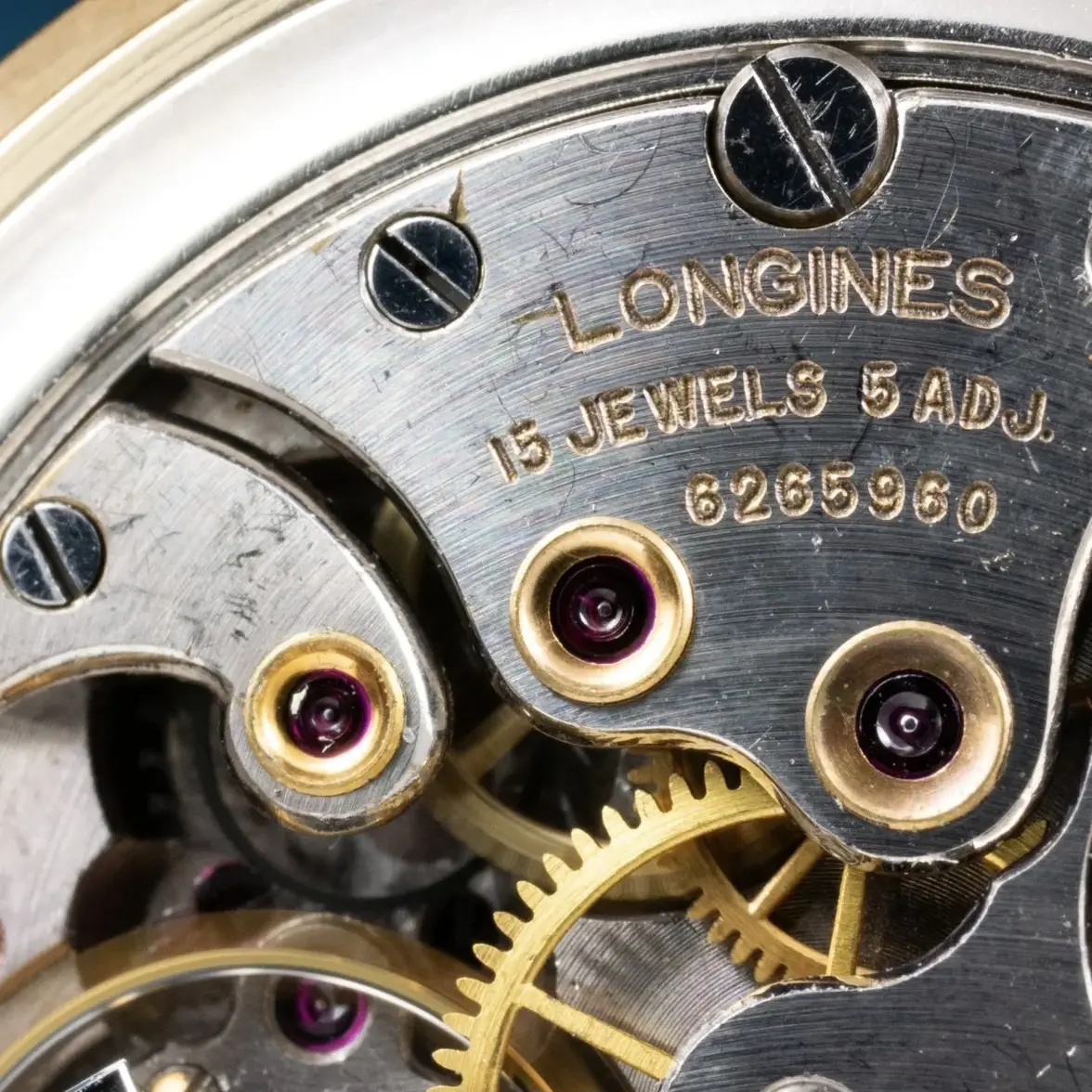
In this case, yes, this is a red flag. For later watches with order numbers on inner casebacks, they will differ. The length here clearly points to this being a serial, vs. an order number, which should match the movement.

Juergen
 
Posts
4
Likes
1
Thanks, I misunderstood what you meant by iteration number. 👍
Hi this is exactly what i am looking for.

I understand what the four digit reference number means in he case back.

I dont understand what iteration number indicates. For example the 4 in your picture. mine says 2.

Does the individual number has anything to do with how many were produced of that reference or its an unrelated number?

I am looking for information to determine how many were produced of a watch that is why i am asking all this. 99% its a one year only so would be neat to know how many were actually made.

Any help is apprechiated.

Thank you.
 
Posts
225
Likes
284
Hi this is exactly what i am looking for.

I understand what the four digit reference number means in he case back.

I dont understand what iteration number indicates. For example the 4 in your picture. mine says 2.

Does the individual number has anything to do with how many were produced of that reference or its an unrelated number?

I am looking for information to determine how many were produced of a watch that is why i am asking all this. 99% its a one year only so would be neat to know how many were actually made.

Any help is apprechiated.

Thank you.
This is something I would like to understand too, although my own focus is on late 1960s / early 1970s watches.

The case references on the insides of the casebacks always seem to be followed by a single digit iteration number in this period. There does seem to be some temporal sequentiality to it, i.e. the later a watch of a particular reference was made, the higher the number, but this doesn't always seem to be consistent (but maybe apparent inconsistencies are just due to swapped casebacks?).

I have seen nothing to suggest that there are any physical differences between cases with the same case references but different iteration numbers (except perhaps the addition of engraved designs on the back, with these being missing in most examples of iteration 1, but this could simply be coincidence of design change with iteration number progression).


Therefore I think your idea of the iteration number tracking how many examples of a particular reference were made is not a bad one. As the serial number is not specific to case reference, you can't use that to know how many watches of a given reference were produced in a given period. So it would make sense to have a case-reference-specific "counter".

But even assuming this is true, how many watches would be represented by a single digit change of iteration number? And would this figure be consistent across different references?
 
Posts
225
Likes
284
At the risk of bifurcating the discussion, another puzzle I'm interested in is why there were so many changes in case numbers in the early 1970s. It seems that many cases that appear superficially identical have completely different case reference numbers in 1969 and in 1971.

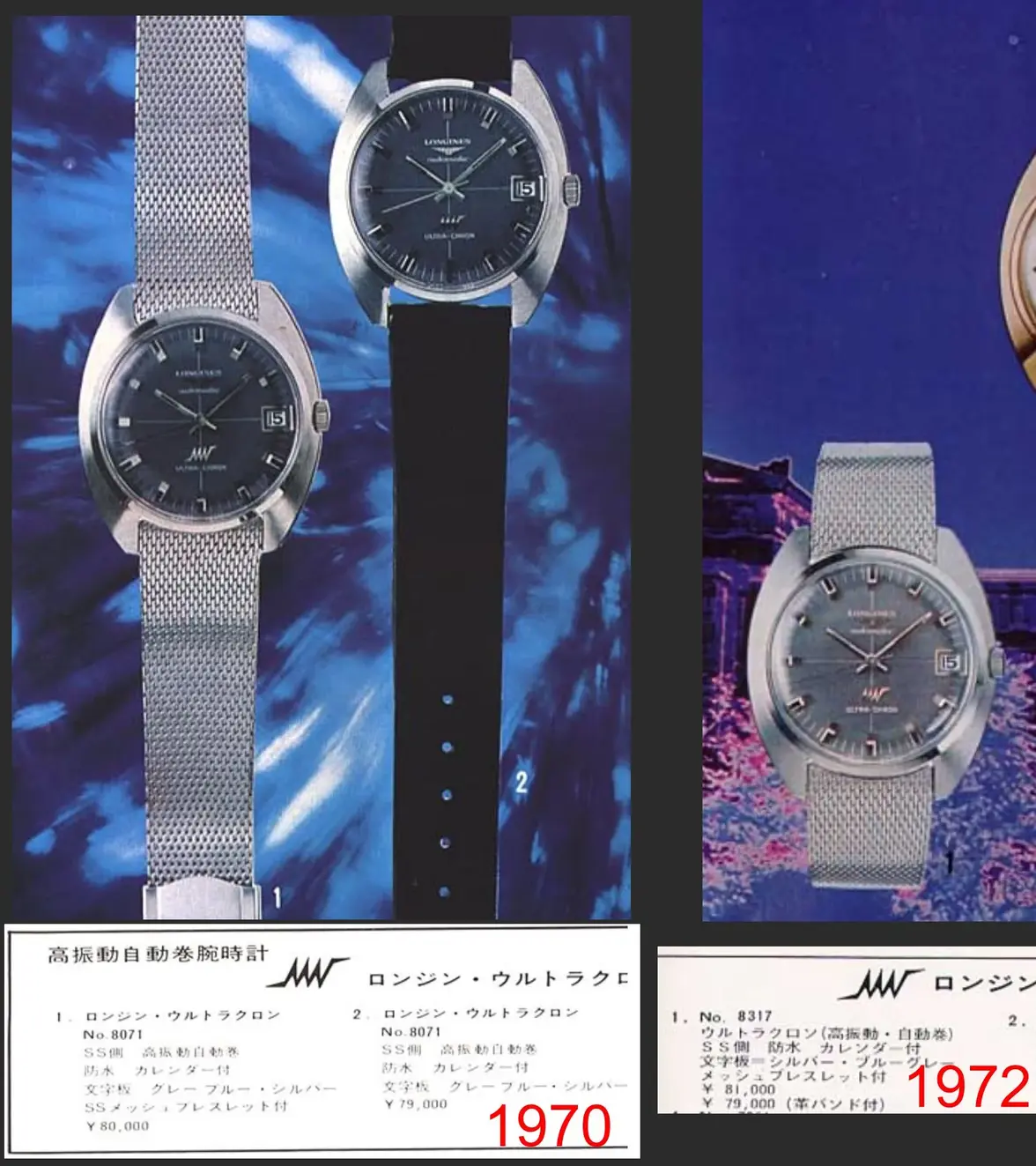
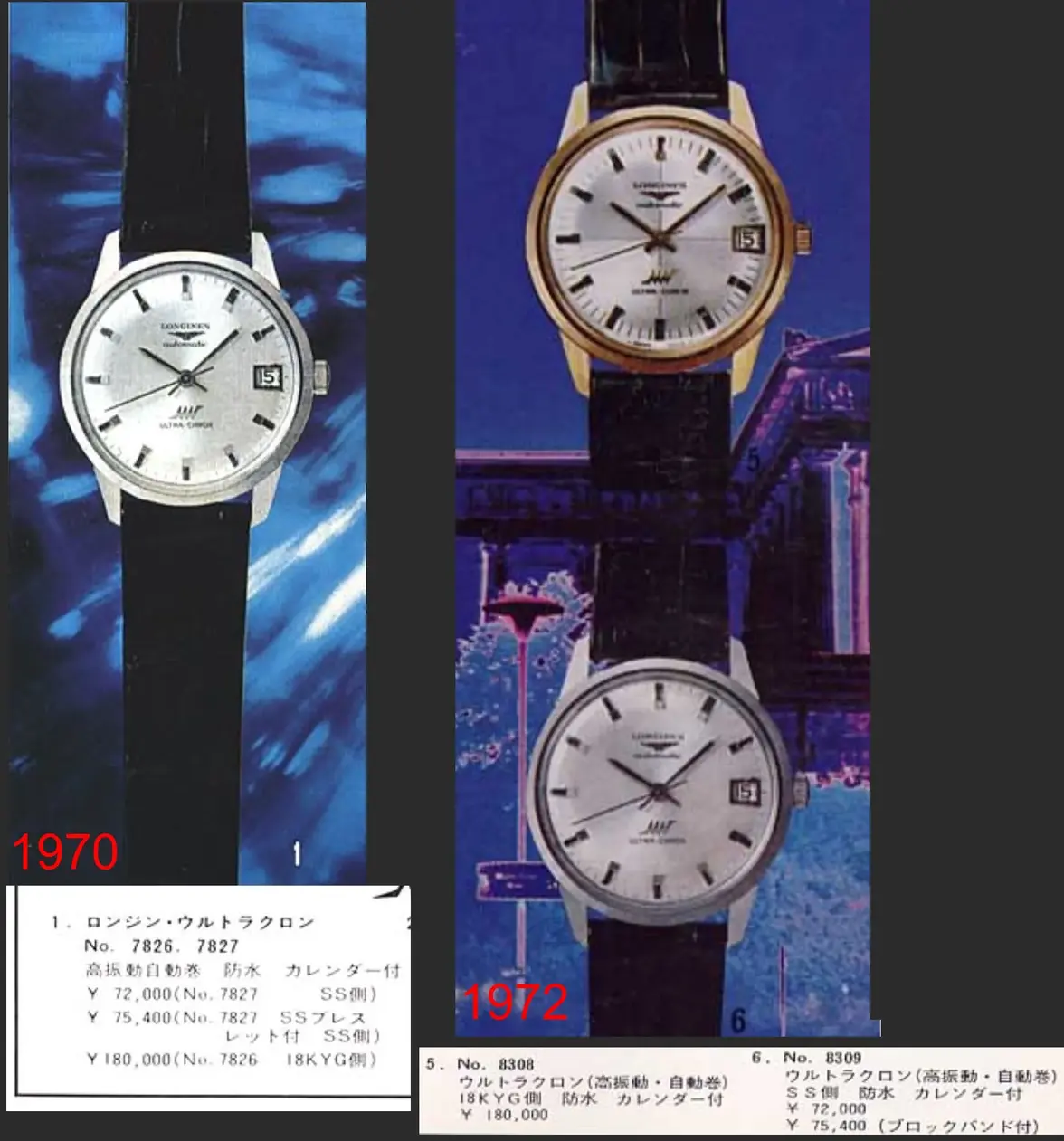
You can easily see what I mean if you compare the Japanese calaogues from 1970 and 1972, e.g.:

1970
http://nakahiro.parfait.ne.jp/catarog1970/moji/longines1970.html
1972
http://nakahiro.parfait.ne.jp/catarog/moji/longines2.html

It's almost as if they decided to ditch most of the reference numbers and assign new ones for no obvious reason. As a result, there is considerable confusion when people are trying to find the reference for a particular watch and haven't actually opened it to look at the case number.

For example, the steel c-case watch that has the reference 8071 in the 1970 catalogue seems to be the same as the one in the 1972 catalogue that has the reference 8317:


Another example is particularly relevant at the moment, because it's the vintage model on which the design of the recent Ultra-Chron Classic re-issue was based. This case design seems to have been one of the first Ultra-Chrons released in 1967, when it had the reference 7827 (for the steel version) and 7826 (18K). Then in the 1972 catalogue, apparently the same cases are now 8309 and 8308.

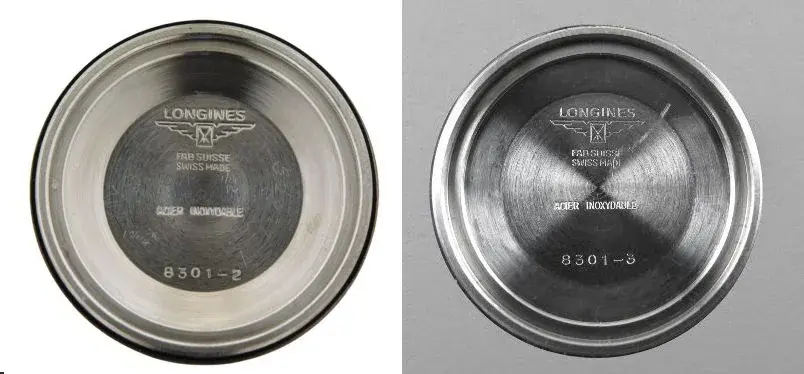
I'm very aware that minor changes to a case's design can often result in it being assigned a new case reference number. In my blog on the Ultra-Chron "jumbo" models I identified the switch from the case references 7950, 7951 and 7952 to the references 8348, 8301 and 8302 with a significant change in the style of the caseback:

https://www.moonagewatches.com/post...ls-part-2-case-variants-and-reference-numbers

But for most of these case reference changes there is no obvious change in the physical design, and the fact that they all seem to happen at the same time (1970 or 1971) suggests that there's another explanation. Unless perhaps there was a universal minor change made to all or most cases around this time that's difficult to see, e.g. in the type of steel they were made of, or the method of manufacturing...?

The upshot of all of this is that if you are interested in Longines models that were produced throughout the late 1960s and early 1970s, more often than not each identifiable model has two different reference numbers, one for examples made before (and during?) 1970 and one for those made after 1970. But why...?
 
Posts
2,820
Likes
4,923
But for most of these case reference changes there is no obvious change in the physical design, and the fact that they all seem to happen at the same time (1970 or 1971) suggests that there's another explanation.
Interesting observation. I wonder if it could be related to the movement? According to "At the Heart of an Industrial Vocation" (Patrick Linder, 2007), Longines came out with the caliber 430 in 1967. They then came out with a revised version, the caliber 6641, in 1972. Such a change seems consistent with the dates of the catalog images you showed above. I wonder if you have seen examples of references 8308, 8309, or 8317 with caliber 43x?

EDIT: P.S. My theory seems to be incorrect as I quickly found multiple examples of ref. 8317 with cal. 431.
Edited:
 
Posts
225
Likes
284
According to "At the Heart of an Industrial Vocation" (Patrick Linder, 2007)
Incidentally, I'd love to find a copy (or a scan) of that book. Appears to be out of print and not currently available 2nd hand anywhere.
 
Posts
225
Likes
284
Interesting observation. I wonder if it could be related to the movement? According to "At the Heart of an Industrial Vocation" (Patrick Linder, 2007), Longines came out with the caliber 430 in 1967. They then came out with a revised version, the caliber 6641, in 1972. Such a change seems consistent with the dates of the catalog images you showed above. I wonder if you have seen examples of references 8308, 8309, or 8317 with caliber 43x?

EDIT: P.S. My theory seems to be incorrect as I quickly found multiple examples of ref. 8317 with cal. 431.
That's weird, my initial reply to your reply seems to have vanished!

I was just saying that yes, the shift from the 431 to the lower beat movement seems to have happened the best part of a couple of years after the shift in the case back numbers, which I get the impresison might have happened in 1971 or even late 1970.

I had wondered if it might have had something to do with the move to put serial numbers on casebacks, but the timing isn't right for that either as it happened in 1969.