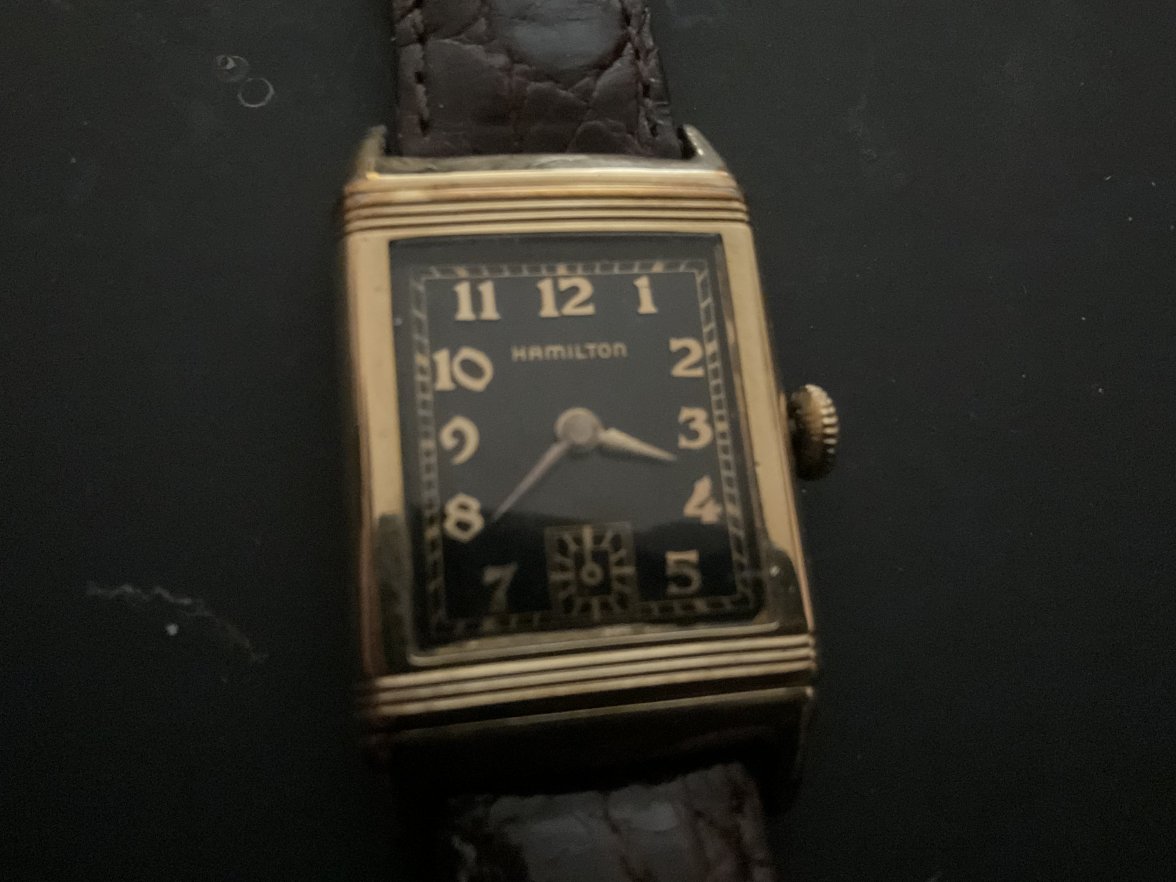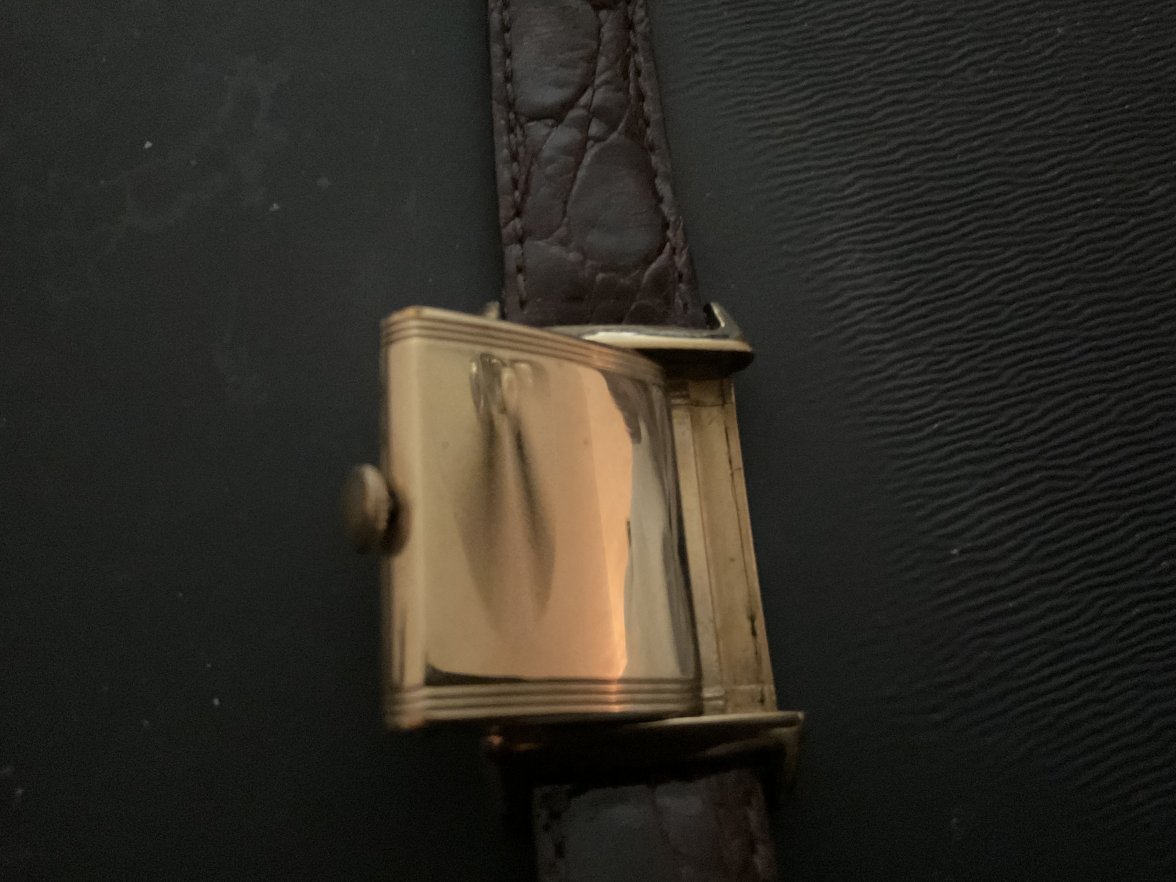
Longines 1939 14K reference 4100 curved/curvex “drivers watch”

Posts
1,145
Likes
5,651
Would you agree that I shouldn’t touch the dial?

I think everyone that has responded to this thread would agree, including me.

Thank you for sharing this watct, it`s very interesting👍
 
Posts
16
Likes
20

  • Radiumpasdion
  • Blue Hands
  • Modest Proposal
    DD12:
  • Syrte
  • Thanks to you and all…terrific to come from afar and to be welcomed to this terrific group.
    A am thankful that with all that have shared and contributed with an amazing amount of knowledge
    and thought. It is very kind that all have greeted me such goodwill. Again Thanks.
    My last thought….
    Would you agree that I shouldn’t touch the dial
Edited:
 
Posts
7,689
Likes
22,049
@Radiumpassion has already responded what everyone would respond regarding the dial. It is beautiful and if you touch it you will destroy the beauty and value of the watch.
 
Posts
16
Likes
20
@Radiumpassion has already responded what everyone would respond regarding the dial. It is beautiful and if you touch it you will destroy the beauty and value of the watch.
 
Posts
13,629
Likes
18,979
I came across a ‘Gold Mine’…..Pateck watch company seems to be the originator of this style watch and maybe Longines was just testing a copy of the Pateck watch.
Then as now, the watch business was a very “copycat” enterprise. One reason for this is that there were relatively few families involved in the upper eschelons of watchmaking, especially in Switzerland, and members of these families were scattered throughout many Swiss companies.

What tended to happen is that some smart person invented a new innovation (whether working for a company or not), patented the new design, and licensed it to watch companies and/or watch case manufacturers. Sometimes the inventors were individuals or smaller watch companies who sold or licensed these patents to larger companies. The Reverso is a good example of this. I believe these angled watch cases also came about using this model.

You also need to remember that in those days watch companies generally did not manufacture their own watch cases. Even Patek did not make their own cases. They were contract manufactured by many specialty companies.

So the way to research who “invented” or was the first to manufacture these angled watch cases would be to research Swiss or American patent records, not by looking at auction results.

The Patek Philippe watches you cited seemed to have been produced in the late 1930’s at the same time as the others.
gatorcpa
 
Posts
2,829
Likes
4,945
Would you agree that I shouldn’t touch the dial?
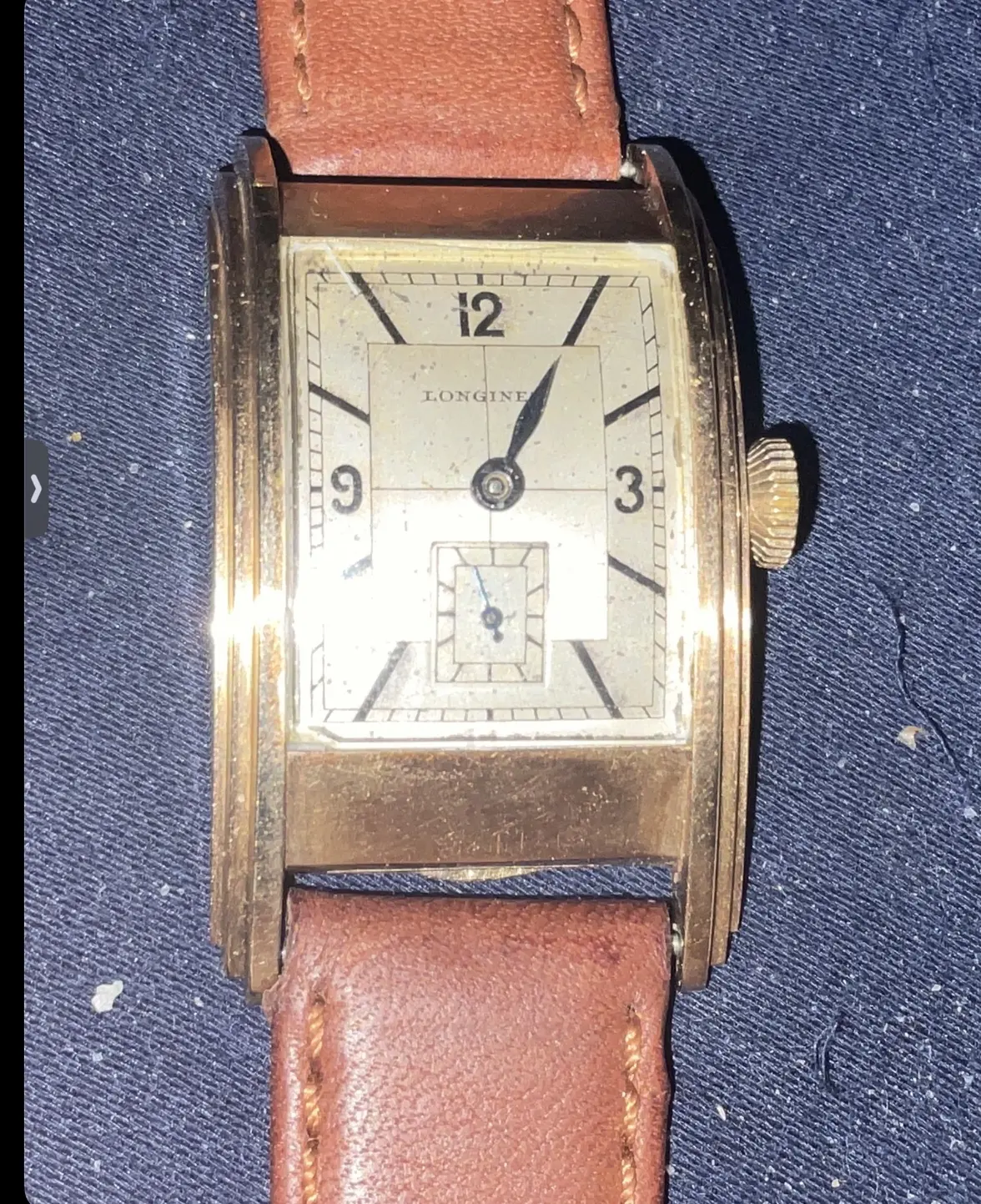
Yes! Longines dials of this type (yours was made by Stern Freres) used an organic varnish that was very prone to deterioration from moisture. The dial in your watch is actually in pretty good condition. Attempting to clean the dial is a large risk that could significantly impact the appearance and value. I would strongly advise you to not touch the dial.
 
Posts
322
Likes
858
+1. Sorry, I cannot post a photo of the ref. 4100 from Goldberger's book because of the copyrights.
If you want to sell it leave it as it is. The dial looks beautiful so.👍
 
Posts
16
Likes
20
Then as now, the watch business was a very “copycat” enterprise. One reason for this is that there were relatively few families involved in the upper eschelons of watchmaking, especially in Switzerland, and members of these families were scattered throughout many Swiss companies.

What tended to happen is that some smart person invented a new innovation (whether working for a company or not), patented the new design, and licensed it to watch companies and/or watch case manufacturers. Sometimes the inventors were individuals or smaller watch companies who sold or licensed these patents to larger companies. The Reverso is a good example of this. I believe these angled watch cases also came about using this model.

You also need to remember that in those days watch companies generally did not manufacture their own watch cases. Even Patek did not make their own cases. They were contract manufactured by many specialty companies.

So the way to research who “invented” or was the first to manufacture these angled watch cases would be to research Swiss or American patent records, not by looking at auction results.

The Patek Philippe watches you cited seemed to have been produced in the late 1930’s at the same time as the others.
gatorcpa

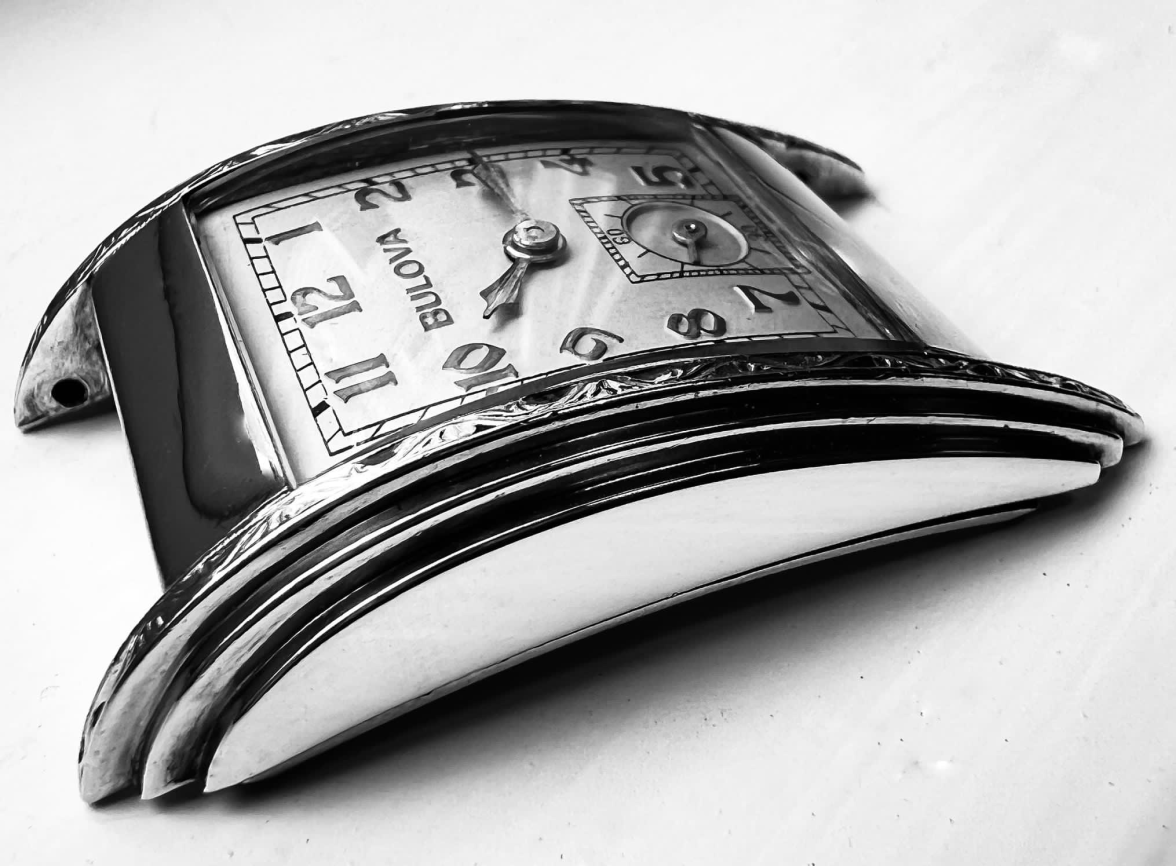
Your absolutely on point. And will be very difficult to establish who designed the original curved watch in this discussion.
The whole industry was rampant with in the 1920’& 1930’ of small and established watch companies requested, or purchased the use another’s patent, design and movements. And sometimes just never asked.

Gatorcpa, your story of the Hamilton ‘Otis’ (1938-1940) one of the more colorful & unique stories in the industry..
And how for decades the established story was of ‘Hamilton’ stealing or just arguing that their design of the Flip/reverse Watch was theirs to be manufactured.
The truth as we found out that Jaeger LeCoultre never sued Hamilton and until recently it was established that Jaeger actually sold the right & license for the Otis to be manufactured for $.60 cents a case. All the work on this story is due to the hard work of Mark Cardelucci at www.vintagehamilton.com

My Otis, one of my first or second watch I purchased.in the late 1960’s!.
Edited:
 
Posts
16
Likes
20
IMPORTANT UPDATE Hi everyone,
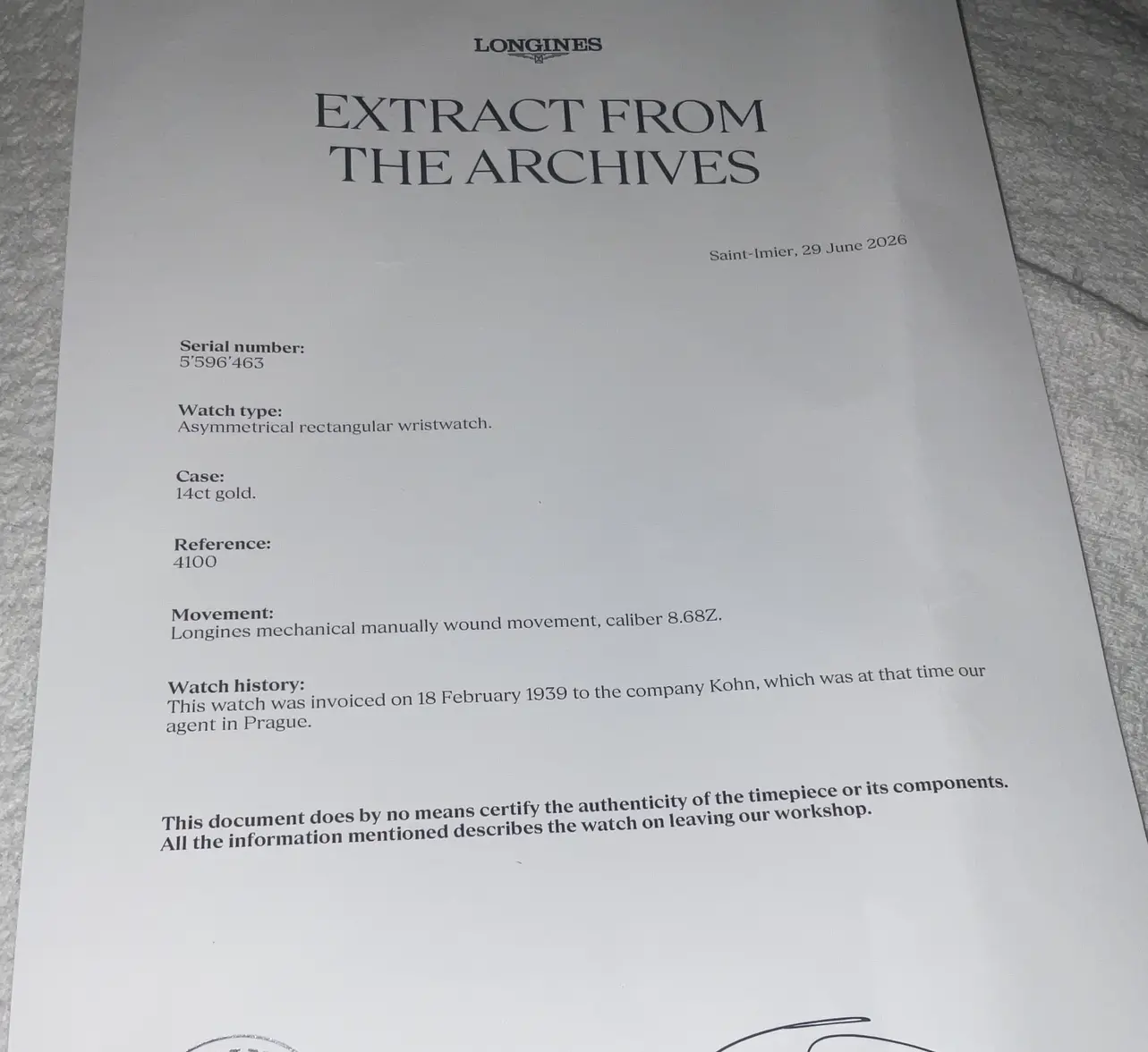
Just wanted to close the loop on this watch and provide a final update for the archive record. I followed through and ordered the official Extract from the Archives directly from the Longines Heritage department in Switzerland.
Attached are the photos of the official extract—fresh out of its plastic sleeve—along with the factory invoice from the Swatch Group for the 120 CHF archival fee. As you can see, serial number 5'596'463 is officially confirmed as a genuine 14ct gold reference 4100 manually wound caliber 8.68Z, invoiced on February 18, 1939, to Kohn in Prague.
Beyond confirming the technical specifications and the case architecture, receiving this extract uncovered the profound and incredibly sobering history this watch carries.
The exact invoice date—February 18, 1939—places this piece at the literal precipice of one of the darkest chapters in European history. Longines shipped this luxury asymmetrical driver's watch to the Kohn firm in Prague during the final weeks of peace. Merely 25 days later, on March 15, 1939, Nazi Germany invaded Czechoslovakia and occupied Prague.
The Kohn family name is deeply tied to Prague's Jewish community. Immediately following the occupation, Jewish-owned businesses, jewelers, and assets across the city were systematically targeted, confiscated, or forced into liquidation under the regime's 'Aryanization' policies. The families themselves faced catastrophic displacement and deportation.
Because this solid gold watch arrived just three weeks before the borders completely closed, it likely became a piece of displaced history—a highly valuable, easily transportable asset that somehow managed to survive the collapse of pre-war Prague. It stands not just as a rare timepiece, but as a silent, tangible witness to the lives and culture upended in the spring of 1939.
Thanks to everyone here who chimed in on this piece when I first brought it to the forum. It's an honor to share both its verified authenticity and its incredible, haunting historical journey with you all.
 
Posts
7,689
Likes
22,049
Thank you for the update and for this poignant reminder that sometimes watches can bear witness to human lives.

And you should really get that minute hand re-attached, it would be a pity for that watch to have survived so much and lose a critical component.