- Posts
- 136
- Likes
- 116
tjs1295
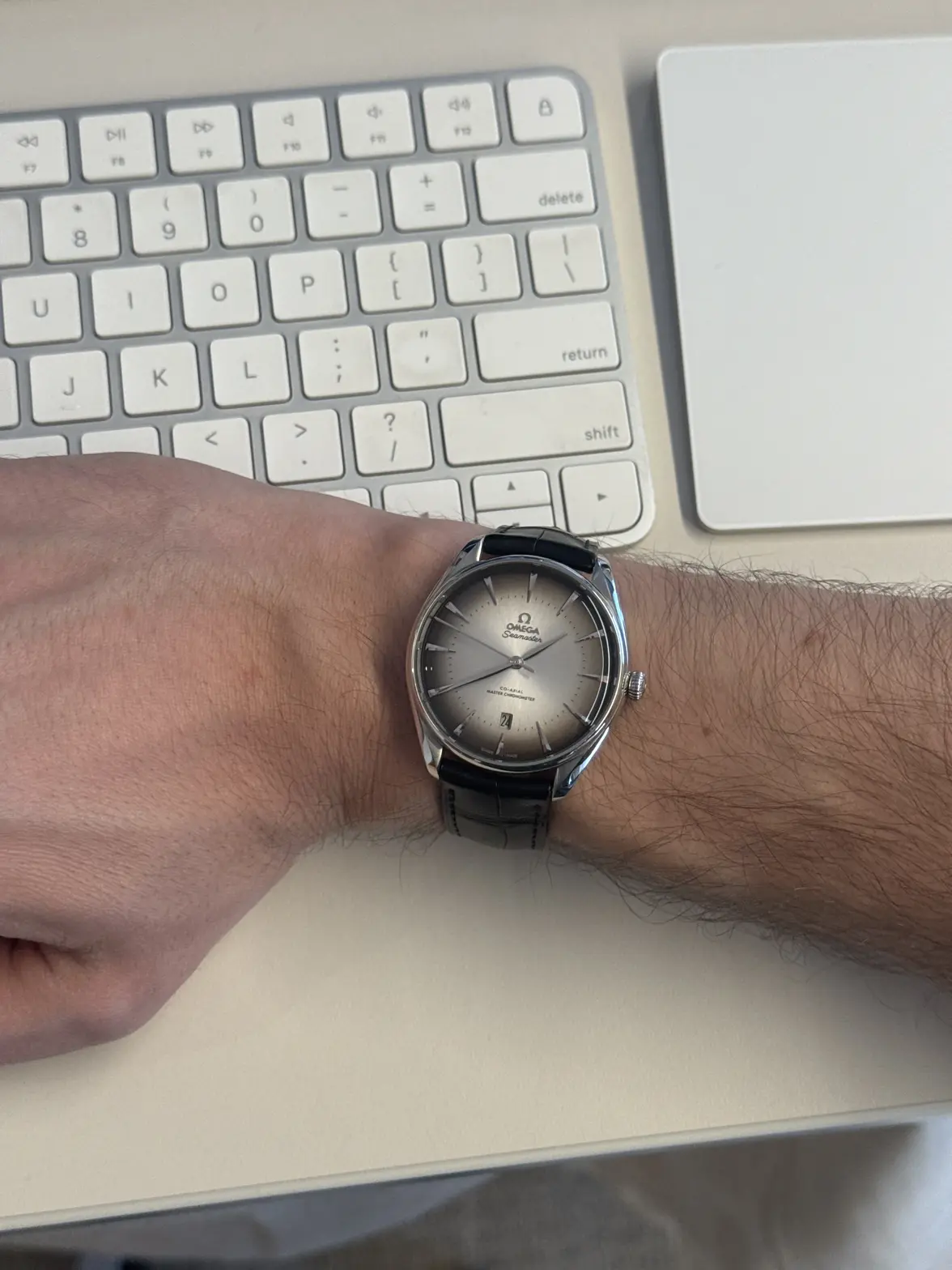
·Omega consistently uses domed crystals, but despite this I have found that my heritage seamaster wears almost identically to a comparable 6 digit sub in thickness. .
Please consider donating to help offset our high running costs.
Omega consistently uses domed crystals, but despite this I have found that my heritage seamaster wears almost identically to a comparable 6 digit sub in thickness. .

No, but neither can any other 39mm watch with a visible crown...


New to me slang. I like it, very distinctive. AI said young white men in track suits but I picture old white men with gray haired chests and gold chains in track suits.
I'm surprised you think modern Omega is the choice of chav. Not to be argumentative, but I thought it just the opposite, that Omega would appeal to more cerebral watch fans. Could just be it's different around the world. I think of Rolex as being the go-to chav watch, especially the Daytona and gold day- date, although these are more likely to be replicas due to the expense.

At what point does case shape and excessive size become a lie?
My point being, modern Omega is chasing that segment
There can be chavs with spendable funds - it includes the lower-middle classes with a minor clerical or other bullshit job and a lot of debt. It's mainly a class thing though - for instance David Beckham is an archetypal chav

In my limited time in the UK (mainly Oxford and London), I saw young men mostly wearing Rolexes.
Anyways, here’s a recent Omega I like a lot better than JLC’s ultra thins (although I would take the gold with blue dial and moonphase and any of the copper dials over this). Not the thinnest, but great wearing experience and design.
Case in point then, he mostly wears Rolexes or Tudors (and is apparently a Tudor brand ambassador!). By your own example, Rolex is indeed the Chav watch.

While we generally agree on many things throughout this thread, I cannot agree with this statement. The human eye is capable of distinguishing objects down to almost 0.02 mm. People can determine if a painting or picture is 1/32" off level (about 0.8mm), and generally, our ability to perceive these differences becomes sharper the smaller the object is, while the larger the object, the more difficult it is to tell what difference these minute measurements make, especially as measurements relate to one another. Obviously the other factor is distance. We can discern individual human hairs (around 0.04 to 0.1mm thick), but the further away we are the more difficult this becomes.
Especially in regards to a 0.5 mm difference as how impacts the bezel or dial diameter or the relationship between the two, we can absolutely perceive that difference clearly (even if we can't quantify it very well).
As always, it's going to matter where and how these differences are. In terms of thickness 0.5 mm in the crystal is probably going to be more difficult to perceive than 0.5 mm in the mid case. 0.5mm in the case back is also going to be a lot more noticeable because it's likely going to translate to a larger spacing between the bracelet end links and our wrist.
I do agree that some of the measurement concerns are exaggerated, but we can perceive those differences.
(Edited to add: a great example of how we perceive the relationship between very small measurements is the human eye itself. The iris has a relatively fixed outer diameter of roughly 12mm, and the pupil has a general "normal" average diameter of 4mm. As the muscles in the iris contract to control the size of the pupil, the pupil changes from between 2 to 8 mm in diameter, and as this happens the iris appears to be much larger, or much smaller. This isn't that much different than the ratio between a dial and bezel. we can perceive minute changes in someone else's eyes, and in fact because the measurements of the system are so small, it is typically quite noticeable when someone's pupil has changed.)

It’s a weird logic, but I think that for a lot of people, there’s no judging Omega irrespective of Rolex—meaning their negative assessment of the former only makes sense in relation to their assessment of the latter, even if they don’t explain that, or even fully comprehend it themselves.
I’d imagine it goes something like this: Rolex is overpriced and overhyped, and people resent all the waitlisting and game-playing that brand does, but at least their watches walk the walk on the resale market, holding value and liquidating easily. Omega is the brand that’s supposed to be comparable in quality but more approachable and sensibly priced—and since they pretty much suck on the secondary market, one can even get a discount from the AD. It’s a refuge from Rolex without having to make too many compromises.
Once you start seeing Omega, then, hiking their prices to the point where it just starts to make more sense to wait for a Rolex—and once they too start making customers wait forever for desirable new releases—that distinction goes away and not to Omega’s advantage.
I could be wrong, but I’m guessing that’s the reasoning behind much of the negativity. (To be clear, I’m not endorsing this. I do think Omega’s pricing is ludicrous now, but I’m quite happy to let other people take that hit and then buy their heavily discounted remorse-purchases on the resale market.)
I couldn't care less what YouTubers think. But it's the price increases that are putting me off. I know, tariffs, but my white speedy is 1000 more than it was when I got it June 2024, and the new reverse panda is 1300 more than that. I just don't see it.

I think what's interesting is the market that Omega previously occupied before moving upwards in price is now effectively the current used Omega market, they're not going to make anything off it but the current crop of recent used watches are so good and so well made compared to the latest releases that they present pretty great value

I think what's interesting is the market that Omega previously occupied before moving upwards in price is now effectively the current used Omega market, they're not going to make anything off it but the current crop of recent used watches are so good and so well made compared to the latest releases that they present pretty great value
I also think Omega's older pieces are, on average, better than their current ones. The only line I think is at its peak currently is the Speedmaster, and that's also the only one I'd consider buying new.
The last Seamaster they made that I think was genuinely better than anything that came before it was the Planet Ocean Liquidmetal in 2009. Everything after that hasn't necessarily been bad, but it's always been "I prefer x older model over that."
Rolex seems to be faring a bit better in this sense. I'd buy a current Sub over an older one, if they'd sell it to me. Rolex are masters at iterative improvement, Omega seems to take one step forward and two steps back a lot.
I'm not sure that I completely agree. I wouldn't call Omega's older watches as being "better" than the current Omega's. That is certainly not true if you compare Omega now vs. Omega 1970's and early 1980's. There was frankly a lot of junk from Omega during that time other than the Speedmaster and a few other models. ... The problem that I have with Omega currently is that there are too many models, are too expensive, the watches cases are too thick, and poor marketing.
I think that you can also make a reasonable argument that Omega is currently building a better watch than Rolex and has been doing it for some time.


