Grime on barrel

Posts
250
Likes
713
You can get into cheaply enough. I would compare it to getting into a sport. It takes a bit to purchase everything, but if it’s a hobby then it can be worth it.
Look on EBay or find you your local NAWCC/AWCI/BHI chapter (I don’t know where you are located) and find some good quality, used tools.

A lot of the Chinese made tools will be totally fine for hobby use. I would use good quality tweezers, though. The Chinese made movement cleaning machines can be had for a reasonable cost.

There are a lot of joke made solutions out there you can try. I know hobbyist on various sites don’t like spending the big bucks on L&R fluid so they have come up with recipes for rinses and cleaners. You can even use camp fuel as a rinsing agent.

For hundreds of years watchmakers have cleaned watch movements with whatever they had. Lighter fluid and sawdust to dry. Go back further and they used ear wax or whale blubber to lubricate them! My point is , watchmaking is a very old art/science. Yes, modern machinery, tooling, lubricants and fluids all help to get watches running, etc but it is, at its core, a very low tech job.

if you have the patience and hand skills you will pick it up. It’s not a mystical art. Get plenty of good books and read them. I could recommend Jendrtizski’s practical watch repairing. Fantastic book.

Now, the barrel. Do not use a fibre glass brush, that will scratch the barrel to buggery and it’s really bad practice. You need to give that a good clean out with sharpened peg wood and then put it in the solution to clean, and rinse. I would definitely suggest a small ultrasonic tank. You can put the cleaning solution in jars just like Jim has done.
 
Posts
65
Likes
6
Forgot to mention, do not clean pallet forks or balance wheels in alcohol (denatured/IPA) as you risk softening the shellac that holds the pallet jewels and roller jewel. Many watches now do not use shellac, but unless you know what it is, assume shellac.

Use naphtha or benzine, or preferably, watch cleaning/rinse solution.

As to the cost of setting up a "hobby" workshop, you could probably do it for under USD$1000, depending on what level of "professional" tools and equipment you select.

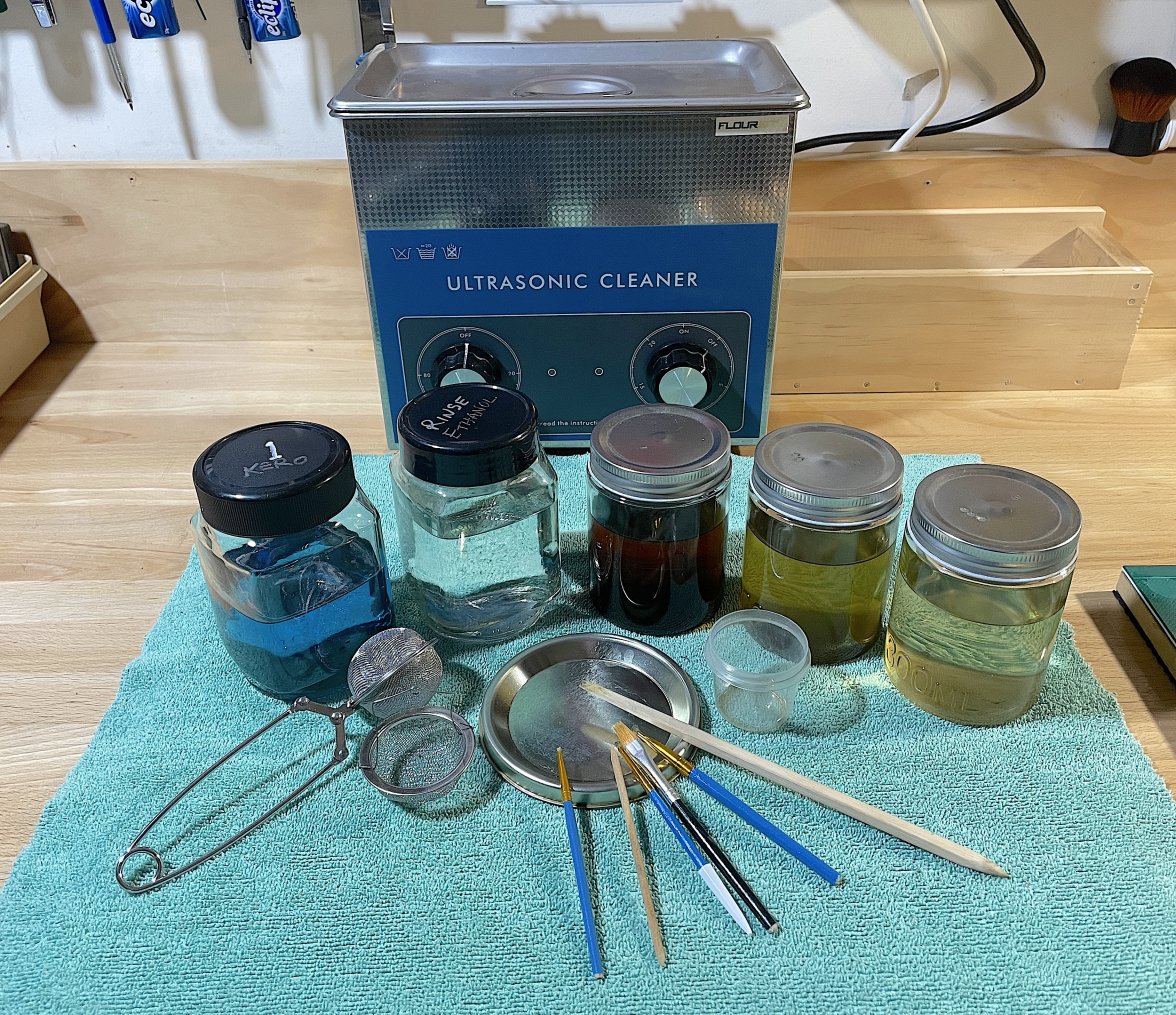
This is what I use for basic cleaning, red arrows point to manual cleaning, green to US cleaning.


When the rinse in jar 3 looks dirty, it becomes rinse 2. The original rinse 2 is disposed of and the jar cleaned and filled with clean rinse and is nice and clean rinse 3 again.
As you can see, my cleaning jar is looking a bit dark, so it's time to dispose of the fluid and get fresh stuff.
I do the same cycle as the rinse. A clean jar for the fresh cleaner and the old cleaner is used for very dirty jobs until it too gets replaced.

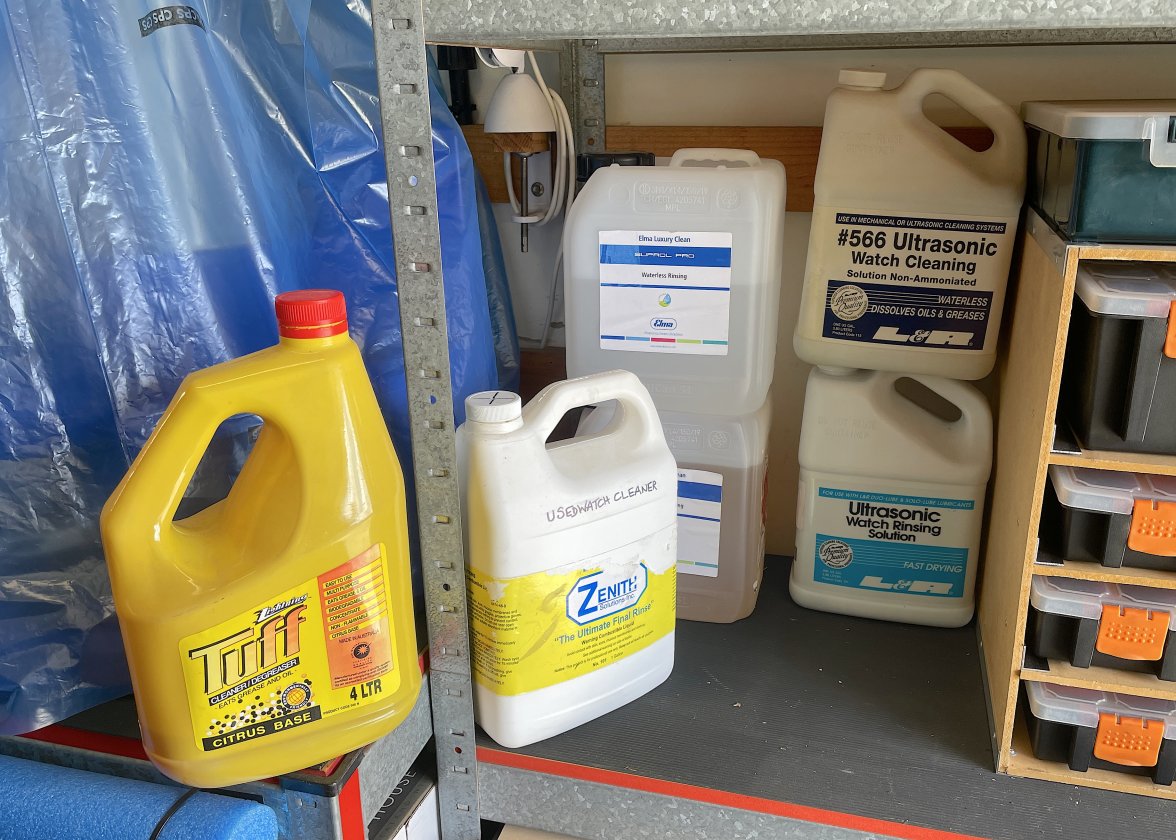
It's not only buying these fluids you have to consider. There's also the issue of what to do with them when they are no longer suitable.

All of my used cleaning/rinse fluids are stored in original used containers and when full, my mate takes them to his depot where they have an oil/petrochemical disposal system.

Managing your little chemical farm is another task you get to manage 😁.


I got naptha and
Before I had an ultrasonic and a watch cleaning machine I used brushes of different stiffness and readily available fluids for cleaning.

A small artists paint brush with the bristles cut to about 5mm is good for scrubbing without damaging. For mainspring barrels I used kerosine or WD40 as a cleaner and allowed the parts to soak overnight and then used brushes and toothpicks to remove the gunk.

The cleaning fluids must be rinsed off with denatured alcohol and then rinsed again in isopropyl alcohol.

I've found that even a professional US cleaner can't remove some of the dried grease in barrels, e.g.: the black stuff Seiko use needs to be mechanically removed.

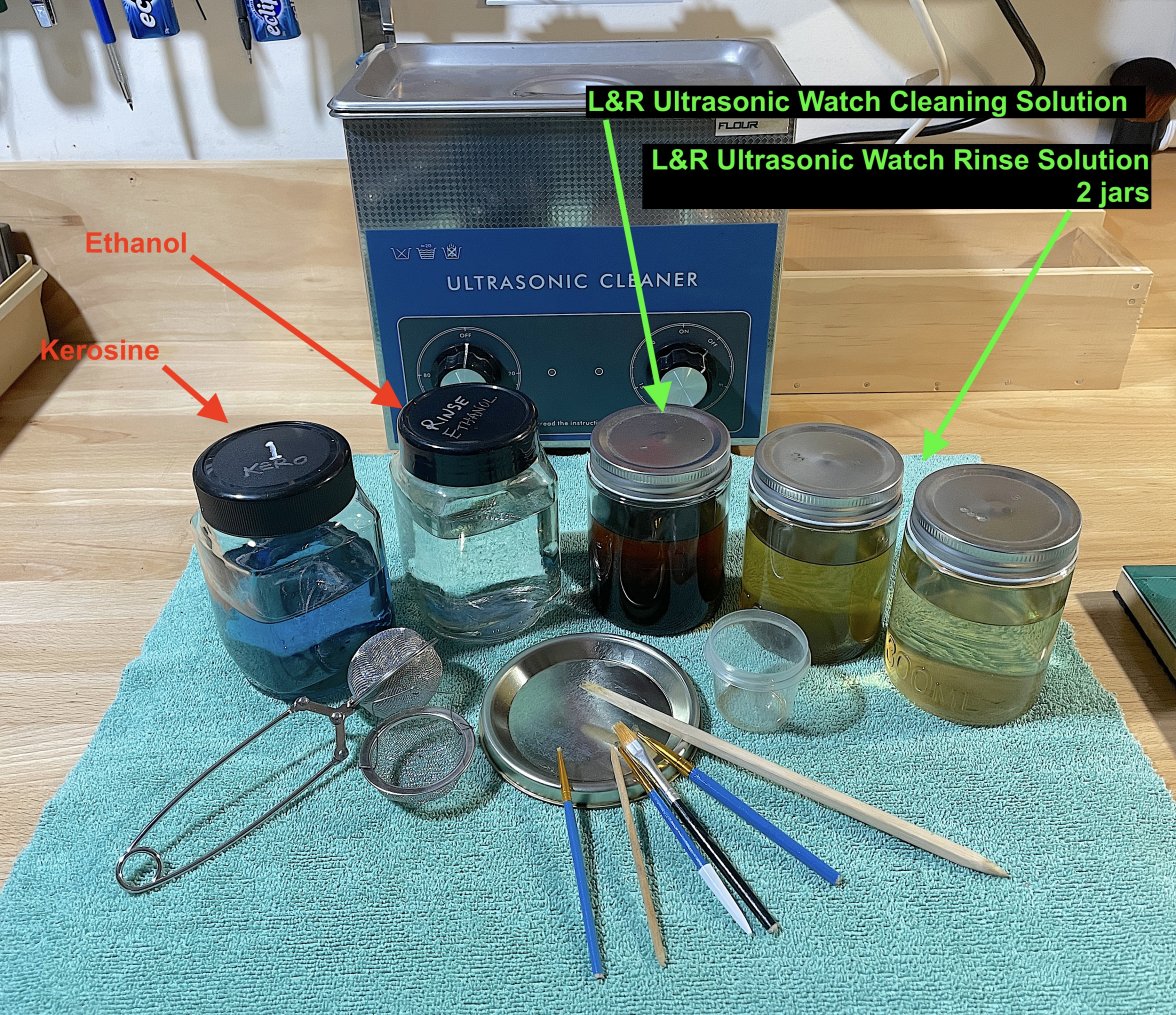
Here is what I use when I get stubborn gunk.


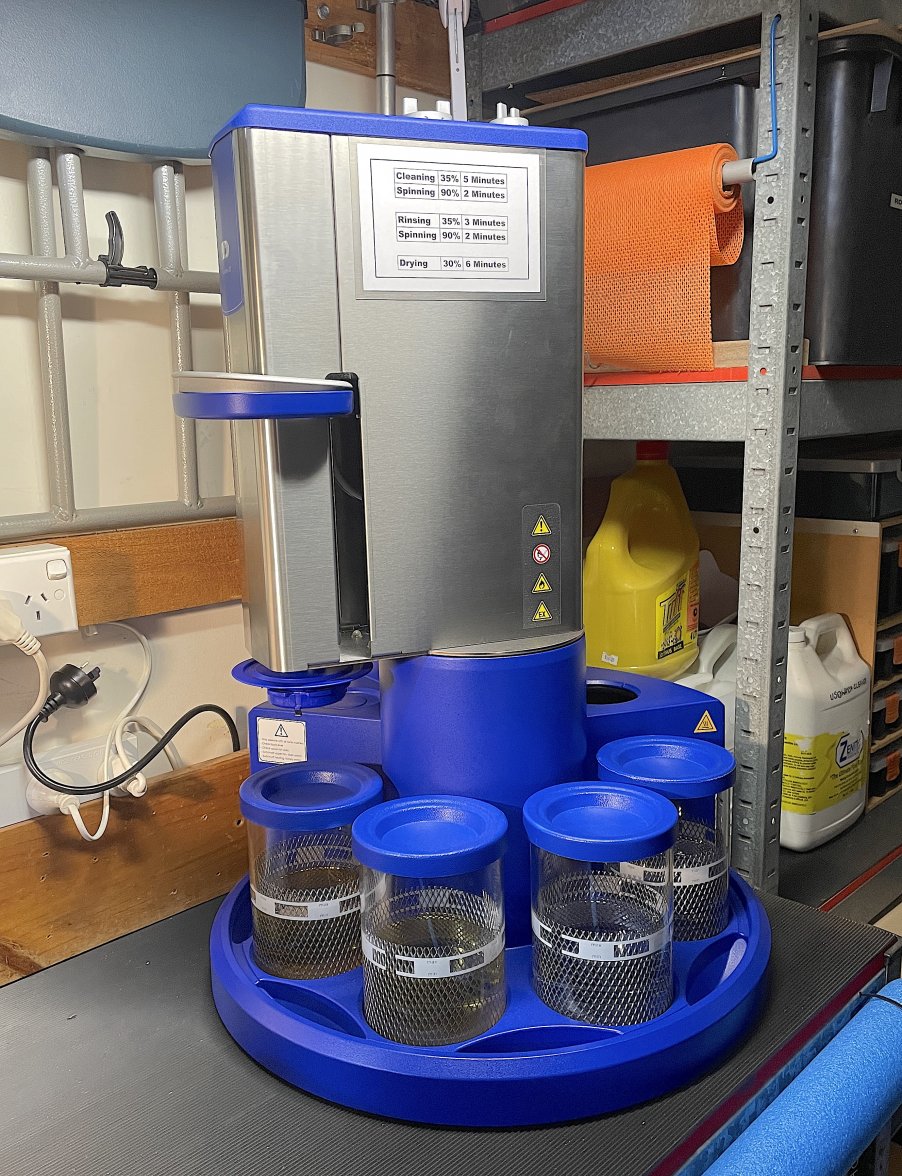
And here's what I use for "normal" cleaning, however, you can still do a good job without ultrasonics and cleaning machines.

Before I had an ultrasonic and a watch cleaning machine I used brushes of different stiffness and readily available fluids for cleaning.

A small artists paint brush with the bristles cut to about 5mm is good for scrubbing without damaging. For mainspring barrels I used kerosine or WD40 as a cleaner and allowed the parts to soak overnight and then used brushes and toothpicks to remove the gunk.

The cleaning fluids must be rinsed off with denatured alcohol and then rinsed again in isopropyl alcohol.

I've found that even a professional US cleaner can't remove some of the dried grease in barrels, e.g.: the black stuff Seiko use needs to be mechanically removed.

Here is what I use when I get stubborn gunk.


And here's what I use for "normal" cleaning, however, you can still do a good job without ultrasonics and cleaning machines.

Before I had an ultrasonic and a watch cleaning machine I used brushes of different stiffness and readily available fluids for cleaning.

A small artists paint brush with the bristles cut to about 5mm is good for scrubbing without damaging. For mainspring barrels I used kerosine or WD40 as a cleaner and allowed the parts to soak overnight and then used brushes and toothpicks to remove the gunk.

The cleaning fluids must be rinsed off with denatured alcohol and then rinsed again in isopropyl alcohol.

I've found that even a professional US cleaner can't remove some of the dried grease in barrels, e.g.: the black stuff Seiko use needs to be mechanically removed.

Here is what I use when I get stubborn gunk.


And here's what I use for "normal" cleaning, however, you can still do a good job without ultrasonics and cleaning machines.


I got kerosine and denatured alcohol today plus a small painters brush. The barrel soaked for a couple of hours and i managed to get some of the grime of with the brush and a chopstick. Will let it soak for longer and use the "tools" again. I've worked as a bike mechanic but are not used to theese small parts. Otherwise it is similar how cogs, levers and so on work together. I'm a self learned bikemecanic and believe I'm going to get to learn this to. But I have no plans in opening a business.

Thanks a lot JimInOz!
 
Posts
65
Likes
6
You can get into cheaply enough. I would compare it to getting into a sport. It takes a bit to purchase everything, but if it’s a hobby then it can be worth it.
Look on EBay or find you your local NAWCC/AWCI/BHI chapter (I don’t know where you are located) and find some good quality, used tools.

A lot of the Chinese made tools will be totally fine for hobby use. I would use good quality tweezers, though. The Chinese made movement cleaning machines can be had for a reasonable cost.

There are a lot of joke made solutions out there you can try. I know hobbyist on various sites don’t like spending the big bucks on L&R fluid so they have come up with recipes for rinses and cleaners. You can even use camp fuel as a rinsing agent.

For hundreds of years watchmakers have cleaned watch movements with whatever they had. Lighter fluid and sawdust to dry. Go back further and they used ear wax or whale blubber to lubricate them! My point is , watchmaking is a very old art/science. Yes, modern machinery, tooling, lubricants and fluids all help to get watches running, etc but it is, at its core, a very low tech job.

if you have the patience and hand skills you will pick it up. It’s not a mystical art. Get plenty of good books and read them. I could recommend Jendrtizski’s practical watch repairing. Fantastic book.

Now, the barrel. Do not use a fibre glass brush, that will scratch the barrel to buggery and it’s really bad practice. You need to give that a good clean out with sharpened peg wood and then put it in the solution to clean, and rinse. I would definitely suggest a small ultrasonic tank. You can put the cleaning solution in jars just like Jim has done.

I like the way you see it, they used to manage this a long time ago so why shouldn't I? I'm taking small steps here and maybe I'll invest in a US in the future.
 
Posts
65
Likes
6
Before I had an ultrasonic and a watch cleaning machine I used brushes of different stiffness and readily available fluids for cleaning.

A small artists paint brush with the bristles cut to about 5mm is good for scrubbing without damaging. For mainspring barrels I used kerosine or WD40 as a cleaner and allowed the parts to soak overnight and then used brushes and toothpicks to remove the gunk.

The cleaning fluids must be rinsed off with denatured alcohol and then rinsed again in isopropyl alcohol.

I've found that even a professional US cleaner can't remove some of the dried grease in barrels, e.g.: the black stuff Seiko use needs to be mechanically removed.

Here is what I use when I get stubborn gunk.


And here's what I use for "normal" cleaning, however, you can still do a good job without ultrasonics and cleaning machines.

Would a painters brush be to harsh to clean crystals?
 
Posts
250
Likes
713
Sorry I mean jewels 🙄
It’s best to clean jewels with sharpened peg wood.

Don’t get me wrong, I think it’s important to have the latest equipment and tooling as a professional, you need to stay up to date with latest cleaning solutions, lubricants, tools, etc. I just think there is a lot of high minded bollocks that goes on with watchmaking and hobbyists can absolutely get by with less. If you are a hobbyist who starts charging for services then it’s a different story as this is an unregulated industry.
 
Posts
65
Likes
6
It’s best to clean jewels with sharpened peg wood.

Don’t get me wrong, I think it’s important to have the latest equipment and tooling as a professional, you need to stay up to date with latest cleaning solutions, lubricants, tools, etc. I just think there is a lot of high minded bollocks that goes on with watchmaking and hobbyists can absolutely get by with less. If you are a hobbyist who starts charging for services then it’s a different story as this is an unregulated industry.
I definitely see your concern. But that is not my plan at all.
 
Posts
65
Likes
6
I just found out that my wife who's a chemist ha a US at work 😁 Should i run it in a jar with kerosine? As I don't have L&R by the moment. And is there any part you shouldn't run i US?
 
Posts
123
Likes
72
eap little ultrasonic machines often available from drug stores
I just found out that my wife who's a chemist ha a US at work 😁 Should i run it in a jar with kerosine? As I don't have L&R by the moment. And is there any part you shouldn't run i US?

Biggest concern would be around the balance spring assembly and pallet fork. Both have set gems that are typically set with shellac or some other kind of set material, if you wash that away you're gonna be in a world of pain.
 
Posts
15,466
Likes
45,795
And so is his expected childish PM response.

In the true spirit of the season, observe the mistletoe on my coat tails!
 
Posts
123
Likes
72
In the true spirit of the season, observe the mistletoe on my coat tails!
Tis the season to be jolly... tra la la la la....
 
Posts
65
Likes
6
Biggest concern would be around the balance spring assembly and pallet fork. Both have set gems that are typically set with shellac or some other kind of set material, if you wash that away you're gonna be in a world of pain.
I’ve actually considered that the pallet fork jewels could come of. And I really don’t want to be in that position. Thanks for the advice!
 
Posts
17,935
Likes
37,504
Has anyone ever become a competent watch repair technician by learning on a forum such as this? I doubt it.

May I allay your doubt.

I started by following a basic on-line Seiko course produced by Nick Hacko. That got my interest, and I followed a number of on-line guides and tutorials (some good, some just terrible).

One place that's provided me with the best guidance has been this forum. Some of the expert members here have shared their knowledge (both publicly and privately) and have been an immense help in my journey to become a "hobby watchmaker".

So far I've successfully serviced everything from an 19th century English lever fusee to a modern Swiss chronograph, even a Seiko diver that is now worth at least AUD$28,000. 😉

At this moment, I'm half way through restoring a bit of a basket case Seiko 6138 chronograph, case, bracelet and movement, the whole package.