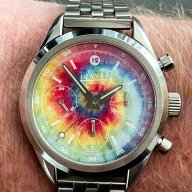
Early Explorer 1016, with a Twist

Posts
6,832
Likes
13,797
What conclusion are you drawing then? That the engravings aren't original if they're 'too shaky'? Perhaps 'not care' wasn't the correct term to use, but it's clear that the quality was variable to say the least.

Casebacks were stamped and produced en masse as they are not specific to a single watch in the same way as a serial engraving is, so it's not comparing like with like.
If it is "My" conclusion you ask for, please don't go crazy if it's not agreeable.

I would say it is more a belief than a conclusion. Conclusion being a result of analysis and fact seeking and belief being more of an opinion based on "existing" data and perception.

So my belief is that the SS engraving is not factory but an after the fact addition. Wether the addition is made as quality control (ironic if it is so) or costume compliance...by a Rolex sub-division or by a third party on the distribution line..I don't know.

But I do believe that at some point this watch was made, by Rolex, and had the factory engravings inside and in the movement, perfectly made, consistent from piece to piece through thousands of examples...and it was sealed and ready to go...and it did not have that stainless steel engraving in it. Whomever, wherever and for whatever reason it is there I don't think it's the result of a production line step. It is part of a separate process that affects different watches at random times in different ways. The opposite of what any product line of any brand seeks to accomplish.

That's my belief.

 
Posts
603
Likes
2,567
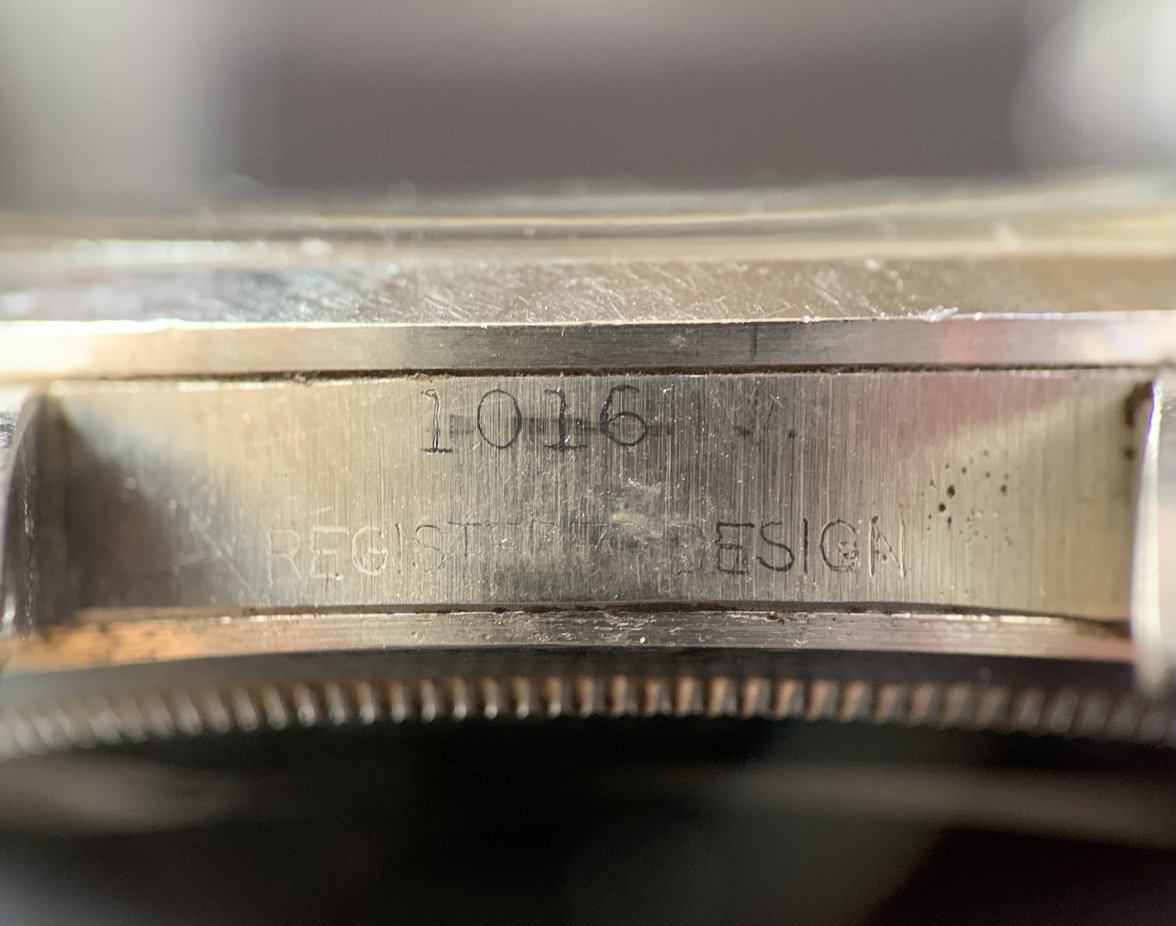
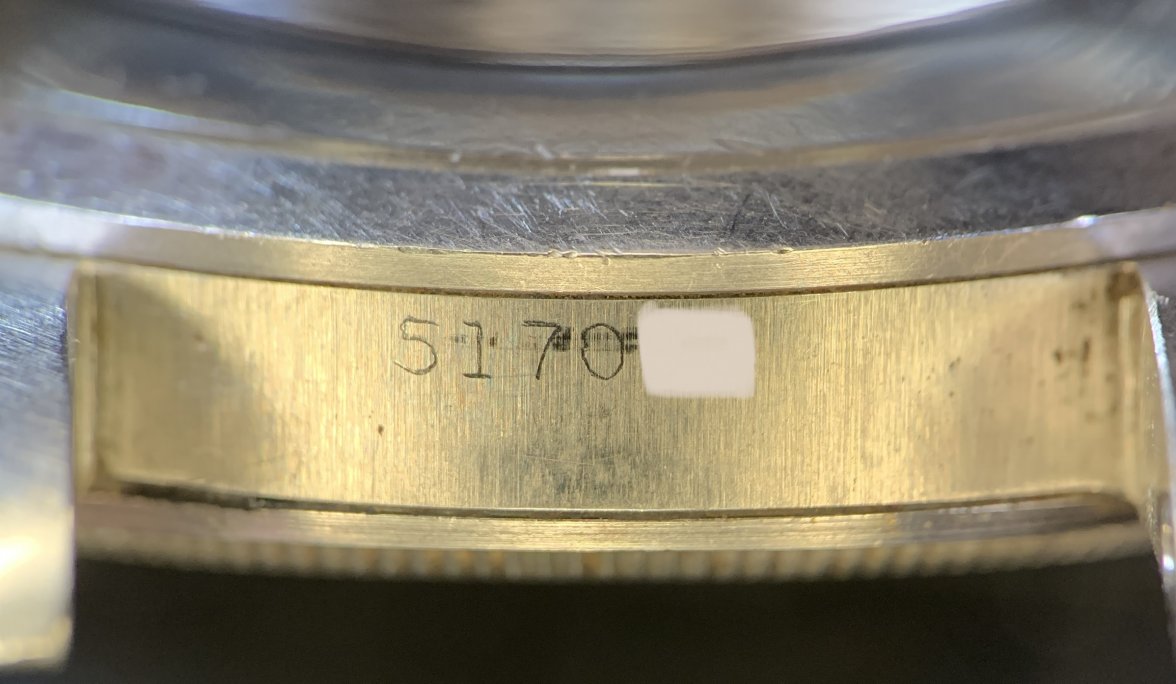
Funny how there is an extreme amount of pitting on the left and the right of the serial number - but not on the serial number itself... 😉🤦
Almost as if someone welded it, got rid of the pitting to preserve the numbers - and afterwards hand engraved the watch (of course with the correct numbers, not saying the watch itself is not original).

Not sure if you read where I noted that the stuff on there was present because I hadn't cleaned the watch. Magically, much of that "extreme amount of pitting" cleaned off with q-tips. And if it had been welded to fix pitting by the engravings, why leave the tiny amount of pitting present on the right side of the first picture that overlaps the GN in "design"? [The part that's rubbed away partially in the middle of "registered design" is likely because it was worn on a thick leather strap that abutted the case right there.] But I'm sure you'll find reasons why this is further evidence of aftermarket welding/re-engraving.


Scenario 1. Even if we should take these seriously, verifying the originality of an example is an extremely hard thing to do, if not impossible, given how easy it is to fake.
Scenario 2. Nobody should take these markings seriously.

I like this take on it. In the end, the level of evidence that can be produced for anything uncommon in this space will reach no higher than that of a 'case series.' So I will never prove it to the level that some here demand. That's fine, I'm not trying to sell the watch to them, just enjoying it and showing an interesting example.

Moreover, this is probably the least important portion of the watch; I just thought the case back engraving was a curious thing that is seen from time to time from watches of this period. I didn't even notice it for the first day or so (because engraving is light), until I remembered seeing these on other examples, and took my loupe out. I don't think it should be taken too seriously or think, in any way, that it should add to the value of the watch or that those that don't have it are deficient/incorrect. If that were the case, the evidence should be more substantial. I do find the offense that some have taken to this amusing though.

In the end, I like both scenarios.
 
Posts
8,098
Likes
28,531
I’d note the somewhat self-contradictory nature of @Tony C. s reasoning here. On one hand he’s saying the engraving is so egregiously bad that no serious collector could take it seriously; on the other hand he’s saying people could do these things to fool serious collectors? Point being, it seems this observation cuts both ways at best, so we should move on to other critiques

What I have repeatedly said and implied is that it difficult to believe that Rolex would allow such work to leave their factory, or be produced under their supervision. There is nothing inconsistent between that point, and the separate observation that such poor work is easy to replicate, and leads to further problems/complications. Perhaps I needn't repeat the point again, but you have provided no basis on which to dismiss it.

I think you’re incorrect here, and that these Hermès inscriptions were done by Rolex in connection with filling their order terms - but I’m here thoroughly inviting contradictory info!

Did Tiffany & Co do their own dial logos on Tiffany watches, too?

With regard to dials, I believe that you are wrong. As you know, the vast majority of dials were outsourced, and companies like Gübelin and Tiffany, etc., would almost certainly have had control of their signatures. I am not certain that they would have full control (e.g. placement), but the design and ultimate execution, yes.

The point of course was not whether the inscription was as bad; the point was merely that it was not the same quality, depth, or technique as the interior engravings. Obviously this is relevant because for several pages you and others were saying in effect “if the technology was available on the inside of the caseback then it shows it is ridiculous to suggest that different techniques/qualities could be present on the outside of the same caseback”

That's a tortured point. The analogy, as far as it goes, is not important at all. There were countless companies that produced different types of engravings on the inside and outside of case backs, so that was never a point of contention. The points, which I made clear, were primarily the shocking distinction in quality, and secondarily the redundancy, and neither directly apply to the HERMES examples.
Edited:
 
Posts
86
Likes
107
Again: watch original. Of course. Nice example. Love it.
Engravings: bad. not original.
Where is proof of your assertation that the engravings are not original? I believe they are original based on examples in my collection where engraving quality is inconsistent.
 
Posts
86
Likes
107
I never suggested that the watch wasn't original, so that's a straw man. Any my persistence has been underpinned by specific arguments, so why not attempt to challenge them, rather than wave them off solely because you deem someone else to be an expert?
It's one thing to debate the quality control and inconsistencies from this period. It's another for you to persist in criticizing a piece that you have yet to provide irrefutable evidence to support your position.
 
Posts
8,098
Likes
28,531
It's one thing to debate the quality control and inconsistencies from this period. It's another for you to persist in criticizing a piece that you have yet to provide irrefutable evidence to support your position.

Irrefutable evidence? I have, from the beginning, claimed to be very skeptical. The OP obviously has no irrefutable evidence of originality, either, so I don't understand your point.
 
Posts
2,959
Likes
6,317
It's one thing to debate the quality control and inconsistencies from this period. It's another for you to persist in criticizing a piece that you have yet to provide irrefutable evidence to support your position.

Neither side will ever have irrefutable evidence. That is the nature of vintage.
 
Posts
86
Likes
107
Irrefutable evidence? I have, from the beginning, claimed to be very skeptical. The OP obviously has no irrefutable evidence of originality, either, so I don't understand your point.
Well... OP posted plenty of content and pics to present the provenance of this watch. It's really a stretch for you or others to claim someone would have engraved the caseback after the fact, given the condition of the piece and lack of service evidence from pics. A non-original engraving of this sort on a caseback wouldn't do anything to add or subtract value either. If you are going to challenge the engraving and it's origin, then the burden is on you to provide reasonable evidence to the contrary.
 
Posts
473
Likes
1,187
Irrefutable evidence? I have, from the beginning, claimed to be very skeptical. The OP obviously has no irrefutable evidence of originality, either, so I don't understand your point.

At some point, a preponderance of evidence should be seen as significant enough to undercut all the buy-what-abouts offered, honestly. I'm curious what it *would* take for you to accept the watch as not only (obviously) authentic, but the caseback markings as overwhelmingly likely to have been done by Rolex as well. Honestly curious.
 
Posts
2,520
Likes
17,832
It's really a stretch for you or others to claim someone would have engraved the caseback after the fact, given the condition of the piece and lack of service evidence from pics.

Actually, I think this is the other way around: It’s a stretch to assume, because of condition and the ‘remembered history’ of the watch that the caseback ‘engraving’ is factory original. Plenty of times, I’ve discovered that family and original owners have forgotten whole aspects of a watch’s history.

A non-original engraving of this sort on a caseback wouldn't do anything to add or subtract value either.

Maybe yes, maybe no, I think. And, if it can be established that the engraving is factory original, maybe that makes it rare enough to contribute to its appraised value.

If you are going to challenge the engraving and it's origin, then the burden is on you to provide reasonable evidence to the contrary.

Challenging, to me, means raising questions. The OP, a knowledgeable collector, posted his hypothesis about a piece he recently picked up. His hypothesis is being tested by challenging questions.
 
Posts
8,098
Likes
28,531
Well... OP posted plenty of content and pics to present the provenance of this watch. It's really a stretch for you or others to claim someone would have engraved the caseback after the fact, given the condition of the piece and lack of service evidence from pics. A non-original engraving of this sort on a caseback wouldn't do anything to add or subtract value either. If you are going to challenge the engraving and it's origin, then the burden is on you to provide reasonable evidence to the contrary.

At this point, the OP has provided two, very limited, partial photos of the case back. How are you able to judge the condition on that basis? I hope that he does provide more, so that we might be able to further parse out the questions surrounding the engraving.

We have also yet to see, on this thread, an example of an equally poor "stainless steel" engraving. One helpful member linked to a Phillips example, which was superficially compelling due to the overall condition of the watch. But the quality of that engraving was arguably higher, while at the same time there were other disturbing issues. The 6542 to which I linked had an engraving that is far superior.

At some point, a preponderance of evidence should be seen as significant enough to undercut all the buy-what-abouts offered, honestly. I'm curious what it *would* take for you to accept the watch as not only (obviously) authentic, but the caseback markings as overwhelmingly likely to have been done by Rolex as well. Honestly curious.

Yes, at some point, but to my mind we're not at that point yet. The OP, and at least some other Rolex collectors themselves, seem to agree that the quality of these markings varied wildly. They are also willing to accept remarkably poor examples as original. It then follows, as I have mentioned several times now, that such markings would be extremely easy to fake, and, given the high number of vintage Rolex that circulate in the market, coupled with their high values, there can be no doubt that at least some re-engaved examples have been bought and sold. So to assume that a watch with a particularly poor engraving is necessarily "factory original" would be naïve, in my view.

We can continue to debate the OPs watch, but especially without better photos of the case back and engraving, there isn't yet sufficient evidence to convince me, or some others, of originality.
Edited:
 
Posts
86
Likes
107
Actually, I think this is the other way around: It’s a stretch to assume, because of condition and the ‘remembered history’ of the watch that the caseback ‘engraving’ is factory original. Plenty of times, I’ve discovered that family and original owners have forgotten whole aspects of a watch’s history.


Maybe yes, maybe no, I think. And, if it can be established that the engraving is factory original, maybe that makes it rare enough to contribute to its appraised value.


Challenging, to me, means raising questions. The OP, a knowledgeable collector, posted his hypothesis about a piece he recently picked up. His hypothesis is being tested by challenging questions.
1. While that may be true, evidence presented shows a watch that was not serviced and barely worn... likely put away for years.

2. I highly doubt it would diminish value, just as initials on these vintage pieces in top-top condition have negligible impact. The exception would be initials or engraving that confirmed a person of notoriety's ownership.

3. I'm all for intellectual debate to challenge what we believe to be true. There comes a point where evidence to the contrary may not be available and the provenance stands on it's own merit along with studied examination of all the other details, which the OP has provided. It's also a bit odd to think someone would engrave that on their caseback rather than something much more common, such as initials.
 
Posts
473
Likes
1,187
Yes, at some point, but to my mind we're not at that point yet. The OP, and at least some other Rolex collectors themselves, seem to agree that the quality of these markings varied wildly. They are also willing to accept remarkably poor examples as original. It then follows, as I have mentioned several times now, that such markings would be extremely easy to fake, and, given the high number of vintage Rolex that circulate in the market, coupled with their high values, there can be no doubt that at least some re-engaved examples have been bought and sold. So to assume that a watch with a particularly poor engraving is necessarily "factory original" would be naïve, in my view.

We can continue to debate the OPs watch, but especially without better photos of the case back and engraving, there isn't yet sufficient evidence to convince me, and others, of originality.

But by this logic, to be clear, you're arguing that because something's possible, your questions+doubts could, essentially, never ever be resolved. Ever. Even if someone who literally made the website for this reference, which you referred to; someone plenty of folks recognize as being as close to an expert as could be asked for; someone who, sure, could potentially be engaged in an enormous deception but who, if not, has been nothing but transparent about the watch, its provenance, etc.; even if all of those factors have been met, your doubt remains. Is that correct? I specifically asked what it would take for you to accept this as what it's being presented as; that hasn't been answered.
 
Posts
2,520
Likes
17,832
It's also a bit odd to think someone would engrave that on their caseback rather than initials.

It’s not hard to imagine all sorts of improbable scenarios where somebody thought engraving that was a clever idea. If the engraving was a little deeper, a little more accomplished, then factory applied would not seem so improbable, to me at least.

It is a spectacular watch, I must say, and I would be proud to have it in my collection. I don’t think questioning the assertion about the caseback engraving is meant to disparage OP or even the watch itself.
 
Posts
86
Likes
107
It’s not hard to imagine all sorts of improbable scenarios where somebody thought engraving that was a clever idea. If the engraving was a little deeper, a little more accomplished, then factory applied would not seem so improbable, to me at least.

It is a spectacular watch, I must say, and I would be proud to have it in my collection.
That's really the bottom line as I see it. It's interesting and fun to debate the quirks of vintage Rolex back in this era, yet at some point certain aspects are moot in terms of value and impact to the merit of a piece such as this find.
 
Posts
2,520
Likes
17,832
I’ve been troubled for a long time about Rolex engraving issues, particularly from the 60’s and early 70’s, as have many others. There are plenty of threads on TRF where various engravings are questioned, and for good reason.

There’s also no question but that there are plenty of Rolex watches where the engravings have been added or ‘reengraved’ by various people for legitimate and illegitimate reasons. This is not to suggest anything about the OP’s watch but just to explain that debates about Rolex engravings from this period are both justified and important, in my eyes at least, because I learn from all of them.
 
Posts
8,098
Likes
28,531
But by this logic, to be clear, you're arguing that because something's possible, your questions+doubts could, essentially, never ever be resolved. Ever.

No, I'm simply arguing that to my mind there are still unanswered questions, and the evidence is not yet conclusive.

Even if someone who literally made the website for this reference, which you referred to; someone plenty of folks recognize as being as close to an expert as could be asked for; someone who, sure, could potentially be engaged in an enormous deception but who, if not, has been nothing but transparent about the watch, its provenance, etc.; even if all of those factors have been met, your doubt remains. Is that correct? I specifically asked what it would take for you to accept this as what it's being presented as; that hasn't been answered.

Andrew may well be an expert, but it is silly to suggest that he shouldn't be challenged on a particular issue because of his status. I never remotely suggested that he was attempting to deceive. What I did suggest is that confirmation bias can be a powerful force, and especially after one has spent significant money on something.

I don't doubt his superficial report of the provenance of the watch, but at the same time, and as others have pointed out, families of deceased owners of watches don't always get all of the details right.

What would it take for me "to accept this as what it's being presented as"? If you mean "original", it would minimally take more and better photos. But I have no doubts that Andrew's beliefs are sincere.
 
Posts
3,998
Likes
9,018
The analogy, as far as it goes, is not important at all. There were countless companies that produced different types of engravings on the inside and outside of case backs, so that was never a point of contention. The points, which I made clear, were primarily the shocking distinction in quality, and secondarily the redundancy, and neither directly apply to the HERMES examples.

^^^ this is the only thing that seems a tortured assertion given:

Why on earth would Rolex have done something like that, when "stainless steel" is stamped on the inside of the case back? ... Complete nonsense, in my view.

T[Only a 3rd party] would do so if they somehow believed, no matter how absurdly, that it might add "authenticity" to the watch... There is zero chance that Rolex was responsible for it.

[I don’t believe it], because "stainless steel" is stamped on the inside of the case back, and in the quality that one would expect. So why on earth would the same company have employed someone to also scratch a terrible, redundant message by hand on the case back?


ll repeat just one of my questions: As "stainless steel" is stamped on the inside of the case back, and in the quality that one would expect, why on earth would Rolex have employed someone to also scratch an additional, terribly executed, and redundant message by hand on the case back?

Of course your main points were the particularly terrible quality and the redundancy of SS in particular - but were they not couched in a general air of disbelief that there would ever be a reason to be redundant on inside/outside caseback, and also be of almost ANY variation in quality?

C’mon, man, it’s easy:

You should put forward a good reason you think there is no chance Rolex would in its entire history double stamp SS (given any number of reasons this could have been the case), and no chance that a single watch could have ever escaped Rolex’s grasp with a particularly bad engraving (given that plenty of fairly bad did escape)

I’d be genuinely interested to hear this explained purely by deduction and armchair assertions (which you admit to being limited to).

Maybe more interested, even, then hearing @t_swiss_t having to explain that it affirmatively must have happened - which you are so keenly looking for (despite reciprocating, as far as I can tell)
 
Posts
86
Likes
107
I’ve been troubled for a long time about Rolex engraving issues, particularly from the 60’s and early 70’s, as have many others. There are plenty of threads on TRF where various engravings are questioned, and for good reason.

There’s also no question but that there are plenty of Rolex watches where the engravings have been added or ‘reengraved’ by various people for legitimate and illegitimate reasons. This is not to suggest anything about the OP’s watch but just to explain that debates about Rolex engravings from this period are both justified and important, in my eyes at least, because I learn from all of them.
I fully agree that debate on unscrupulous enhancements or forged counterfeits is justified and important for the collector community. In this specific case, the provenance and evidence presented make it very unlikely that this was a "doctored" up piece. "Stainless Steel" is not an engraving that would materially make this piece worth more.
 
Posts
6,598
Likes
26,722
You either aren't reading carefully, or are producing a straw man.
I never suggested that the watch wasn't original, so that's a straw man.
That's a straw man.
I think the real point of this thread was for @Tony C. to give us a lesson in straw man fallacies. 😉