Demagnitizing

Posts
16,307
Likes
44,981
I am totally with you here!
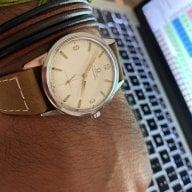
I bought a cheap blue chinese demagnetizer last year, as i suspected my 2254 was running fast all of a sudden. Then i did exactly as people advice.. Once i held the watch close to demagnetizer, i heared a really loud noise and felt massive vibration in my hand. Probably was the balance still oscilating. I got so scared to do more damage than any good, that i never touched that thing again! Not sure if one has to hack the movement prior to demagnetizing or not.
The vibration thing is scary at first but is normal for a demag device- when you do it with tape heads you feel the vibration too as it approaches the head. But as @Canuck said, I would never touch it directly to metal as fine as a hairsping. I didn’t remove the case back for fear of contacting the hairsping- I just ran it over the back of the watch with the dust cover in place as well.
Would it possibly been more effective over the bare movement? Would the caseback and dustcover have “protected” the movement from the demag device? Should I try it again over the bare movement?

 
Posts
29,188
Likes
75,420
My experience has been that the demagnetizer works, in that watches showing magnetization via a compass or the Lepsi app could be demagnetized. However, I also have never found that it significantly affected timekeeping.

Were the watches in question running very fast? If they were and demagnetizing didn't help, then it's possible the demag was not done correctly, or was not strong enough. Or the watch movement wasn't magnetized toe begin with. Keep in mind that a compass has a magnet in it, and will react to any ferrous material it comes near.

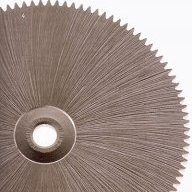
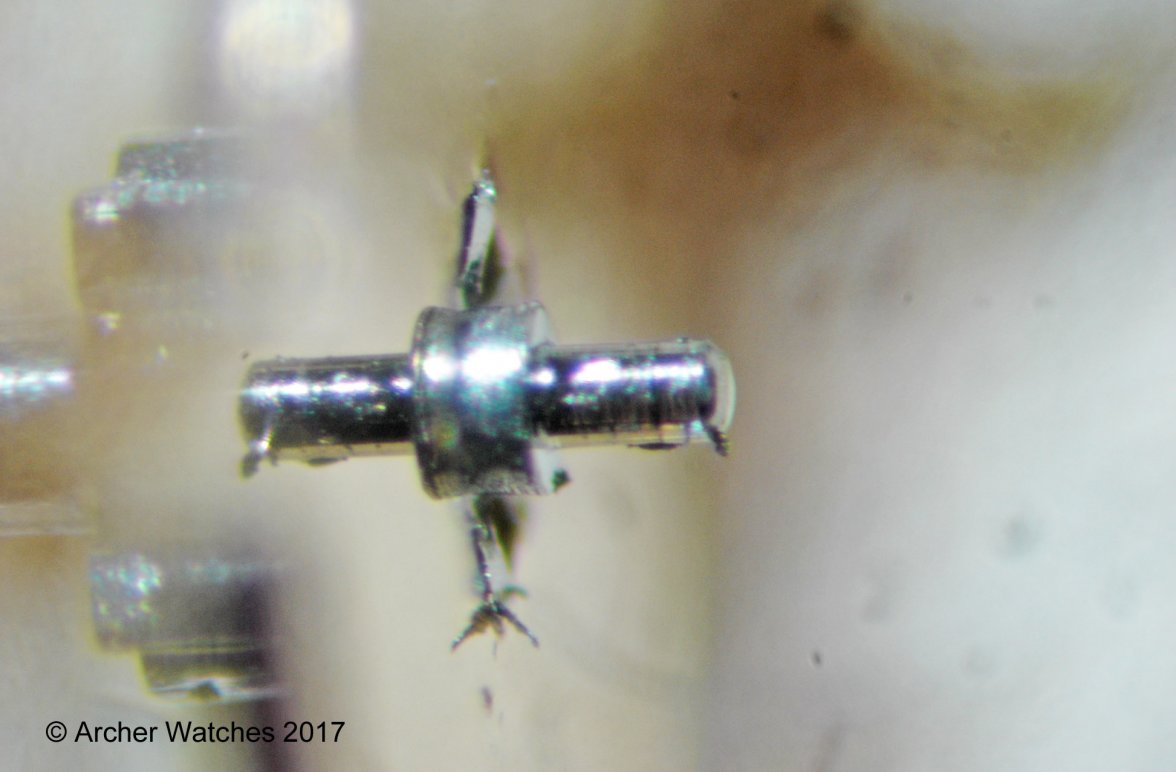
A demagnetizer is an essential part of any watchmaker's set of tools - I use mine every day. It's standard practice to demag a disassembled movement before cleaning, because often there is metal debris inside the movement that you are trying to wash away in the cleaning machine. But if you forget to demag, you may end up with "clean" parts that look like this:

 
Posts
23,328
Likes
51,939
Were the watches in question running very fast? If they were and demagnetizing didn't help, then it's possible the demag was not done correctly, or was not strong enough. Or the watch movement wasn't magnetized toe begin with. Keep in mind that a compass has a magnet in it, and will react to any ferrous material it comes near.

A demagnetizer is an essential part of any watchmaker's set of tools - I use mine every day. It's standard practice to demag a disassembled movement before cleaning, because often there is metal debris inside the movement that you are trying to wash away in the cleaning machine. But if you forget to demag, you may end up with "clean" parts that look like this:


I am thinking of one recent case, for example, where a watch was running about two minutes fast per day, and showing high magnetization using the Lepsi app. After demagnetization, it showed no measurable magnetization using the Lepsi app, but the timekeeping was unchanged. However, it was a new purchase, and I have no knowledge of the service history, so it's absolutely likely that the movement is simply badly in need of service, or that there is some oil or foreign object in the mainspring. In any case, it's going in for a service after the holidays anyway, the demagnetization was really just something I wanted to try out.
 
Posts
29,188
Likes
75,420
The vibration thing is scary at first but is normal for a demag device- when you do it with tape heads you feel the vibration too as it approaches the head. But as @Canuck said, I would never touch it directly to metal as fine as a hairsping. I didn’t remove the case back for fear of contacting the hairsping- I just ran it over the back of the watch with the dust cover in place as well.
Would it possibly been more effective over the bare movement? Would the caseback and dustcover have “protected” the movement from the demag device? Should I try it again over the bare movement?

I don't know what the strength of the unit you have is, so it's difficult to say for sure if it's appropriate for demagnetizing watches. Certainly the case and inner cover (which is not really a dust cover, but to protect the watch from magnetic fields) will make the demagnetizer less effective than when using it on a movement that is removed from the case. But there's another concern...

When something is magnetized, the dipoles in the item are all aligned, and you are trying to make them random. To do this you either have a constant field and move the item away from the field slowly before turning the field off, or you use a demag with a decaying field - this is the type I use. I am assuming the tape head demag is a constant field, but if it is much stronger than is needed for watches, it's possible that you can't move it far enough away with your arms before turning it off, and in that case you are not properly demagnetizing the item.

So it could be that the watch isn't magnetized at all, or it could be that the demag isn't strong enough to be effective through the case and inner cover, or that it's too strong and the field is not weak enough when you turn it off. BTW this is what mine looks like...demagnetizing a Cal. 321 balance:


When you press the button the capacitor discharges, and the field decays on it's own. No need to move the watch, part, or tool away from the unit.

Cheers, Al
 
Posts
29,188
Likes
75,420
I am thinking of one recent case, for example, where a watch was running about two minutes fast per day, and showing high magnetization using the Lepsi app. After demagnetization, it showed no measurable magnetization using the Lepsi app, but the timekeeping was unchanged. However, it was a new purchase, and I have no knowledge of the service history, so it's absolutely likely that the movement is simply badly in need of service, or that there is some oil or foreign object in the mainspring. In any case, it's going in for a service after the holidays anyway, the demagnetization was really just something I wanted to try out.

If it's done right, no harm in trying to demag first.
 
Posts
23,328
Likes
51,939
I am thinking of one recent case, for example, where a watch was running about two minutes fast per day, and showing high magnetization using the Lepsi app. After demagnetization, it showed no measurable magnetization using the Lepsi app, but the timekeeping was unchanged. However, it was a new purchase, and I have no knowledge of the service history, so it's absolutely likely that the movement is simply badly in need of service, or that there is some oil or foreign object in the mainspring. In any case, it's going in for a service after the holidays anyway, the demagnetization was really just something I wanted to try out.

Meant to write "hairspring" obviously. 🤦
 
Posts
16,307
Likes
44,981
If it's done right, no harm in trying to demag first.
That’s what is was seeking- the no harm. I learned long ago, better to ask a “stupid” question before I do something stupid.

I could just hear my watchmaker saying - oh, the problem was really simple, but then you went and hit it with the demag and now....
 
Posts
1,641
Likes
5,189
The vibration thing is scary at first but is normal for a demag device- when you do it with tape heads you feel the vibration too as it approaches the head. But as @Canuck said, I would never touch it directly to metal as fine as a hairsping. I didn’t remove the case back for fear of contacting the hairsping- I just ran it over the back of the watch with the dust cover in place as well.
Would it possibly been more effective over the bare movement? Would the caseback and dustcover have “protected” the movement from the demag device? Should I try it again over the bare movement?
Before demagnetiing Omega i tested the device on my old Seiko, and there was no vibration at all. So i thought it was not that difficult. But once i placed the 2254 on demagnetizer i felt strong force and at first could hardly lift ut off the device, once i was moving it away it was vibrating strongly that you could really hear it. I got very uncomfortable with tgis experiment and never touched the device again, in fear of damaging something.
So you are saying this vibration is something normal?
 
Posts
29,188
Likes
75,420
Before demagnetiing Omega i tested the device on my old Seiko, and there was no vibration at all. So i thought it was not that difficult. But once i placed the 2254 on demagnetizer i felt strong force and at first could hardly lift ut off the device, once i was moving it away it was vibrating strongly that you could really hear it. I got very uncomfortable with tgis experiment and never touched the device again, in fear of damaging something.
So you are saying this vibration is something normal?

The vibration is due to the alternating current, so yes in a constant field style demagnetizer, this is normal. In my previous engineering life, magnetism was something our product (bearings) was not supposed to have at the end of the manufacturing process, but magnets were used in material handling of the parts, and workholding of the parts (in grinding machines for example). We had very large demag units (coil types) that parts would run through down a chute, but if the part was hung up for some reason and was stuck in the demag, it would heat up to the point you couldn't touch it.

Think of any ferrous material as being full of little magnets. When all those magnets are aligned with their North and South poles in the same direction, they are all pulling together and the item is magnetized. The demag creates an alternating magnetic field that causes all the little magnets inside the item to swing back and forth as the current alternates. As you slowly move the item away from that field, they swing back and forth a little less, and the idea is that all these will stop in random orientations, leaving the item demagnetized.
 
Posts
3,577
Likes
8,160
causes all the little magnets inside the item to swing back and forth as the current alternates

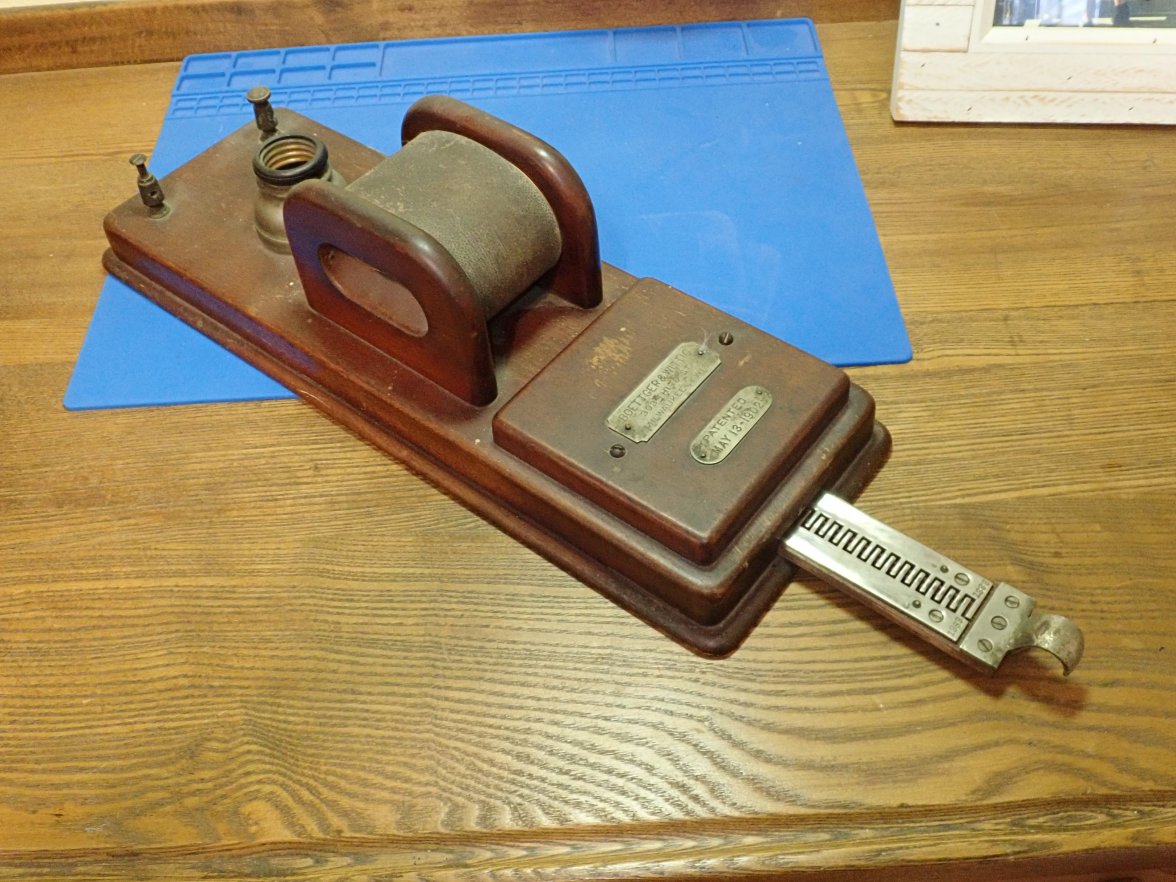
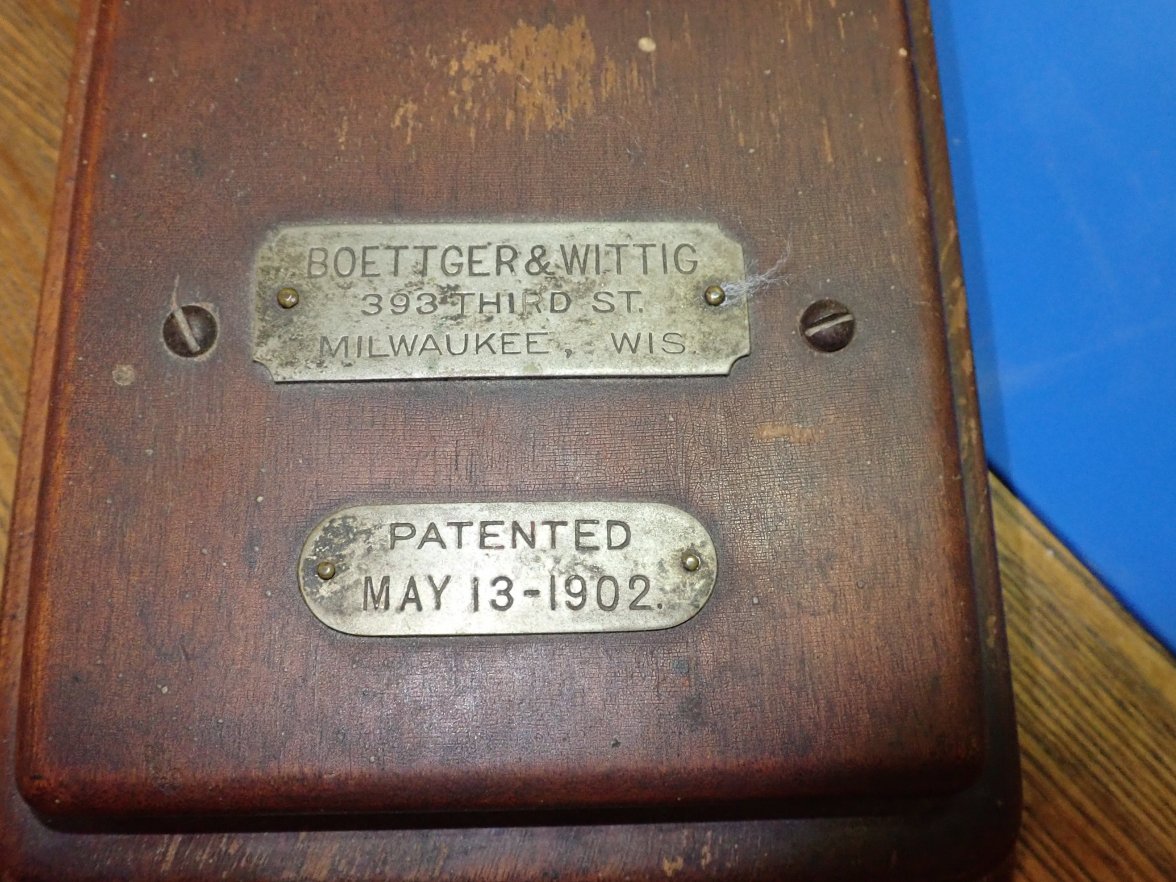
I have the oldest one I've seen and it illustrates Al's point. Using DC current (patent office shows the old glass jar acid type battery), you evidently slid the arm in and out reversing the current hundreds of times.

I've never tried to use it but I think it's too cool looking to discard. My wife thinks I'm a hoarder, not a collector but there's probably some old-timer, some history collector or interior designer that could use it.


Posts
657
Likes
2,027
I have the oldest one I've seen and it illustrates Al's point. Using DC current (patent office shows the old glass jar acid type battery), you evidently slid the arm in and out reversing the current hundreds of times.

I've never tried to use it but I think it's too cool looking to discard. My wife thinks I'm a hoarder, not a collector but there's probably some old-timer, some history collector or interior designer that could use it.


That's really beautiful!
 
Posts
3,502
Likes
8,770
We had very large demag units (coil types) that parts would run through down a chute, but if the part was hung up for some reason and was stuck in the demag, it would heat up to the point you couldn't touch it.

Essentially a low-power induction furnace?
 
Posts
1,232
Likes
5,682
More than once I have got watches who were sent keeping good time but once arrived will run very fast, more than 1h/day. The reason has always been the same: two coils of hairspring have stuck together due to mail bumpy road. That's something you can see with the loupe.
SOLUTION: Shaking the watch until hairspring goes back to normal. (yeah, most probably Archer would say that's crap, so I don't reccommend but it works for me)

I have the Chinese blue thingy to desmagnetize but never used it. I once switched it on and scared me to death.
 
Posts
29,188
Likes
75,420
More than once I have got watches who were sent keeping good time but once arrived will run very fast, more than 1h/day. The reason has always been the same: two coils of hairspring have stuck together due to mail bumpy road. That's something you can see with the loupe.
SOLUTION: Shaking the watch until hairspring goes back to normal. (yeah, most probably Archer would say that's crap, so I don't reccommend but it works for me)

I have the Chinese blue thingy to desmagnetize but never used it. I once switched it on and scared me to death.

Coils don’t stick together unless there’s a reason. Magnetism, oil, etc....
 
Posts
15,221
Likes
44,698
Coils may appear to be stuck together when viewed by someone who is not the best judge of hairspring deformities. But periodically, hairsprings can get hung up on regulator gates or curb pins, or even inner coils hopping over a Breguet overcoil. Demagnetizers are not directly a solution for problems like these. There is a chance that the effect of a trip through a demagnetizer may untangle a tangle. But that does not constitute “demagnetizing” the watch. “Shaking” the watch until the hairspring returns to normal MAY untangle a tangle, but it won’t unstick stuck coils, are demagnetize a watch.
 
Posts
2,327
Likes
2,541
I ran across an old article, Popular Mechanics October 1912 page , about demagnetizing a pocket watch.
I think there's a similar one in "the Boy Mechanic".
The article stated this had become a serious problem around that time due to power plants springing up. Workmen and visitors, the article mentioned some VIP visitors, found their watches running wild after visiting the generator rooms.
The article gave instructions on building your own demagnetizer.
Also how to do the job by spinning the watch on a thread near a motor or generator.
https://books.google.com/books?id=A...AQQAg#v=onepage&q=demagnetize a watch&f=false

For the OP's watch I'd hazard a guess that whoever serviced it last used too much oil and some migrated to the hair spring.
Edited:
 
Posts
16,307
Likes
44,981
I ran across an old article, perhaps in "The Boy Mechanic", about demagnetizing a pocket watch.
The article stated this had become a serious problem around that time due to power plants springing up. Workmen and visitors, the article mentioned some VIP visitors, found their watches running wild after visiting the generator rooms.
The article gave instructions on building your own demagnetizer. IIRC it involved a railroad spike or horseshoe among other common items.
Perhaps I can find it again.

For the OP's watch I'd hazard a guess that whoever serviced it last used too much oil and some migrated to the hair spring.
I am willing to bet that since a hobbiest did the last service (no offense to watchmaking hobbiests- one of my closest friends is one), that you may be right about too much oil.

And although many may laugh at the idea of using horseshoe and railroad spike- I have a sneaking suspicion that a large percentage of the geeks- er, I mean members here have one if not both at their disposal and the rest of the probable parts needed for the 19th century demagnetizer. 😗
 
Posts
1,232
Likes
5,682
Coils don’t stick together unless there’s a reason. Magnetism, oil, etc....

Yep. Usually oil/dirt in my cases, as later found out by watchmaker. I got one magnetized once at work but never in the mail. I use a compass to find out.
 
Posts
2,327
Likes
2,541
Yep. Usually oil/dirt in my cases, as later found out by watchmaker. I got one magnetized once at work but never in the mail. I use a compass to find out.
Glad it wasn't anything major. Excellent looking watch.

I suspect one of my watches became magnetized when I held it close to my monitor screen while setting the time by the NIST site clock. trying to synchronize the second hand, It suddenly gained three seconds in one hour, its normally dead on.
I used my Chinese blue box on it and it immediately settled down.
Back to less than one second + per day I hope.

Not sure if the monitor caused this or the speakers on each side.
 
Posts
27
Likes
34
I just learned about demagnetizing watches this year. I noticed some of my most accurate watches were no longer accurate. They were all in the same box as well. It seemed odd so I did a Google search. Purchased a $7 demagnetizer and back to normal. I also read somewhere, don't recall where, but an old school CRT would work as well. I remember the satisfying press of the degauss button on one of my old CRT's and if I find one again I might get it. I am curious if holding the watch up to the screen while pressing the button would be an instant degauss for the watch?