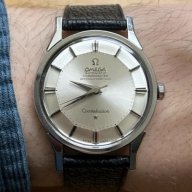
Caseback stickers for my 14900 Connie

Posts
498
Likes
410
Hi all,

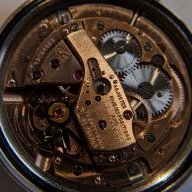
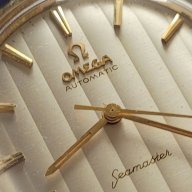
Strange title I understand. I’ve managed to acquire a 14900 ref pie pan in amazing condition that I plan to wear reasonably regularly, and as the caseback is in very good condition I would like to take the precaution of installing a sticker to keep it that way.

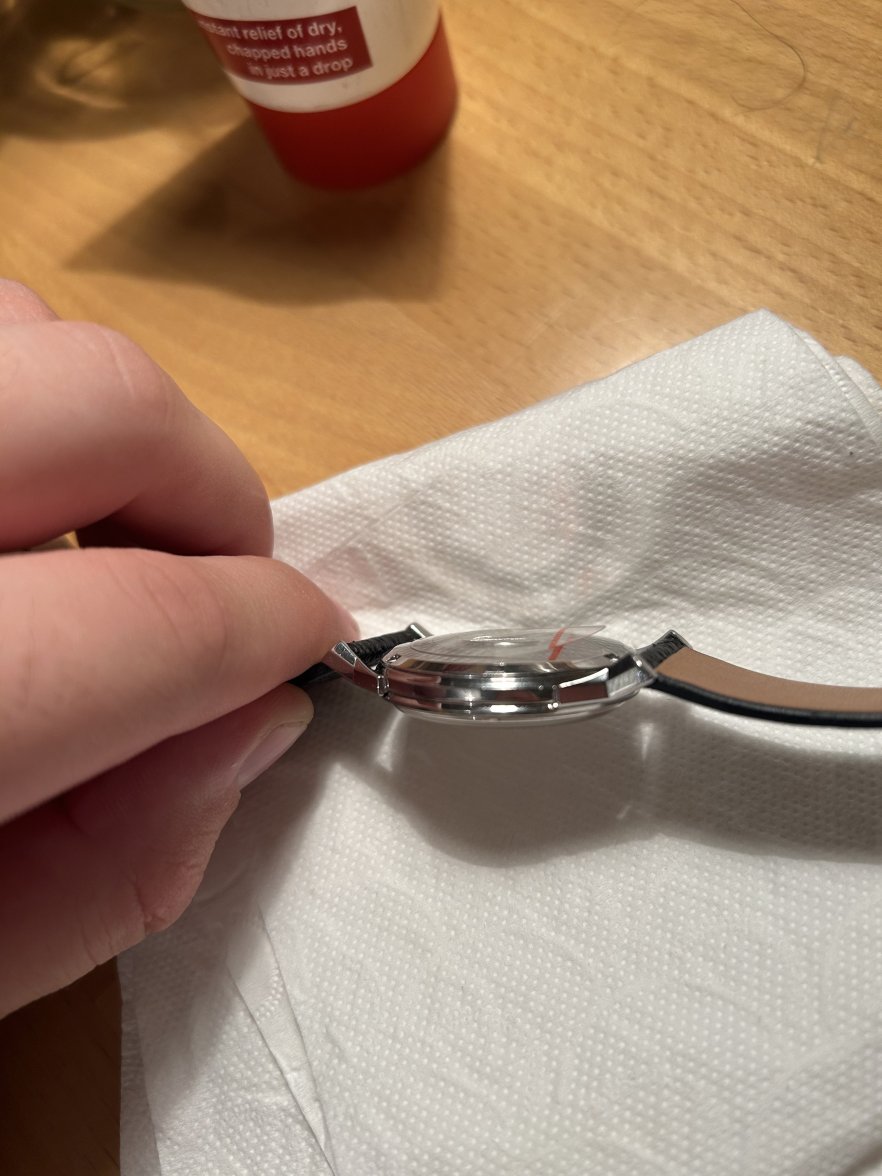
I’ve read and searched other threads many of which to say try Cousins UK who sell stickers, and I duly bought some - one in 20mm and the other in 25mm. However, due to the design of the caseback (that being it has a lip, as well as the raised emblem), and the fact that these stickers have a red edge to them without adhesive, the result is that they basically don’t adhere at all. A pic below shows what I mean. Can anyone offer any advice?

Thanks!
 
Posts
9,550
Likes
52,725
If you clean the caseback of sweat, oil secretions, etc. regularly, you don't need a case back protector. Just use a microfiber eyeglass cleaning cloth and lense cleaning solution and be gentle. The vast majority of Constellation casebacks that have badly faded observatory medallions, missing stars, etc. are the result of overpolishing, not day to day wearing.
Edited:
 
Posts
1,540
Likes
2,635
Well, I've put an exhibition caseback on my 14902 so I can see the 561. The original caseback now lives in the watch box, where the medallion shouldn't get scratched barring some crazy event.
 
Posts
7,580
Likes
13,991
I remember vinyl covered furniture back in the 60's....not a good look then, or now.

OP, unless you have skin like the Sandman from the Spiderman universe just wear your watch, its back will outlive you.
Edited:
 
Posts
498
Likes
410
If you clean the caseback of sweat, oil secretions, etc. regularly, you don't need a case back protector. Just use a microfiber eyeglass cleaning cloth and lense cleaning solution and be gentle. The vast majority of Constellation casebacks that have badly faded observatory medallions, missing stars, etc. are the result over overpolishing, not day to day wearing.
Thanks, that’s useful to know. It’s so common to see badly faded medallions so that’s what I’d like to avoid - however if it’s over polishing as you say then that’s fine.
 
Posts
16,307
Likes
44,983
Thanks, that’s useful to know. It’s so common to see badly faded medallions so that’s what I’d like to avoid - however if it’s over polishing as you say then that’s fine.
Overpolishing and clunking them down on bracelets on the dresser. Those clasps and links will cause micro-abrasions over the course of decades. If you wear it on a strap, keep it clean of dirt and debris (another micro-abrasive with friction against the skin) and put them on a soft surface at night, it shouldn’t do any damage.
I usually “place” my braceleted watches down on the dresser or put them back in their pillow (in my case cut pipe insulation) in the drawer at night.

Those stickers can actually do more harm than good as they start to peel on the edges and will trap dirt and grit and rub against the back as you wear it. Then when you peel it off you will have a ring of wear around the edges of where the sticker was
 
Posts
880
Likes
1,693
The best resting position for a wristwatch is on the side, crown up. Nothing touches the caseback and it's also the best position for the balance wheel pinions.
 
Posts
2,608
Likes
3,044
King Seiko's and Grand Seiko's etc. have medallions that rarely survive life, but props to Omega, most of them seem to have survived
 
Posts
7,111
Likes
23,095
The best resting position for a wristwatch is on the side, crown up. Nothing touches the caseback and it's also the best position for the balance wheel pinions.

Isn’t the balance wheel staff horizontal when the watch is on the side, thereby creating a moment arm? How would this be better that dial down for the balance?
 
Posts
498
Likes
410
Isn’t the balance wheel staff horizontal when the watch is on the side, thereby creating a moment arm? How would this be better that dial down for the balance?
I have to say I’ve not heard this one before. I’ve always heard the dial being face up is better as the balance wheel is horizontal and the staff rotates around a fixed point.
 
Posts
7,111
Likes
23,095
I have to say I’ve not heard this one before. I’ve always heard the dial being face up is better as the balance wheel is horizontal and the staff rotates around a fixed point.

Yes, the balance staff would be vertical in both dial up and dial down positions, no?
Edited:
 
Posts
880
Likes
1,693
If your watch rests dial up, the weight of the balance is supported by a single pinion. If it rests dial down, same but with the other pinion.

Crown up solves this issue.

A little clarification on my part: when I say it's the best resting position, I don't mean for timekeeping but durability of the movement.
 
Posts
7,111
Likes
23,095
If your watch rests dial up, the weight of the balance is supported by a single pinion. If it rests dial down, same but with the other pinion.

Crown up solves this issue.

A little clarification on my part: when I say it's the best resting position, I don't mean for timekeeping but durability of the movement.

So, if I’m getting this right, you’re saying less friction of the balance wheel when the watch is in a vertical position, rather than horizontal?
 
Posts
880
Likes
1,693
So, if I’m getting this right, you’re saying less friction of the balance wheel when the watch is in a vertical position, rather than horizontal?

Not really, just more even friction.
 
Posts
1,915
Likes
5,766
Holy Shit... came for the comments,

definitely not disappointed.