Can The 2021 Omega Speedmaster Moonwatch Professional Still Be Considered A Moonwatch?

Posts
922
Likes
493
This idea that “a moonwatch is what Omega says it is” is only nominally true.

When Omega markets a watch as a “moonwatch,” they’re trading on sentimentality and “heritage” behind the space mission and Omega’s roll in that story. So the view of “a moonwatch is what Omega says is a moonwatch” simply ignores the more substantive question many are attempting to discuss: whether Omega’s marketing is stretching too far any meaningful sense of actual sentimentality and heritage attached to a given watch.

A given watch’s actual connection to heritage and sentimentality can vary, despite Omega’s singular label.

It only casts Omega in a poor light if they're stretching the truth too far.
 
Posts
922
Likes
493
Still not sure why this criteria 👎👎😁

To bring focus to the aspects of what constitutes a Moonwatch.
Without the propper focus it becomes increasingly obtuse.

This thread is providing plenty to chew on as it is👍
 
Posts
24,232
Likes
53,964
Still not sure why this criteria 👎👎😁

According to the statement of specifications I have seen, manual winding was not a requirement. See #6.

STATEMENT OF SPECIFICATIONS

1. Accuracy - Must not gain or lose more than 5 seconds over a 24 hour period. Desirable to have an accuracy equal to or better than 2 seconds per 24 hours.

2. Pressure Integrity - The chronometer [sic] must be immune to large variances in pressure to include a range from 50 feet of water positive pressure to a negative pressure of 10 millimeters of mercury.

3. Readability - All disks, bands, and figures must be readable in various lighting conditions. The chronograph must be readable under both "red" and "white" lighting conditions to or beyond a 5 foot candle illumination intensity. Either a black face with white figures and numerals or black on white is satisfactory. The chronograph should not cause glare at the high illumination levels. A stainless steel case with a satin finish is preferred.

4. The chronograph must have stop-start elapsed dials with

a. Seconds to 1 minute
b. Minutes to 30 minutes
c. Hours to 12 hours or greater.

5. The chronograph must be shockproof, waterproof, and antimagnetic. In addition, the face cover must be shatterproof.

6. The chronograph may be powered electrically, manually or the self-winding type; however, it must be capable of being manually wound and re-set.

7. Reliability - the Manufacturer must guarantee the watch to operate properly under normal conditions for at least one year time period. Performance data and specifications should be supplied by the manufacturer. Manufacturer guarantee and/or warranty should also be included.
 
Posts
1,046
Likes
5,442
So I know who’s Dwight on this thread, but how many are Jim?
 
Posts
922
Likes
493
According to the statement of specifications I have seen, manual winding was not a requirement. See #6.

STATEMENT OF SPECIFICATIONS

1. Accuracy - Must not gain or lose more than 5 seconds over a 24 hour period. Desirable to have an accuracy equal to or better than 2 seconds per 24 hours.

2. Pressure Integrity - The chronometer [sic] must be immune to large variances in pressure to include a range from 50 feet of water positive pressure to a negative pressure of 10 millimeters of mercury.

3. Readability - All disks, bands, and figures must be readable in various lighting conditions. The chronograph must be readable under both "red" and "white" lighting conditions to or beyond a 5 foot candle illumination intensity. Either a black face with white figures and numerals or black on white is satisfactory. The chronograph should not cause glare at the high illumination levels. A stainless steel case with a satin finish is preferred.

4. The chronograph must have stop-start elapsed dials with

a. Seconds to 1 minute
b. Minutes to 30 minutes
c. Hours to 12 hours or greater.

5. The chronograph must be shockproof, waterproof, and antimagnetic. In addition, the face cover must be shatterproof.

6. The chronograph may be powered electrically, manually or the self-winding type; however, it must be capable of being manually wound and re-set.

7. Reliability - the Manufacturer must guarantee the watch to operate properly under normal conditions for at least one year time period. Performance data and specifications should be supplied by the manufacturer. Manufacturer guarantee and/or warranty should also be included.

Quite right.
However, the manual wind aspect is a definitive nod to all the originals in the entire lineage from Mercury through to Apollo, ISS and Shuttle programme.
Perhaps we may also consider the ultimate approval in way of the characteristics of the only type of watch that has recieved the Snoopy award😉
 
Posts
24,232
Likes
53,964
Quite right.
However, the manual wind aspect is a definitive nod to all the originals in the entire lineage from Mercury through to Apollo, ISS and Shuttle programme.
Perhaps we may also consider the ultimate approval in way of the characteristics of the only type of watch that has recieved the Snoopy award😉

Absolutely. Manual winding is an incredibly distinctive feature of the watch that was chosen. Emotionally, it would be hard to imagine a Moonwatch Speedmaster that wasn't hand winding.

In the context of the overall conversation on this thread (e.g. the discussion about rotor motion in microgravity), I just think it's interesting to note that NASA didn't require a hand-winding watch. They were perfectly willing to consider an automatic or electric watch.
 
Posts
795
Likes
1,157
According to the statement of specifications I have seen, manual winding was not a requirement. See #6.

..............................

I'm more concerned about #7.
 
Posts
3,998
Likes
9,018
In the context of the overall conversation on this thread (e.g. the discussion about rotor motion in microgravity), I just think it's interesting to note that NASA didn't require a hand-winding watch. They were perfectly willing to consider an automatic or electric watch.

Dan, we’re these specs pre-1969/70 (ie, before there existed an auto chrono)?

EDIT: never mind, I’d missed the bit in #6 - I suppose that suggests these were later qualifications, not those originally used for the first tests of watches?
 
Posts
24,232
Likes
53,964
Dan, we’re these specs pre-1969/70 (ie, before there existed an auto chrono)?

EDIT: never mind, I’d missed the bit in #6 - I suppose that suggests these were later qualifications, not those originally used for the first tests of watches?

This was from the original statement of specifications from Deke Slayton attached to the famous memorandum. Auto-winding chronographs were imminent, so apparently they were willing to consider them, as well as hypothetical electrical chronographs. Actually, now this makes me wonder about the first electric chronograph. Must be a tuning fork.
 
Posts
3,998
Likes
9,018
This was from the original statement of specifications from Deke Slayton attached to the famous memorandum. Auto-winding chronographs were imminent, so apparently they were willing to consider them.

That’s impressive; iirc the initial tests took place ~1965, which would place these specs a good 4 years prior to the first announcement of an auto-chronograph!

In either event, safe to say why an auto-chrono wasn’t chosen 😁
 
Posts
29,665
Likes
76,821
That’s impressive; iirc the initial tests took place ~1965, which would place these specs a good 4 years prior to the first announcement of an auto-chronograph!

In either event, safe to say why an auto-chrono wasn’t chosen 😁

Well...could say 18 years after actually...


Of course not in serial production, so clearly doesn’t count, but interesting nonetheless!
 
Posts
24,232
Likes
53,964
That’s impressive; iirc the initial tests took place ~1965, which would place these specs a good 4 years prior to the first announcement of an auto-chronograph!

In either event, safe to say why an auto-chrono wasn’t chosen 😁

You're right, the requisitioning was in late 1964. I'm sure @SpeedyPhill has posted this already somewhere, but I can't put my fingers on it.
 
Posts
3,998
Likes
9,018
Well...could say 18 years after actually...

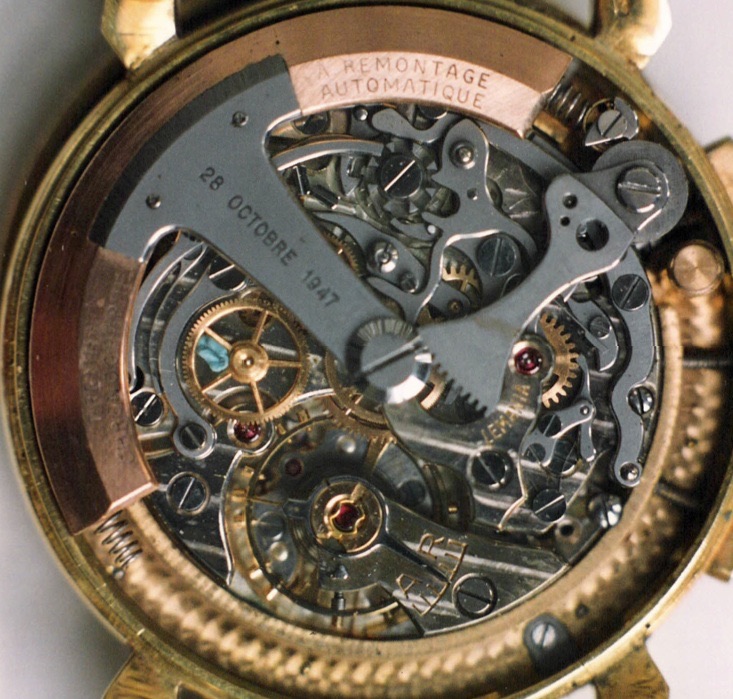
Ah this must be the Albert Piguet bumper prototype for Lemania?! I don’t think I’ve seen a photo before - cool

Fair enough!

I seem to remember Lemania’s response being basically that it’s “superfluous.”
 
Posts
4,698
Likes
17,795
Absolutely. Manual winding is an incredibly distinctive feature of the watch that was chosen. Emotionally, it would be hard to imagine a Moonwatch Speedmaster that wasn't hand winding.

In the context of the overall conversation on this thread (e.g. the discussion about rotor motion in microgravity), I just think it's interesting to note that NASA didn't require a hand-winding watch. They were perfectly willing to consider an automatic or electric watch.

There have been some good threads on Automatic Omega in Space. @SpeedyPhill has a lot of info and photos.
https://omegaforums.net/threads/176-007-and-cal-1040-family-review.32325/page-9#post-1686490
 
Posts
922
Likes
493
Absolutely. Manual winding is an incredibly distinctive feature of the watch that was chosen. Emotionally, it would be hard to imagine a Moonwatch Speedmaster that wasn't hand winding.

In the context of the overall conversation on this thread (e.g. the discussion about rotor motion in microgravity), I just think it's interesting to note that NASA didn't require a hand-winding watch. They were perfectly willing to consider an automatic or electric watch.

Yes, duly noted👍
Given the watches were routinely serviced and repaired. I wonder if NASA didn't see any potential problems with an auto wind as being an issue because anything that may have cropped up with them would've been dealt with.
Keep in mind that trips into space had only ever been for short periods of time until ISS.
Edited: