Amplitude test results and service (3510.50)

Posts
9
Likes
7
Hello all

I have recently bought a Speedmaster Reduced (3510.50) and just received timegrapher test results. The watch was bought based on description that the watch meets all tehnical requirements and that the test results is within an acceptable limit.

As I am quite new to the world of mechanical watches, my knowledge about reading a timegrapher is rather sparce. I can see from various sources that the amplitude should be approx 250-270.

I would be very happy if anyone is able to help me to analyse the numbers and tell if I should consider servicing this watch now or maybe wait until the warranty expires from the shop (1 year from now).

CH: Rate: +001 / Amplitude: 248 / Beat error: 0.3
6H: Rate: -002 / Amplitude 222 / Beat error 0.0
9H: Rate: -000 / Amplitude 223 / Beat error: 0.5
12H: Rate: -006 / Amplitude: 219 / Beat error: 0.4
3H: Rate: -004 / Amplitude: 215 / Beat error: 0.1
FH: Rate: -002 / Amplitude 248 / Beat error: 0.2

Rate difference: 0.07
Amplitude difference: 0.33

I've used the watch for a little under a week and it looses around 5 seconds a day when I wear it during the day and takes it off before I go to bed.

Please let me know if theres anything else you need to know in order to assess the numbers above.

 
Posts
5,522
Likes
9,437
Do you know the lift angle that was entered into the timegrapher?
 
Posts
29,669
Likes
76,828
In addition to the lift angler, we need to know if the watch was fully wound prior to the tests, and if the chronograph was running or not.
 
Posts
5,636
Likes
5,810
You "should have" manually wound it eleventy-thousand times before putting it on the first time as well.

I generally wear automatics to bed because tossing around winds them a bit during the night. That might work for you, it might not. There is no one answer that applies to everyone.
 
Posts
7,176
Likes
23,249
You "should have" manually wound it eleventy-thousand times before putting it on the first time as well.

I generally wear automatics to bed because tossing around winds them a bit during the night. That might work for you, it might not. There is no one answer that applies to everyone.

You raise an interesting point re: automatics with regard to wearing vs testing. The Omega website notes somewhere that winding an automatic 15 times prior to initial wearing is sufficient to allow normal activity to continue running the watch. But what about prior to putting on the timegrapher - 60 times or so?
 
Posts
5,636
Likes
5,810
You raise an interesting point re: automatics with regard to wearing vs testing. The Omega website notes somewhere that winding an automatic 15 times prior to initial wearing is sufficient to allow normal activity to continue running the watch. But what about prior to putting on the timegrapher - 60 times or so?
Omega does have a spec for that but I don't remember what it is. I'm sure @Archer does. But whenever I put on an automatic, I wind it at least 60 times, and each "wind" is probably 2 to 3 crown revolutions. Because of my musical training, I count in groups of four. 😀
 
Posts
29,669
Likes
76,828
The spec is "wind it fully"...😀
 
Posts
9
Likes
7
Thank you everyone for all the replies so far.

To Archer and BlackTalon:
During the test, the chronograph was not running. The watch was wound 40 turns before testing. I am not aware of the lift angle used - the seller seems a bit confused by this term. The test, now I just learned, was performed on a vibrograph. I don't know the difference between this testing method compared to a timegrapher.
 
Posts
478
Likes
490
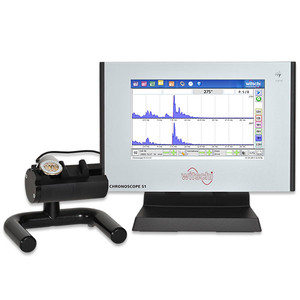
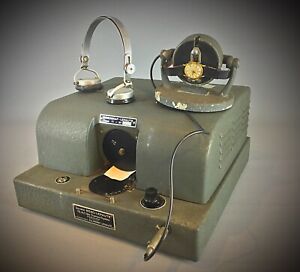
vibrograf is a brand. They could have used this

or that


Both are(were) built by Vibrograf

You say you buy it from a shop, and they are offering a warranty? I would not be very confident buying from a watch shop that does not know what a lift angle is...
Maybe you should ask again to ensure they ask the question to their watchmaker directly, in case the customer side is handled by someone who knows only about selling.
 
Posts
9
Likes
7
I bought from a trusted seller on Chrono24 with lots of good ratings and checkouts, who offers a 1 year warranty on the mechanic, but I can definitely see your point.
Edited:
 
Posts
328
Likes
244
If the watch is losing time as you mentioned minus 5 sec/day, then it may not be running within spec. It may need service or calibration. Purchasing a pre owned watch from secondary market reseller, or a private party, unless the watch was just serviced by the factory or an authorized service provider such as @Archer, then you should buy it based on the condition, and the completeness of the set with the plan that the price you pay, plus sending it off for service equals the price for a top grade piece. Hopefully you got a good price on the piece, and maybe what it needs is some service to make it good as new. If the seller claims to have a watchmaker but can't give you correct interpretation of the timegrapher, you may need the help of another watchmaker. I am sure you can get it sorted out and the watch will provide excellent service.
 
Posts
9
Likes
7
Rado, I think you are absolutely right. The watch is almost like new when you look at it from the outside - it is in absolute stellar condition. The price was good and if a service is needed quick i’ll do that of course although I would have preferred waiting with a service to after the warranty period.
 
Posts
24,242
Likes
53,989
Nothing is forcing you to have the watch serviced simply because it is running -7s/day.
 
Posts
29,669
Likes
76,828
Thank you everyone for all the replies so far.

To Archer and BlackTalon:
During the test, the chronograph was not running. The watch was wound 40 turns before testing. I am not aware of the lift angle used - the seller seems a bit confused by this term. The test, now I just learned, was performed on a vibrograph. I don't know the difference between this testing method compared to a timegrapher.

It will be a fairly modern machine if it's giving you amplitude. So most machines default to 52 degrees, and the lift angle for this movement is 51. This isn't a huge thing normally, but having the lift angle too high does skew the amplitude readings, and those are what concern me. So for every degree the lift angle is off, the balance amplitude will be off by about 6 degrees. In this case IF the lift angle was 52, then all your readings are actually about 6 degrees lower than what you show.

So your lowest amplitude is 215, so it would really be about 209. The thing is, the minimum balance amplitude that Omega allows 24 hours after full wind is 200 degrees in any position measured. If you are already as low as 209 (or even 215) at full wind, it is unlikely that 24 hours later you will be above 200. So this watch is not meeting Omega specs for balance amplitude, and amplitude is a measure of the health of the movement.

So although Dan is right when he says this:

Nothing is forcing you to have the watch serviced simply because it is running -7s/day.

If you paid a price for a movement that was meeting Omega specs, this one doesn't do that really, because of the amplitude, and also because the average rate is too low - it should fall between -1 and +11 for the Cal. 1143 and 3220 that are in the reduced.

So the question is how will these people service if it you send it back to them. Being a modular chronograph movement, many watchmakers don't service them at all, and many who do simply service the base movement and not the module. There is a mistaken belief that the module is only operating when the chronograph is running, and that's not the case at all - every hand on the dial that moves is part of that module, so the module is working all the time just the move the hour, minute and constant seconds hands. Servicing just the base movement is doing half the job.

Anyway, not sure what to tell you on how to proceed, but I would at least contact the seller and find out what they would do if you sent it back for service. But at least you know it's not what it should be, so your initial instincts were right.

Cheers, Al
 
Posts
9
Likes
7
Archer, thank you so much for taking your time. It is much appreciated.

I will talk to the seller and see if we can find a sensible solution.

The issues that needs to be attented to can easily be fixed during a service from a professional watchmaker who knows what they are doing, I suppose? I got plenty of those in my area.
 
Posts
9
Likes
7
Quick update; I received a small discount on the watch and I will put that amount (and some of my own money) in to a service in the near future by one of the good watchmakers in my area. A good solution I think based on the stellar outside condition of the piece.

I have now also had the watch looked at by my local watchmaker and he got similar timegraph results using the correct lift angle. He thinks a service makes sense.

Thank you so much for the help!
Edited:
 
Posts
4,815
Likes
12,193
Quick update; I received a small discount on the watch and I will put that amount (and some of my own money) in to a service in the near future by one of the good watchmakers in my area. A good solution I think based on the stellar outside condition of the piece.

I have now also had the watch looked at by my local watchmaker and he got similar timegraph results using the correct lift angle. He thinks a service makes sense.

Thank you so much for the help!

Sounds like a perfect solution!
 
Posts
792
Likes
918
I'm curious; the common opinion is that the Dubois-Depraz module in the 3220 is not serviceable and parts are not available.

I'm looking at the Omega Tech sheet for the module and not only does it describe servicing, but lists parts as Omega reference numbers. This would lead me to believe that they may be available to someone with an Omega parts account.

I've read opinions that replacing the module is considered part of a complete service. While I can't find a price on the DD 2000 module, a similar module (ETA 2894.8510) goes for $500, potentially adding that much or more to the service cost. I've also read opinions that the module has successfully been serviced and others that say it can be skipped.

Does anyone have experience with getting a module serviced or replaced and was it itemized in the cost. Again, just curious; I don't have a dog in the fight.

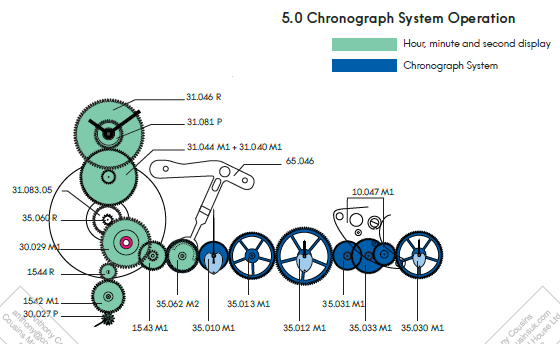
Also, to underscore Archer's point about the module being an integral part of the watch, here's the schematic from the tech sheet:


The base movement is depicted in white and the green gears are always in play. Part 35.060R is a gear pressed onto the seconds wheel (forth wheel) shaft and 31.083.05 is the cannon pinion driving wheel. The minute and hour hands are depicted at the top and the running seconds is at the bottom.
 
Posts
29,669
Likes
76,828
Omega doesn't sell the modules. So when people say "Oh the module gets replaced at service" my question is always, where are these modules coming from?