- Posts
- 60
- Likes
- 17
Sebastian Tombs
·Hell's teeth, I'll resurrect the sundial in that case, thanks for the heads up

You are welcome. Not an option for me unfortunately: the sun has been abolished in the United Kingdom in 1976.
Please consider donating to help offset our high running costs.
Hell's teeth, I'll resurrect the sundial in that case, thanks for the heads up




There is no benefit to the watch, regardless of how you place it, when it is off the wrist. However, there may be an effect to the rate of time keeping of the watch in the various positions. It can be useful to know which positions in which the watch gains, or loses, or maintains an accurate rate. To determine that, you would need to draw up a chart which has headers over a column for DATE, P/U (*), P/L (*), P/D (*), P/R (*), F/U (*), F/D (*), RATE GAIN, RATE LOSS, and RE-SET. Choose a time source that is convenient, and stick with it only. When you take the watch off, set it to your time source, mark your chart with date, mark position, place the watch in that position. Check the rate in the morning and mark seconds (fast or slow). If there is a position in which there is no variation, put a 0 in gain and loss.
Repeat the above each time after re-setting the watch, and you'll soon have an idea how to place it to compensate for rate variation when you wear it. Every watch is different as to how it might react to such a test. There is no "one size fits all" answer.
If you don't see predictable, repetitious rates over these tests, the watch might benefit from servicing. If you don't choose to go to all this trouble, wear it and enjoy it.
* pendant UP, pendant LEFT, pendant DOWN, pendant RIGHT, face UP, face DOWN.
I wouldn't have started it if only I Jihad the idea…



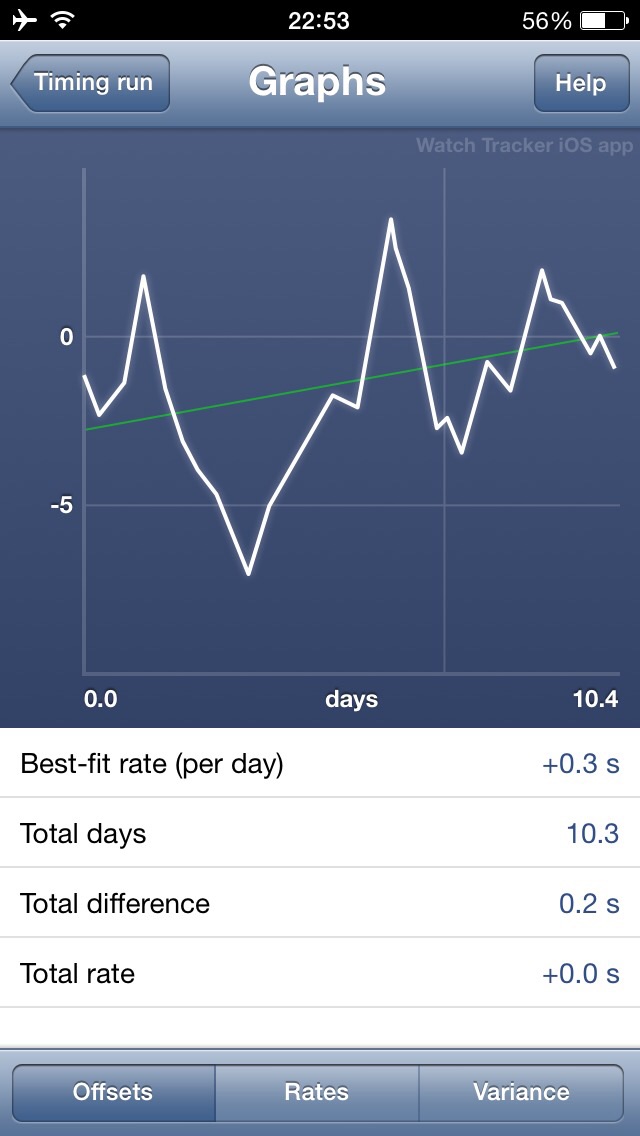
My Speedy Pro was displaying a change in accuracy since going overseas. I determined it was slightly magnetised. Back in the UK it would run a steady +2-5spd, and I'd rest it dial up overnight. Since de-magging it (I'm still overseas) I noticed it was running ever so lightly slow (maybe -1-3spd). I remembered that by resting it crown up, it ran slightly fast. Since then I've been tracking the accuracy. If it's a bit fast, I'll rest it dial up, or wear as normal (as it's a bit slow while on the wrist). If a slow, crown up. I've been doing this now for 10 days, and in that time it has gained a total of 1.2seconds!
I'm still a little concerned that the 'default' rate, i.e. on the wrist, is a little slow, but for now I'm happy I can self-regulate it, at least until get back to the UK.
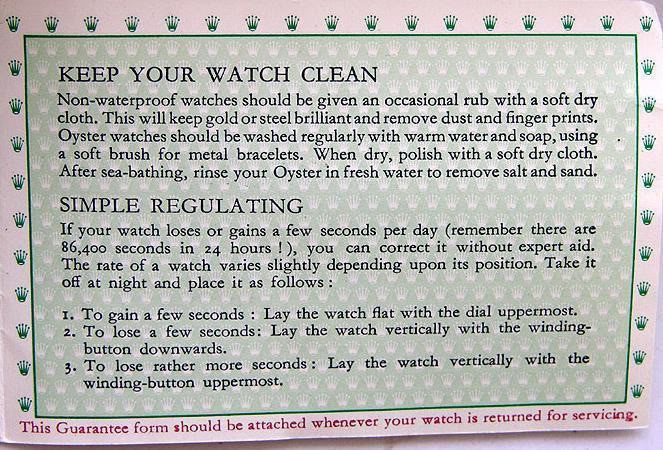
For the Rolex and as they state in the owner manual, if you rest your watch crown up and as vertical as posible it will loss some seconds, left the watch resting over the crown verticaly and it will gain some seconds. Years ago i've owned one and I've checked this and really work that way.
This works for Rolex, don't know about Omega 2500 or later, I think this variations could be possible thanks to the escapement, but on co axial's could be different.
On my actual Seamaster I always let it rest with crown up and is keeping good time (+2sec/day), it's only have five weeks of use.

This pops up from time to time.
Check this out: http://www.fourtane.com/fourtane-blog/keeping-your-rolex-accurate
Thank you for your contribution Maximus. I must admit that while I know that there may be slight variations depending on resting position, I wouldn't have thought this to be a phenomenon so 'measurable'. The way you describe the position you adopt for your watch in order to correct the rate either way is going to be very useful to me. When time (and will) allows I will start charting the rate of mine. I synchronised my Rolex with the British National Physics Institute's atomic clock NTP server last Monday at 9:20 a.m., I am waiting until tomorrow to check the accuracy of the watch for the first time. Wish me luck 😀 I then will see what can be done and if it can be trickled down to my Omega as well. Thanks again!