Acceptable Constellation accuracy?

Posts
221
Likes
169
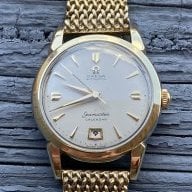
Jumping the gun here, prior to intended purchase, but just wondering what the 'acceptable' daily loss or gain (am presuming it would normally be a loss?) would be, for say a cal 561?
Thinking about how far you should allow the performance to deteriorate before having a service?

 
Posts
29,196
Likes
75,443
The timekeeping isn't a good indicator of the need for servicing. If the timekeeping is very bad or erratic, yes that can be an indicator of the need for servicing, however the opposite is not true. So if it runs fine, that doesn't mean it's fine inside.

Omega's timing specs for all Cal. 55X and 56X movements are as follows:

Average daily rate can be from 0 to +18 seconds per day.

Total positional variation, measured over 3 positions only for all movements, can be as much as 30 seconds at full wind, and 40 seconds 24 hours after full wind.

This is what Omega requires, but obviously any individual watchmaker can do better or worse, depending on skill level and how much money is put into the movement.

Cheers, Al
 
Posts
5,636
Likes
5,800
In your experience, how often can you get an "officially certified" chronometer to run to those specifications? So far I have avoided buying vintage chronometers for fear of them not being chronometers anymore.
 
Posts
92
Likes
115
My recently serviced 1972 Constellation 1021 was set to the second two days ago. It is currently 22 seconds fast.
 
Posts
909
Likes
4,359
My 1970 Cal 564 keeps to within two seconds a day. It was fully serviced, timekeeping slipped, was sent back for readjustment and now runs brilliantly when worn every day.
 
Posts
61
Likes
47
So I just checked my 1969 cal 682 Constellation (using toolwatch.io) and learned it’s gaining 16 seconds/day. This is acceptable, I gather?
 
Posts
5,636
Likes
5,800
So I just checked my 1969 cal 682 Constellation (using toolwatch.io) and learned it’s gaining 16 seconds/day. This is acceptable, I gather?
Hell no. Assuming it is certified, the standard is -4 to +6 in five positions. I'm sure I'm misremembering, so Al will be here in a few minutes. 😀 But assuming that watch has been serviced within the past few years, it should be closer than that.

But parts wear and you can't always find replacements and in a 70-year old watch, dozens of watchmakers might have been inside of it. That's why I do not (currently) own any chronometers that are older than 1990. Perhaps not a reasonable position, I just don't know....
 
Posts
29,196
Likes
75,443
Hell no. Assuming it is certified, the standard is -4 to +6 in five positions. I'm sure I'm misremembering, so Al will be here in a few minutes. 😀 But assuming that watch has been serviced within the past few years, it should be closer than that.

But parts wear and you can't always find replacements and in a 70-year old watch, dozens of watchmakers might have been inside of it. That's why I do not (currently) own any chronometers that are older than 1990. Perhaps not a reasonable position, I just don't know....

Please red post 2 in this thread...
 
Posts
5,636
Likes
5,800
Please red post 2 in this thread...
Yes, but if it's "officially certified", wouldn't it have originally met COSC specifications?

This is the part I'm not understanding. If it was "officially certified" when new, at what point do you find it reasonable that it no longer meets the certification requirements?
 
Posts
29,196
Likes
75,443
Yes, but if it's "officially certified", wouldn't it have originally met COSC specifications?

This is the part I'm not understanding. If it was "officially certified" when new, at what point do you find it reasonable that it no longer meets the certification requirements?

What each person finds reasonable or acceptable is up to them. I've outlined what Omega thinks is acceptable - as I've said numerous times, they do not make these run to chronometer status, regardless of that status when they were made. As I said individual watchmakers will do better or worse depending on a number of factors.

From a practical standpoint, for a watch of this age, if it was a chronometer or not when new has far less impact on performance than how it was treated over time, and how much money the current owner is willing to spend to get it running to whatever standard they deem is acceptable.
 
Posts
1,144
Likes
3,111
In your experience, how often can you get an "officially certified" chronometer to run to those specifications? So far I have avoided buying vintage chronometers for fear of them not being chronometers anymore.
I just looked back at the service doc Archer sent with my Constellation he worked on 3 years ago. Looks like he got it to right around 2 seconds per day.

If I'm being honest the fact that it was a chronometer didn't really mean anything to me when I bought the watch. I liked it the watch, I don't rely on it to save people's lives, so I bought it. 😀 The fact he got it to around 2 seconds fast a day is remarkable and not lost on me but if it was running 20 seconds fast a day I'd still wear it as much as I do now.
 
Posts
5,636
Likes
5,800
From a practical standpoint, for a watch of this age, if it was a chronometer or not when new has far less impact on performance than how it was treated over time, and how much money the current owner is willing to spend to get it running to whatever standard they deem is acceptable.

OK, thanks. This was my experience with the restoration of my KO 2627 with a caliber 355 movement. There was a lot inside that movement that was sufficiciently worn, and we made a point of sourcing NOS parts where possible, and my watchmaker inserted a bushing for the automatic-winding part. A little extra work in adjusting on his part and on my wrist it performs very well indeed.
 
Posts
61
Likes
47
Thanks for this helpful exchange. What I’m coming to understand is that the “chronometer” label was as much savvy marketing as any kind of fact. Yes, these watches were extremely accurate for their era, and yes, quality control at Omega was excellent. But nothing can guarantee continuing accuracy at that level beyond the moment the watch left the factory. I’m pretty happy with my slightly fast mechanical beauty ♥️
 
Posts
29,196
Likes
75,443
Thanks for this helpful exchange. What I’m coming to understand is that the “chronometer” label was as much savvy marketing as any kind of fact. Yes, these watches were extremely accurate for their era, and yes, quality control at Omega was excellent. But nothing can guarantee continuing accuracy at that level beyond the moment the watch left the factory. I’m pretty happy with my slightly fast mechanical beauty ♥️

Yes and no. For these movements specifically, there are no real differences between the chronometer rated movements and the regular movements. For example all the materials used are exactly the same. However, these did get much more adjusting work done on them at the factory, to bring them within the tolerances for chronometers.

In more modern watches, there are often real differences in the materials used for things like the balance wheel, the balance spring, and the mainspring on the chronometer certified movements, compared to the regular movements. All these things contribute to better accuracy and allow the watches to easily pass COSC certification.