- Posts
- 743
- Likes
- 2,545
bradurani
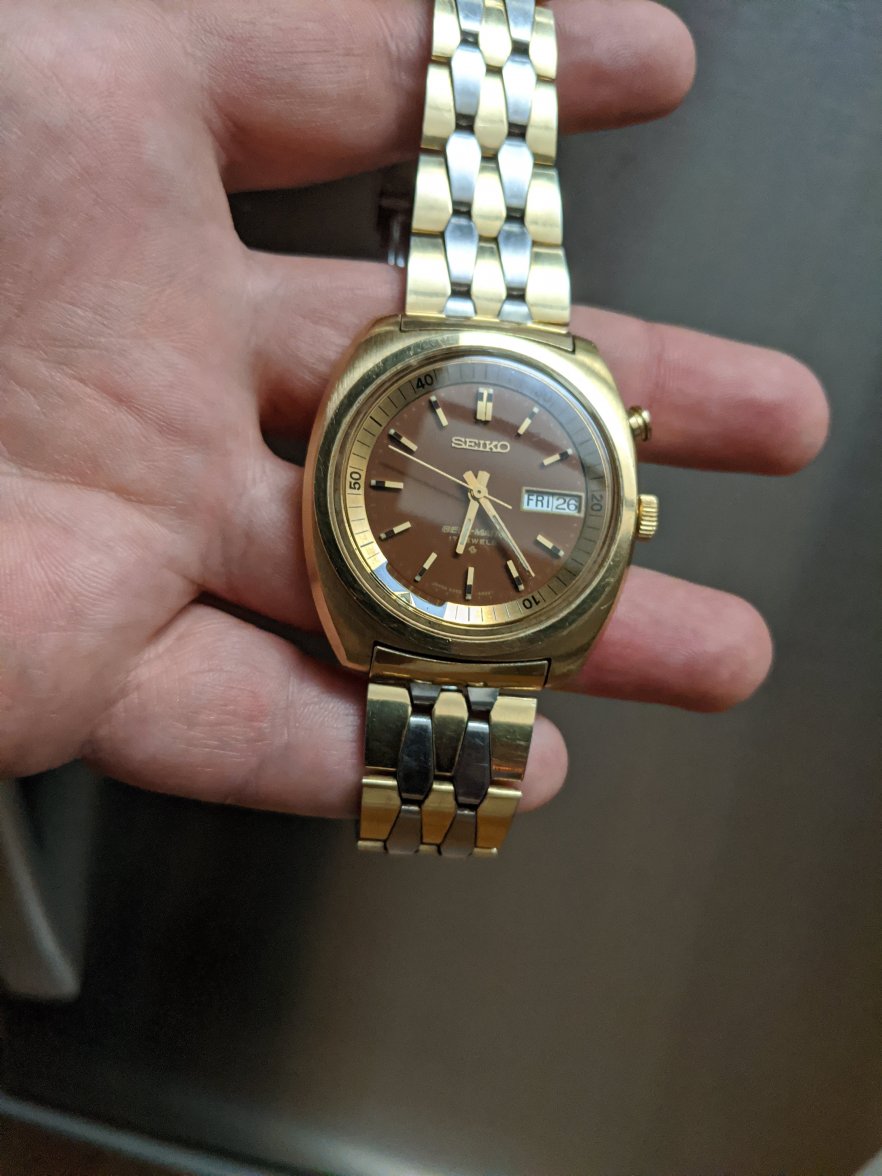
·I found a treasure at a local store yesterday, a funky two-tone version of the Seiko 4006 BellMatic from 1971. I collect vintage Seiko, so I plunked down $150 for it, even though I didn't really covet this model. "Meh, I'll keep it in the box a few months, wear it a few times then flip it", I thought.
Then I posted pics to IG, and another collector reached out enquiring if I'd sell it. A few Google searches and I priced it at $300, with the smug satisfaction that I could double my money in a matter of hours with an easy flip.
Then a funny thing happened. I phoned a friend who suggested it's worth closer to $500. It being gold-plated, they never show up in good condition, like mine, with the plating intact, so I should ask $450.
My college economics professor will tell you that because decisions are rational, I should now be even more smug and sell without hesitation. If it was a good deal selling at $300, it's a better deal at $450. Alas, we are not rational. The realization that my piece was coveted, made me covet it more. Suddenly, the unique two-tone coffin-link bracelet and oh-so-70s brown dial are boldly attractive to my greedy eyes. Why was I ever considering selling it? I want to keep it forever.
It has long been known that consumers are not rational. This has spawned the rise of Behavioral Economics, a branch which accepts this as a foundational tenet, and is now the dominate branch of econ in many areas.
I'm not sure if the particular bias I've fallen for has a name, but it seems like the opposite of anchoring bias. Regardless, its influence is powerful. I've already moved the BellMatic from my backup case to my main case.
To be clear, it's not that I've decided to hold the watch because it's worth more (an economic choice), it's that knowing someone else wants it made me like its funky style and unique colors more. That's not rational, but it is very, very human.

Then I posted pics to IG, and another collector reached out enquiring if I'd sell it. A few Google searches and I priced it at $300, with the smug satisfaction that I could double my money in a matter of hours with an easy flip.
Then a funny thing happened. I phoned a friend who suggested it's worth closer to $500. It being gold-plated, they never show up in good condition, like mine, with the plating intact, so I should ask $450.
My college economics professor will tell you that because decisions are rational, I should now be even more smug and sell without hesitation. If it was a good deal selling at $300, it's a better deal at $450. Alas, we are not rational. The realization that my piece was coveted, made me covet it more. Suddenly, the unique two-tone coffin-link bracelet and oh-so-70s brown dial are boldly attractive to my greedy eyes. Why was I ever considering selling it? I want to keep it forever.
It has long been known that consumers are not rational. This has spawned the rise of Behavioral Economics, a branch which accepts this as a foundational tenet, and is now the dominate branch of econ in many areas.
I'm not sure if the particular bias I've fallen for has a name, but it seems like the opposite of anchoring bias. Regardless, its influence is powerful. I've already moved the BellMatic from my backup case to my main case.
To be clear, it's not that I've decided to hold the watch because it's worth more (an economic choice), it's that knowing someone else wants it made me like its funky style and unique colors more. That's not rational, but it is very, very human.