What would affect daily accuracy? UPDATE

Posts
404
Likes
330
Well, it's been running at about 3-3.5 secs a day for the last few days. The last 24hrs has seen a jump of 8secs though! I'm not panicking by any stretch, but it's unusual so I'll be keeping an eye on it. I'm going to be here in these much warmer conditions for another few weeks yet so I hope it'll settle down.
 
Posts
404
Likes
330
Well, it was bought brand new in November last year and went for servicing under warranty shortly after that so I should hope not!
 
Posts
2,326
Likes
1,884
A shock could do that for a day or two as the shock protection settles back 100% into position. You'll have to watch it for a couple of days.

Tom
 
Posts
1,325
Likes
1,870
Does anyone know if going through airport screening can affect watch accuracy?
 
Posts
404
Likes
330
That is another thought that had crossed my mind, as I had to go through 2 scanners on my journey out here. I don't think they do affect them though. If it did, I would expect gains much more than a few seconds extra per day.

I'm still scratching my head a little on this one. It's a shame I exposed the movement to a shock almost as soon as I got here, as I now can't differentiate that from the atmospheric/altitude affects.

Does anyone know if the Bellagio boutique would look at a regulation for me?
 
Posts
2,326
Likes
1,884
It's not time to panic yet. Jumping that much in one day is nothing. If it's a trend over a week, then that's something significant. I had thought that you were watching it for a while.

Tom
 
Posts
16,863
Likes
47,901
Does anyone know if going through airport screening can affect watch accuracy?

No not at all have worked at airports and sea ports for over 15 years and gone through scanners many times daily and never had a drama..
 
Posts
34,267
Likes
38,886
No not at all have worked at airports and sea ports for over 15 years and gone through scanners many times daily and never had a drama..
Yea but in Northern Territory airports all they bother checking is that you're wearing clean thongs, under the 15 beer limit for boarding and not smuggling any illegally caught fish.
 
Posts
16,863
Likes
47,901
Only airport lounge in Australia where thongs and singlets are still allowed 🤦
 
Posts
1,023
Likes
762
So would the 1863 movement withstand more or less shock in comparison to the new co-axial movements. I mean the moonwatch has been proven to take a beating and remain accurate, but has technology surpassed it that much?
 
Posts
29,672
Likes
76,830
So would the 1863 movement withstand more or less shock in comparison to the new co-axial movements. I mean the moonwatch has been proven to take a beating and remain accurate, but has technology surpassed it that much?

The co-axial escapement by itself does not add any shock resistance. There are other features on the newer watches (8500 and 9300 based watches) that would have some value in terms of shock resistance, but only if you are referring to it in terms of affecting accuracy of the movement, rather than damage.

Modern watches all have shock protection on the balance staff pivots, so regardless if it is regular Incabloc, Kif, or the new system that Omega is using, I don't think there is any significant difference in how those systems protect the staff from breaking during a shock. If there was, Omega would be screaming t from the mountain tops at every opportunity. So the likelihood of having a broken staff from dropping the watch for example, is probably about equal with all those systems with all else being equal (mass of the balance, diameter of pivots, hardness of pivots, etc.)

What is an advantage on the newest movements is the free sprung silicon balance spring. First off, a free sprung balance does not have a regulator that can move with a shock, so in order to affect the accuracy it takes a shock big enough to distort the balance spring. Since balance springs have little mass, that means it takes a large shock to distort them. Second is the silicon material the spring is made of the in latest watches. When I was at Omega for training on co-axial watches, they showed us the silicon spring just by itself. As they passed it around the room, we were encouraged to grab onto the stud of the spring with our tweezers, and pull the spring straight up, until we stretched into basically a straight line shape. I did that, and then let it back down, and the spring returned to it's previous shape - a metallic balance spring would not fare well at all doing this test...it would be permanently and severely deformed.

So the spring is much less likely to go out of shape, both in actual use, and when being worked on. I see many remarks about the incredible accuracy of the newest "co-axial" movements, but that accuracy really has little to do with the escapement - it comes from that silicon spring. If you were to use that same balance spring technology on a traditional Swiss lever escapement watch, you would get the same results...

Hope this helps.

Cheers, Al
 
Posts
1,023
Likes
762
The co-axial escapement by itself does not add any shock resistance. There are other features on the newer watches (8500 and 9300 based watches) that would have some value in terms of shock resistance, but only if you are referring to it in terms of affecting accuracy of the movement, rather than damage.

Modern watches all have shock protection on the balance staff pivots, so regardless if it is regular Incabloc, Kif, or the new system that Omega is using, I don't think there is any significant difference in how those systems protect the staff from breaking during a shock. If there was, Omega would be screaming t from the mountain tops at every opportunity. So the likelihood of having a broken staff from dropping the watch for example, is probably about equal with all those systems with all else being equal (mass of the balance, diameter of pivots, hardness of pivots, etc.)

What is an advantage on the newest movements is the free sprung silicon balance spring. First off, a free sprung balance does not have a regulator that can move with a shock, so in order to affect the accuracy it takes a shock big enough to distort the balance spring. Since balance springs have little mass, that means it takes a large shock to distort them. Second is the silicon material the spring is made of the in latest watches. When I was at Omega for training on co-axial watches, they showed us the silicon spring just by itself. As they passed it around the room, we were encouraged to grab onto the stud of the spring with our tweezers, and pull the spring straight up, until we stretched into basically a straight line shape. I did that, and then let it back down, and the spring returned to it's previous shape - a metallic balance spring would not fare well at all doing this test...it would be permanently and severely deformed.

So the spring is much less likely to go out of shape, both in actual use, and when being worked on. I see many remarks about the incredible accuracy of the newest "co-axial" movements, but that accuracy really has little to do with the escapement - it comes from that silicon spring. If you were to use that same balance spring technology on a traditional Swiss lever escapement watch, you would get the same results...

Hope this helps.

Cheers, Al
I'll never get tired of listening to your wealth of knowledge Al.
So in terms of modern technology the silicon balance spring (found in all Omega co-axial's or just 8500 / 9300?) is what's made the biggest improvement in both accuracy as well as wear & tear.
 
Posts
29,672
Likes
76,830
I haven't gone through all the variations to see what has silicon and what doesn't, but off the top of my head none of the 2500's or the 3313 have the silicon spring - they have metallic balance springs, but they are free sprung so no regulator. The 3330, and the later versions of the 8500 family have the silicon spring (originally the 8500 didn't have it), and the 9300's have it.

And yes, I would say this spring has the biggest impact on accuracy - to be able to serially produce basically perfect balance springs, and have them maintain their shape is a big thing in terms of producing consistent accuracy. They still have to be regulated, and if improperly done this can cause poising errors, but these springs are the main source of the consistent accuracy you see. That's not to say a regular old Swiss lever with a regulator on it can't be as accurate, just that it takes more work/skill to get there.

Wear and tear - that's a whole other subject. Omega stated quite clearly in the training I attended that the sole purpose of the co-axial escapement was to extend service intervals. Those extended service interval claims started out much longer than they ended up. The claims made are questionable in my experience. The escapement is just one part of a larger groups of parts with many lubrication points that form the watch movement, and I can tell you that I rarely get watches in for service that the only problem with them is the escapement lubrication...so does eliminating* lubrication there really make a significant difference? What about the rest of the movement? You don't have to be a watchmaker to figure out the answers...

Cheers, Al

* - lubrication still required on the co-axial - not for friction but it acts as a cushion to protect the co-axial wheel from getting chewed up like this:

 
Posts
1,023
Likes
762
I haven't gone through all the variations to see what has silicon and what doesn't, but off the top of my head none of the 2500's or the 3313 have the silicon spring - they have metallic balance springs, but they are free sprung so no regulator. The 3330, and the later versions of the 8500 family have the silicon spring (originally the 8500 didn't have it), and the 9300's have it.

And yes, I would say this spring has the biggest impact on accuracy - to be able to serially produce basically perfect balance springs, and have them maintain their shape is a big thing in terms of producing consistent accuracy. They still have to be regulated, and if improperly done this can cause poising errors, but these springs are the main source of the consistent accuracy you see. That's not to say a regular old Swiss lever with a regulator on it can't be as accurate, just that it takes more work/skill to get there.

Wear and tear - that's a whole other subject. Omega stated quite clearly in the training I attended that the sole purpose of the co-axial escapement was to extend service intervals. Those extended service interval claims started out much longer than they ended up. The claims made are questionable in my experience. The escapement is just one part of a larger groups of parts with many lubrication points that form the watch movement, and I can tell you that I rarely get watches in for service that the only problem with them is the escapement lubrication...so does eliminating* lubrication there really make a significant difference? What about the rest of the movement? You don't have to be a watchmaker to figure out the answers...

Cheers, Al

* - lubrication still required on the co-axial - not for friction but it acts as a cushion to protect the co-axial wheel from getting chewed up like this:

So interesting Al.

Bringing it back to the Speedmaster. How do the newer movements fair (2500/8500/9300 etc) next to the modern 1861/3? Which do you see coming in for service more and for different needs?
 
Posts
29,672
Likes
76,830
I don't keep detailed statistics like this, and even if I did they could be incredibly misleading. I service far more watches that are not co-axial than those that are. One of the primary reasons a co-axial ends up on my bench is for the escapement - sticky residue on the intermediate escape wheel. This is a design problem, and although there is a work around on these, the real solution is to use a different version of the co-axial (which is what Omega has done). I have written on this quite a lot so if you search here and at WUS Omega forum, you can find more details...
 
Posts
404
Likes
330
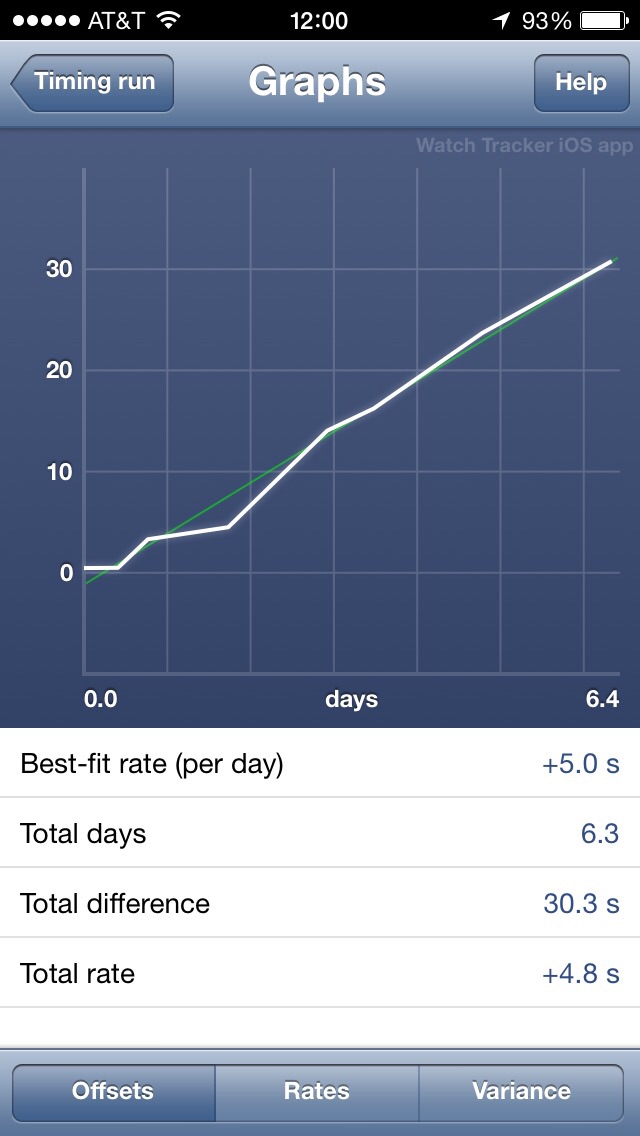
So, I've been experimenting a little with my 1863, and have some data although I'm not entirely sure as to what conclusion can be drawn.

I used the watch normally for 6 days, recording the accuracy about once a day, winding roughly at the same time each day. I was doing the same activities I did at home on the UK, and it rested dial up for about 8 hours each night. Here are my findings...


As you can see, it's a reasonably steady rate of +5spd. Remember back in the UK, and prior to banging it against a door handle, it was running at a consistent +2spd

So, I tried not wearing it for a couple of days. I left it resting dial up in a draw, only picking it up to wind each morning. In 2 days it gained less than a second! The consistent position, temperature etc meant it ran perfectly! I then wore it last night for approx 2.5 hours, set it down again overnight and re-measured this morning. It had gained 3.5secs! This equates to the rate of +5spd again!

So, what can I draw from this? Maintaining the watch in a constant state of rest, with no positional, temperature or shock changes means the watch is bang on accurate. As soon as I start to wear it, the rate shoots up. As it does not lose anything when resting, I'm just making sure it doesn't get any worse really, until the next day of wear!

I'm still drawn to the fact that the daily rate is +3spd faster where I am now in than in the UK. Taking positional differences out of the equation (as my activities remain the same) there a two main differences. One, the shock it sustained as soon as I arrived here. Could this have diminished the capacity of the watch to remain accurate during normal use, sustaining the usual positional and slight shock variances? I.e. the watch is affected more now by positional variance due to something that has changed inside the watch? Two, the climate here is much different than in the UK. It's is much hotter, and temperature gradients are more severe (the heat of outside vs air con in a vehicle or indoors). It is also much less humid (don't know if that has an effect). Also, the altitude is higher here, going from +2,500-3100ft AMSL here vs pretty much sea level back home.

I have tried to be objective and apply some sensible reasoning to my thoughts, however my lack of real technical knowledge about mechanical watches and the movement itself means I have limited understanding of potential effects.

If you have read this far, I thank you, and welcome any further comments, suggestions etc you may have. Although I'm not overly worried, as it is still performing even to chronometer standards (just!) I am in a process of learning more and more about watches, and my watch, and because I had +2spd, that is the standard I set my watch to, and would like to know if I can get it back!

Cheers!

 
Posts
1,634
Likes
1,125
I think the most interesting thing will be if it goes back to 2s when you come back to the UK. If so, something to do with the geographical change. If not, the bang.
 
Posts
404
Likes
330
That is something I had considered actually, and it would indeed be interesting. However, I am not back in the UK for another month so that's a long time to wonder!
 
Posts
2,326
Likes
1,884
Watchmakers will tell you that the Incabloc (or whatever) returns immediately.

For 97%, likey true.

That last 3% seems to be significant.

Tom