Watch story thread

Posts
15,234
Likes
44,729
Here I am again, whether you’re ready or not.

More years ago than I can recall, the missus told me of a watch that was coming up at a local auction, and that I might be interested in it. I went to the preview. I was interested.

This watch came as you see it, in a burgundy vinyl case, with a linen sachet with the name of the watch case maker on it (Keystone Watch Case Co.), and the red cardboard outer shell. To this day, I find it difficult to ascertain whether this watch has ever been used. In the pictures, you will see the original recipient’s initials, hand engraved on the case back. Inside the case back is the story about the original owner. Beyond the story told by the engraving, I know nothing about the original owner.

The watch is a 1924 model, 17-jewel, Waltham Colonial (12-size), in a solid 14-karat yellow gold Keystone case.
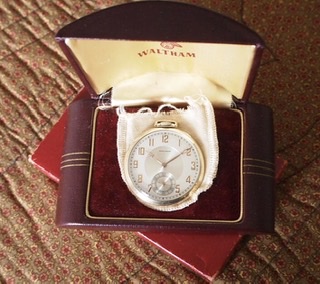

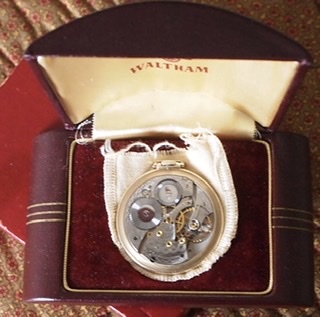
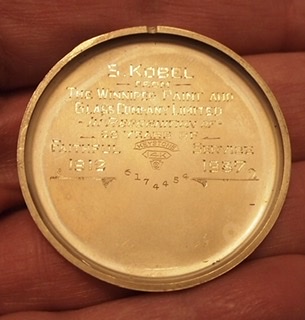
The hand engraved inscription inside the case back Indicates that it was presented by the Winnipeg Paint and Glass Company Limited (Winnipeg, Manitoba) In Recognition Of 25 Years of Faithful Service 1912-1937.

These are among the things I don’t know. Was this a retirement gift, or just a 25th anniversary of his employment? How old was he when he started? What was his position with the company? Why did he not use the watch? How is it the family let it go for less than the scrap value of the case? They family’s loss is my gain. Truth to tell, I don’t use the watch either. It is presently 83 years old, and has been serviced once, (by me). Will it ever fall into the hands of an owner who will use it? Who knows!
 
Posts
15,234
Likes
44,729
A bump, and a story, not about a watch, but a watch attachment.

My maternal grandfather was born in England, in about 1865. As a young man, he learned to play the cornet, and was a constable, and member of the London Police band. He had the honour of performing before Queen Victoria in the London Crystal Palace which was built for the Great Exposition in 1851. I have his Boosey & Hawkes silver plated cornet which I don’t play. He married my grandmother, likely circa 1890, and they started a family.

After his police service, he joined the British Army, probably in about 1895. He was a sergeant in the army during the Boer War (1899-1903). He had experience as a butcher and a shoe maker, talents likely picked up at various times over his youth. These talents were to come in handy.

By about 1905, he and my grandmother had 3 children. My grandparents were lured by advertising placed in the media in England, speaking in glowing terms of the opportunities available to those who migrated to Canada. They sold everything except the clothes on their back, and everything of value or was otherwise portable, and sailed to Canada. They took a homestead in central Saskatchewan, near the village of Waldheim.

The children rode horseback to school, and they went barefoot all summer long so there was money to buy winter clothing and boots. My grandfather plied his talents as a butcher and shoemaker, both for their own benefit, but a lot of bartering was done with neighbours. Bartering came in handy when there was little or no money. Cold storage for food was done by lowering sacks down the family well, suspended above the water.

They bought a prefabricated house by catalog, from the Eatons department store. It was shipped by rail to somewhere close, then transferred by sled (in winter) to their homestead. The homestead cost $10.00 for 160 acres, and you had two years to improve it, and turn it into a working farm.

By 1909, three more children arrived, including my late mother. I had the good fortune in about 1980, to join a family reunion on the site of the original farm which was then in the middle of a wheat field. The house had been moved off the farm, and to a town nearby. During the reunion, I had chance to tour the house. It was built when a 2x4 was 2” x 4”, not 1 3\4” x 3 3/4” as they are today. My grandmother didn’t weigh 100 pounds soaking wet. She was a Londoner born and bred, and I have NO idea how she would have coped with six children, living in an un-insulated house in the middle of nowhere, about 110 years ago.

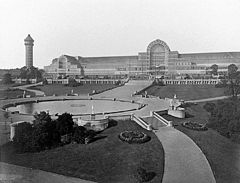
I have included a picture of my grandfather in his London police uniform taken circa 1895, a picture of the Crystal Palace which was destroyed in the mid 1930s, and also the subject of this post. The chain shown on the front of his tunic was probably not the same chain as I show below.

My grandfather’s 9-karat rose gold Waldemar pocket watch chain. Sadly, there is no hallmark or date letter, though each of the links is stamped 9-karat. I am assuming it was made circa 1890. Attached to the chain is an English half sovereign coin dated 1897, and my 14 karat gold pen knife. The picture of the Crystal Palace is from 1884.

.
 
Posts
15,234
Likes
44,729
Tuesday afternoon. I have only been out of the house three times in the last two weeks, other than to attend to icy sidewalks. Some folks might view this inactivity to be retirement. If this is retirement, you can have it!

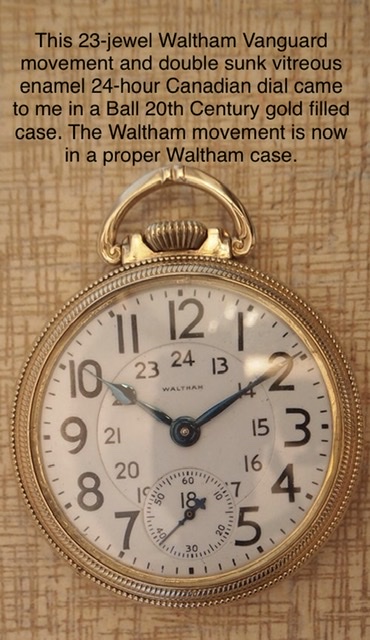
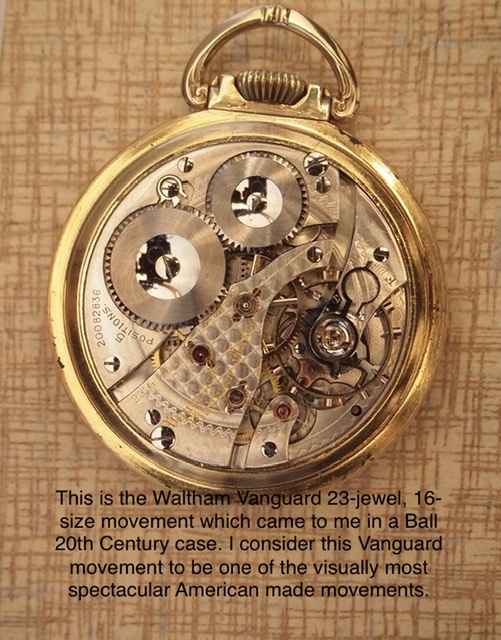
I recently told the story of two pocket watches in my collection. I showed the picture of a 16-size ORRS Ball (Hamilton) in a Ball 20th Century case. I also showed the only picture I had on hand of a Waltham 23-jewel Vanguard which was a poor photo. But at that time, it was the only picture I had. The Vanguard had mistakenly found its way into my friend’s collection. I have the watch back. I won’t reiterate the story, but I will show the complete picture story, including better pictures of the Waltham.

 
Posts
901
Likes
4,167
A great outcome. I love the Vanguard movement especially. Your posts have reminded me that my wife has a nice Waltham chronometer somewhere - watch this space.....
 
Posts
15,234
Likes
44,729
A great outcome. I love the Vanguard movement especially. Your posts have reminded me that my wife has a nice Waltham chronometer somewhere - watch this space.....

You are committed! We’re going to watch for your post.😀
 
Posts
4,758
Likes
12,040
You are committed! We’re going to watch for your post.😀

Agreed @lindo we are counting on you for future entertainment.
 
Posts
901
Likes
4,167
You are committed! We’re going to watch for your post.😀

OK, here it is, but I just noticed my typo - it is a chronograph, not a chronometer.

As I have mentioned on other posts, my wife is an inveterate (read obsessive/compulsive) collector of any old stuff from antique shops, auctions, markets and fairs that takes her fancy. She has a finely honed sense for quality, and an eagle eye for a bargain.

This has included picking up some very nice watches over the years. This Waltham chronograph came from a rather run down auction house that she was visiting to look at some jewellery - she liked the watch and went for it, much to the consternation of a watch dealer who was expecting to pick it up for a song. She still has it and has so far not succumbed to my blandishments.

 
Posts
15,234
Likes
44,729
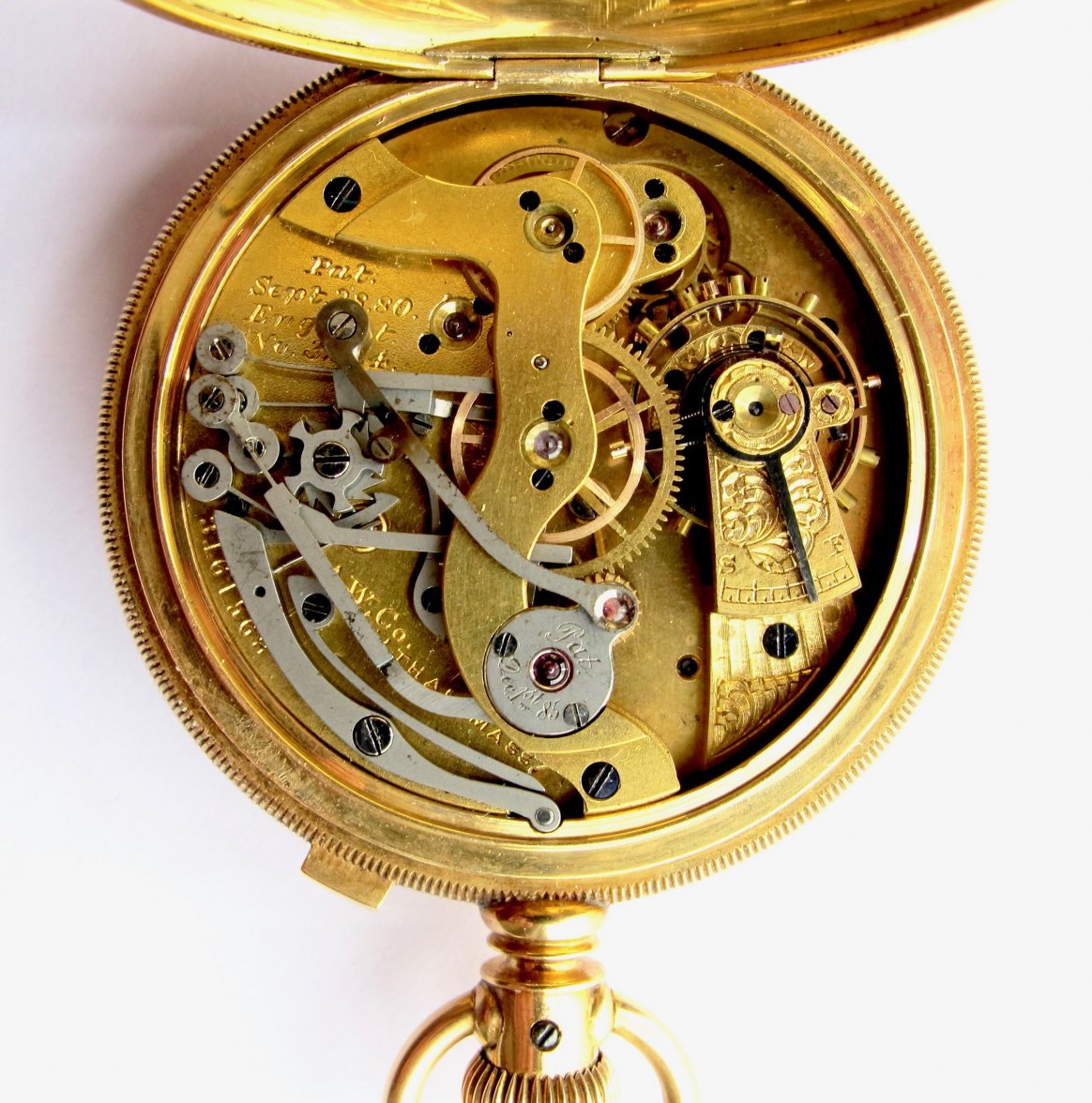
Now that is one rare bird! And in superb condition. The Waltham book calls it a 14-size, Model 1884 with 13-jewels, 3/4 plate, stem set. Produced during a run of 2,800 of that model. An 18-karat gold case with case paper intact. These were also produced in. 15-jewel model. What is odd is that the Waltham Grey book calls that an open faced model, but it is clearly a hunter. That is if I am reading the S# correctly. Nice!
 
Posts
4,758
Likes
12,040
OK, here it is, but I just noticed my typo - it is a chronograph, not a chronometer.

As I have mentioned on other posts, my wife is an inveterate (read obsessive/compulsive) collector of any old stuff from antique shops, auctions, markets and fairs that takes her fancy. She has a finely honed sense for quality, and an eagle eye for a bargain.

This has included picking up some very nice watches over the years. This Waltham chronograph came from a rather run down auction house that she was visiting to look at some jewellery - she liked the watch and went for it, much to the consternation of a watch dealer who was expecting to pick it up for a song. She still has it and has so far not succumbed to my blandishments.


Exquisite piece. Is it running seconds at 9 and 15 minute counter for the chrono at 3?
 
Posts
15,234
Likes
44,729
The margin of the dial is marked in increments of 25, to a total of 300. Anyone care to speculate on what that is all about? My guess is that this scale is used for dividing seconds into fifths (5 beats per second, 300 beats per minute.) at present, the seconds hand is indicating 4.0 seconds. At 5 beats per second, you might be able to see the logic in my reasoning. 4.2 seconds, 4.4 seconds, 4.6 seconds, 4.8 seconds, 5 seconds (or 25 beats of the escapement).
 
Posts
4,758
Likes
12,040
The margin of the dial is marked in increments of 25, to a total of 300. Anyone care to speculate on what that is all about? My guess is that this scale is used for dividing seconds into fifths (5 beats per second, 300 beats per minute.) at present, the seconds hand is indicating 4.0 seconds. At 5 beats per second, you might be able to see the logic in my reasoning. 4.2 seconds, 4.4 seconds, 4.6 seconds, 4.8 seconds, 5 seconds (or 25 beats of the escapement).

I cannot imagine another explanation. Keen observation @Canuck
 
Posts
15,234
Likes
44,729
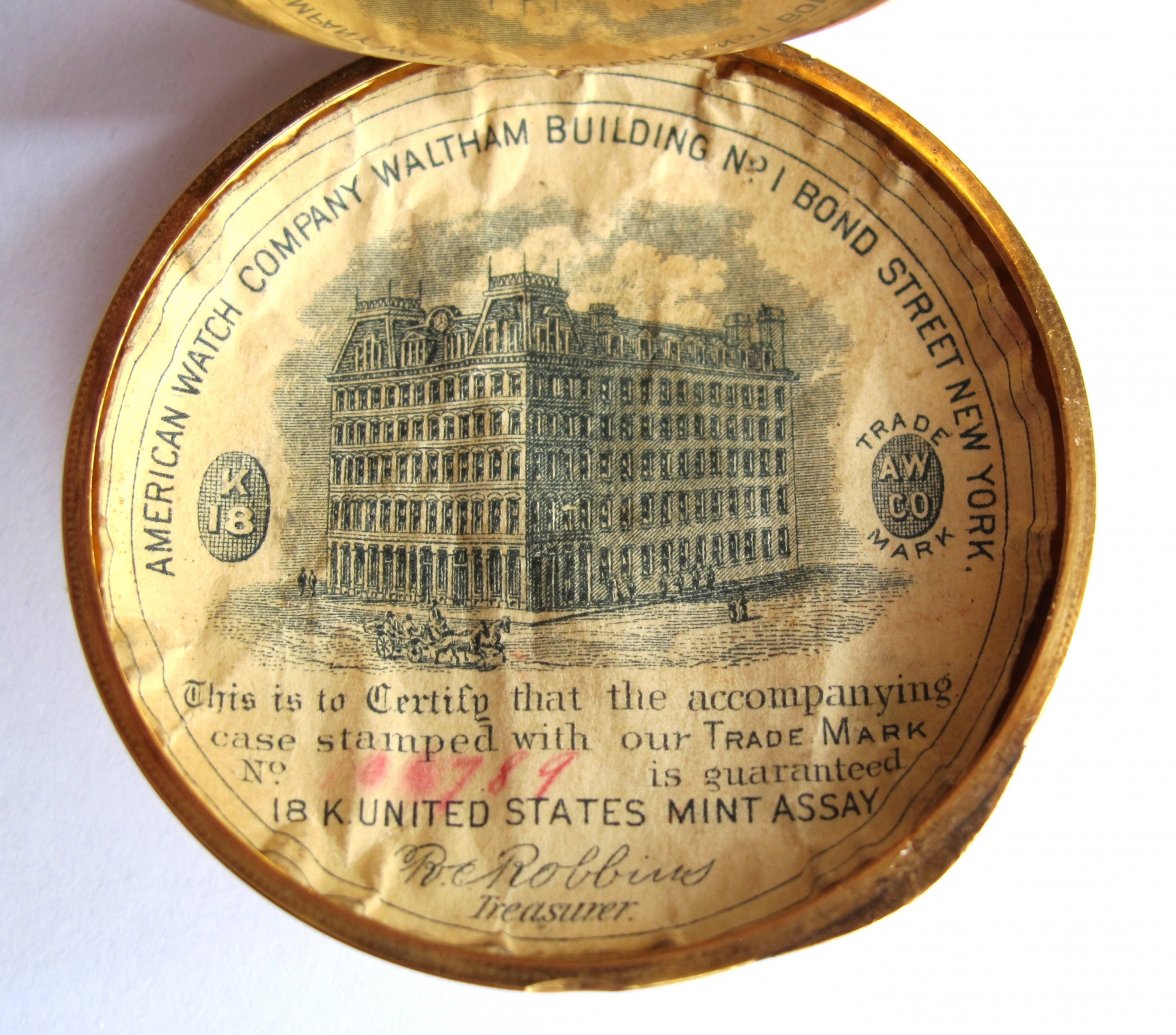
The name on the case paper in your chronograph, R Robbins, Treasurer, is significant. Royal (his first name) Robbins was a huge influence over the watchmaking industry in the U S. He was one of the reasons that Waltham became the significant firm that it became. In 1857, Robbins was in partnership with Appleton in the wholesaling of watches. Ownership,of the firm that became Waltham was up for grabs. Robbins saw promise in the firm and bought it at auction. He was heavily involved with Waltham for many years.
 
Posts
901
Likes
4,167
Thanks @Canuck. You have provided extra information that I had not found on line (probably not looking in the right places). It is another example of how the existence of this Forum and its knowledgable members adds real value to what we know about items. Your stories in this thread are a classic example of watchmaking history.

I much prefer owning watches that I can connect with someone or something, or that are key examples of a brand's history and technological development. Thanks for keeping the thread going.
 
Posts
15,234
Likes
44,729
Thanks @Canuck. You have provided extra information that I had not found on line (probably not looking in the right places). It is another example of how the existence of this Forum and its knowledgable members adds real value to what we know about items. Your stories in this thread are a classic example of watchmaking history.

I much prefer owning watches that I can connect with someone or something, or that are key examples of a brand's history and technological development. Thanks for keeping the thread going.

Any item can be said to have sentimental value as well as intrinsic value. Your Waltham had only marginal sentimental value since you have so little connection to its past. And marginal intrinsic value since you knew so little about it. Hopefully now you have a greater sense of sentimental AND intrinsic worth in it.

The 1884 model chronograph was available both in open faced and hunter models (yours). The same basic movement was used in both models. I have included an image of the open faced model which you will see has the subsidiary dials vertical, while your hunter cased model the subsidiary dials are horizontal. This was done by rotating the same movement 90° in the two cases. This Waltham movement was developed by Waltham, based on patents by H A Lugrin of New York.

 
Posts
15,234
Likes
44,729
A bump, and another watch with a story. Let me know when you’ve had enough.

My late father was a Depression era watchmaker who plied his trade right up until he passed away at age 76, in 1976. This might possibly apply to more than just the trade of watch repair. These years were prior to fax machines, the internet, and otherwise easy access to everything (almost) that you might need. You didn’t throw very much away because you never knew when you might need it.

When I started going to my late father’s watch repair shop on Saturdays, at age 8 years, he gave me a metric micrometer, a ruler, a box of 1,000 manila envelopes, and a drawer the was 8 inches across, 8 inches deep, and two feet long. It was full,of broken watch mainsprings he had accumulated over ten years (at that point in 1948), and he wanted me to measure width, thickness, and length, Mark the dimensions of each spring an a Manila envelope, and file it in a drawer. I learned how to read a micrometer.

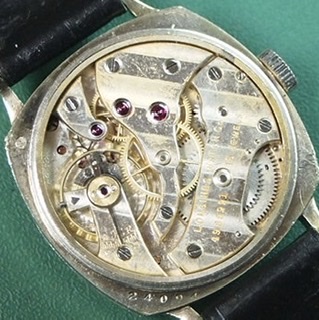
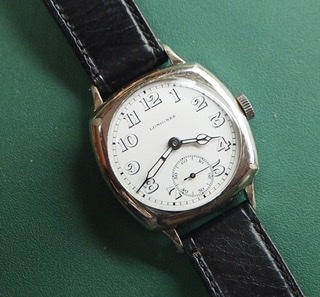
When he passed away in 1976, I inherited the residue from his business, including parts, tools, and hundreds of orphan watches and movements. One of these is the subject watch. A late 1920s Longines gent’s watch.

It had a good vitreous enamel dial, a decent white gold filled, Canadian made case, but a horrible movement that had been repaired dozens of times, and was finally beyond doing anything with. That carcass had existed in a drawer full of hopeless cases since 1976 when I inherited all his stuff. This thing ran, sort of, but it was shot!

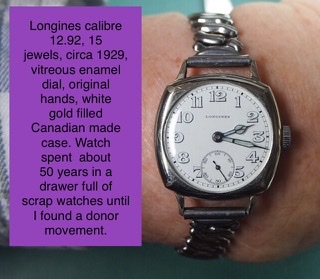
Several years ago, a friend visited an elderly retired watchmaker friend in Denmark, and he came back with several watches. One of them was a ratty Longines in a totally worn out gold filled case, and horrible dial. But the movement was the same as mine, and it was in much better shape.

I took my dial and my case, and his movement, and presto, the watch you will see pictured. I love it.


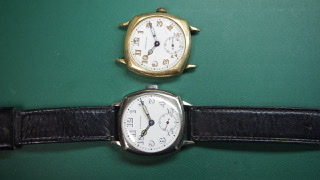
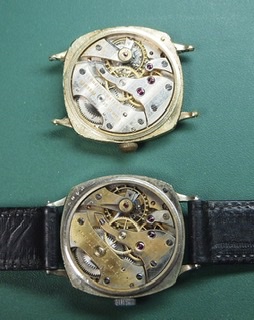
Above, The donor watch, top. My watch, bottom.
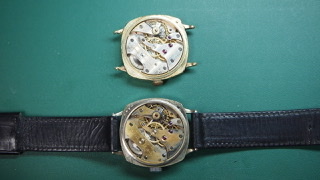
Below,the donor watch top, my watch, below. U G L Y movement, worn out, washed up.


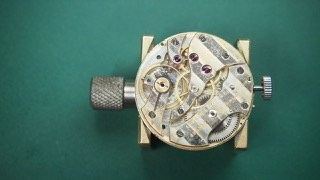
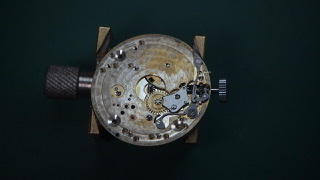
Below, the movement from the donor watch stripped, and cleaned. Below right, the donor movement re-assembled and running.


RR

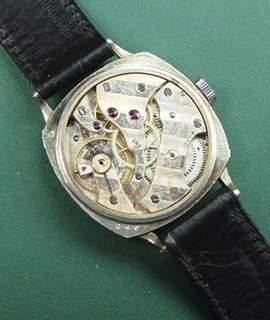
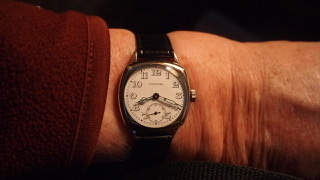
Above, the donor watch movement finished, the dial from my watch fitted to it, movement in my white gold filled case, the finished watch, and assorted views on the wrist. Another watch with a story.
 
Posts
4,758
Likes
12,040
Below, the movement from the donor watch stripped, and cleaned. Below right, the donor movement re-assembled and running.

Above, the donor watch movement finished, the dial from my watch fitted to it, movement in my white gold filled case, the finished watch, and assorted views on the wrist. Another watch with a story.

I enjoyed the story and do like the watch. I like the hand style. Does this watch have lumed hands, but no lume one the dial? Also, what is the case size?
 
Posts
15,234
Likes
44,729
Both the donor watch and mine have the same hands, so I assume they are original. I have heard the hand style called skeleton. The dials are a match, the dial on the donor watch is rough but still having some lume left, and mine probably had lume at one time, but it had likely been removed more than 50 years ago. The hands on both watches had traces of lume on the hands. I re-lumed the hands on mine. The case measures 30 mm from 3 to 9, and 34 mm diagonally.

I have had the watch since my father died in 1976, but I am certain it had lain dormant in my late father’s stash for decades prior to that. I did all the work on it about two months ago. I still have the movement that was originally in this case. It’ll do for spares.
 
Posts
2,326
Likes
1,884
Both the donor watch and mine have the same hands, so I assume they are original. I have heard the hand style called skeleton. The dials are a match, the dial on the donor watch is rough but still having some lume left, and mine probably had lume at one time, but it had likely been removed more than 50 years ago. The hands on both watches had traces of lume on the hands. I re-lumed the hands on mine. The case measures 30 mm from 3 to 9, and 34 mm diagonally.

The dial companies will relume the dial and hands for you with generally good success (as I am sure you probably know). Everest Watch Works in USA does a FABULOUS job, but you pay more.

Tom
 
Posts
4,758
Likes
12,040
Both the donor watch and mine have the same hands, so I assume they are original. I have heard the hand style called skeleton. The dials are a match, the dial on the donor watch is rough but still having some lume left, and mine probably had lume at one time, but it had likely been removed more than 50 years ago. The hands on both watches had traces of lume on the hands. I re-lumed the hands on mine. The case measures 30 mm from 3 to 9, and 34 mm diagonally.

I have had the watch since my father died in 1976, but I am certain it had lain dormant in my late father’s stash for decades prior to that. I did all the work on it about two months ago. I still have the movement that was originally in this case. It’ll do for spares.

I like how you have done the lume, overall the watch has a very clean look.
 
Posts
15,234
Likes
44,729
The dial companies will relume the dial and hands for you with generally good success (as I am sure you probably know). Everest Watch Works in USA does a FABULOUS job, but you pay more.

Tom

I have only ever had one dial refinish include a re-lume. It was done by Kirk Dial of Kent Washington, who do excellent work. On the one dial they did for me, the lume was not well done. I returned it and had the lume removed. The guy who gave me the donor watch called me last week. He’s been back to Denmark, and has brought back more watches. I have told him about this Longines, and suggested he’ll probably want it back. If he does, he’ll get the newly finished watch, the reject parts movement from my original watch, and his ratty case, back. That is, if he wants it, and we can agree on price. I’ll let him worry about the lume if he buys it.