Using Screw head positions to "fingerprint" a movement

Posts
2,921
Likes
14,963
I was recently reading an article about the provenance of a vintage Rolex 6265 owned by the prominent watch collector, John Goldberger:
https://perezcope.com/2022/12/31/rolex-daytona-6265-the-unicorn-frankenstein-plot/

In the article, the author says "The markings on the case are identical and all screw head positions are a perfect match which can be considered unique like a finger print." He then illustrates that with this picture to prove his point. His main point is that the screw head line positions can be used like a fingerprint to uniquely identify a watch movement (over and above other identifiers on the movement)

221230-comp-rolex-daytona-6265-2877587-white-gold-unicorn-goldberger-movement-case-2010-vs-2018.jpg


I don't have enough vintage Rolex knowledge to know who's right or wrong in this case, but it made me wonder about a few things, and I thought I'd ask forum members (pardon my ignorance).

1. I'd imagine that an untouched movt would have the various screws all in a particular line pattern which could act as a 'fingerprint'. But after servicing, would the screw head line positions change? (I think so, but I'd like to know from the experts)

2. For any movement, the position of the screw heads would vary I guess between different watches with the same movement inside? Eg. two Rolex 6265s with the same movement inside, when opened, would have their screw heads lines in a different positions I think? (which would validate the idea of the 'fingerprint' as in the link above).

Thanks in advance!
Edited:

 
Posts
4,593
Likes
10,810
Yes for sure different movements of the same caliber would have different screw head positions. Chances are the same movement after a service would retain approximately the same clock positions of the heads as well, providing the screws were tightened to around the same torque.
 
Posts
433
Likes
830
an interesting concept, I will try to note the positions of the screwheads before and after a service next time and see if they do indeed stay the same.

My feeling is they wouldn't, but I also don't know the exact process of how the screws are held when they are slotted, i.e. would every screw thread be in the same position with respect to the slot.

Most movements use multiples of the same type of screw, and I only ever worry about the correct type of screw going back into the corresponding hole, and not making sure its the exact same screw that came out.
 
Posts
3,402
Likes
13,196
Read that article yesterday night and was wondering if a discussion about it would start here… The screw head positioning is certainly a start. 😁
 
Posts
24,257
Likes
54,012
an interesting concept, I will try to note the positions of the screwheads before and after a service next time and see if they do indeed stay the same.

My feeling is they wouldn't, but I also don't know the exact process of how the screws are held when they are slotted, i.e. would every screw thread be in the same position with respect to the slot.

Most movements use multiples of the same type of screw, and I only ever worry about the correct type of screw going back into the corresponding hole, and not making sure its the exact same screw that came out.

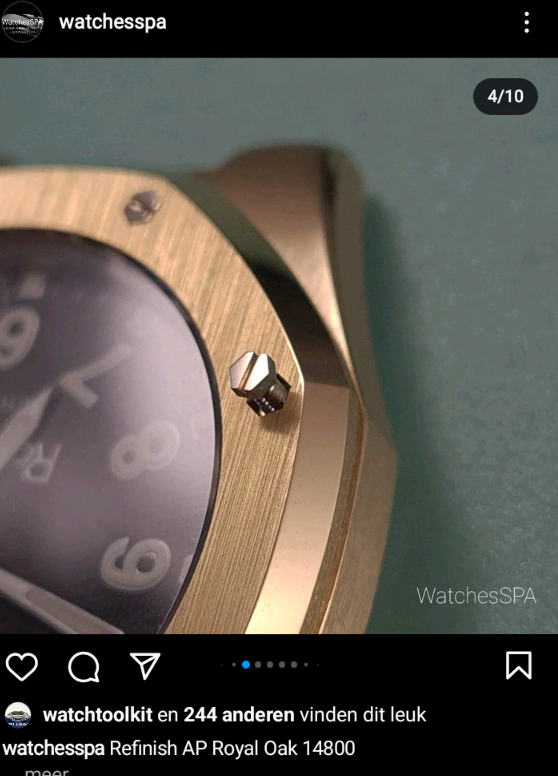
I agree. I can't imagine that many watchmakers ensure that the same screws go back into the same holes. The only screwhead positions that people worry about are those on a Royal Oak bezel, and of course those are tightened differently, allowing control over the slot orientation.
 
Posts
1,372
Likes
2,000
IIRC, the screws on the APRO bezels are actually double headed with the heads in the front held stationary at the correct position as the ones in the back are tightened.
 
Posts
24,257
Likes
54,012
IIRC, the screws on the APRO bezels are actually double headed with the heads in the front held stationary at the correct position as the ones in the back are tightened.

👍
 
Posts
5,990
Likes
28,668
IIRC, the screws on the APRO bezels are actually double headed with the heads in the front held stationary at the correct position as the ones in the back are tightened.
Yes:
 
Posts
24,257
Likes
54,012
👍

Yes, the screwheads are captive. Even so, I've occasionally seen them in the wrong orientation when reassembled by someone who didn't pay attention to details.
 
Posts
15,478
Likes
45,849
I was recently reading an article about the provenance of a vintage Rolex 6265 owned by the prominent watch collector, John Goldberger:
https://perezcope.com/2022/12/31/rolex-daytona-6265-the-unicorn-frankenstein-plot/

In the article, the author says "The markings on the case are identical and all screw head positions are a perfect match which can be considered unique like a finger print." He then illustrates that with this picture to prove his point. His main point is that the screw head line positions can be used like a fingerprint to uniquely identify a watch movement (over and above other identifiers on the movement)

221230-comp-rolex-daytona-6265-2877587-white-gold-unicorn-goldberger-movement-case-2010-vs-2018.jpg


I don't have enough vintage Rolex knowledge to know who's right or wrong in this case, but it made me wonder about a few things, and I thought I'd ask forum members (pardon my ignorance).

1. I'd imagine that an untouched movt would have the various screws all in a particular line pattern which could act as a 'fingerprint'. But after servicing, would the screw head line positions change? (I think so, but I'd like to know from the experts)

2. For any movement, the position of the screw heads would vary I guess between different watches with the same movement inside? Eg. two Rolex 6265s with the same movement inside, when opened, would have their screw heads lines in a different positions I think? (which would validate the idea of the 'fingerprint' as in the link above).

Thanks in advance!

I’d suggest that in the intervening years between 2010 and 2018, the subject movement has not been dismantled. Many of the stand-off screws are dedicated to specific positions in the mechanism. So chances are, they’ll line up after re-assembly. Some of the screws used as examples in the images were not likely have been removed because they are not screws! They are eccentric cams used for adjusting the depth of mesh of the chronograph wheels. Plate screws are the colour of another horse. Many of them are likely identical, so when the watch is assembled with the plate screws in alternate positions, the slots will not line up. I am led to ask what the purpose of this post is!
 
Posts
2,842
Likes
4,537
Try finding screws in the assortment box for 5 AS 1187/94 scrap movements. Let alone which screw goes to what movement.

I do recall when scratch building a watch, the challenge was to make them go all the same way. There are also tools which shave off under the head to control the depthing. I have a screw polishing table, which can be used to control how long the screw is. Normally this is used to polish the head.

Hopefully I can find that Val-72 eccentric, making one would be a pain. Those things are glass hard (why turning one in an old movement is not a good idea.)
 
Posts
24,257
Likes
54,012
I am led to ask what the purpose of this post is!

The blog that was linked in the OP traces the history of a "unique" watch that sold for more than $6M at auction and demonstrates that it was the same watch that sold years before, but in very different condition, and with different external parts (e.g. dial and bezel). The positions of the screwheads, along with distinctive marks on the case, are used as evidence. To me, the evidence is totally compelling, and apparently led the owner of the watch to admit that the watch had been "restored."
 
Posts
29,672
Likes
76,830
IIRC, the screws on the APRO bezels are actually double headed with the heads in the front held stationary at the correct position as the ones in the back are tightened.

Yes, they are bolts, not screws...
 
Posts
1,954
Likes
5,908
Not with me overtightening them they wouldn't.
 
Posts
29,672
Likes
76,830
I agree. I can't imagine that many watchmakers ensure that the same screws go back into the same holes.

Indeed, that is not a thing watchmakers do. You will often have many of the same type in one movement, so as long as you use the right type, nothing else matters...
 
Posts
1,954
Likes
5,908
Indeed, that is not a thing watchmakers do. You will often have many of the same type in one movement, so as long as you use the right type, nothing else matters...

NO! But wait, what about my fingerprint movement and resale value?! 😁
 
Posts
2,921
Likes
14,963
Thanks everyone for the info provided in the various posts - very enlightening indeed, and as always, I learned something new! The other related thread gives more background to the post too, very helpful reading if you're curious.
Edited: