- Posts
- 1,778
- Likes
- 3,535
Ron_W
·I wish we had some solid insight into exactly which process they actually used,

In the 1960s, printed aluminium watch bezels (like those on vintage Rolex Submariner and GMT-Master models) were created through a multi-step process of machining, anodizing, and stenciling. This method provided a durable, lightweight alternative to fragile, cracking materials like Bakelite. [1, 2, 3, 4]
The production sequence involved:
- Stamping and Machining: Thin aluminium discs were stamped out and machined with precise notches and inner/outer diameters to fit the watch case. [1]
- Anodizing: The aluminium was anodized—an electrochemical process that creates a thick, protective oxide layer on the metal's surface. This layer also made the metal porous so it could accept dye. [1, 2, 3, 4]
- Color Dyeing: The metal rings were submerged in chemical dyes to get the desired color (e.g., black, or a mix of red and blue for the famous "Pepsi" bezels). [1, 2, 3]
- Masking and Printing: To print the numerals and hash marks, a mechanical mask was placed over the dyed aluminium. Enamel or lacquer paint was then applied to the exposed areas via early pad printing techniques, filling the recessed areas with bold white or gold paint. [1, 2, 3]
- Sealing: Finally, the bezel was treated with a sealing process to lock in the color and protect the printed paint from moisture and salt water. [1]
A Hallmark of Vintage Bezels
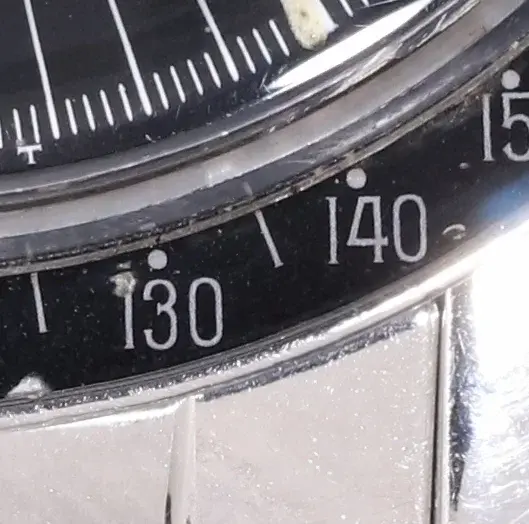
Because the stenciling masks were often cut using early, less precise pantograph or mechanical milling techniques, 90-degree angles were nearly impossible to achieve. As a result, the markers and numbers from 1960s bezels feature rounded, organic corners rather than the sharp lines seen on modern laser-etched ceramic bezels. [1]