Just wanted to say, I didn't intend this thread to be only about archery, so if people want to talk about other events please go ahead.
But since some have expressed an interest in watching some archery, I thought I would explain how the scoring and event works.
Way back when I started shooting in the 70's, the method of determining the winner was pretty simple - everyone shoots some arrows in a pre-determined format (called a FITA round, actually 2 of them over 4 days), and at the end of the event, whoever had the most points wins. Each arrow is worth 10 points, and 288 arrows are shot over the event, so the scoring was out of 2880 points. This was the format when archery was brought back into the Olympics in 1972.
But the IOC was grumbling to various sports (including archery) that they needed to be more "TV friendly" and watching that style of archery tournament is about as exciting as watching grass grow. Often winners were known long before the event was over. So after some other experiments that used essentially the same format but cut the numbers of archers remaining in the field as the event went along (called the Grand FITA, which was last shot in 1992 going from memory), by 1996 they had revamped the format completely.
Now you shot a ranking round, which will start in about 11.5 hours in Japan, and this is ranks the archers from top to bottom. 64 men and 64 women (yes not many, and typically in a year the Olympics is one of the smallest archery events there is). That total is out of 720, so now only 72 arrows shot for ranking purposes.
Then the next stage is the single elimination format. Archer ranked 1 shoots against archer ranked 64, 2 against 63, and so on. Single elimination, so one loss and your tournament is over. The only time you can lose and still advance is in the semi-finals, where you would then shoot for bronze. This is the overall format that is used to this day for the individual competition.
Back in 1996, which was the first Olympics of this new format, the way you won a head to head match was to shoot a number of arrows (in the early rounds of the event it was 18 arrows, and in the later stages it was 12 arrows) and whoever had the most points at the end of those arrows won the match. I shot many tournaments using this format, and in some I won against much stronger archers, and some I lost against much weaker archers, and for the most part the majority of archers were not fans of this format.
The reason was simple - it became apparent over time that this format introduced a factor of randomness into the event that meant that the best archers wouldn't advance on a regular basis. You still had to be good to win, but in an 18 or 12 arrow match, one mistake even a small one, meant that you would crash out of the event. It was a big adjustment, because in the old format that was the norm back in 1972, over the 288 scoring arrows shot, you could make a mistake or two and still recover, but when you live and die by a fraction of that number of arrows, the stakes on every single shot are exponentially higher. There were instances where the 64th ranked person beat the 1st ranked person, either because one person made a small error, or the other one got lucky for 18 arrows, and then crashed out the next round. Some archers started to refer to it as a lottery rather than a competition - personally I think that goes too far, but I understand the concerns certainly, and it brought up great debates about what determines the best archer, because an archer shooting very well for a very long period of time, and an archer shooting near perfectly for a short period of time, are not always the same person.
For example, my friend Shawn (who is the coach in Tokyo) was a very strong match shooter, even though he was not always near the top in the ranking rounds. So if he came up against a much better archer in a match, his ranking didn't really reflect how good he was at shooting matches.
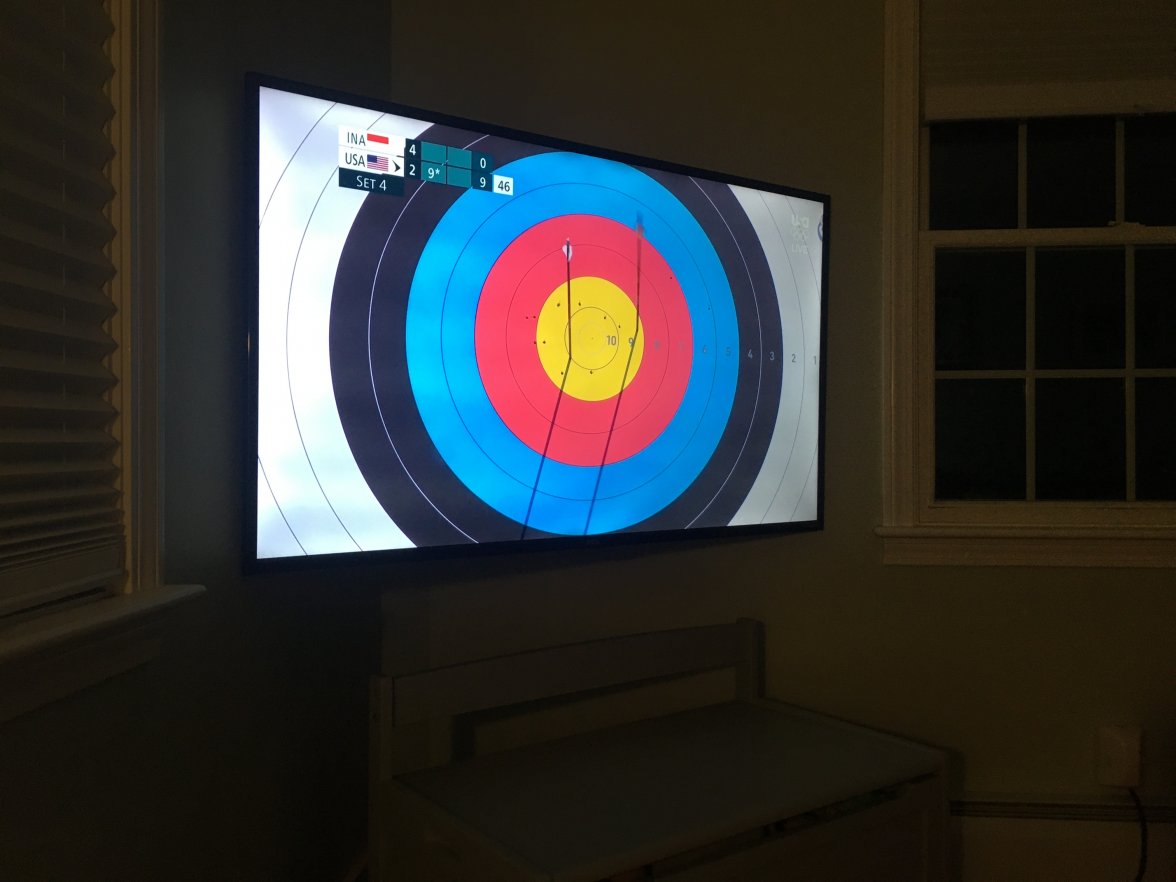
One can argue if that format is fair or not, but eventually the format was changed to what we have now. Still the same single elimination format overall, but how each match is decided is quite different. Matches are decided by set points, rather than by arrow points. Each archer shoots a set of arrows, and at the end of that set, set points are awarded by who has the higher score. 2 set points are up for grabs in each set, so if you win outright, you get 2 set points and the loser gets 0. If you tie in a set, you each get 1 set points. You have to win 6 set points to win a match and move on, and in the event of a tie on set points at 5 each, there is a one arrow shoot off, which is very exciting to watch.
Here's an example - 2019 world championships gold medal match for the women's event, and it has a bit of everything, including a one arrow shoot off for gold:
So this format within each match allows you to make a mistake (at least early on in the match), and not lose the match, and have a chance to recover.
I've never shot this format personally, but talking to many archer who have, everyone feels this is a very good system that allows the better archers to rise to the top.
For those who decide to watch, I hope you find it enjoyable.