To anyone who has actually had a modern Omega for 7 years or more

Posts
196
Likes
75
Hi. How many of you guys have actually owned a coaxial Omega for at least 7 problem free, service free years?

And if so, which caliber coaxial?

I'm trying to draw some valid conclusion by asking owners, or watchmakers, who have had first-hand long-term positive (or negative) experience.

(Most information on these movements is hypothetical and unfounded, by cynics or by enthusiasts. They seem to form opinions based on internet hearsay. "Authorities" are usually businesses).
Edited:
 
Posts
5,636
Likes
5,810
I've had some flavor of 2500 for at least that long. I don't wear it every day, though.

No troubles though it did have to go to Omega twice for service; apparently, at least in my case, the Miami service center can't find its butt wiht both hands.

It's the best timekeeper I have.
 
Posts
126
Likes
246
I have a Deville(8500 coax) I purchased new in 2012. It is still running and keeping good time. I have not had it serviced.
 
Posts
420
Likes
490
The first co-axial movement was used in 1999 and the problems with early versions are well documented. They've made improvements and the movements have proven to be very reliable since then.

Whether that is because of the co-axial escapement is another discussion...
 
Posts
597
Likes
3,868
My Omega SMP 2220.80 with the Co-Axial 2500C. 11 years and still going strong.

52671769105_3850a4710f_b.jpg
 
Posts
559
Likes
1,178
I have the blue AT 231.10.42.21.03.003 which is believe has the 8500G; no issues since I bought it in 2016, unserviced so far, and keeps time within spec.
 
Posts
5,561
Likes
53,988
I have owned several coaxial escapement watches for 7+ years. A calibre 2500 that has been trouble-free and never serviced, a calibre 8500 non-master which has been trouble-free and never serviced, and a calibre 8508 and 8500 master coaxial which each experienced a date wheel failure (manifest as a failure of the jump-hour complication) -- these problematic watches were repaired and serviced by Omega, unfortunately when out of warranty.
 
Posts
196
Likes
75
The first co-axial movement was used in 1999 and the problems with early versions are well documented. They've made improvements and the movements have proven to be very reliable since then.

Whether that is because of the co-axial escapement is another discussion...
Right. I'm asking actually about 7 year old Omega's modern watches that are service free for whatever reason.
 
Posts
869
Likes
3,632
Right. I'm asking actually about 7 year old Omega's modern watches that are service free for whatever reason.
I suggest that you rephrase the title of the thread. Sounds like you are asking about watches with co-axial escapement purchased new in 2015 - 2016 only.
 
Posts
29,659
Likes
76,804
Right. I'm asking actually about 7 year old Omega's modern watches that are service free for whatever reason.

What is it specifically that you are trying to determine?
 
Posts
196
Likes
75
What is it specifically that you are trying to determine?
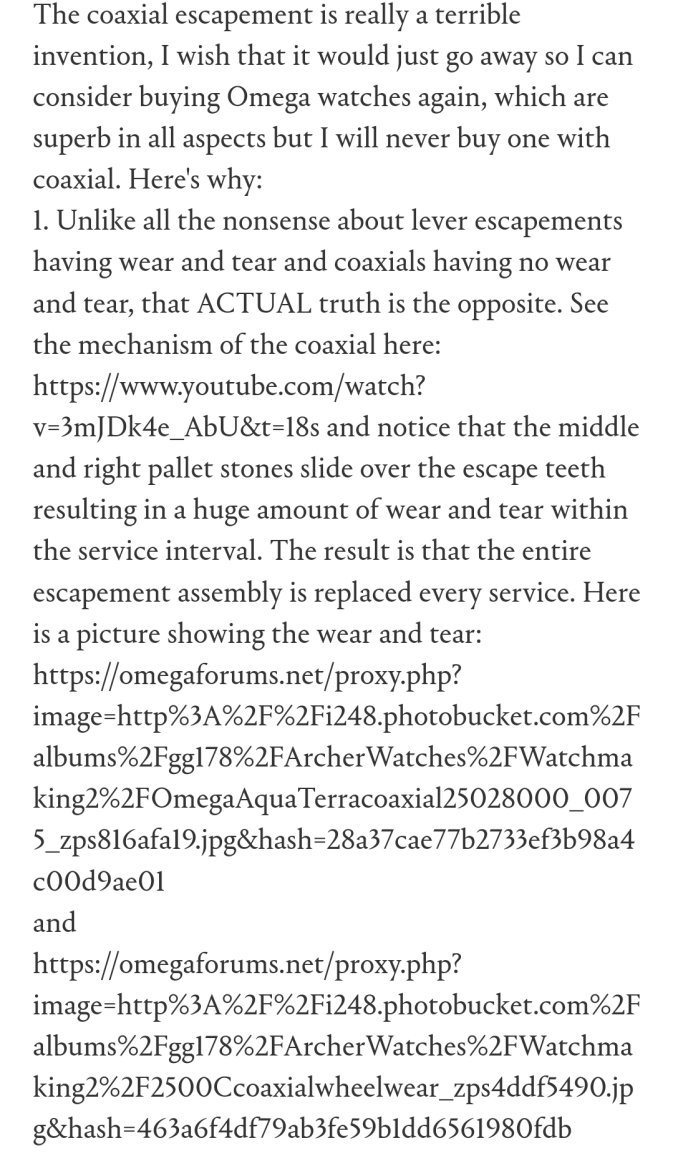
Whether or not Modern Omegas are long-term trustworthy. Negative rants like the one attached are almost as prevalent as the bandwagon praises. I'd like to know real world experience.
 
Posts
4,698
Likes
17,794
I have a couple of 9300's which have run fine. Also an 8900.... all doing good since 2015/2016, no issues to report
 
Posts
196
Likes
75
Whether or not Modern Omegas are long-term trustworthy. Negative rants like the one attached are almost as prevalent as the bandwagon praises. I'd like to know real world experience.
Gulp. I just paid attention that the ranter in the attachment is citing you, Archer.
 
Posts
5,636
Likes
5,810
Gulp. I just paid attention that the ranter in the attachment is citing you, Archer.
and using Al Archer's pics....
 
Posts
4,698
Likes
17,794
George is watching ...... and you dont want to get on the grumpy side of George.....

 
Posts
29,659
Likes
76,804
George is watching ...... and you dont want to get on the grumpy side of George.....

George is 6 feet under, so unless we are living in a George Romero movie, I'm not too worried what George might think...
 
Posts
29,659
Likes
76,804
Whether or not Modern Omegas are long-term trustworthy. Negative rants like the one attached are almost as prevalent as the bandwagon praises. I'd like to know real world experience.

Gulp. I just paid attention that the ranter in the attachment is citing you, Archer.

Yes, the photos links are clearly mine - not sure about the video...where does this rant come from?

You can look at this question in different ways, but the fact is every watch is going to have a failure point. The question is, is that point earlier than expected, so earlier than say the stated normal service interval from the brand (I assume this is why you picked 7 years, as Omega recommends service between 6 and 8 years).

Generally speaking, if the watch runs as long as the brand's service interval says it will, people are happy, and consider it to be reliable. When something fails earlier than expected, that's when people get upset - the initial 2500's for example had this issue for a long time. But Omega came up with a work around, so that even the 2500's with 2 level co-axial escapements, can run long enough not to cause a "premature" failure, and then everyone says the issue is cured. It hasn't been cured in reality, but it's been made to last as long as any other part inside the watch, so practically it's cured because it's no longer the reasons for the watch needing service.

So how do we apply this to current co-axial escapement watches? Well, I don't see much evidence that the escapements cause any sort of premature failure. People would be whining about it on forums if that were the case, like they did back when the 2500 issues were in full swing.

Now the "rant" does point out that the escapement experiences wear, and often when I see someone post that their Omega came back from servicing, I can see that the parts that were returned include the pallet fork and co-axial wheel, among others. So is this a significant thing? I guess it depends on your perspective.

I can tell you that on certain ETA calibers, that I almost always have to replace the third wheel. Why is that? Well, the jewel on the dial side for this wheel is very small, and doesn't hold much oil, so that oil tends to disappear before it is on other wheels, and the third wheel pivot wears out.


It doesn't cause the watch to fail prematurely if we use our definition from above, so to me (and watch owners out there) it's not an issue. So yes, the lever escapement parts on these watches don't need replacing at every service, but the third wheel does, so does this make these movements better or worse than the Omegas?

I think a lot of this is just how you view these things, rather than there being any inherent problem. This is why Rolex is smart not to return parts to their customers - it lets them have the impression that their movements are somehow more durable than other companies movements are, since nothing ever appears to wear out, when that isn't true at all...

Not sure I answered your question, but hopefully you find it helpful.

Cheers, Al

 
Posts
196
Likes
75
Yes, the photos links are clearly mine - not sure about the video...where does this rant come from?

You can look at this question in different ways, but the fact is every watch is going to have a failure point. The question is, is that point earlier than expected, so earlier than say the stated normal service interval from the brand (I assume this is why you picked 7 years, as Omega recommends service between 6 and 8 years).

Generally speaking, if the watch runs as long as the brand's service interval says it will, people are happy, and consider it to be reliable. When something fails earlier than expected, that's when people get upset - the initial 2500's for example had this issue for a long time. But Omega came up with a work around, so that even the 2500's with 2 level co-axial escapements, can run long enough not to cause a "premature" failure, and then everyone says the issue is cured. It hasn't been cured in reality, but it's been made to last as long as any other part inside the watch, so practically it's cured because it's no longer the reasons for the watch needing service.

So how do we apply this to current co-axial escapement watches? Well, I don't see much evidence that the escapements cause any sort of premature failure. People would be whining about it on forums if that were the case, like they did back when the 2500 issues were in full swing.

Now the "rant" does point out that the escapement experiences wear, and often when I see someone post that their Omega came back from servicing, I can see that the parts that were returned include the pallet fork and co-axial wheel, among others. So is this a significant thing? I guess it depends on your perspective.

I can tell you that on certain ETA calibers, that I almost always have to replace the third wheel. Why is that? Well, the jewel on the dial side for this wheel is very small, and doesn't hold much oil, so that oil tends to disappear before it is on other wheels, and the third wheel pivot wears out.


It doesn't cause the watch to fail prematurely if we use our definition from above, so to me (and watch owners out there) it's not an issue. So yes, the lever escapement parts on these watches don't need replacing at every service, but the third wheel does, so does this make these movements better or worse than the Omegas?

I think a lot of this is just how you view these things, rather than there being any inherent problem. This is why Rolex is smart not to return parts to their customers - it lets them have the impression that their movements are somehow more durable than other companies movements are, since nothing ever appears to wear out, when that isn't true at all...

Not sure I answered your question, but hopefully you find it helpful.

Cheers, Al
Yes, the photos links are clearly mine - not sure about the video...where does this rant come from?

You can look at this question in different ways, but the fact is every watch is going to have a failure point. The question is, is that point earlier than expected, so earlier than say the stated normal service interval from the brand (I assume this is why you picked 7 years, as Omega recommends service between 6 and 8 years).

Generally speaking, if the watch runs as long as the brand's service interval says it will, people are happy, and consider it to be reliable. When something fails earlier than expected, that's when people get upset - the initial 2500's for example had this issue for a long time. But Omega came up with a work around, so that even the 2500's with 2 level co-axial escapements, can run long enough not to cause a "premature" failure, and then everyone says the issue is cured. It hasn't been cured in reality, but it's been made to last as long as any other part inside the watch, so practically it's cured because it's no longer the reasons for the watch needing service.

So how do we apply this to current co-axial escapement watches? Well, I don't see much evidence that the escapements cause any sort of premature failure. People would be whining about it on forums if that were the case, like they did back when the 2500 issues were in full swing.

Now the "rant" does point out that the escapement experiences wear, and often when I see someone post that their Omega came back from servicing, I can see that the parts that were returned include the pallet fork and co-axial wheel, among others. So is this a significant thing? I guess it depends on your perspective.

I can tell you that on certain ETA calibers, that I almost always have to replace the third wheel. Why is that? Well, the jewel on the dial side for this wheel is very small, and doesn't hold much oil, so that oil tends to disappear before it is on other wheels, and the third wheel pivot wears out.


It doesn't cause the watch to fail prematurely if we use our definition from above, so to me (and watch owners out there) it's not an issue. So yes, the lever escapement parts on these watches don't need replacing at every service, but the third wheel does, so does this make these movements better or worse than the Omegas?

I think a lot of this is just how you view these things, rather than there being any inherent problem. This is why Rolex is smart not to return parts to their customers - it lets them have the impression that their movements are somehow more durable than other companies movements are, since nothing ever appears to wear out, when that isn't true at all...

Not sure I answered your question, but hopefully you find it helpful.

Cheers, Al

Very helpful. I understand that probably each movement or brand has its Achilles heel. It's how the brand chooses to deal with these weaknesses that matters. Ultimately the coaxial Omega watch is just has reliable as anything else and no worse with respect to consumer expectations. It passes the tests.
 
Posts
224
Likes
142
Great view as always Al.

In terms of Omega's. I am probably a good sample. I have never sold any and keep my auto all on winders when not wearing them,.

PO 2500, had to be serviced early due to issue Al described above.
PO LM LE, had to be serviced about 5 years in.

Now here is where the longevity is.
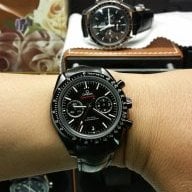
PO Titaniume Blue, PO Titanium chrono, DSOM, GSOM PCA, Aquaterra james bond, AT golf master coaxial, never been serviced and all keep accurate time to this day. Keep in min the DSOM is 10 years now and got that piece probably a year after it was out. I am always shocked when I pull them off the winder to wear and they are either exactly on or fast by a few seconds.
 
Posts
5,976
Likes
28,566
GSOM PCA
Had an opportunity to buy this but felt it would be to big for my wrist, I would not mind seeing a pic now and again.👍