The "Collector's Conundrum"

Posts
15,048
Likes
24,057
That's my cue.

208659-2063abf8f84af155c34427e00690db3a.jpg
Yes, when Dennis told me "Canadian Fishing Trip" I got very excited. But all I can say is, Never again
 
Posts
13,698
Likes
53,498
Watch collecting is a disease and part of my OCD spectrum as far as my wife is concerned. Layovers in foreign airports are torture! My view is buy what you like and intend to wear. Insuring and repairing these things will keep my collecting bug at bay.
 
Posts
859
Likes
2,451
At 300+ watches I think I passed your conundrum long ago.... My solution to your conundrum was to buy frequently enough for my wife to lose interest in what I was doing.

At 300+ watches you must need someone to manage your collection. I'll do it! And you can pay me in watches. Killing 2 birds with 1 stone. 😉
 
Posts
171
Likes
373
....
So with that in mind, give me a call Ray and let me know whats available. 😁

Am I understanding your response correctly? You're ready to sell me that non-Omega nipple dial root beer GMT that I haven't seen you wear in years? 😁
 
Posts
171
Likes
373
....

@Ray916MN I hear what you are saying, and even though my collection is a fraction of yours, I grapple with the same conundrum. One thing I have found is that at times it is necessary for the health of the collection to do some blood letting. At 300 watches, I am sure that there are pieces that you will never miss, and the funds raised from their sale will allow you to A) maintain the rare and valuable pieces to the highest degree and B) allow you to seek out new and interesting watches.

No need to sell the best pieces in your collection, when the middle and lower end, when evaluated in groups, still have tremendous value in the market.

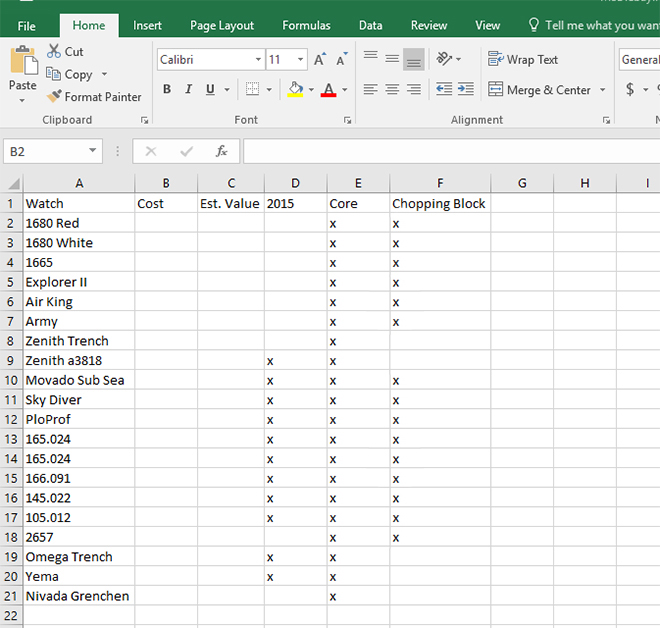
My advice, create a spreadsheet with the price paid, estimated market value, and last but not least, whether you consider the watch as part of your core collection. When you complete it, sort by the Core column, and you will be shocked at how many watches can move on without impacting your overall collection. Prepare yourself for the realization that if you do liquidate these watches, you will sitting on a pile of cash to start the hunt for new "core" pieces. Seeing the price paid vs. current market value as a whole, can be a sobering experience, and give you a new focus on how you want to move forward.

I have this master spreadsheet, and it helps me manage collection.

For years I've been thinking about a database for my collection to keep track of what I've got and maintenance records, serial numbers for insurance and pics and to allow me to quickly be able to slice and dice what I own into collections (e.g. space watches, divers, high frequency, chronographs, gmt, brands, models, movements), but I haven't found a good solution for what I want. The slice and dice would help me zero in on what I want to buy to help complete collection groups as I'm a thematic collector as well as an individual piece collector. Thematic pieces are typically bought more to complete a collection theme (e.g. space flown: Breitling Cosmonaute 809, Seiko Pogue, Speedmaster 105.012, Sturmanskie Gagarin and Accutron Astronaut) and individual pieces are bought more to wear. Of course there is sometimes significant overlap between thematic and individual collecting

With respect to price paid and current market value, I've been avoiding that like the plague. Sharing online and at Red Bar gatherings has made me realize that my collection has grown in value to the point where if it were sold, the proceeds could fund substantive non watch purchases. Too much awareness of this is sure to ruin watch collecting for me.

In terms of getting rid of watches "I'll never miss", I've started pulling together a sell pile. Probably 20 watches or so at this time, but not enough total value to impact my collecting.

So far my solution to vintage watches becoming too valuable to subject to regular wear has been to "retire" the watch and buy a less collectible version to wear. A few years ago after speaking with cicindela at a local watch show, I went home and bought a 145.022 to have a Speedmaster to knock around with and retire the 105.012. I've ended up doing this for more and more watches over the years. Not sure this approach is something that makes sense to sustain.
 
Posts
4,043
Likes
13,950
@Ray916MN from seeing the pic of your collection, you are spot on, that number is probably pretty darn high, and I can see how it could complicate things. View your collection is small, manageable "micro collectio

I think the first step is to catalog your entire collection and create tabs that make sense to how you see your collection (i.e. thematic, etc.). If you have two or more examples of a specific reference, rate it on a scale (i.e. A, B, C). Basically, you want to click through the tabs, and be able to sort it such that the spreadsheet spits out watches that may make the most sense to sell.

IMO, the only real way to accomplish a serious thinning of the herd is to take emotion out of the process is be data driven, and break each watch down based on a set of defined parameters, and values.

It will be a bunch of work, but I think that you will be glad that you are doing it in the long run.

With so many watches, my biggest concern would having them sit for long periods of time, unless of course you a supermegauber watch winder and a lot of free time for the manual wind models 😀

A good buddy of mine in TX talk all of the time about our "plan" for our current and future collections--we bounce ideas, scenarios, etc. off each other, and hold the other one to stick to their "plan". It has helped both of us a ton over the past 5 months, as we have a voice of reason when it comes to our buying and selling proclivities.

Take this advice with a grain of salt, but I task you with the challenge of narrowing down your collection to a core of 100 watches. Whether or not you can do it, I don't know, but going through the exercise will help you evaluate your collection, and give options for how to move forward, and hopefully have a new roadmap.

Best of luck!

 
Posts
25,980
Likes
27,707
Am I understanding your response correctly? You're ready to sell me that non-Omega nipple dial root beer GMT that I haven't seen you wear in years? 😁

Hey @Ray916MN - Don't f🤬king try to cut in line in front of me pal!!!! 🫨 .....but if you can get him to part with the pink gold capped Constellation pie pan, then I'll retract my dibs on the Root Beer. 😉 😀
 
Posts
670
Likes
676
"300+ watches" ??!!
Will be quite a challenge daily rotation for a year...on having a family portrait in a photo frame for us?? 😀
 
Posts
171
Likes
373
Hey @Ray916MN - Don't f🤬king try to cut in line in front of me pal!!!! 🫨 .....but if you can get him to part with the pink gold capped Constellation pie pan, then I'll retract my dibs on the Root Beer. 😉 😀

Dibs?!?!? Like you were like doing this???


Man, if you want it that bad you can have it! OTOH, I had no idea Steve was interested in this kind of action. 😵‍💫
 
Posts
171
Likes
373
@Ray916MN from seeing the pic of your collection, you are spot on, that number is probably pretty darn high, and I can see how it could complicate things. View your collection is small, manageable "micro collectio

I think the first step is to catalog your entire collection and create tabs that make sense to how you see your collection (i.e. thematic, etc.). If you have two or more examples of a specific reference, rate it on a scale (i.e. A, B, C). Basically, you want to click through the tabs, and be able to sort it such that the spreadsheet spits out watches that may make the most sense to sell.

IMO, the only real way to accomplish a serious thinning of the herd is to take emotion out of the process is be data driven, and break each watch down based on a set of defined parameters, and values.

It will be a bunch of work, but I think that you will be glad that you are doing it in the long run.

With so many watches, my biggest concern would having them sit for long periods of time, unless of course you a supermegauber watch winder and a lot of free time for the manual wind models 😀

A good buddy of mine in TX talk all of the time about our "plan" for our current and future collections--we bounce ideas, scenarios, etc. off each other, and hold the other one to stick to their "plan". It has helped both of us a ton over the past 5 months, as we have a voice of reason when it comes to our buying and selling proclivities.

Take this advice with a grain of salt, but I task you with the challenge of narrowing down your collection to a core of 100 watches. Whether or not you can do it, I don't know, but going through the exercise will help you evaluate your collection, and give options for how to move forward, and hopefully have a new roadmap.

Best of luck!

You're getting off track. I have no problems with owning 300+ watches. My watchbox is sized for 450.

The question is what to do when the increasing rarity and difficultly in repairing an maintaining a vintage watch you bought to regularly wear makes it increasingly sensible to stop wearing it. The conundrum is any collector collecting with an intent to regularly wear long enough is bound to run into a point where wearing a vintage watch makes less and less sense.
 
Posts
1,372
Likes
3,454
Just wear them. If they break, fix them. If you can't fix them, sell the bezels and you'll get your initial investment back. 😉
 
Posts
4,043
Likes
13,950
Now I want to see what a 450 watch box looks like!
Me too!

Sorry, was a bit confused. My thought was to trim your collection so that you could have a more manageable rotation of top tier watches that you would wear, enjoy, and therefore have a better chance of keeping in good running order.

By trimming the fat and running a more lean collection, you would free up funds for service, straps, storage, and of course, more badass watches...possibly alleviating the conundrum.
 
Posts
2,598
Likes
5,660
You're getting off track. I have no problems with owning 300+ watches. My watchbox is sized for 450.

The question is what to do when the increasing rarity and difficultly in repairing an maintaining a vintage watch you bought to regularly wear makes it increasingly sensible to stop wearing it. The conundrum is any collector collecting with an intent to regularly wear long enough is bound to run into a point where wearing a vintage watch makes less and less sense.

But if you have 300+ watches then you can't have bought them all to regularly "wear", unless by regular you mean once per year. And if you bought them to wear, then at no point should it become sensible to stop wearing them. It is true that for a "collector" it may be sensible to stop, if that collector gets their pleasure from taking them out the safe once in a while and wants to keep them operational.

How about narrowing your collection down to say 10 movements, and making sure you have multiple examples of each movement plus a small stockpile of spares. That way you could use stockpiled parts or sacrifice a whole watch to keep the others running. And practically speaking, a strategy like that should keep your collection wearable until you're not around to wear them anymore...
 
Posts
171
Likes
373
Now I want to see what a 450 watch box looks like!

Nothing fancy. Blue print file.

P1010152.jpg
Drawers lined with felt and wood separators
0304160723a_zps6awfi16c.jpg
This is the "regular wear" chronograph drawer. There is a regular wear dive drawer, and the rest of the drawers are for the most part watches bought solely to collect. Regular wear means, pick a watch out, and wear it for 3 to 7 days straight before picking another watch. It does not mean, wear it in daily rotation.

Just wear them. If they break, fix them. If you can't fix them, sell the bezels and you'll get your initial investment back. 😉

The worry isn't movements, the worry is bezels, other case parts and overall condition. I do have spare movements for parts, but sparing case parts is another thing entirely. With respect to maintenance, anything I wear which doesn't run accurately or exhibits some problem goes into the maintenance section of the cabinet with a note on the problem. When I get enough watches in this section, they go out for service.

As I mentioned earlier an example of the conundrum is my 105.012. It was a watchmaker's personal watch in excellent original condition when I purchased it years ago for what a used 1861 Speedmaster goes for today. Pristine DON bezel, hands, dial, 1039 bracelet (when I use to regularly wear it, I put an 1171 bracelet on it). In the case of the 105.012, I bought a 145.022 to have something to regularly wear. While I doubt this watch will end up in the same situation as the 105.012, the way the market is, who knows.There are perhaps a half a dozen other watches I own that are in the same situation, bought as collectibles that I could strap on for a week or so and wear, but which now receive only careful wear.

Here's another way to put the conundrum. The maxim of buying vintage watches is the three most important things to consider are condition, condition, condition. When a vintage watch model is relatively plentiful and reasonably priced on the market and you buy it, it makes sense to regularly wear and enjoy a pristine watch. When the passage of time makes the watch model rare (especially with respect to condition) and premium priced and originality and condition makes tremendous difference in value, what do you do?
 
Posts
13,698
Likes
53,498
Do you insure all these? Rare models to the safe deposit box?
 
Posts
4,043
Likes
13,950
If out of 300 watches, there are only 6-10 that are in the same case as the 105.012, I think it makes sense to liquidate the lower end pieces to fund finding redundancy pieces, i.e. another 105.012 that is NOT in pristine condition. By having a "beater" second watch, you do not have to worry excessive wear to the pristine example.

This approach would also help consolidate your collection--would you rather have another 105.012 to wear and enjoy or 5-10 mid range watches?

I hear you on case parts, but in all honestly, how many times have you damaged a watch and needed a new case part? It takes a lot to toast a bezel.

Also, I think it gets down to your comfort level wearing and enjoying the more valuable pieces in your collection. What is your threshold for value/enjoyment of ownership? It sounds like your threshold may be below the current value of some of your watches, and if that is the case, I would lock them in a safe, and focus on watches that within the threshold.

Let's be honest, at 300 watches, your rotation means that watches barely get worn, and unless you are working on an offshore oil rig, I doubt that 1-2 days of wear a day will cause any damage that would impact value.