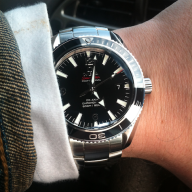
So here's a real situation - customer of mine who I serviced a watch for years ago needs it serviced again, but I'm too busy. He emailed me yesterday to let me know he has taken it to a boutique to have it sent to Omega for service. The watchmaker at Omega may look at the condition of the watch and when it was last serviced by them...
"Wow these pivots are in great shape! Hardly any wear on the parts, so I'll report this up the chain that these watches are lasting way longer than expected!" Of course he has no idea that I've serviced it in the interim, and have already replaced all those wear parts at that time.
Here's another situation - watch gets sold, and comes back to Omega for it's first service. No wear in the parts, but the watchmaker reporting his observations at Omega has no idea that for the most parts it has been sitting in a drawer since it was bought, so has had very little use. This is why the "observations" theory is problematic when you get down to the practical side of it.
As for the life testing theory, when I was working as an engineer the company I worked for did all kinds of life testing on new products, and that process often affected my project schedules so I was well aware of what went into it. It was something I was curious about so I did specifically ask about this when I was at Omega for training. They did say that some 8500's were assembled with the silicon balance springs and given to people tow ear for a couple of years, but that was all that they knew of. While it's possible that they do life testing that the people I spoke to were not aware of, all I can say is that based on how poorly the 2500 roll out was done, and how much Omega had to play catch up to solve problem after problem on those, the testing they did wasn't very good.
Omega knows that they will win some and lose some when it comes time to perform a service, and to them that's not terribly important. Looking at the parts that are returned and sheer level of waste in the way they do things tells me they aren't that concerned if another wheel or two that retail for $14 are worn or not. All they need to ensure is that at the end of the day they balance out and they don't lose more than they win on.
I guess for me there's nothing that had been stopping Omega from increasing the service intervals for years, so the fact that this happened at the same time as they moved the warranty to 5 years to keep up with Rolex, tells me this is more about marketing than about the engineering of the movement or the observations of watchmakers at the service center.