Semi quick set date question - damage to movement?

Posts
498
Likes
410
Hello,

I haven’t been able to find a dedicated thread on this topic, and wanted some ideas all in one place (as I’ve only seen this discussed briefly on other threads about movement types).

On 50s/60s movements with semi quick set date features (that is to say, winding back and forward between 9 and 12 to advance the date) does anyone have any anecdotal or factual knowledge on whether or not this is ‘bad’ for the movement? As far as my basic understanding of cogs and gears meshing goes, I would assume the movement was designed in such a way to be wound back and forth. But let’s say I wear the watch a few times a week, but not quite enough to keep it fully wound, so each time I wear it I have to set the date. Is this going to accelerate wear?

Thanks in advance.

 
Posts
4,339
Likes
10,272
I don't recommend it (at least often).
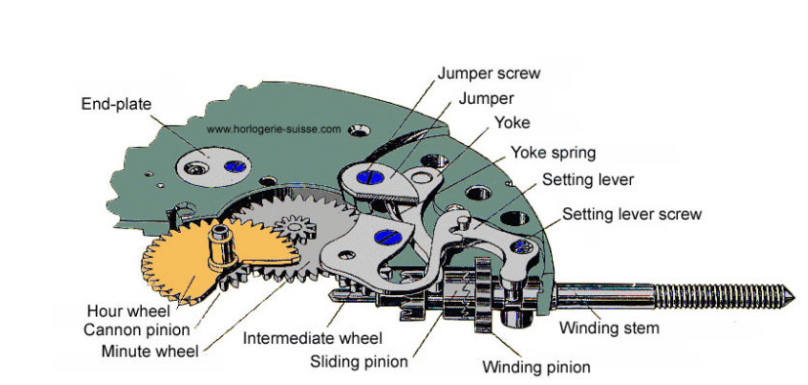
The cannon pinion, which is a friction part that is meant to slip when setting the time, wears out.

You can google it. Below is a pic from the web:

 
Posts
3,742
Likes
6,360
Is this going to accelerate wear?
Yes, the cannon pinion will wear out faster.

Oh, redpcar you beat me to it .
 
Posts
498
Likes
410
Thank you both. And then, what’s the effect on the watch? As in, what goes wrong with it?

And does winding forward all the way through 24 hours avoid this wear, or is that even worse?
 
Posts
37
Likes
71
I didn't know that. and so far have been concentrating on watches with no date complication.
 
Posts
24,250
Likes
53,996
Thank you both. And then, what’s the effect on the watch? As in, what goes wrong with it?

And does winding forward all the way through 24 hours avoid this wear, or is that even worse?

There are some great websites explaining how watch movements work. This is one of my favorites:
https://ciechanow.ski/mechanical-watch/
 
Posts
498
Likes
410
There are some great websites explaining how watch movements work. This is one of my favorites:
https://ciechanow.ski/mechanical-watch/
What an amazing resource! I’ve always felt it would go over my head to try and understand how watch movements work, but this breaks it down quite literally in a really useful way. Thank you
 
Posts
4,339
Likes
10,272
When the cannon wears out, the watch movement runs but the hands don't advance. This is one of the most common issues with mechanical watches. The more you adjust the hands, the more wear occurs on the cannon pinion. Think of it like a clutch on a car/truck with a standard transmission.
 
Posts
498
Likes
410
When the cannon wears out, the watch movement runs but the hands don't advance. This is one of the most common issues with mechanical watches. The more you adjust the hands, the more wear occurs on the cannon pinion. Think of it like a clutch on a car/truck with a standard transmission.
Gotcha. I’m trying to gauge how much wear exactly it’ll take before this sort of thing starts to happen. I mean, the way I see it, semi quick dates were around for long enough, and didn’t seem to have too many issues (from what I understand). Obviously quick set date quickly followed but I imagine this was less about wear and more about convenience.
 
Posts
3,742
Likes
6,360
Gotcha. I’m trying to gauge how much wear exactly it’ll take before this sort of thing starts to happen. I mean, the way I see it, semi quick dates were around for long enough, and didn’t seem to have too many issues (from what I understand). Obviously quick set date quickly followed but I imagine this was less about wear and more about convenience.
When I check a watch, I pull the crown out and move the hands backward a bit, if the second hand stops and moves back, the cannon pinion is ok. If the second hand keeps moving forward, the cannon pinion is worn and not much friction left.
 
Posts
193
Likes
161
Gotcha. I’m trying to gauge how much wear exactly it’ll take before this sort of thing starts to happen. I mean, the way I see it, semi quick dates were around for long enough, and didn’t seem to have too many issues (from what I understand). Obviously quick set date quickly followed but I imagine this was less about wear and more about convenience.
The wear on the canon pinion happens whenever you set the time whether you have date function or not. With the non-quick date watches, obviously, you have to advance many hours in order to set to the next date, and thus more wear. I think if the cannon pinion and the motion works are properly lubricated, the wear should be very minimum, but its hard to say how much. Someone used transmission clutch analogy, and it's like asking how many times you can engage and disengage the clutch before it would fail.
 
Posts
498
Likes
410
The wear on the canon pinion happens whenever you set the time whether you have date function or not. With the non-quick date watches, obviously, you have to advance many hours in order to set to the next date, and thus more wear. I think if the cannon pinion and the motion works are properly lubricated, the wear should be very minimum, but its hard to say how much. Someone used transmission clutch analogy, and it's like asking how many times you can engage and disengage the clutch before it would fail.
Yes, or perhaps, how many times you can change gear (the clutch of a car doesn’t actually use any gears - the wear is of the friction plate). I read some article once about grinding gears, and they had a famous ex rally driver being interviewed and he said something like ‘you can grind gears for about 2 hours straight before all the teeth are worn beyond repair/practical use’. I, of course, take no responsibility for any experiments that may or may not affect the lifespan of your car transmission!
 
Posts
17,939
Likes
37,516
The clutch analogy is valid. Both are friction drives.
 
Posts
498
Likes
410
The clutch analogy is valid. Both are friction drives.
Ok - but just to confirm, the cannon pinion is a gear, right?
 
Posts
17,939
Likes
37,516
Yes, it has a gear at its base that drives the motion works wheels (gears).
The canon pinion is driven by friction between it and the centre wheel shaft.
 
Posts
3,742
Likes
6,360
Ok - but just to confirm, the cannon pinion is a gear, right?
Outside is gear, inside is clutch.
 
Posts
29,671
Likes
76,830
Thank you both. And then, what’s the effect on the watch? As in, what goes wrong with it?

And does winding forward all the way through 24 hours avoid this wear, or is that even worse?

It’s not a problem. Winding through the full day several times will cause far more wear than using the 9-12 and back again method.
 
Posts
498
Likes
410
It’s not a problem. Winding through the full day several times will cause far more wear than using the 9-12 and back again method.
Great, thank you. Well there are certainly plenty of early calendar movements that do this, so I’ll rest in the knowledge that the mechanism on mine isn’t going to put as much wear on it.
 
Posts
39
Likes
14
Seems the opinion is split on this one.
So here’s my take:
Winding it a full day (24hrs) to set the date would cause considerable wear and strain primarily on your fingers. But also the crown, stem and like others have already pointed out the cannon pinion. Winding it the semi quickset way would also cause wear on the date corrector, calendar spring and the cannon pinion.
With that being said, would leaving the date incorrect be to much of a trouble?
 
Posts
29,671
Likes
76,830
Seems the opinion is split on this one.
So here’s my take:
Winding it a full day (24hrs) to set the date would cause considerable wear and strain primarily on your fingers. But also the crown, stem and like others have already pointed out the cannon pinion. Winding it the semi quickset way would also cause wear on the date corrector, calendar spring and the cannon pinion.
With that being said, would leaving the date incorrect be to much of a trouble?

First, there is no date corrector, because if there was you wouldn’t need to rock the time back and forth.

Second, the “wear” on the date indicator driving wheel, and the date jumper spring are going to be equal if you advance the date by going back and forth, or by simply winding forward as the “wear” to those is determined by the number of date changes, not how you do them.