- Posts
- 5
- Likes
- 3
AML81
·I’ve been weighing up a Seamaster for a while, and I’ve come to realise that, beyond technical, aesthetic and style preferences about the watch itself, what changes the experience most is the strap or bracelet.
To be clear from the start: this thread is only about the bracelets and straps, not the watches. I’m not comparing or judging the models, which I think are all excellent, and naturally I have my own preferences; I’m just trying to organise what people say about their steel, mesh, rubber and NATO options.
I’ve read a lot here and in the watch press, and opinions vary widely, so I’ve tried to put them in some order. I’ve also tried some of them on at a boutique and added my impressions. I’m sharing it in case it’s useful to anyone, and mostly to hear about your own experience.
1. Diver 300M steel bracelet.
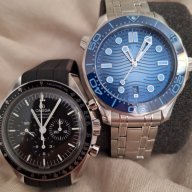
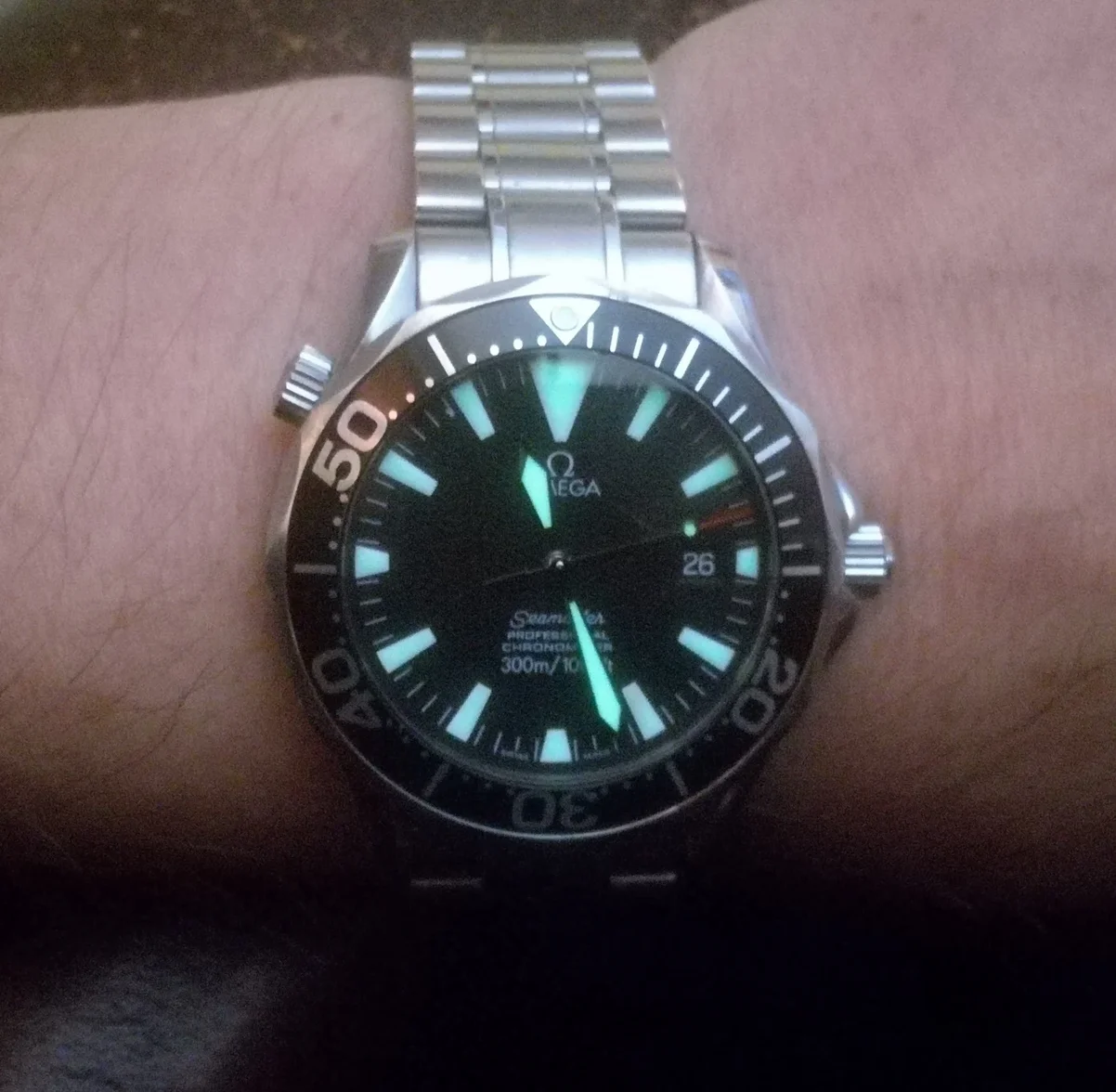
This is the most divisive one. There are plenty of complaints about its weight, the complete lack of taper (it stays at 20 mm all the way to the clasp) and the bulky clasp. Teddy Baldassarre summed it up as a bracelet of real weight and heft, made more noticeable by the lack of taper, and with a distinctly ’90s look. Britt Pearce and Adrian Barker agree it hasn’t aged well aesthetically, while acknowledging that it’s robust, very well built, and its extension and adjustment work brilliantly. They even suggest, as a hypothesis, that the mesh might be a placeholder while Omega redesigns it. When I tried it on, I found it bulky and showy, and I clearly noticed that it doesn’t taper towards the clasp.
2. Diver 300M mesh bracelet.
Opinions are split here, and not just among owners: Gear Patrol went as far as saying the NTTD mesh will go down in Omega history as being as polarising as the famous “tank tread”.
Aesthetically it’s very well liked. Adrian Barker highlights its vintage yet timeless feel, and how photogenic it is. People also value how light it is, how it drapes over the wrist and the fact that, unlike the steel bracelet, it tapers to 18 mm at the clasp.
The criticisms are about ergonomics: the fixed-hole sizing, which can leave you between two sizes, and above all the clasp. Fratello noted the thickness of the stacked layers when resting the wrist on a desk. Britt Pearce and Adrian Barker go further: they find the clasp excessively long and, on small or medium wrists, the mesh folding underneath creates an uncomfortable bulk, something they’d expect to be solved at this price point. There’s a short version that seems to ease the problem.
I tried the one on the 60th Anniversary and found it comfortable and understated, but it was far too long for me; the boutique advised me to order the short size and try it on before deciding.
3. Diver 300M rubber strap.
By far the best-rated of its options. Owners praise the comfort, how securely it holds the watch, and the keeper that locks the tail in place. The few complaints are about length, and Omega offers it in three sizes. I haven’t tried it yet.
4. Seamaster 300 Heritage steel bracelet.
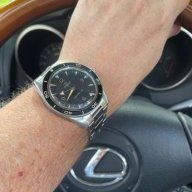
Almost entirely positive. It tapers from 21 to 16 mm, it’s slim, it has push-button adjustment, and it slides under a shirt cuff with no trouble. When I tried it on, I found it remarkably comfortable, the most comfortable of them all. There’s no dedicated rubber strap for it, so a NATO seems the natural alternative.
5. Aqua Terra steel bracelet and rubber strap.
The bracelet is well regarded for comfort and finishing, with its flat butterfly clasp. The criticism centres on fine adjustment: the recently added comfort setting gives about 2 mm, which Fratello found insufficient. The strap I’ve really fallen for is the blue rubber with yellow stitching on the Duplantis, but I’ve found little on how it wears day to day or how it ages.
6. Planet Ocean 2025 steel bracelet.
Not one I’m considering, but worth mentioning as a benchmark. It tapers from 21 to 16 mm, the watch on its bracelet weighs 177 g, and the press has received it very well. Gear Patrol’s only complaint was that the adjustment system breaks the bracelet’s lines when extended.
7. Omega NATO straps.
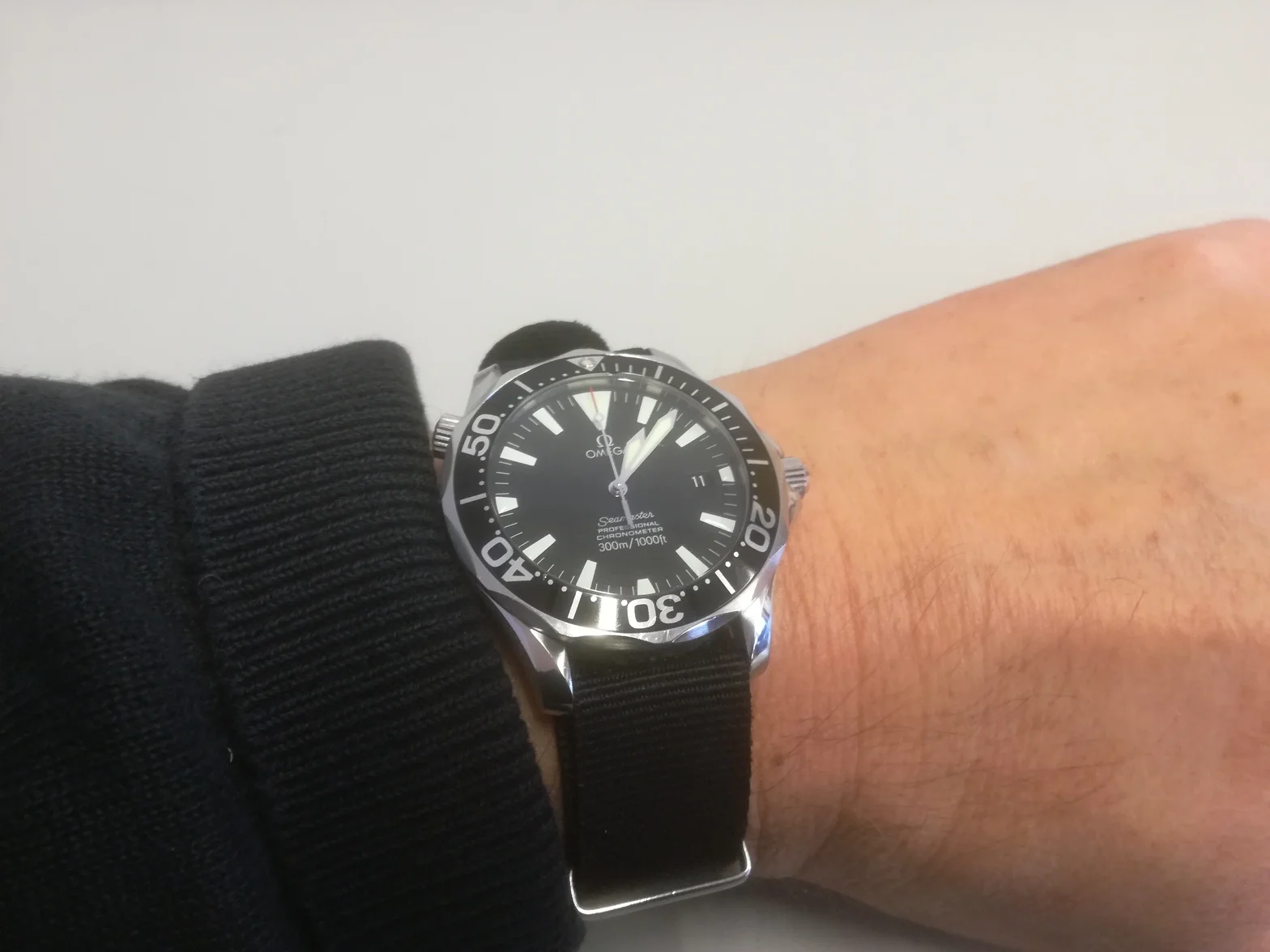
There’s broad agreement that the polyamide one is among the best available in quality and feel. The debate is whether it’s worth the price, and some owners point out that it runs longer than a standard NATO, which doesn’t help the fit. The Diver’s 20 mm lugs make it easy to switch to a NATO or fabric strap, and Adrian Barker admits he prefers wearing it that way. I tried it on the NTTD and, on my 16.5 cm (about 6.5 in) wrist, the excess tail felt a bit bulky.
As a general reference point, Rolex’s Glidelock and Tudor’s T-fit are still the benchmark for fine adjustment, and that’s where people usually ask more of Omega.
A few questions, if anyone has experience:
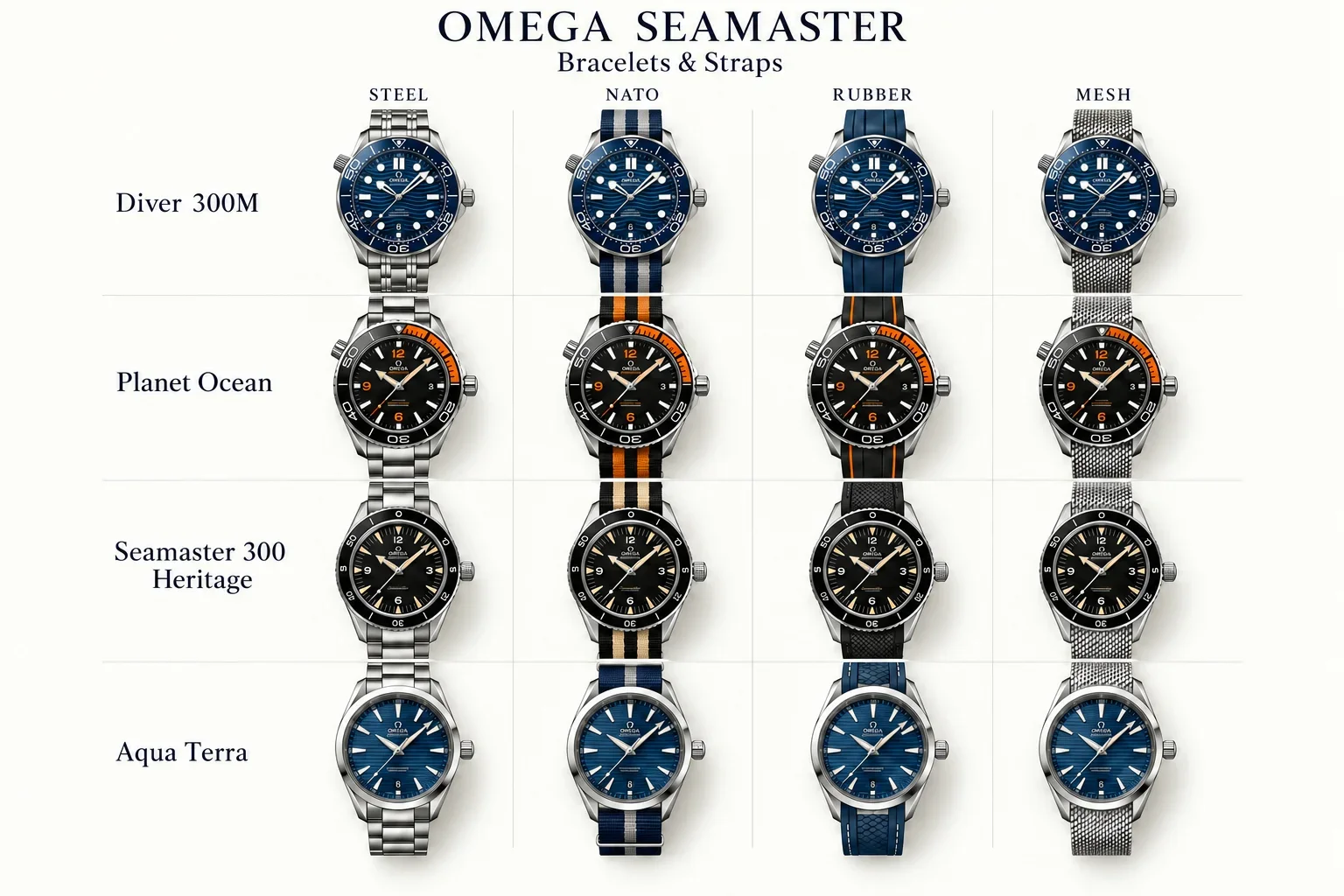
To be clear from the start: this thread is only about the bracelets and straps, not the watches. I’m not comparing or judging the models, which I think are all excellent, and naturally I have my own preferences; I’m just trying to organise what people say about their steel, mesh, rubber and NATO options.
I’ve read a lot here and in the watch press, and opinions vary widely, so I’ve tried to put them in some order. I’ve also tried some of them on at a boutique and added my impressions. I’m sharing it in case it’s useful to anyone, and mostly to hear about your own experience.
1. Diver 300M steel bracelet.
This is the most divisive one. There are plenty of complaints about its weight, the complete lack of taper (it stays at 20 mm all the way to the clasp) and the bulky clasp. Teddy Baldassarre summed it up as a bracelet of real weight and heft, made more noticeable by the lack of taper, and with a distinctly ’90s look. Britt Pearce and Adrian Barker agree it hasn’t aged well aesthetically, while acknowledging that it’s robust, very well built, and its extension and adjustment work brilliantly. They even suggest, as a hypothesis, that the mesh might be a placeholder while Omega redesigns it. When I tried it on, I found it bulky and showy, and I clearly noticed that it doesn’t taper towards the clasp.
2. Diver 300M mesh bracelet.
Opinions are split here, and not just among owners: Gear Patrol went as far as saying the NTTD mesh will go down in Omega history as being as polarising as the famous “tank tread”.
Aesthetically it’s very well liked. Adrian Barker highlights its vintage yet timeless feel, and how photogenic it is. People also value how light it is, how it drapes over the wrist and the fact that, unlike the steel bracelet, it tapers to 18 mm at the clasp.
The criticisms are about ergonomics: the fixed-hole sizing, which can leave you between two sizes, and above all the clasp. Fratello noted the thickness of the stacked layers when resting the wrist on a desk. Britt Pearce and Adrian Barker go further: they find the clasp excessively long and, on small or medium wrists, the mesh folding underneath creates an uncomfortable bulk, something they’d expect to be solved at this price point. There’s a short version that seems to ease the problem.
I tried the one on the 60th Anniversary and found it comfortable and understated, but it was far too long for me; the boutique advised me to order the short size and try it on before deciding.
3. Diver 300M rubber strap.
By far the best-rated of its options. Owners praise the comfort, how securely it holds the watch, and the keeper that locks the tail in place. The few complaints are about length, and Omega offers it in three sizes. I haven’t tried it yet.
4. Seamaster 300 Heritage steel bracelet.
Almost entirely positive. It tapers from 21 to 16 mm, it’s slim, it has push-button adjustment, and it slides under a shirt cuff with no trouble. When I tried it on, I found it remarkably comfortable, the most comfortable of them all. There’s no dedicated rubber strap for it, so a NATO seems the natural alternative.
5. Aqua Terra steel bracelet and rubber strap.
The bracelet is well regarded for comfort and finishing, with its flat butterfly clasp. The criticism centres on fine adjustment: the recently added comfort setting gives about 2 mm, which Fratello found insufficient. The strap I’ve really fallen for is the blue rubber with yellow stitching on the Duplantis, but I’ve found little on how it wears day to day or how it ages.
6. Planet Ocean 2025 steel bracelet.
Not one I’m considering, but worth mentioning as a benchmark. It tapers from 21 to 16 mm, the watch on its bracelet weighs 177 g, and the press has received it very well. Gear Patrol’s only complaint was that the adjustment system breaks the bracelet’s lines when extended.
7. Omega NATO straps.
There’s broad agreement that the polyamide one is among the best available in quality and feel. The debate is whether it’s worth the price, and some owners point out that it runs longer than a standard NATO, which doesn’t help the fit. The Diver’s 20 mm lugs make it easy to switch to a NATO or fabric strap, and Adrian Barker admits he prefers wearing it that way. I tried it on the NTTD and, on my 16.5 cm (about 6.5 in) wrist, the excess tail felt a bit bulky.
As a general reference point, Rolex’s Glidelock and Tudor’s T-fit are still the benchmark for fine adjustment, and that’s where people usually ask more of Omega.
A few questions, if anyone has experience:
- If you’ve moved from the steel bracelet to rubber or the short mesh on the Diver, which one did you settle on for daily wear?
- How does the integrated rubber strap on the Aqua Terra Duplantis hold up over time?
- Does anyone wear the Heritage on a NATO or another strap that works as well for them as its bracelet?
Thanks in advance. I’ll be reading your replies with great interest.