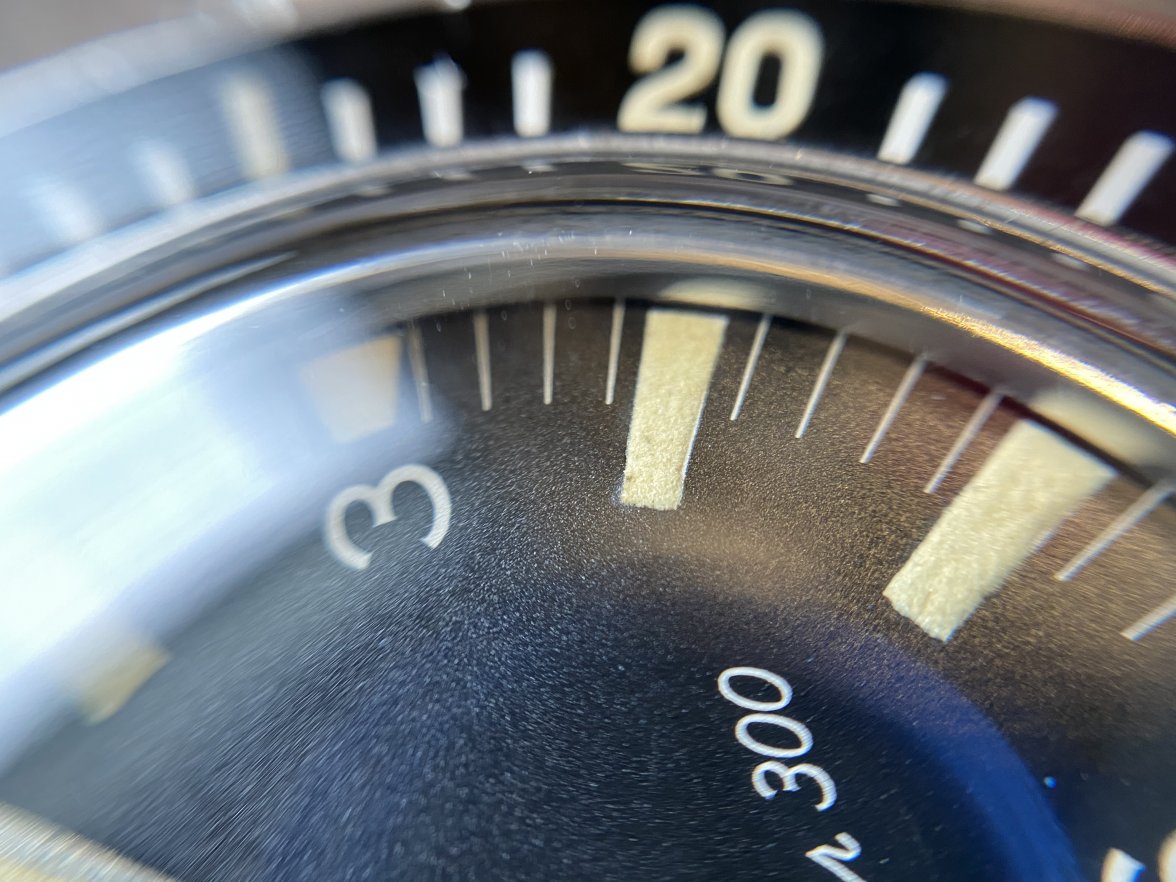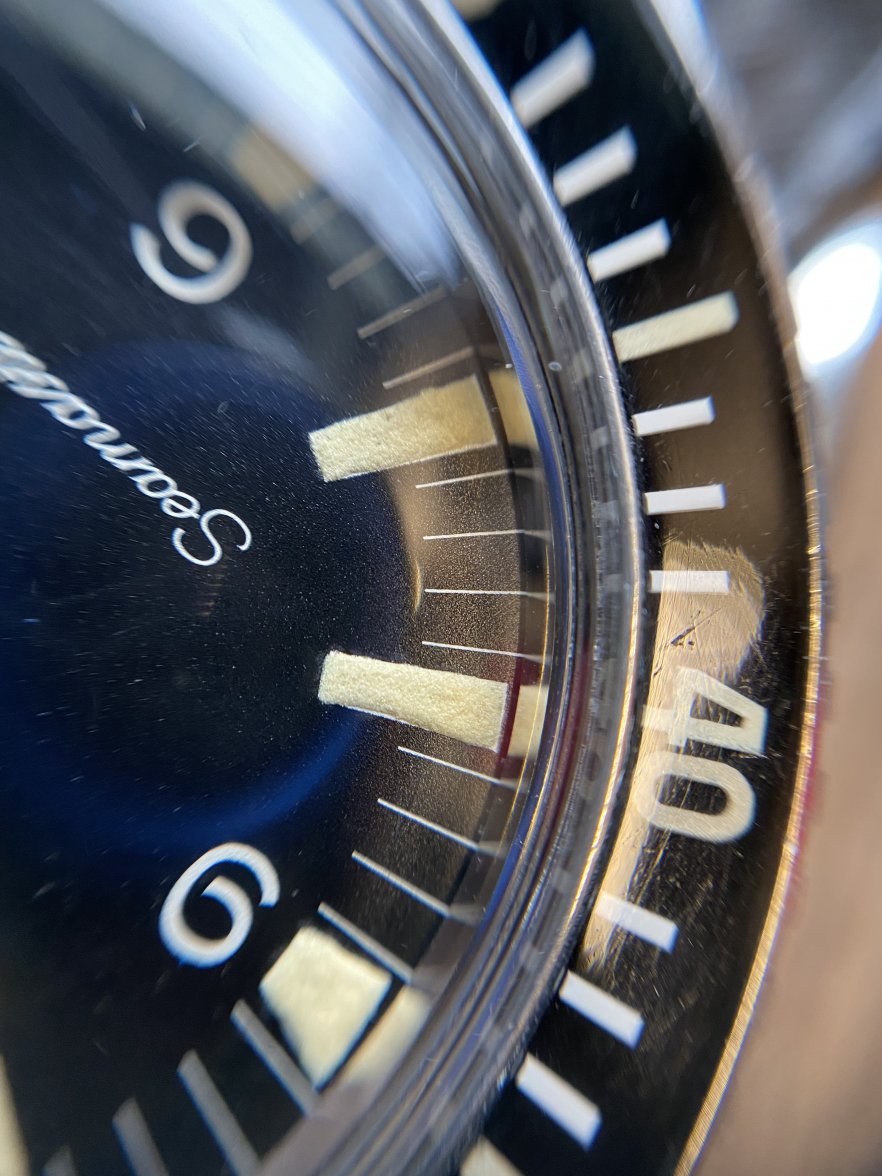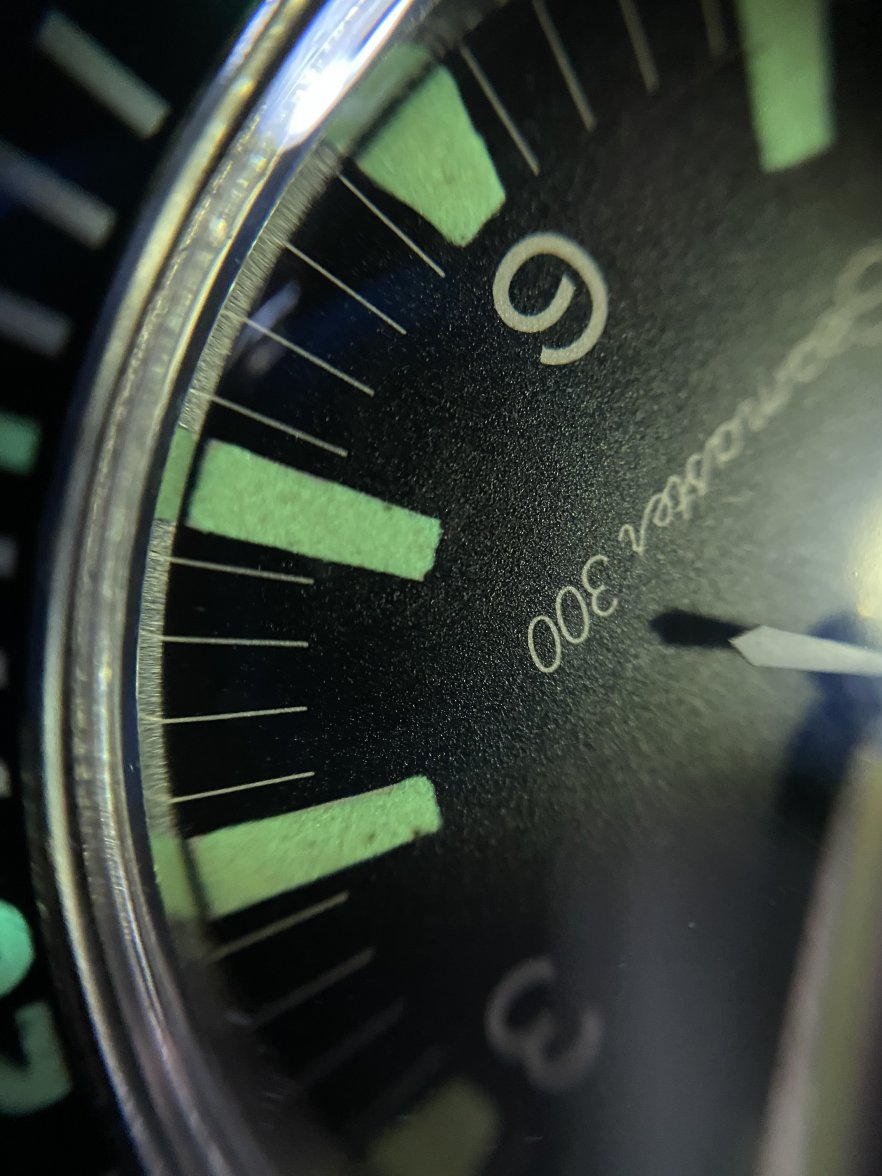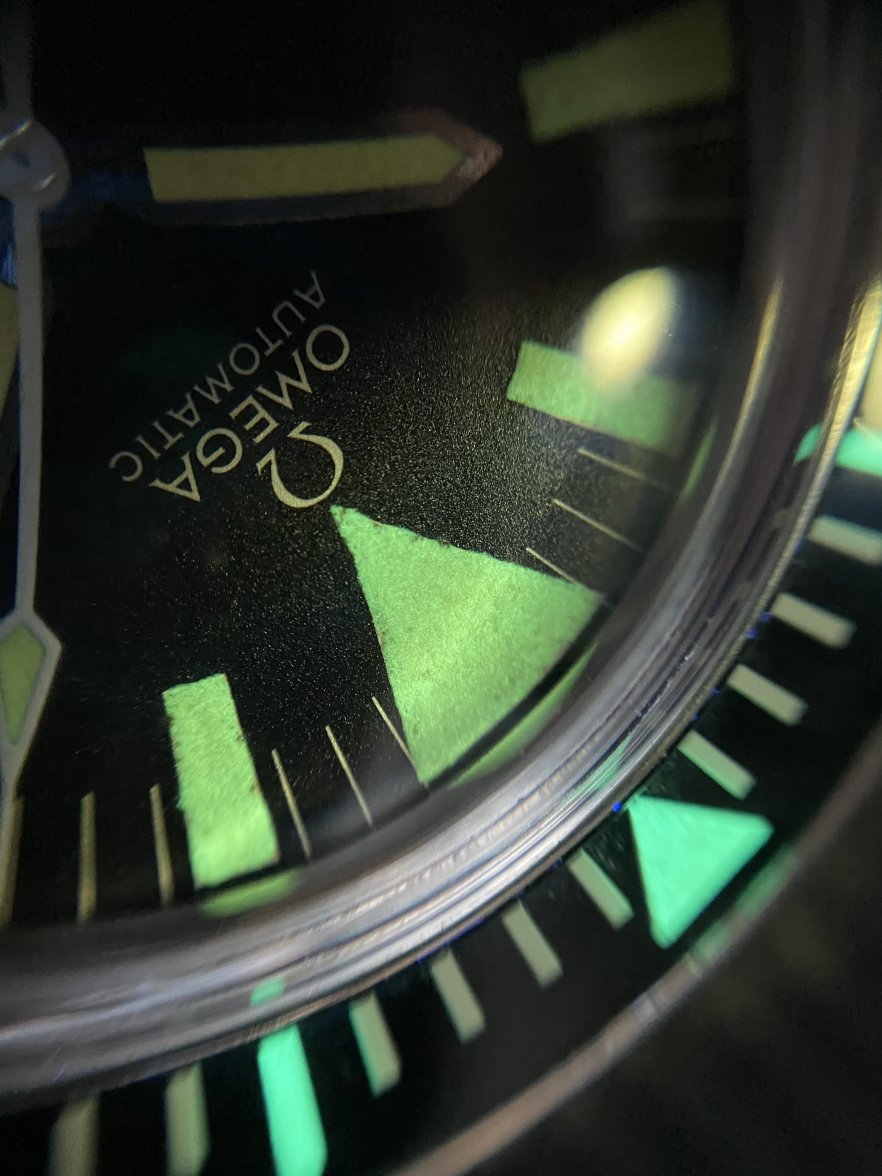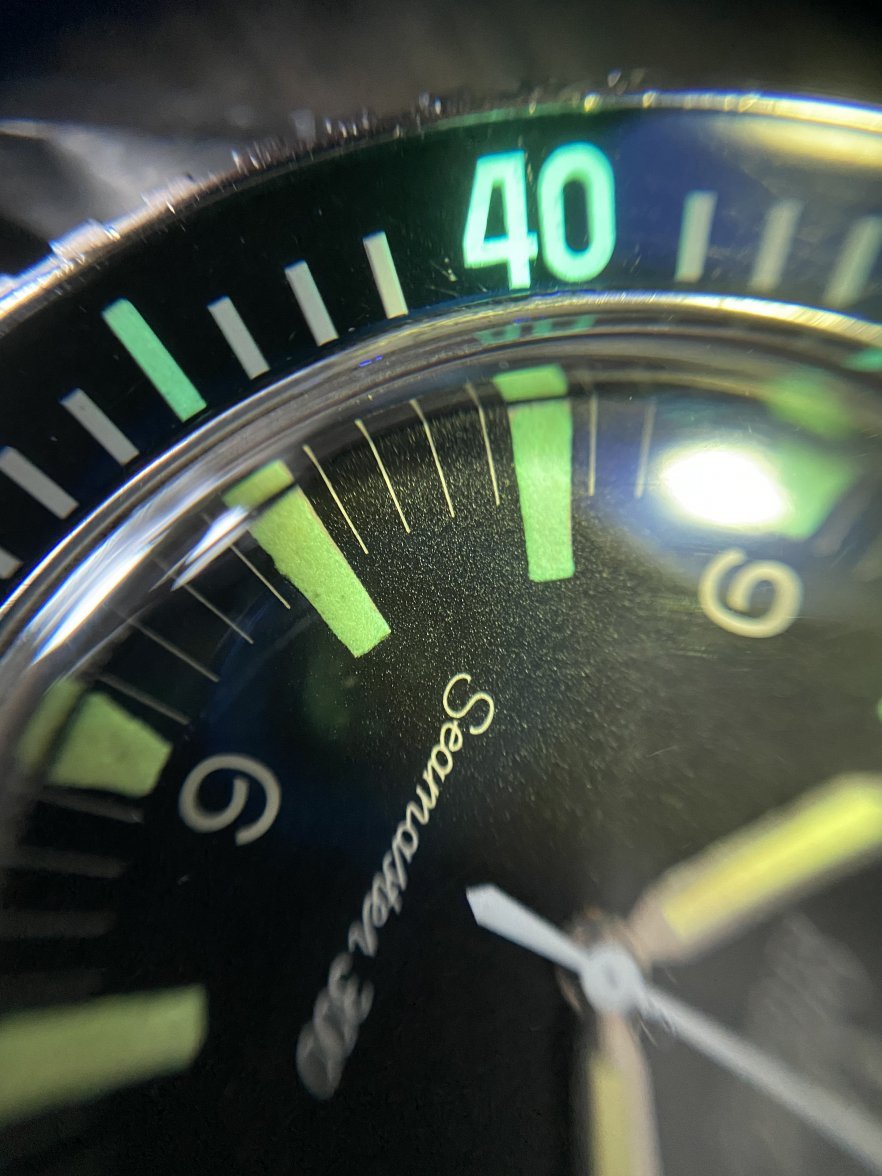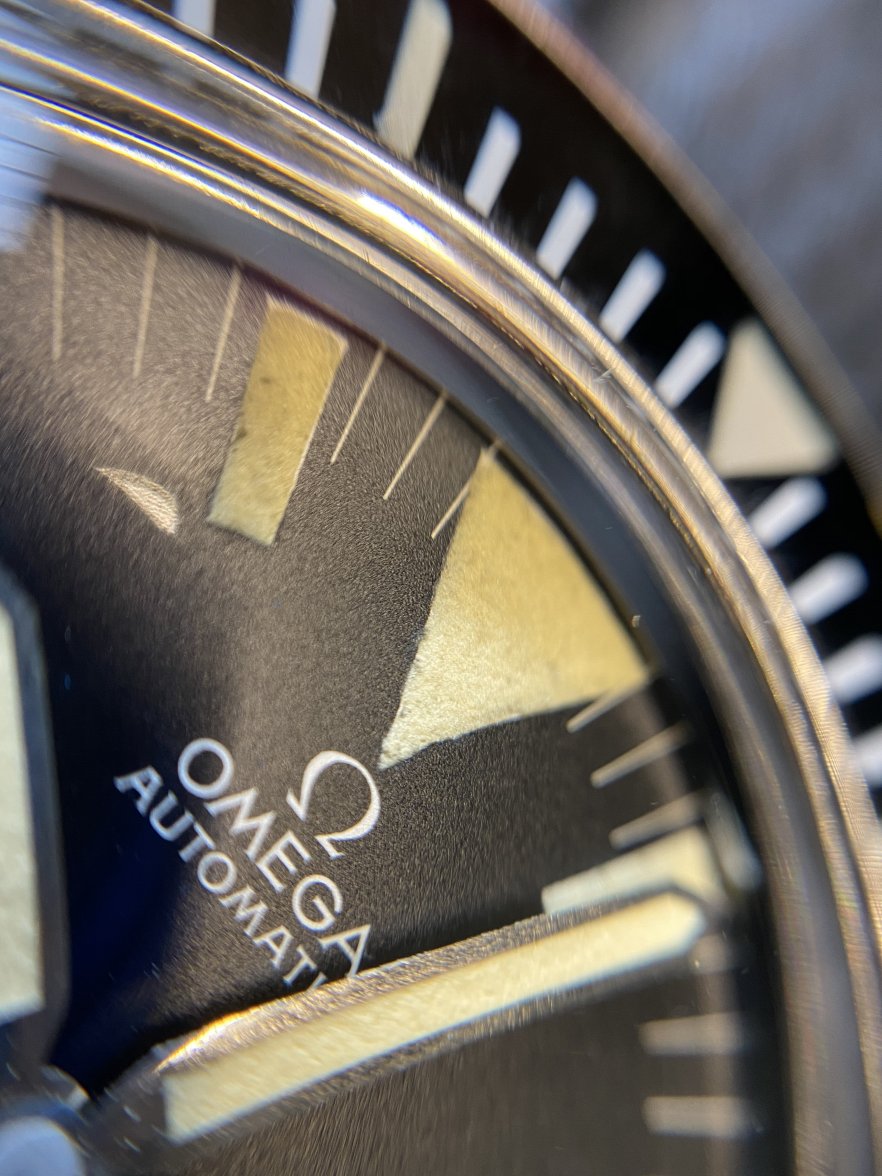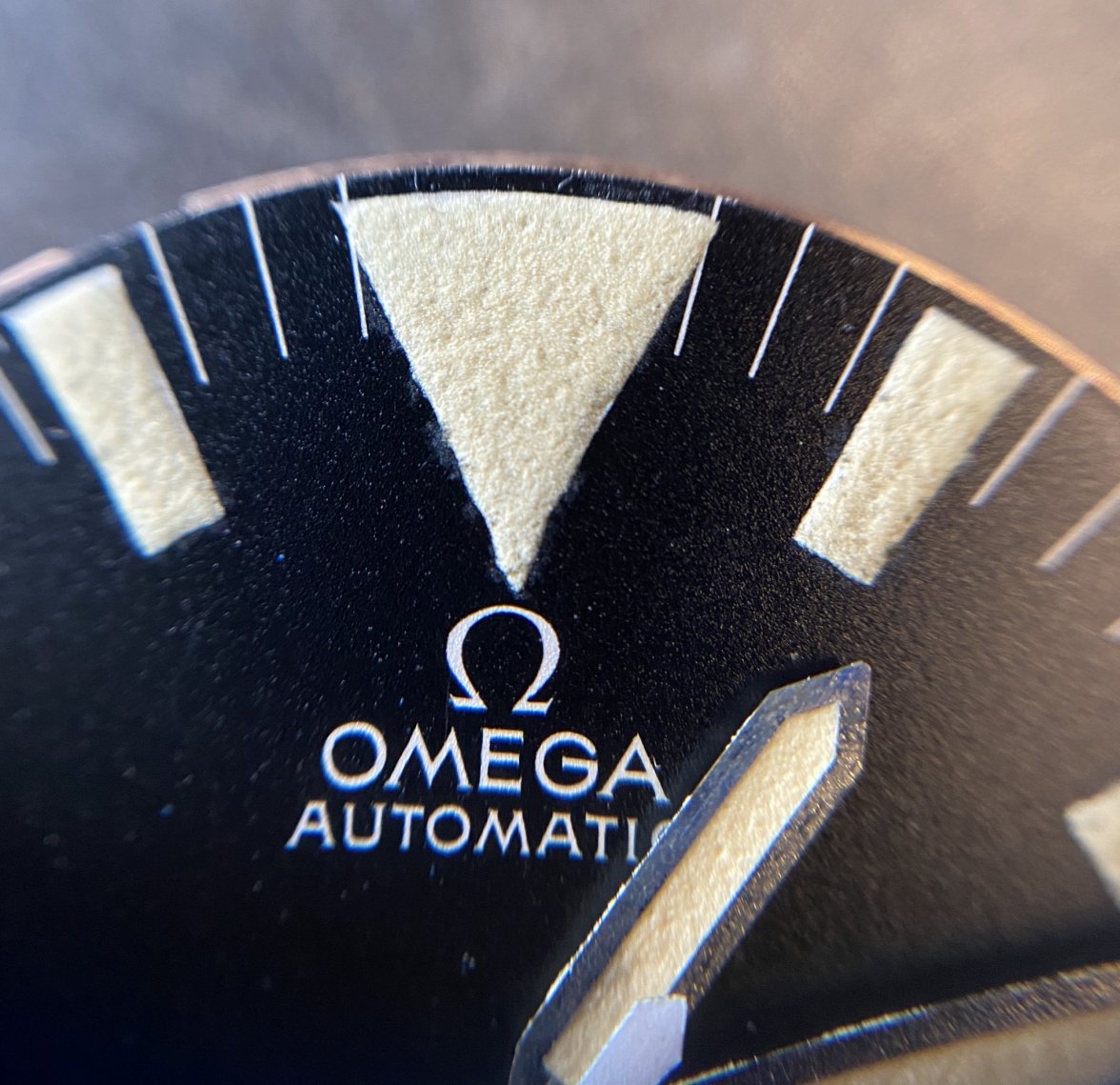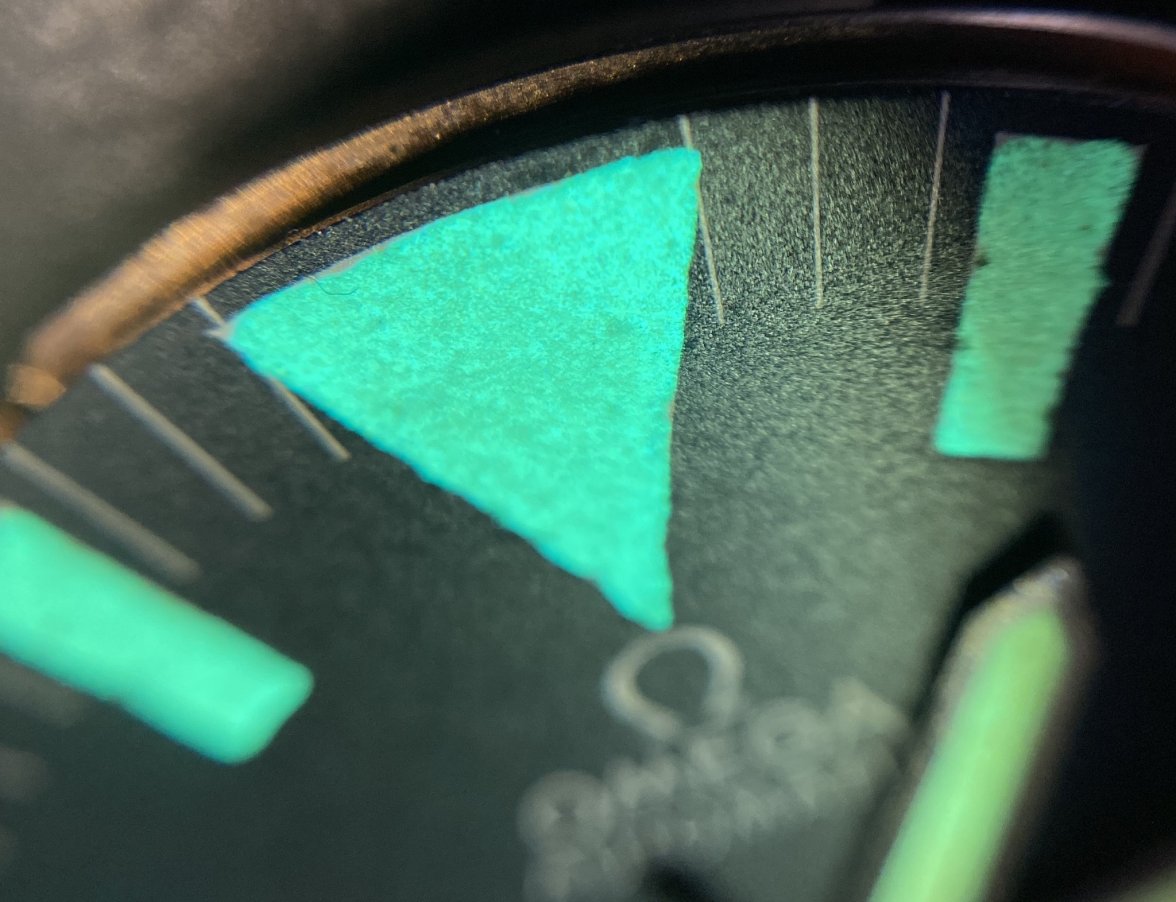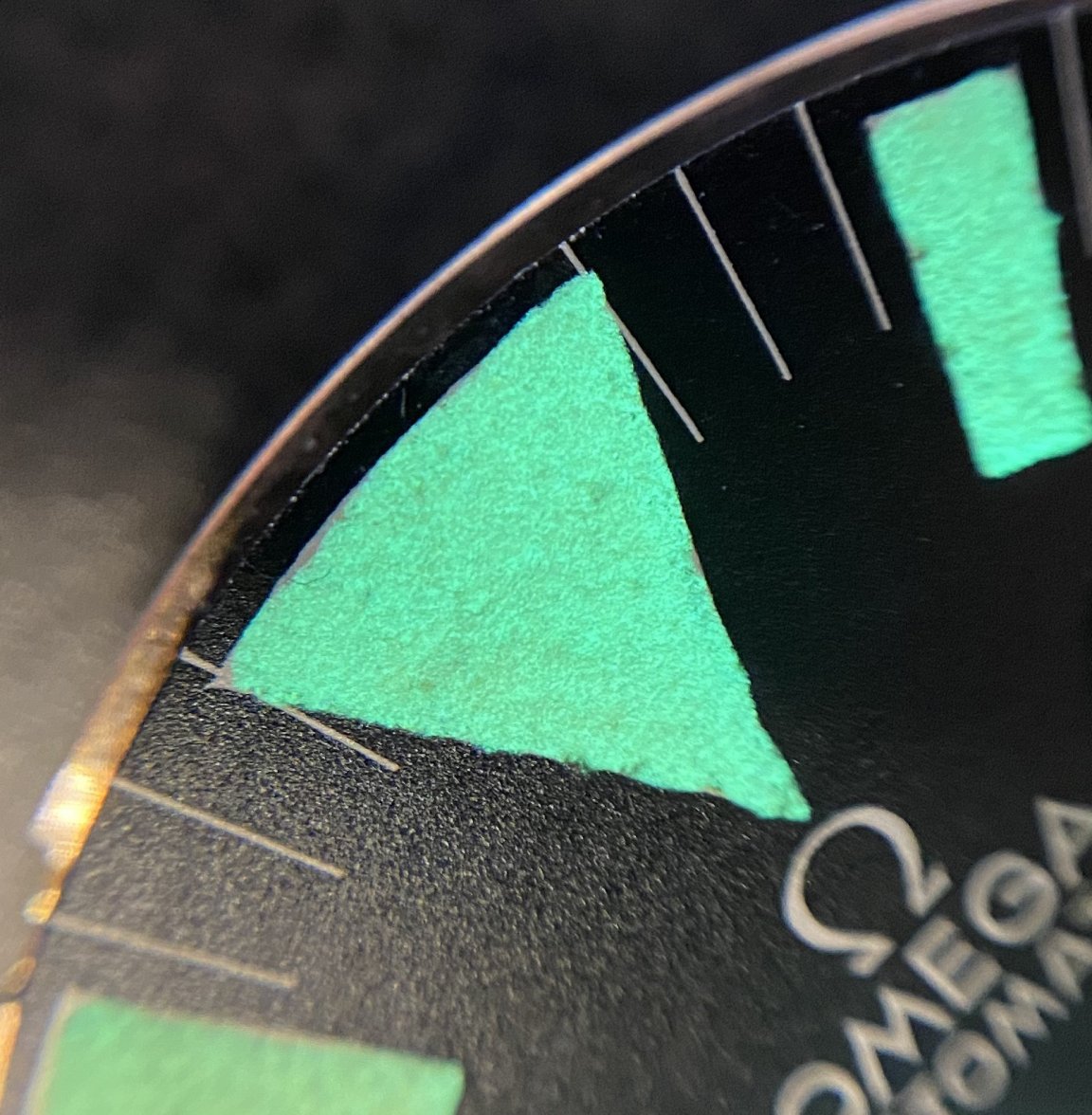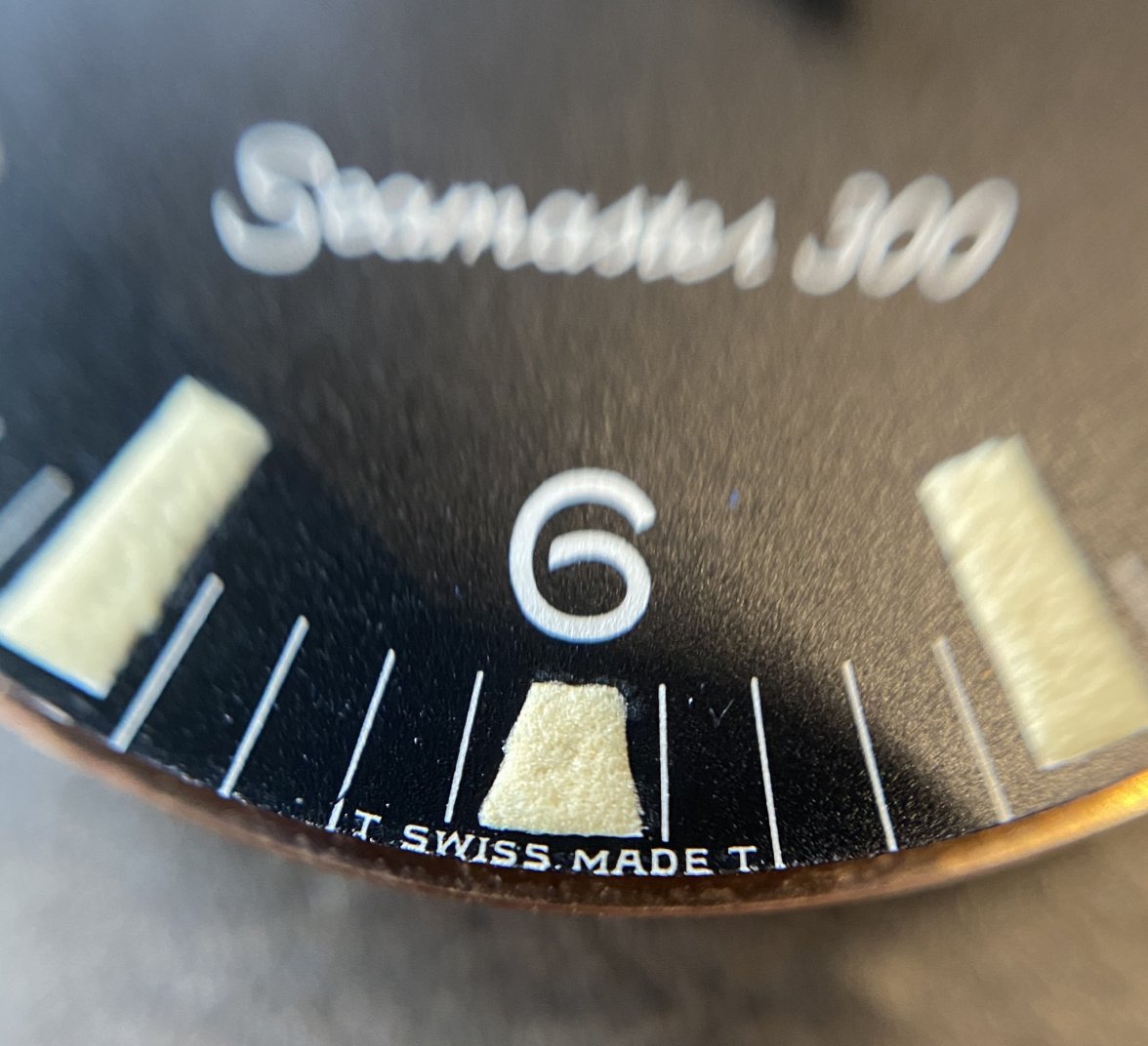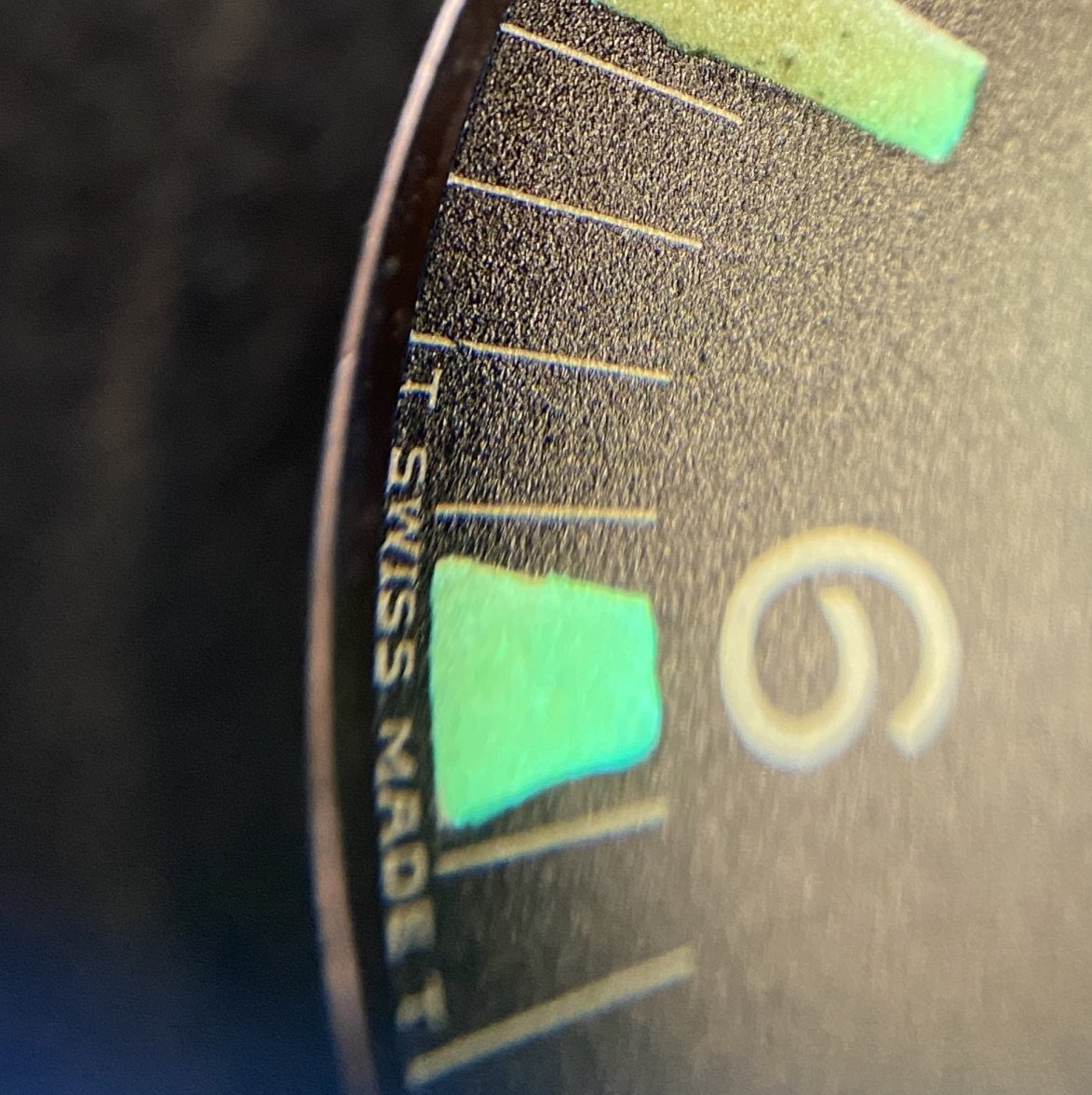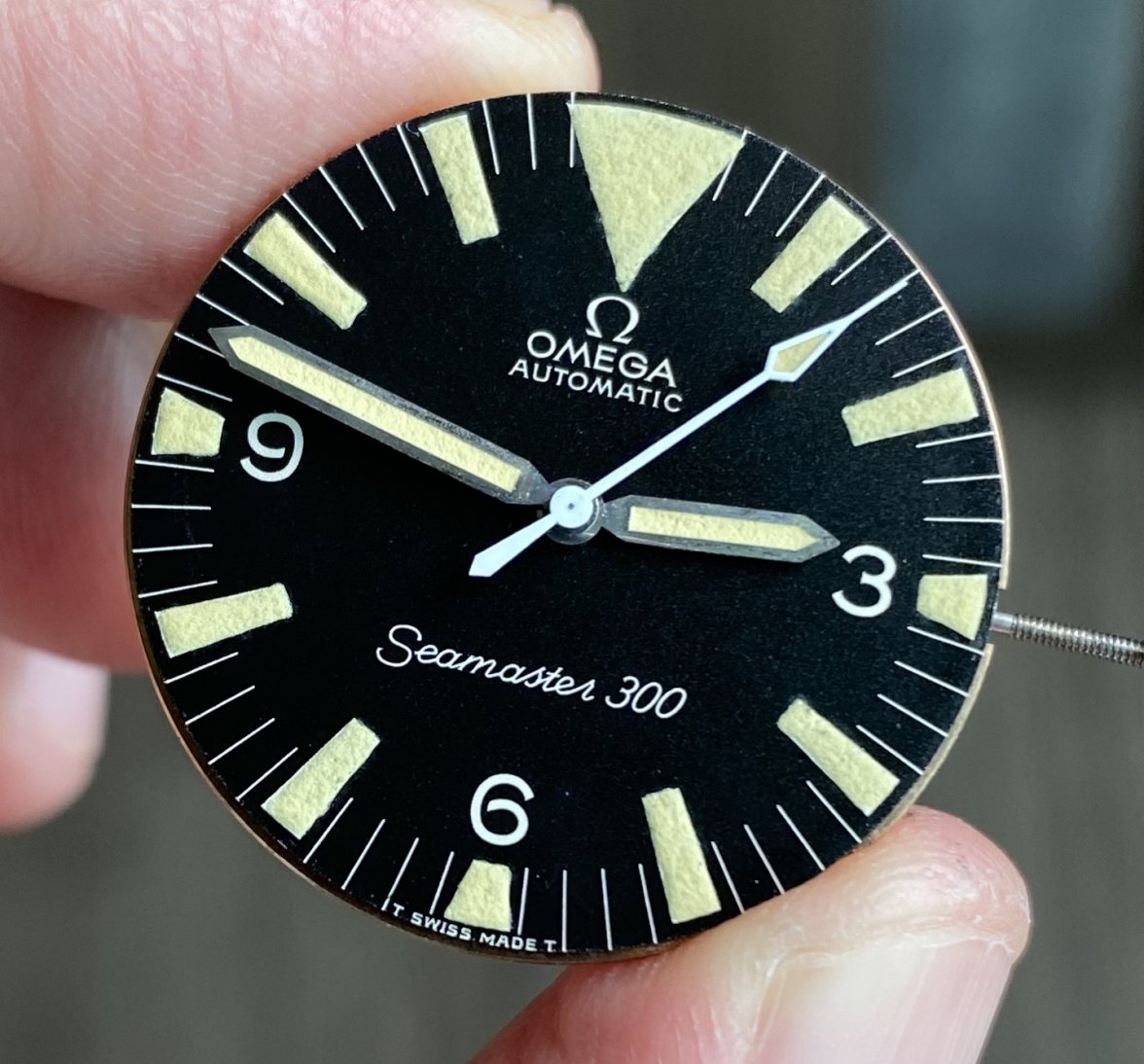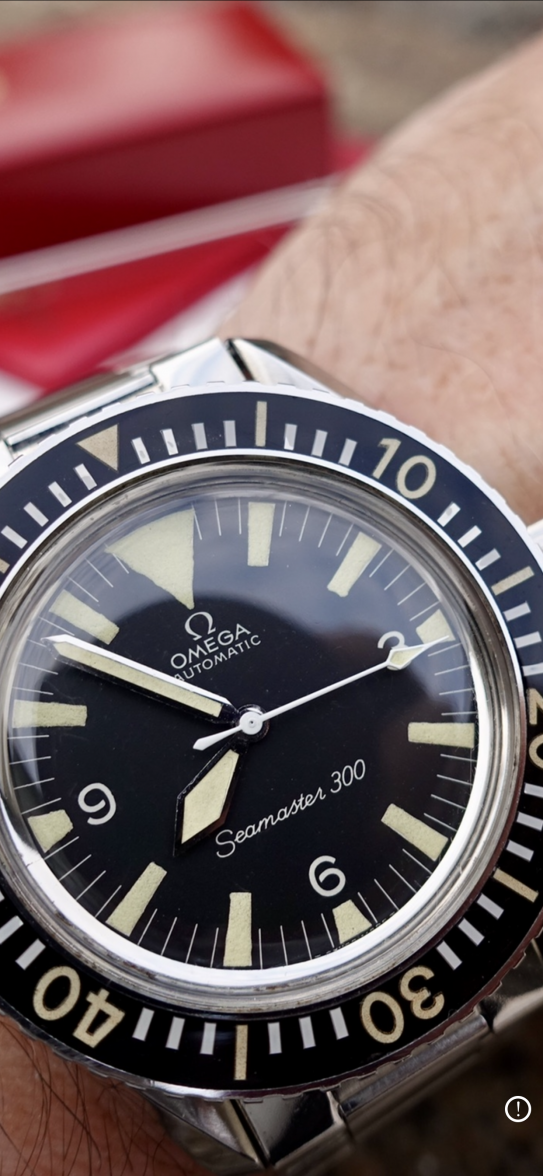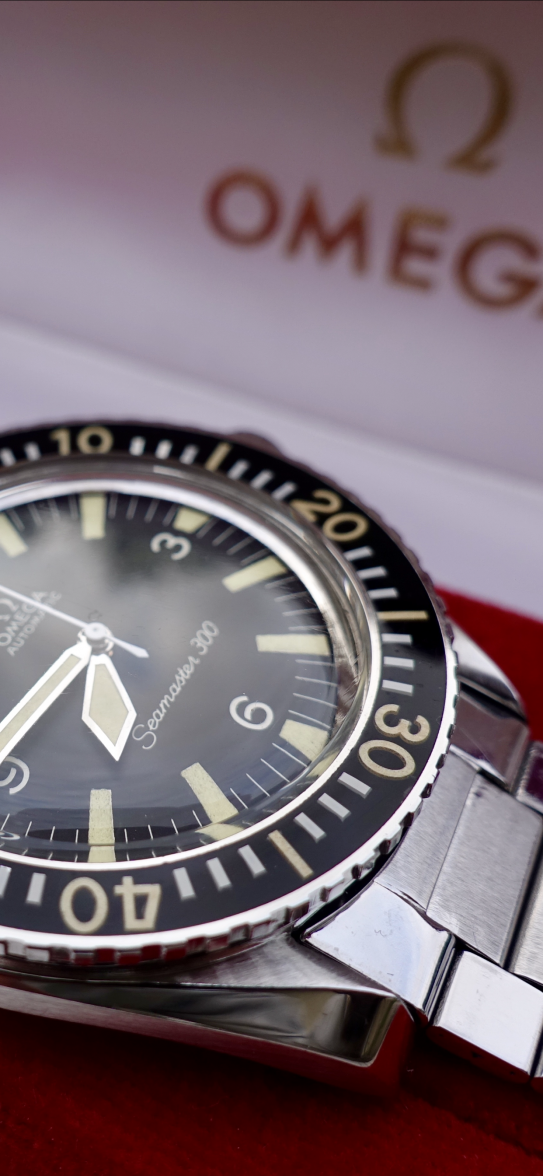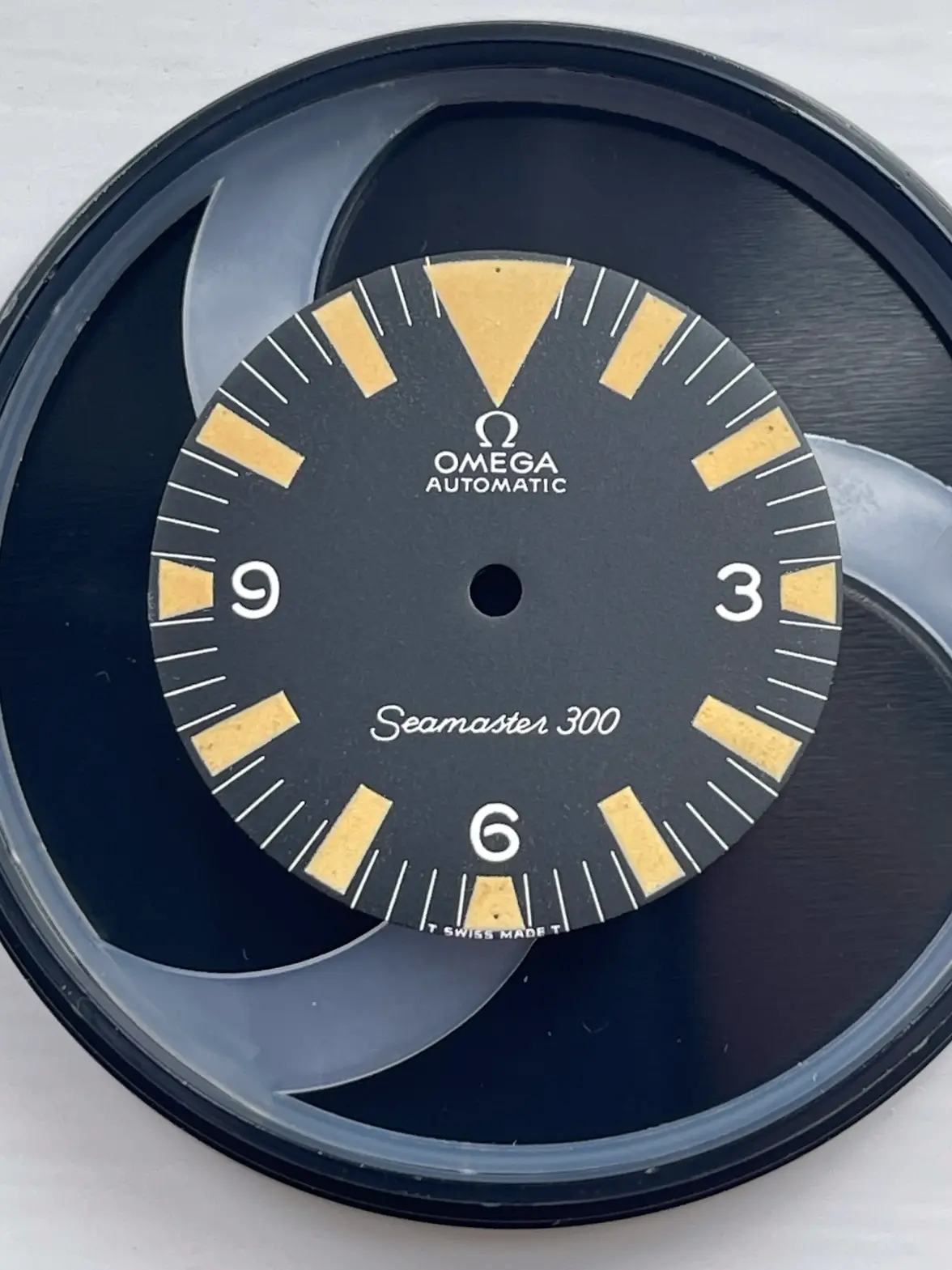
Perhaps a good reference for how original lume looks like on a 165.024 Seamaster (no pin hole)

Posts
398
Likes
1,064
I noticed the pin holes interesting nuances back in 2004 when I was so crazy over Seamaster 300 165.024, in particular the Big Triangle 12 version Back then no one really called it big triangle, at least as far as I know. With a not so good command of English, I began to call it the Big Triangle Seamaster 300. I do not claim to coin that term, but I was sure that I made that up.
Long and Short, I also started to noticed that most original lume has that pin hole at 12 & 6. And that led me wondering if that is the mark of an original lume, without it, it isn’t. Back then when people still read reviews on ebay, I remembering contributing a little review on it.

With enough specimens, especially with those estate auction pieces, First owners or at least good provenance examples or simple really “damaged” with mouldy lumes, where it cannot be a case where the watch is modified, I draw my own conclusion that there were 2 type of examples that exist, with and without pin holes at 12 & 6. To date, I have had owned at least 30-40 pieces that past through my hands on just Seamaster 300 dates/ no date.

To complicate a little further, there were another 2 type of lume application, the earlier ones that existed from the 60s and a later from the 70s. I dare not define the exact dates if you can see as I did not explore and only collect Seamasters as I collect a variety of watches both vintageS and moderns.

The earlier 60s lume I believed was hand applied, and hence forth the lume always looks imperfect, exposing the white Part beneath which I believed was a “template” for the lume designed to be filled. The 60s tend to always look yellowish (let’s not Bring those mouldy examples in), and they are slightly thicker. They always glow in the dark after exposure to light and react to UV. So I believe these are tritium activated zinc sulphate as the phosphor. Very Consistent with many other watch companies Then.

Then we have the later lume, which I believe is made from the 70s onwards and they are usually green, extremely thin in thickness. I believe these are stamp padded, somewhat how Rolex does theirs in their 70s to early 80 (1984) and some stamp pad has too much “ink” soaked and hence gives us what we all love, the ultra maxi dial which is totally out of shape in some.

so before I head out of topic, I’ll like to show how an original lume, Earlier version the 60s, no pin hole Seamaster 300 should look like.

Pin holes are harder to achieve by the average relumer (though it has been done), and the stamp pad thin lume from the 70s are hard to achieve as well so that’s why I decided to show macro shots of an often faked, relumed dial of a Seamaster 300 so that this can be a good reference for the novice OR to a seasoned collector that may not have enough samples to know what’s original what’s not.

Here’s photos under daylight and under UV light. Noticed under UV, there is nearly no speckles of inconsistency of the glow unlike radium, where I believe radium destroy phosphor faster due to its high radioactive nature.

Hope you have found this article useful.
 
Posts
2,671
Likes
24,908
Are the pictures of these watches relumed watch or are they original lumes?
 
Posts
398
Likes
1,064
Are the pictures of these watches relumed watch or are they original lumes?
Original lume. If not the above photoS serve no purpose
 
Posts
2,315
Likes
5,697
From what I have seen the pinholes are always there. Whether you see them pretty easily, or you don't at all.
The holes had nothing to do with the lume, they are a part of the constriction/manufacture methods of the dial.
It all depends on the way the applcation of the lume happened at the factory that day.
Usually, on super mint and clean examples, the holes are less noticeable as the lume is in pretty much factory perfect condition and has not deteriorated or aged.
If you've seen enough of these and have a keen eye for detail, when looking closely you can detect the pinhole hidden under a micro millimeter layer of Tritium. Even on your watch:


Here is my similar 165.024 BT in museum condition. Holes are a hair easier to detect than yours, but very close.


Posts
398
Likes
1,064
Hey buddy good to see you here!

yes initially I thought this may be hidden. It could be the fact that some lume were still wet when first newly applied and the lume were overloaded and hence some pin holes were missing.
However I am very sure that some were really missing that even under a strong light and 10x loupe.

I really suspect every piece should have it BUT I speculated that because of the inconsistent amount of lume, when it was freshly done, the pin hole could be covered.
So that’s why some didn’t have them. That’s only my speculation on the application bit and through observing those original lume with no pin holes
 
Posts
398
Likes
1,064
Let me take some fresh photo of mine without the crystal. Perhaps that can shed some light on this matter!
 
Posts
2,315
Likes
5,697
Hey buddy good to see you here!

yes initially I thought this may be hidden. It could be the fact that some lume were still wet when first newly applied and the lume were overloaded and hence some pin holes were missing.
However I am very sure that some were really missing that even under a strong light and 10x loupe.

I really suspect every piece should have it BUT I speculated that because of the inconsistent amount of lume, when it was freshly done, the pin hole could be covered.
So that’s why some didn’t have them. That’s only my speculation on the application bit and through observing those original lume with no pin holes
Look, there's a sure way to find out.
Scrape the lume off your dial. If the holes are there, I win.
If the holes are not there, you win. 😉😉😁
 
Posts
398
Likes
1,064
Look, there's a sure way to find out.
Scrape the lume off your dial. If the holes are there, I win.
If the holes are not there, you win. 😉😉😁
Haha haha. You’re so right buddy... and evil!

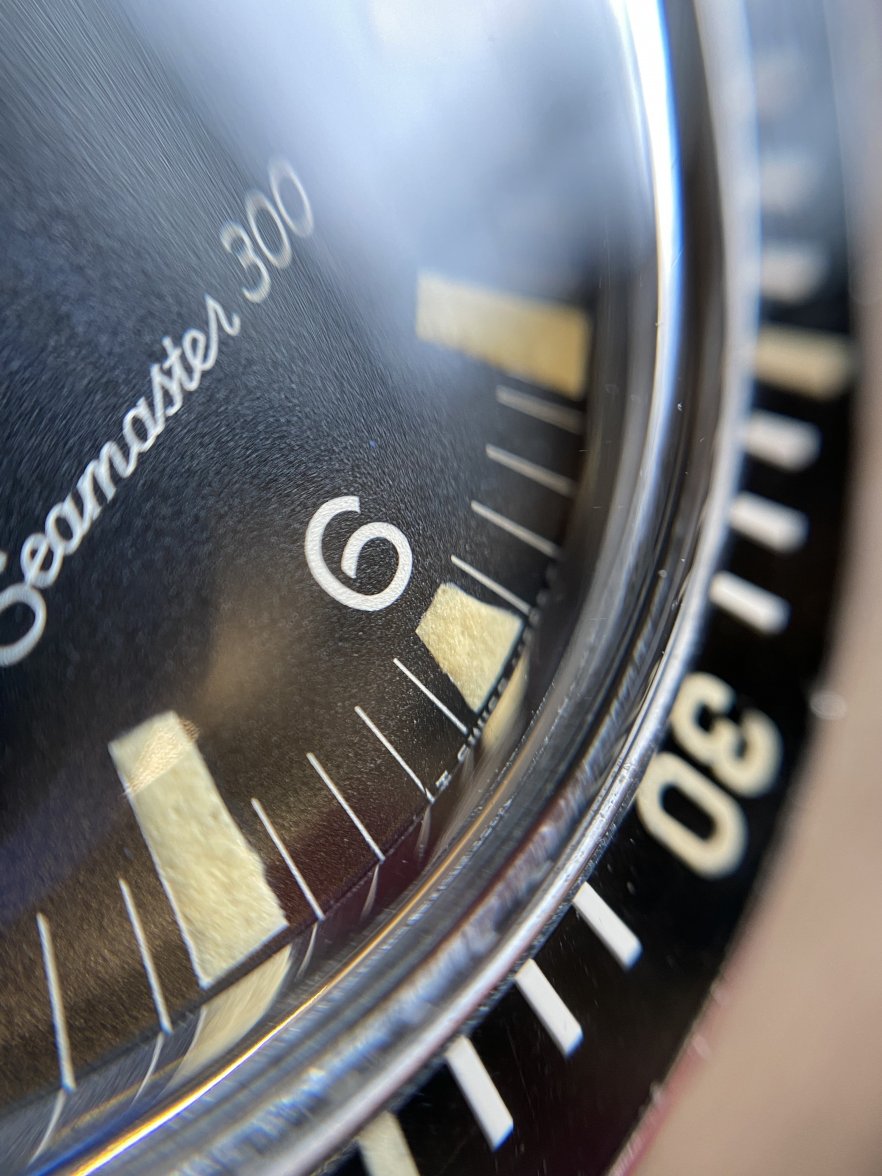
anyway as promised here’s a macro.

Very sure the “hole” that shows in the photos are just another “sunken” part of the lume. I know the 12 looks like a hole. It could be but at 6, there isn’t.
 
Posts
2,315
Likes
5,697
the “hole” that shows in the photos are just another “sunken” part of the lume.
Right. it is "Sunken" exactly at the spot where the hole will be (is). Isn't that just a killer coincidence? 😉


Mine:


Call me crazy but you can also see where the hole is at the 6 on your watch:

 
Posts
908
Likes
2,491
Right. it is "Sunken" exactly at the spot where the hole will be (is). Isn't that just a killer coincidence? 😉


Mine:


Call me crazy but you can also see where the hole is at the 6 on your watch:

I share the same opinion as @ndgal, yours show the pin hole, but veeery faint. The lume on the SM300’s tend to wander about a bit, i believe the lume was applied with a more generous hand than on for example Speedmasters as the lume had a key role in a divers watch. In time the lume settles, and creates this wobbly lume we see on many dials, this would also cover the pin holes. Here’s also my BT for an comparison, the dimple on 6 o’clock is on this exact location on OP’s watch.
Edited:
 
Posts
398
Likes
1,064
I get it. You know I scrutinised for the spot and yes to me it’s a coincidence and the 12 was easier to spot (or just coincidence) but the 6, was nearly impossible.
Let see what the rest think too. Too bad back then we dont have good camera like today and those I sold, I didn’t manage to take a photo at them
 
Posts
2,315
Likes
5,697
I get it. You know I scrutinised for the spot and yes to me it’s a coincidence and the 12 was easier to spot (or just coincidence) but the 6, was nearly impossible.
Take a needle and try to stick it in there.
If it goes through, there's a hole. 😁
If it doesn't, no hole. 😉
 
Posts
1,100
Likes
1,701
the holes are simply through and can be seen also from the back side of the dial. Some dials have them and some other not.
 
Posts
1,344
Likes
1,966
^^^ This. All the .024 dials I have seen uncased have holes when viewed from the back.
 
Posts
398
Likes
1,064
Take a needle and try to stick it in there.
If it goes through, there's a hole. 😁
If it doesn't, no hole. 😉
Hahhahah. And next moment..... the entire lume falls out
 
Posts
24
Likes
38
Hi,

Many thanks to the OP for the very interesting article about original loom on the SM 300.

I have recently acquired a one owner SM300 165.024 Big Triangle No-Date, made in 1966, it is all original with it's original 1506/16 4/66 dated bracelet, on the dial I can't see the pinholes, however the lume is original.


I also have an original NOS 1968 Big Triangle no date dial and hands set, that I acquired from a very nice gentleman who in turn had acquired these along with a job lot of various other makes of watch parts, an incredible find.

This NOS dial has the pin-holes at 12 and 6 and it is marked on the back 68*552.


When comparing the lume of these two dials I noticed :

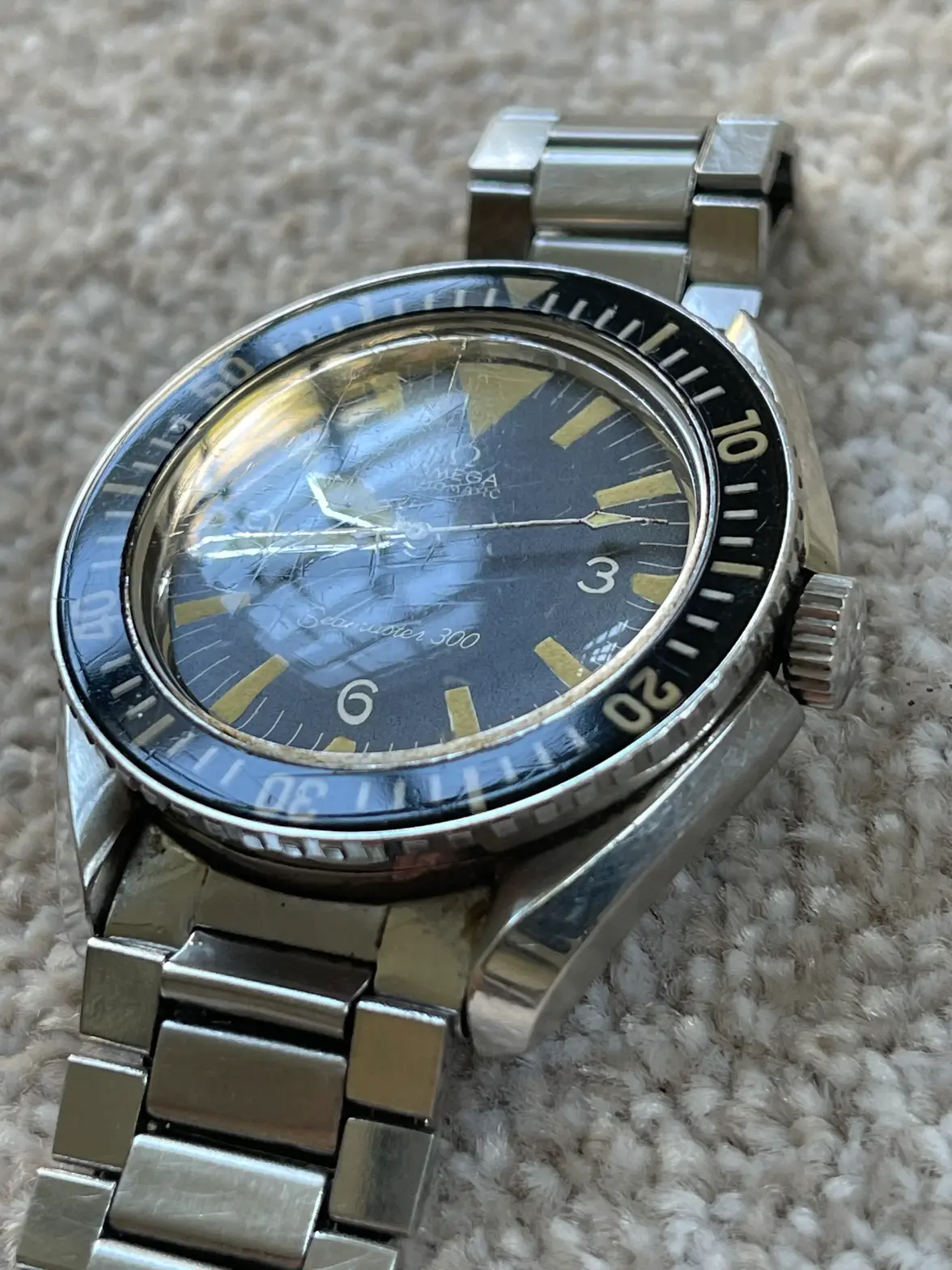
The 1966 dial has a light sand coloured lume, I can't see pinholes and the lume is hand applied, quite imprecisely actually, and very similar to your (OP) dial that you have illustrated in the original post above.

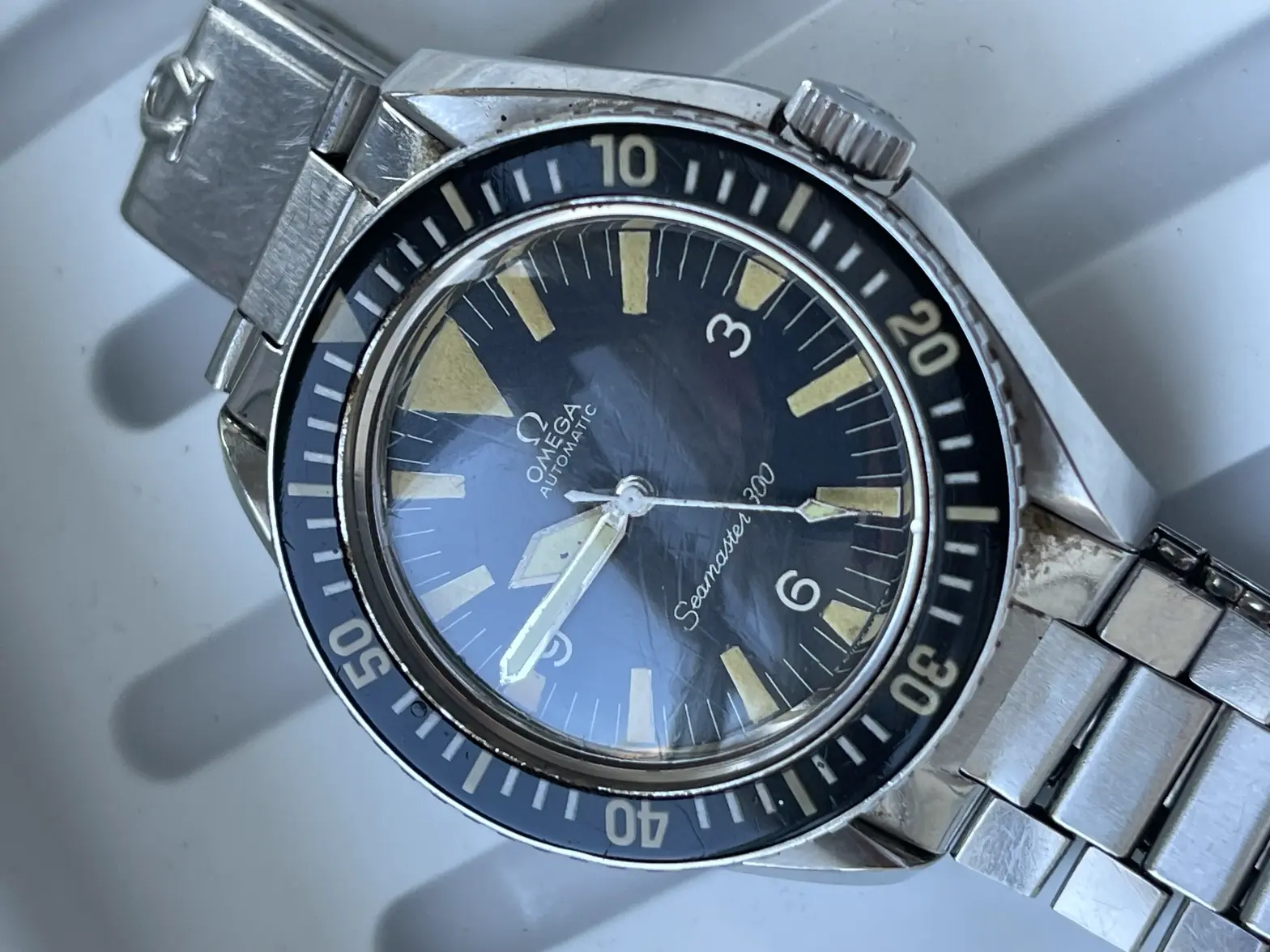
The 1968 NOS dial has a darker sand coloured lume (as do the hands), there are pinholes in the dial at 12 & 6 and the lume is more precisely applied.

It looks like the lume was applied using a stencil?, and I'm guessing the pinholes were used to line up the stencil during application.

I'm not sure but I read somewhere that the Big Triangle No-Date dial was first available in 1966?

So I'm thinking that possibly the earlier production dials were hand applied, like mine and yours (OP) and later on in the production run they changed from hand applying the lume (time consuming and imprecise) to applying the lume using a stencil?

The lume on my 68 NOS dial is a darker sand colour, has the pinholes and the lume is more precisely applied.

I'm not sure if the darker sand colour lume only appears on the later produced dials, however my 68 dial certainly is a darker sand colour than the 66 dial.

Please have a look at my photos of the 66 dial and the NOS 68 dial, the differences in colour and the precision of the lume application is evident.

I have not removed the 66 dial from my watch to check if this dial has pinholes hidden by the lume.

So I'm supporting your theory that original lume doesn't have to always have the pin holes.

I would be very interested in your comments and opinions.

Kind regards,


Nick

(I'm in the UK)

 
Posts
204
Likes
242
As someone who would love to have a vintage 300 but, very leery mostly due to my ignorance of all the tells to ascertain legitimacy of these pieces, I read these articles eagerly for any knowledge I can acquire. Someday my 69 Speedmaster will have a mate in a mid 60s Seamaster 300. Thank you for posting. 🙏🏻
 
Posts
398
Likes
1,064
Wow this is a super old post. I’m glad this post has helped people in their pursuit of the best SM300!
 
Posts
24
Likes
38
Hi @reficul_x , an old post yes, and a very interesting one, thanks again.

It shows that to have original lume on a SM300 dial you don't always have to be able see the pinholes visible, you do however still have to be able to spot if a dial has been re lumed or not!

Maybe some of the SM300 dials don't all have pinholes? and even if all of the SM300 dials do actually all have pinholes, then some are covered over by the lume when it was applied.

I have not yet removed the dial of my 66 SM300 to check if mine has it's pinholes or not.

Your (@reficul_x) and my SM300 dials have their original lume plots which is surprisingly (on the one hand) yet (on the other) reassuringly quite imprecisely applied, and the pinholes are not visible.

It is very very very hard to find a genuinely fully original Big Triangle No-Date SM300, let alone a fully original one with it's acrylic plastic resin insert in super nice condition, and it's original lume plots NOT rotted and mouldy from previous water intrusion.

Almost all SM300's have had at least some parts replaced, or are frankens, or out and out fakes, it takes time and patience to build up the knowledge and details to be able to create and run your own checklist when looking and accessing a watch for sale.

Mostly there will be some sort of a compromise you'll have to make, but I would always say start with the dial (don't compromise on that) and go from there.