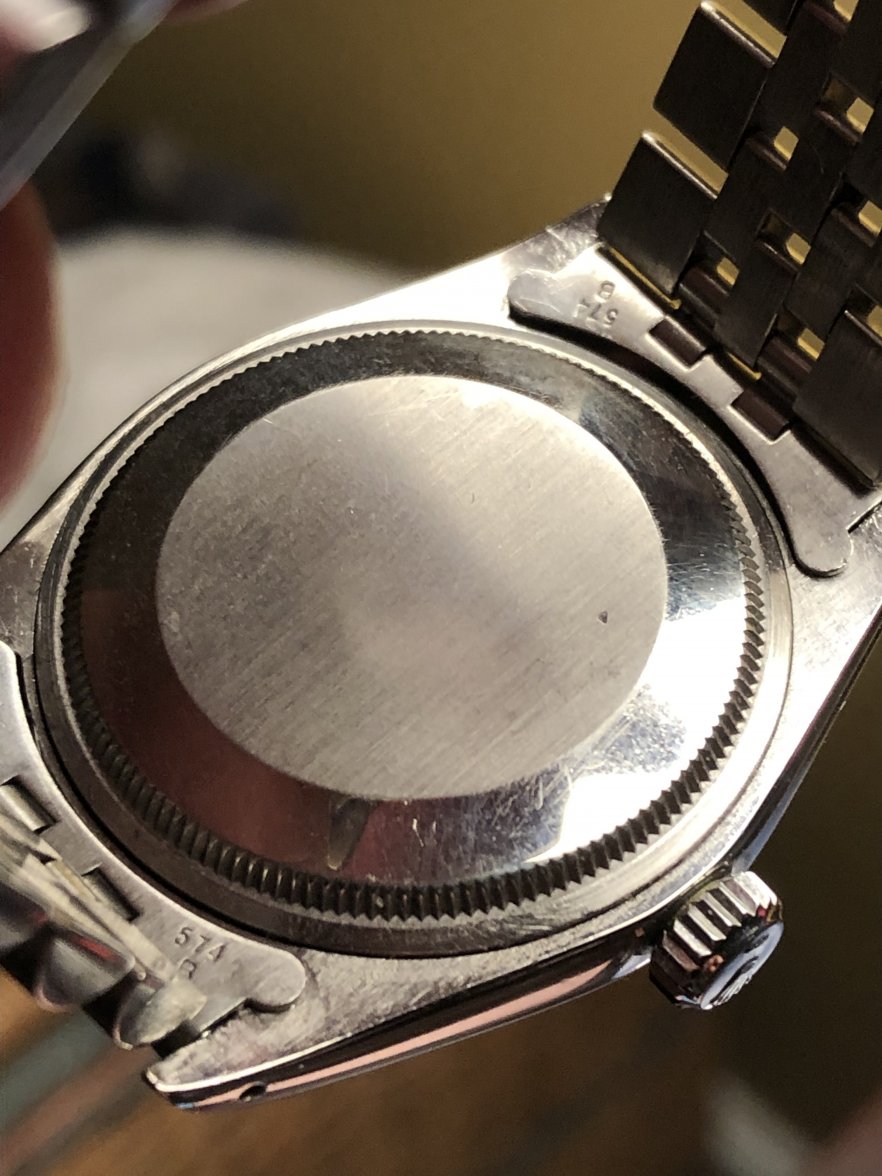
Any watchmaker who has had training from Rolex on refinishing can do this, and likely many more who haven't. Applying a straight grain finish like this is about the easiest thing you can do, and most watchmakers would have learned this technique in school, likely while being required to make some tooling project. For me it was when I was required to make a balance tack:

In the Rolex training I've had they identified particular Rolex emery papers for refinishing case backs - one for steel and a different one for PM cases. Rolex is very anal about how you accomplish things, which is why they have their own Rolex-specific Menzerna polishing compounds, and when using a buffing machine they give you actual RPM's to use for different operations so that with the sizes of bugffs they specify, you will get the correct surface speed. So the specific emery cloth is not generally available as far as I know, so you would have to find an appropriate abrasive. It's a long time ago now, but that balance tack I believe was done with maybe 1500 grit paper...maybe...
So to straight grain the case back, you need a sheet of abrasive paper, a good surface to lay it on, a straight edge, and something to control the rotation of the case back. So Rolex recommend using one of those aluminum clip boards as the primary surface, and laying a thin rubber mat underneath. You then clip the abrasive paper to that, and refinish the back. I've used a glass sheet, but this requires the case back to be perfectly flat, so something with a bit of compliance to it isn't a bad idea. In my current set-up, I use one of those mats that quilters use for cutting out squares, etc., and they can be found at craft stores - they give just enough, but not too much:

So for the purposes of these demo pics, I'll just mock this up on my main bench, because I'm not in the mood to go to the other part of the shop right now and clean it up to take photos...
So here is a case back (for demo purposes only) and a standard Bergeon 4040 movement holder that many watchmakers use:

You mount the case back in the holder like so:

Let's pretend for a minute that the bench mat has the abrasive paper mounted to it, and that this piece of wood is a good straight edge. You invert the case back in the holder, keep it tight to the straight edge, put some pressure on it, and draw it down in the direction of the arrow:

When you get here, you are done:

The key is not to let the case back rotate, so that's why we use the movement holder and a fairly tall straight edge to make sure everything is in a straight line. This is honestly so easy it's almost something anyone can do with a bit of jury rigging. Of course I would use a good steel or other rigid straight edge, and make sure nothing can move around. Then it's just a matter of finding the right grit of paper to closely reproduce the Rolex straight grain. If any watchmaker you are using can't do this, well I'm not sure I would trust them to work on a movement.
Cheers, Al