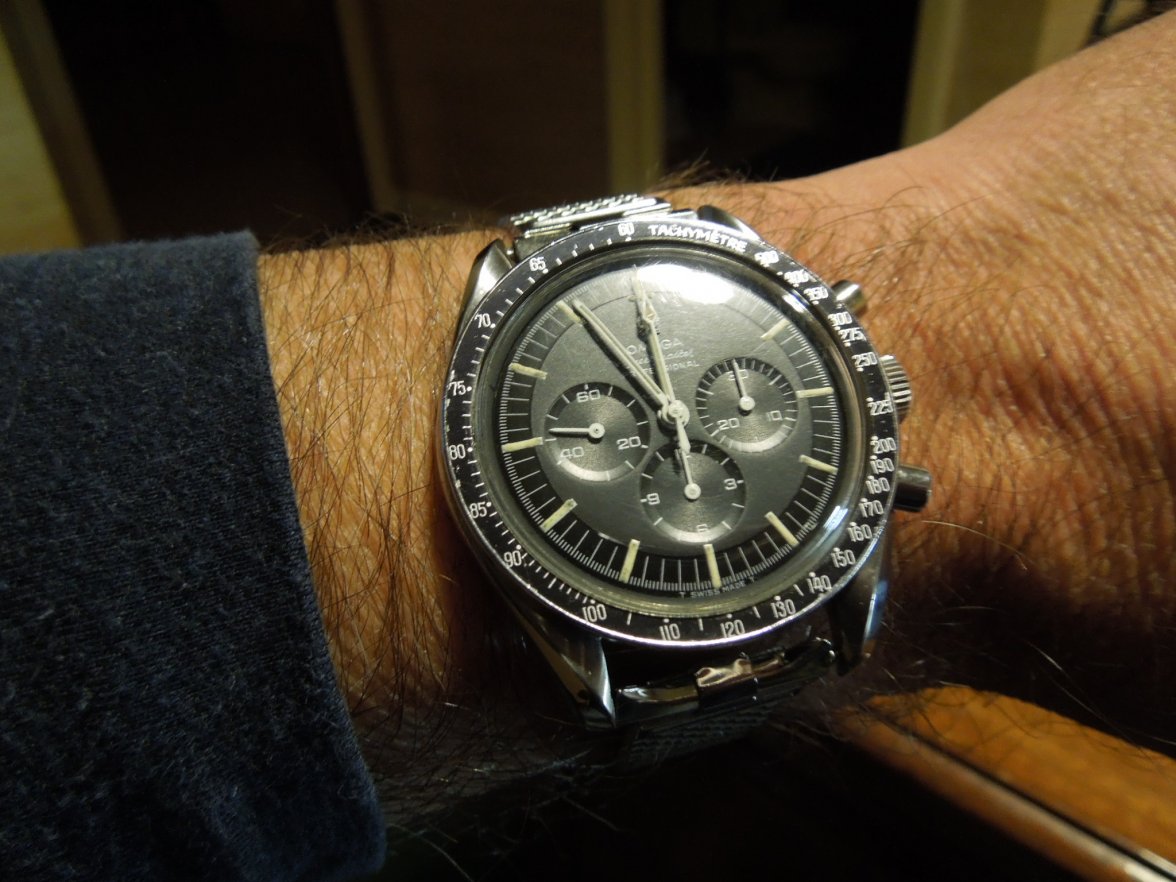
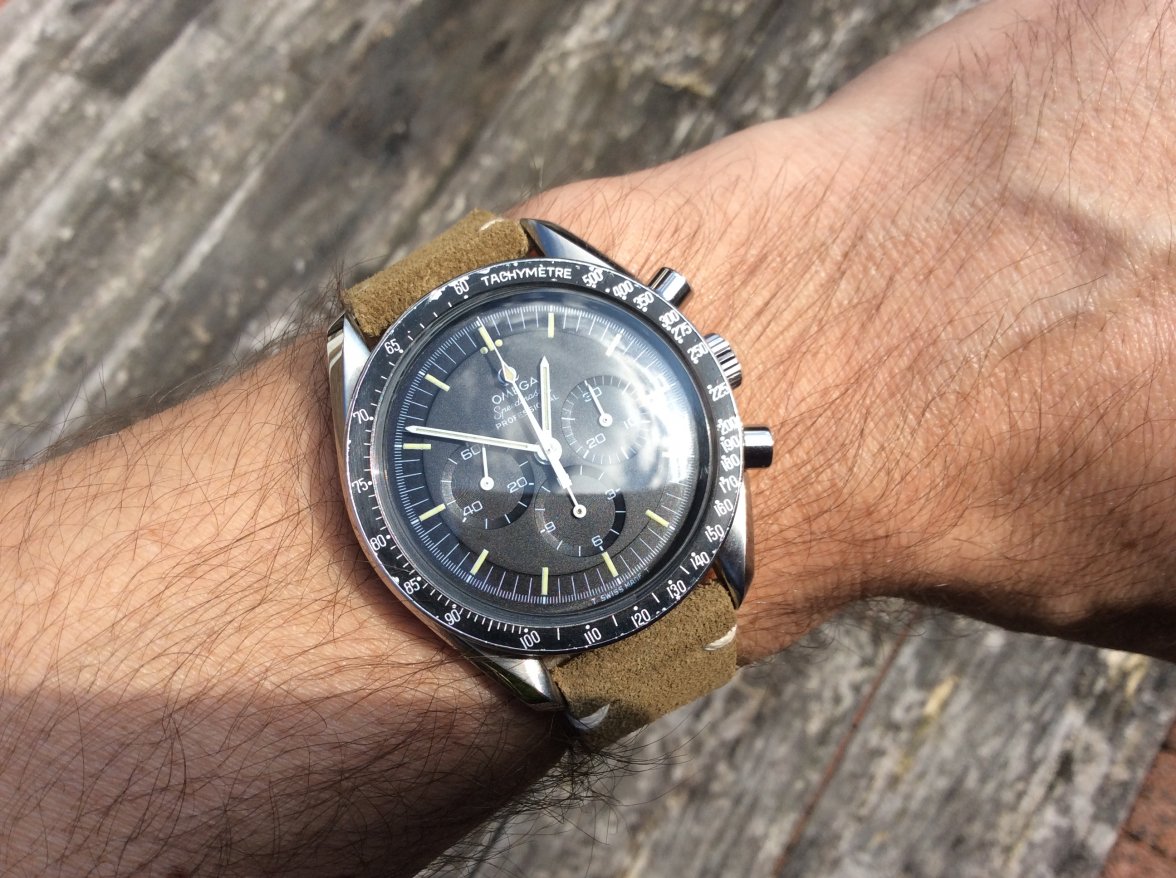
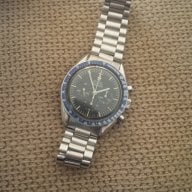
Omega Speedy 105.012-64 color of the dial?

Posts
132
Likes
172
Not exactly a variation. Pre 69 dials can turn brown and are called tropical dials. The Blue bezel can rarely happen on 69 and earlier watches. All dials can rarely fade grey.
This watch left the factory with a black bezel and dial.
I think it would be very nice to talk with a chemist. In my opinion, the quality of the materials that are used, the fine proportion of them, makes the bezel and the dial change the color or retain the initial color. I think Omega made a mistake when they mixt the quantities for some lots. And for this reasons they were a little blue.
Of course, it is important where it is used, the condition and the way is stored.
 
Posts
2,710
Likes
17,411
I turn green with envy馃榿. A real stunner. wear in the best of health!!
 
Posts
2,844
Likes
2,439
Not exactly a variation. Pre 69 dials can turn brown and are called tropical dials. The Blue bezel can rarely happen on 69 and earlier watches. All dials can rarely fade grey.

This watch left the factory with a black bezel and dial.
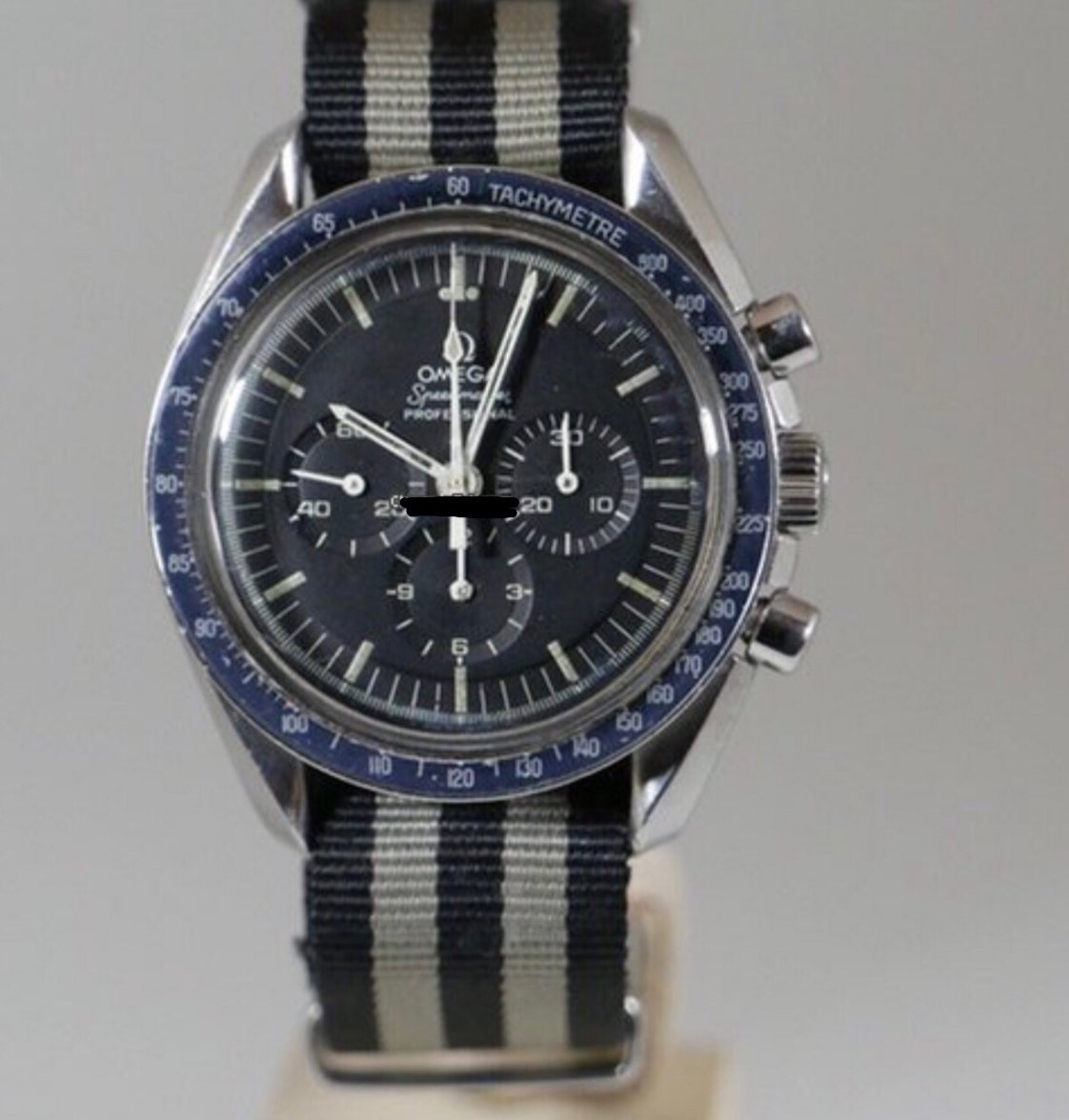
Until recently I've only seen or heard of pre '69 blue DON bezels. Now there appears to be a '71 DNN blue bezel.

I ask only because you're so adamant about all Speedmaster bezels leaving the factory black. Is this either firsthand knowledge or did you hear this from someone that actually worked for Omega?

I'd be interested to hear from our members that have one of these black that now turned blue bezels in their collection.

I wonder if any of them heard the same "tall tale" I heard? That being that occasionally Omega would use a bezel paint from a different supplier. For reasons known only to the "paint gods" this odd-ball painted turned blue. Anybody else heard this tale?

Please help satisfy my curiosity. Thanx, Miki
Edited:
 
Posts
18,203
Likes
27,531
Until recently I've only seen or heard of pre '69 blue DON bezels. Now there appears to be a '71 DNN blue bezel.

I ask only because you're so adamant about all Speedmaster bezels leaving the factory black. Is this either firsthand knowledge or did you hear this from someone that actually worked for Omega?

I'd be interested to hear from our members that have one of these black that now turned blue bezels in their collection.

I wonder if any of them heard the same "tall tale" I heard? That being that occasionally Omega would use a bezel paint from a different supplier. For reasons known only to the "paint gods" this odd-ball painted turned blue. Anybody else heard this tale?

Please help satisfy my curiosity. Thanx, Miki

These dials have faded blue for what ever reason. The 71 blue is questionable and if it's the one I think it is from a month or so ago, I think it was "enhanced " by the seller as the wear pattern on the bezel looked fake to me.

As for the factory selling blue bezels. There is no uniformity between the ones that patina to blue, so not this watch.

I seem to recall a picture with blue and green bezels that where uniform from somewhere that obviously had not faded to that color. As to what these where I've got no idea but this watch and the other blues that show up are not that perfect uniform blue.
 
Posts
2,844
Likes
2,439
Interesting, "enhanced" how? I always thought that if you looked at whatever "chips" on a dial through a 10x loop you would be able to see if they are actually natural color paint that the dial was painted. Yes - No?
 
Posts
3,091
Likes
3,595
I think it would be very nice to talk with a chemist. In my opinion, the quality of the materials that are used, the fine proportion of them, makes the bezel and the dial change the color or retain the initial color. I think Omega made a mistake when they mixt the quantities for some lots. And for this reasons they were a little blue.
Of course, it is important where it is used, the condition and the way is stored.
I think you are exactly correct.
What you say here has long been espoused by Rolex collectors.
Here's the definition of Black:
In the visible spectrum, black is the absorption of all colors. Black can be defined as the visual impression experienced when no visible light reaches the eye. Pigments or dyes that absorb light rather than reflect it back to the eye "look black"
Black is made using Equal parts of the Primary colors Blue, Red, and Yellow. It can also be made using "hues" (mixtures of primary colors)
Primary colors are colors are one color only, that can't be made with other colors.
Why does ultraviolet light cause color to fade?
answer.gif
Because of photodegradation.
It is all about the chemical makeup of an object. The technical term for color fading is photodegradation. There are light absorbing color bodies called chromophores that are present in dyes. The color(s) we see are based upon these chemical bonds and the amount of light that is absorbed in a particular wavelength.

Ultraviolet rays can break down the chemical bonds and thus fade the color(s) in an object - it is a bleaching effect. Some objects may be more prone to fading, such as dyed textiles and watercolors. Other objects may reflect the light more, which makes them less prone to fade.

Red paint is noticeably the fastest colour to degrade, while Blue is the slowest
Red degrades faster because it absorbs higher energy (shorter wavelength) light.
UV coatings are added to outdoor signs to extend the life of the dyes.(Watch dials and bezels too I've read.)


Some theories: ( No, I'm not a chemist, lol)
Dials: Improper or lack of color protective UV coatings or components in the manufacturing Process.
Brown can be made from primary colors mixed disproportionately.
Bezels: Chemical degradation of the UV coating(or as a component of the dye)(salt, chlorine, oxidation) causes the Red
dye to degrade faster than the yellow and blue. Since blue is the slowest to degrade,
you get a blue hued bezel under the right conditions.

Why do bezels fade to gray? Maybe a proper color pigment and uv protective component
mixture fades proportionately(instead of the red faster, blue slowest)
Edited:
 
Posts
18,203
Likes
27,531
Interesting, "enhanced" how? I always thought that if you looked at whatever "chips" on a dial through a 10x loop you would be able to see if they are actually natural color paint that the dial was painted. Yes - No?

The 71 I saw was lighter on the inside part of the bezel which is opposite wear patterns where the outside gets lighter as it is not as protected from scratches.

These blues are normally considered to be faded and exposed to some chemical after they left the factory.
 
Posts
2,844
Likes
2,439
The 71 I saw was lighter on the inside part of the bezel which is opposite wear patterns where the outside gets lighter as it is not as protected from scratches.

These blues are normally considered to be faded and exposed to some chemical after they left the factory.
I believe that the dial in question is in fact lighter shade of blue on the outer edges of the dial 馃槈

I find it most interesting that your were quick to call the blue bezel of this '71 "questionable" but made no mention of the "crud" on the dial especially between 1&3. How did such a keen eye miss that?

BTW: Are you sure it's a lighter shade of blue on the outer edges other than the obvious wear between 9&11?
 
Posts
18,203
Likes
27,531
I believe that the dial in question is in fact lighter shade of blue on the outer edges of the dial 馃槈

I find it most interesting that your were quick to call the blue bezel of this '71 "questionable" but made no mention of the "crud" on the dial especially between 1&3. How did such a keen eye miss that?

BTW: Are you sure it's a lighter shade of blue on the outer edges other than the obvious wear between 9&11?
That's not the one I was thinking about. 馃榾 One came up that was imho backwards.

This does bring up an interesting philosophical issue. As blue bezels are generally thought to be from exposure to some chemical and wear leading to some ghosting, is a manufactured one any less real if the same affect happened by accident or by purpose?

Generally though blue bezels almost without fail tend to be late DON's from what I've seen
Edited:
 
Posts
2,844
Likes
2,439
Maybe that's why the above '71 is so unusual 馃槈
 
Posts
2,844
Likes
2,439
Wow, I just realized we sent this thread in a tail-spin Sorry 'bout that 馃檨
 
Posts
5,317
Likes
24,330
Pretty sure that is a black dial with a gentle natural fade.
 
Posts
3,091
Likes
3,595
Some of mine can look grayish at the right angle.
I think it's just lighting.
 
Posts
132
Likes
172
Pretty sure that is a black dial with a gentle natural fade.
And the bezel is also black. But the light...馃榿
I'll try to make some new photos. In what angle or in what light to look black? Maybe in totaly darkness an it will be like you said: black.馃え
 
Posts
18,203
Likes
27,531
And the bezel is also black. But the light...馃榿
I'll try to make some new photos. In what angle or in what light to look black? Maybe in totaly darkness an it will be like you said: black.馃え
What he is saying is your watch left the factory with a black dial and bezel which changed and faded to blue and grey.
 
Posts
1,775
Likes
7,719
Some of mine can look grayish at the right angle.
I think it's just lighting.

My 145.012 looks fresh anthracite, but my 145.022 has a hint of brown/grey. Mind, it's not a brown dial, but it has a brownish hue (which is nearly impossible to capture).

 
Posts
132
Likes
172
What he is saying is your watch left the factory with a black dial and bezel which changed and faded to blue and grey.
I didn't ask " how my watch left the factory?". We all know how the watch left the factory. The thread is about the dial now. Not in 1964. Im not native english, but i understood for sure what he wanted to say.