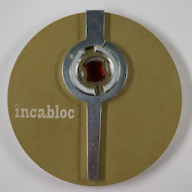
Hi, I’m digging up this old thread again because I had the same problem and found a solution that didn’t require replacing the motor.
I’d bought a 1979 Seamaster quartz with the same symptoms as a project to tinker with and decided to get to the bottom of the issue.
Symptoms: Even with a new battery, the second hand would only twitch but wouldn’t move any further.
Troubleshooting: I disassembled the gears connected to the motor, but even without a load, the rotor could only manage to twitch, but not tick over. I then removed the motor and tested the resistance of both coils. Both had the same resistance, so they appeared normal. Next, I used an oscilloscope to check the motor's contacts on the circuit board. The clock signal was coming to both coils evenly and at the same amplitude, so the control circuit and the rest of the electronics were functioning properly. The only remaining possibilities were sticky oil or contaminants inside the motor itself.
Troubleshooting: I pulled the rotor out of the motor and cleaned everything superficially with Rodico; I also brushed the rotor with isopropyl alcohol. When that didn’t help, I looked into how much a new or used replacement motor would cost, and my mood sank even further...
I took another look at the motor and examined the ruby bearings against the light using a 10x jewelry loupe. On the underside, I could still see contaminants on the inside of the counter bearing/thrust bearing/pivot bearing for the rotor shaft.
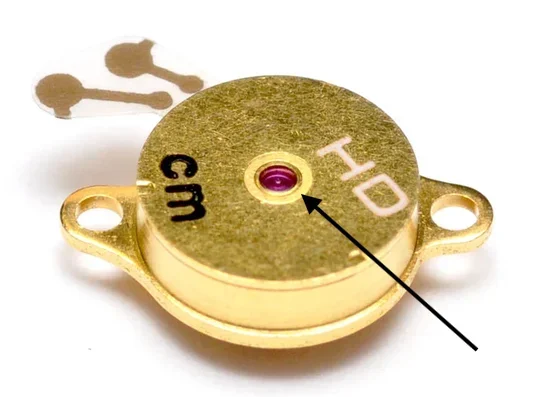
Unfortunately, you can’t reach it from above. But since I considered the motor broken in that condition, I resorted to more drastic measures. I placed the motor on a silicone mat and, using a thin metal pin roughly the same diameter as the rotor shaft - I think it was a PCB drill bit - I pushed the ruby counter bearing out of the motor housing from above through the other axial bearings (don’t lose it!!!). Then I used tweezers to submerge the entire motor in isopropyl alcohol, making sure the contacts stayed dry (I have no idea what kind of substrate material the contacts are on), and carefully swirled the motor back and forth to loosen all the hardened oil in the two radial bearings. Afterward, I brushed the two radial bearings (as far as I could reach) with a soft bristle brush and isopropyl alcohol. Then I carefully placed the tiny radial bearing in the isopropyl alcohol and cleaned it as well with a soft bristle brush.
Once I was satisfied, I let everything air dry, then used tweezers to position the axial bearing back into its original seat and carefully pressed it back into place with the flat end of my cleaning brush handle (made of relatively soft wood). Afterward, I ran my finger over it to make sure it sat flat and was secure. Last but not least, I applied a little watch oil to the tip and shaft of the rotor and reinserted it. And surprisingly, the test showed that despite my crude repair methods (I’m not actually a watchmaker, but I usually work with larger machines), the motor was ticking away nicely again without any hesitation or missing a beat.
I then disassembled, inspected, and cleaned the rest of the movement. I polished the watch crystal and case a bit, and since then, the watch not only looks chic but also runs reliably.
I hope this helps someone and keeps a few more Omega Cal. 1342s alive, since the repair costs would now exceed the value of the watches.
Be brave. Worst case, you’ll end up with what you already had before: a watch that doesn’t run
😉