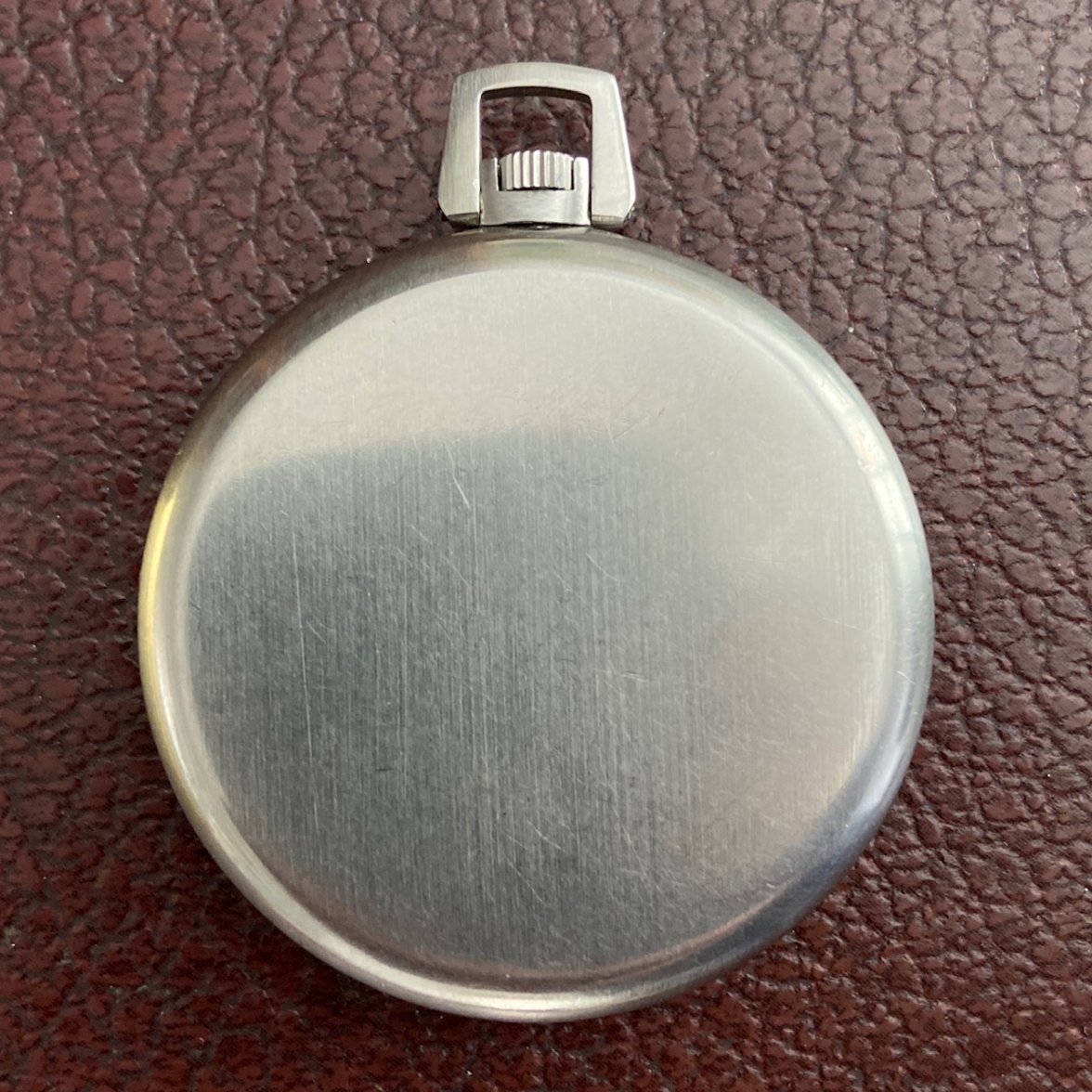
old pocket watch

Posts
8
Likes
7
hello everyone,

i am new to this forum and seeking information on an old omega pocket watch that belonged to my grandfather. it was handed down to me by my father. now, i am passing it on to my son who is getting married soon. the pocket watch does not appear to be a fine watch but rather a working man's watch. it feels good in hand, cool, smooth and well worn.

i'd like to be able to tell him more about the watch than just that "it belonged to your great-grandfather". can anyone tell me more about this watch, e.g., how old, common, rare, etc. would it be worthwhile cleaning/servicing the watch before giving to my son given that it will probably never be used as a timepiece on a regular basis?

i can post more pics if that would be helpful. thank you.
 
Posts
5,636
Likes
5,800
We need to see the movement, numbers in the case back, and there are tiny numbers under the balance that identify the type of movement, this is referred to as "caliber". You will need magnification.

The balance is the little wheel that spins back and forth and has a spring attached to it.
 
Posts
5,081
Likes
15,687
Dang, that’s nice. What a great family tradition. Does that back unscrew to get the above info? It will just be lefty-loosey. It may be a pop-off back, and pictures of all sides will be needed to help you know where to pop it open.
 
Posts
17,597
Likes
36,800
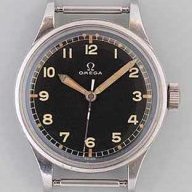
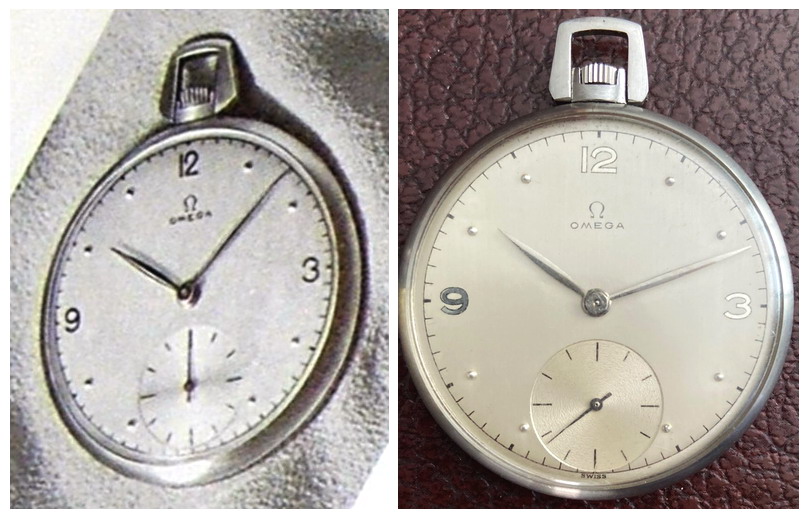
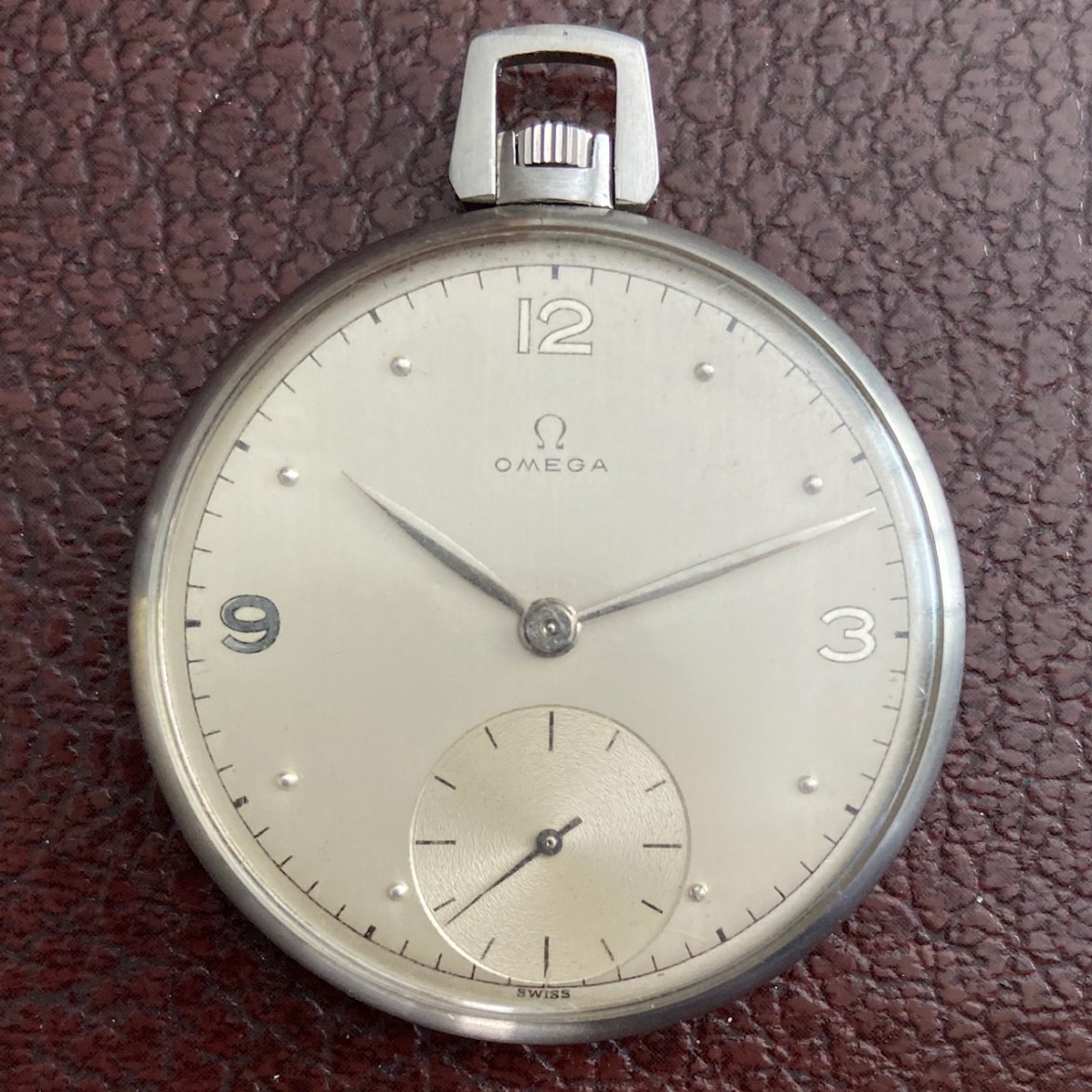
At the moment, it's just an Omega Lépine with a silvered dial, mirror finished arabic numerals and silver leaf style hands.

The style of the bow suggests late 1940s to 1950s, It will probably be a snap back case and housing a caliber 37.5 or a caliber 160.

But until it's opened we will not know.

Paging @tdn-dk
Edited:
 
Posts
8
Likes
7
thank you for your responses.

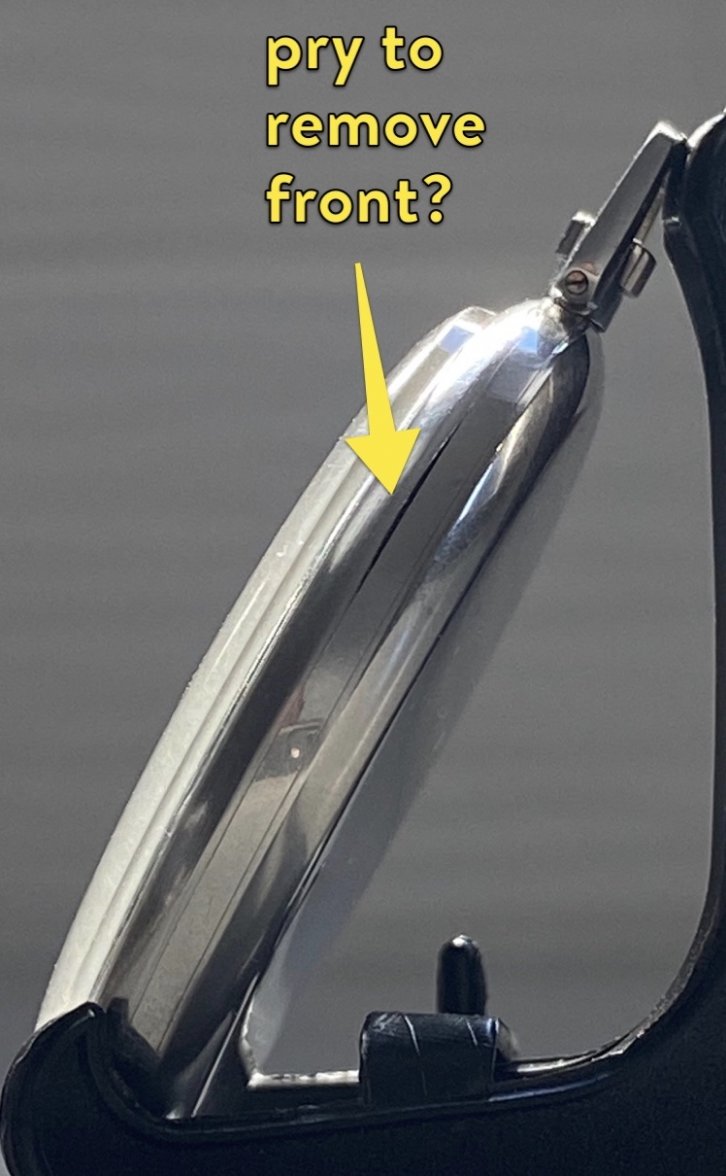
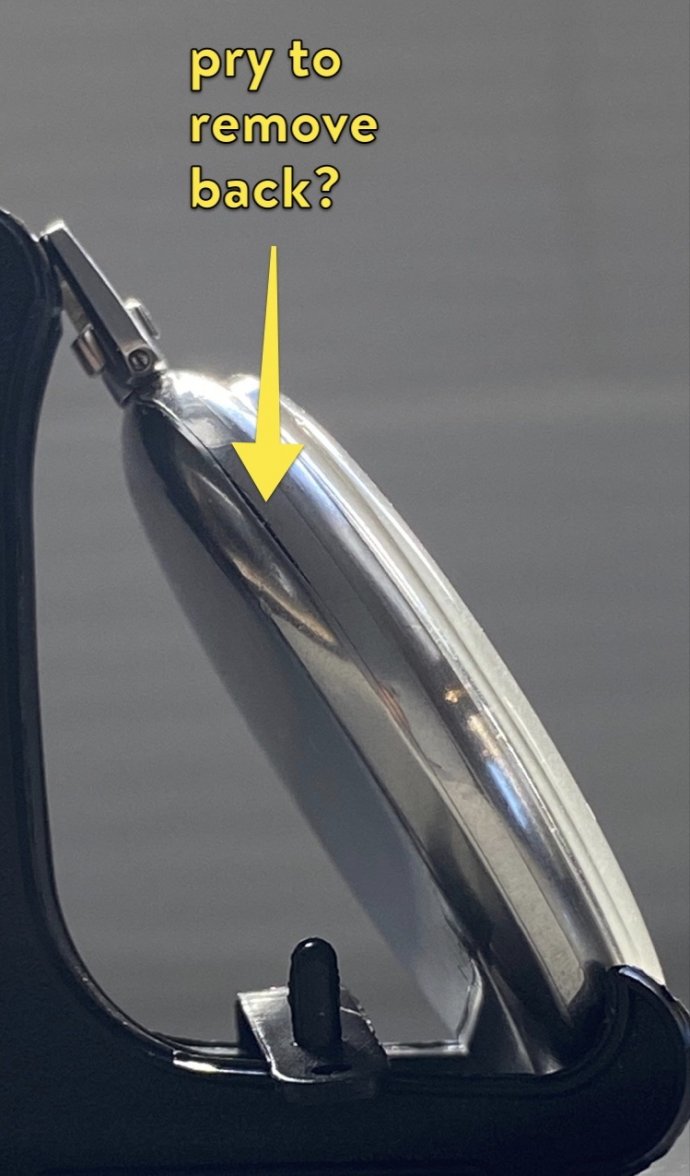
i believe both the back and front pop off as i see two places in the casing where a knife or thin-blade prying tool can be used in the attached photos.

i'm willing to try popping off the back but need reassurance that it'll pop right back on later. thoughts?

i searched online for “omega lepine” (thanks JimInOz), and found a very similar watch for sale in chicago. before divulging anymore, what is the policy here for sharing photos and info found on other websites? i don’t want to break any rules on my first day.
 
Posts
3,530
Likes
7,560
You don´t need to pry off the front, just the back will provide the info we need.

Don´t really pry, its sufficient if you insert the blade and move it gently to the edge of the slot, the back will pop off.
You can put a strong plastic foil around the slot to avoid scratching in case you slip

If you put it back on it only needs some even pressure arount the edge...

Good luck

If you think you take too much risk scratching the case let it be done by a watchmaker.
Edited:
 
Posts
17,597
Likes
36,800
..... what is the policy here for sharing photos and info found on other websites? ...]

As long as you are not profiting from them, or using them in any other nefarious way it's OK. Just using them here for a general reference is fine.

If any are clearly the property of a photographer, or plastered with copyright marks, then an acknowledgement is generally good manners.
 
Posts
17,597
Likes
36,800
thank you for your responses.

i believe both the back and front pop off as i see two places in the casing where a knife or thin-blade prying tool can be used in the attached photos.

i'm willing to try popping off the back but need reassurance that it'll pop right back on later. thoughts?

Don't pry, as noted by Erich. It's just a succession of wedges used to increase the seam until you can get a case knife or a cheese knife in the groove.

See here.

https://omegaforums.net/threads/dang-snapbacks.111610/#post-1473910
 
Posts
8
Likes
7
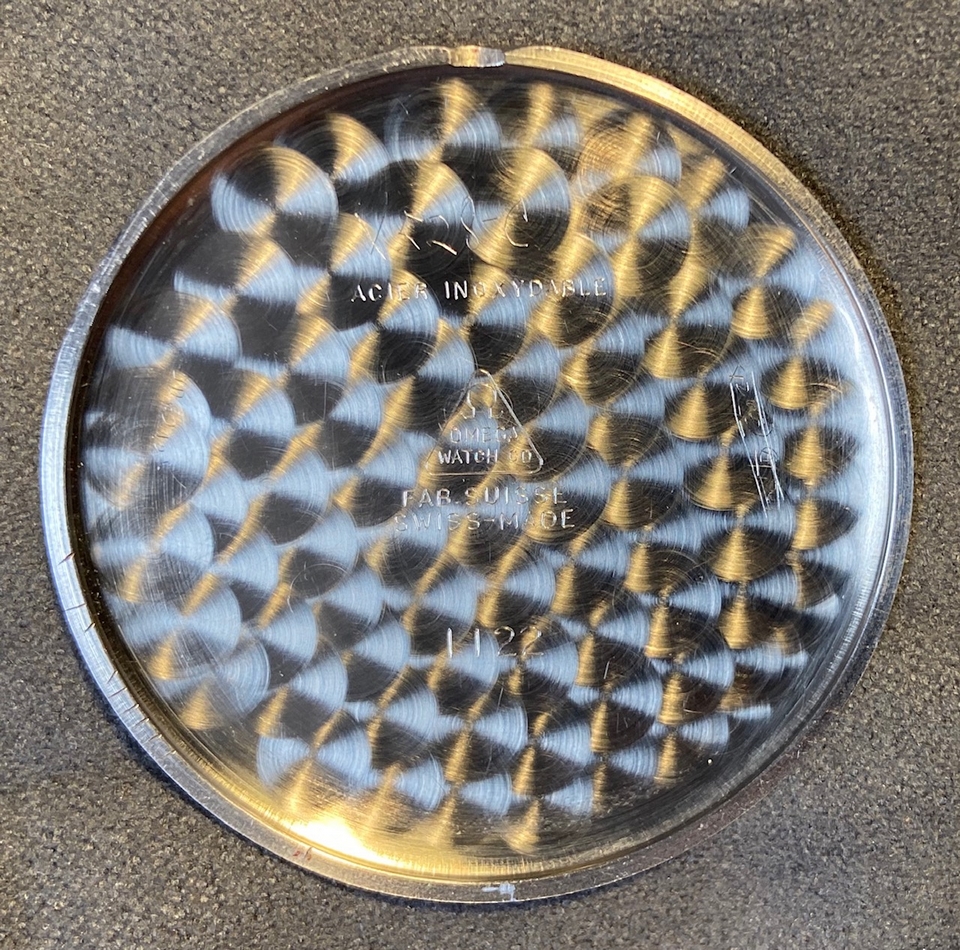
thanks for that excellent thread regarding removing snapbacks! it emboldened me to remove the back which turned out to be quite easy using just the safety blade. pics of the movement and inside case added below. the inner case appears to be stamped with the following:

ACIER INOXYDABLE
OMEGA WATCH CO
FAB. SUISSE
SWISS-MADE
1122

in addition, X528-C appears to be engraved above ACIER INOXYDABLE, though i'm not so sure about the 5. to the right appears to be some engraving that was then crossed out? i can't decipher it. perhaps someone here can.

thanks again for your prompt and reasonable replies. now that it's open, what do i have here?

 
Posts
5,636
Likes
5,800
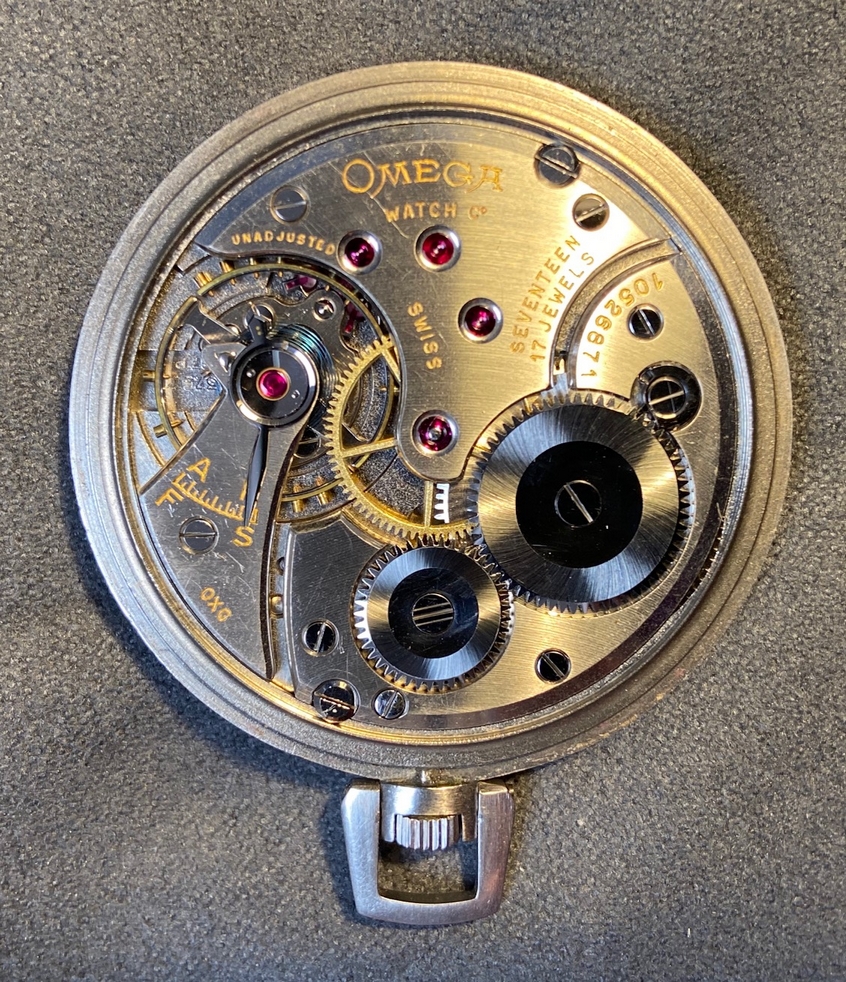
Case number 1122. Caliber is 37.something. Could be 37.5 or 37.6.

In general, the regulator pointer should be somwhere closer to the middle of the scale, and when it's not, that's generally a sign that service is required to get it performing to spec.
 
Posts
15,234
Likes
44,726
The movement is nicely finished, with 17-jewels, Breguet (overcoil) blued steel hairspring, bi-metallic, temperature compensating balance wheel. A better than average grade. Any hand scratched numbers in the case back are from watch repairers, and are meaningless to anybody but the person who made the marks.

The serial number 10526871 seems to indicate approximately mid 1940s. By the time this watch was produced, pocket watches for the man or woman in the street had pretty well been replaced by the wristwatch. The Omega would have appealed to the mature individualist who still occasionally wore a three-piece suit, and liked a pocket watch to carry. The watch would not be considered rare, generally, but scarce in this condition. If it is to be run, it should be thoroughly and competently serviced by someone who specializes in antique and vintage mechanical watches. NOT by Omega, and not at the watch repair counter of your local big box store! Nice watch, by the way! Your family is quite fortunate!
 
Posts
2,112
Likes
1,298
Thats a very nice PW. Slim design with a clean dial and I like leaf hands. Nice clean movement. Some marks, but no rust or corrosion of the plates

The little marks and scratches on the inside back are watchmakers marks. It's to let the next watchmaker know when it was last serviced.

Some are straightforward. Some are codes

DON
 
Posts
17,597
Likes
36,800
You have a very nice watch. Fully jewelled 37.? in pristine condition. I'm envious.

As noted, it should be serviced by a competent watchmaker if you intend to use it.

The OXG stamp is the US Import Code for Omega watches and was most likely sold by Norman Morris or one of his agents.

Although the 10 million serial number points to about the mid 1940s, they were seen in low production watches up until 1951.
 
Posts
8
Likes
7
wow! many thanks to all who have commented, advised, and shared their knowledge, experience, and opinions.
i think i now know more about the watch than my father ever did! i am not surprised that service is required.
this watch has been stored for 30 plus years and was wound only a handful of times during that entire time.

understandably, my next questions are:

-any recommendations for competent watchmakers specializing in antique/vintage mechanical watches in my area?
(northern california/sf bay area)
-what's a fair price for a tune-up for this watch?
-how should antique/vintage watches be stored? should they be wound regularly, or not at all?

in your opinion, are competent watchmakers a vanishing breed, like shoe and vacuum cleaner repair? this last question i ask because i don't think my son will use the watch. most likely he will cherish it as i have and store it in the "sentimental vault".

sorry for all the questions.
 
Posts
15,234
Likes
44,726
Servicing a watch such as the Omega is not done to remove dirt. It is done to completely strip the watch of old, congealed lubricants. To do this, the watch must be totally dismantled. The condition of the watch indicates to me that it likely does not need actual repairs, but more likely minor adjustments during the process of re-assembling and lubrication. However, if the watch HAD been used for years without maintenance, it may need some repairs. Once this is complete, the watch is ready to run reliably and trouble free for years. If you have this work done, it only makes sense to run it. If you have this work done and the watch is put back into storage, un-used, that is up to you. But if the watch is ever to be returned to service after years of again being stored in a sock drawer, the work should be done again. The lubricants used are applied in almost microscopic quantities at points of friction, and whether the watch is run or not run, those lubricants are likely only good for about five years.

The option is to do nothing. When you give it to him, advise him of the wisdom of having it serviced if he ever decides to run it. Fifty years without servicing the watch appears to have done It no harm. If it remains in storage, save your money. Your watch, your choice.

As to finding finding watchmakers who can do a proper job on such a nice watch, in future, that is likely to become tougher. Good watchmakers are becoming scarcer, and repairs more expensive. To say nothing about trying to locate necessary parts for older watches.
 
Posts
8
Likes
7
Servicing a watch such as the Omega is not done to remove dirt. It is done to completely strip the watch of old, congealed lubricants. To do this, the watch must be totally dismantled. The condition of the watch indicates to me that it likely does not need actual repairs, but more likely minor adjustments during the process of re-assembling and lubrication. However, if the watch HAD been used for years without maintenance, it may need some repairs. Once this is complete, the watch is ready to run reliably and trouble free for years. If you have this work done, it only makes sense to run it. If you have this work done and the watch is put back into storage, un-used, that is up to you. But if the watch is ever to be returned to service after years of again being stored in a sock drawer, the work should be done again. The lubricants used are applied in almost microscopic quantities at points of friction, and whether the watch is run or not run, those lubricants are likely only good for about five years.

canuck, thank you. you have educated me and all future visitors who read this. one might say you sound like a "competent watchmaker" (wink wink). having been a moderator on several forums myself, i know it took time to write your thoughtful reply and i want you to know this visitor appreciates it.

The option is to do nothing. When you give it to him, advise him of the wisdom of having it serviced if he ever decides to run it. Fifty years without servicing the watch appears to have done It no harm. If it remains in storage, save your money. Your watch, your choice.

sound advice and most likely what i will end up doing.

As to finding finding watchmakers who can do a proper job on such a nice watch, in future, that is likely to become tougher. Good watchmakers are becoming scarcer, and repairs more expensive. To say nothing about trying to locate necessary parts for older watches.

it is sad that good watchmakers are getting harder and harder to find, a sign of the times i guess.
should i or my son need one in the future, we'll probably come right back here and ask!
many thanks again to all for sharing and commenting.
 
Posts
560
Likes
1,440

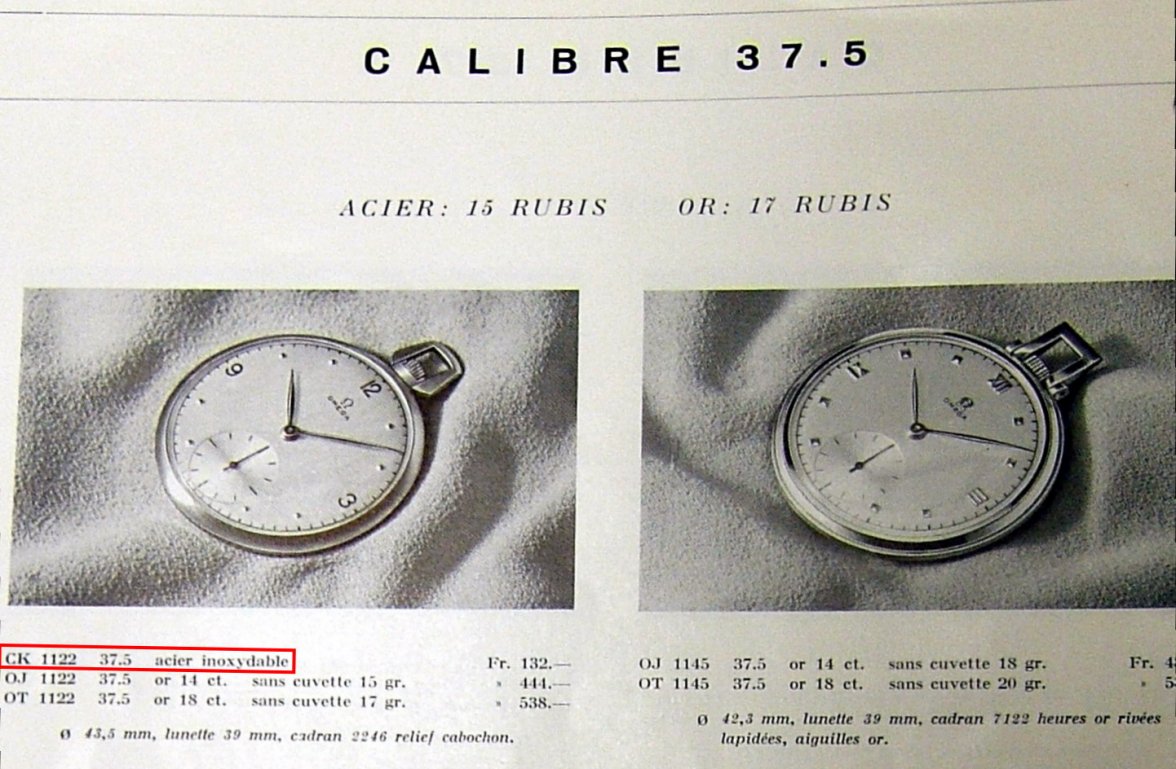
Hello Gleeson, I attach an extract from 1949 Omega catalogue G590 which would appear to show your watch (which also appeared in earlier catalogues), a CK1122 with calibre 37.5.

To explain some of the description, ‘acier oxidable’ means stainless steel (because the watch is also offered in ‘or’ (gold).
In this year (and it clearly varied over the years), the steel version (yours) is offered with ‘15 rubis’ (jewels), the gold version with 17 jewels (but your movement is clearly marked 17 jewels).
For the reference 1122, for the Omega codes, CK means stainless steel, OJ 14 ct. gold and OT 18 ct. gold.
The notes at the bottom show that the watch diameter is 43 mm and the ‘lunette’ (opening: the diameter of the dial showing within the bezel) is 39 mm. Then we get ‘cadran 2246’ and ‘relief cabochon’: ‘cadran’ is dial - and Omega made different dials for the same watch. The ‘cabochon’ are the tiny studs that replace some of the numbers and they are described as ‘relief’ because they are raised.

For each watch reference, there were typically all sorts of variations of case, dial, hands and bow. The case, hands and bow on your watch appear to be the same as in this catalogue version. The dial is slightly different because you have the (lovely!) gilded numbers which (I think) are different in the catalogue version.

The watch will definitely have been exported to the US, marked ‘OXG’ (as already described by Jim) and also the ‘unadjusted’ on the movement.

To find a suitable watchmaker will require an effort and an expense - and it might be tempting not to bother and to do nothing. That would be a GREAT SHAME. Although the watch will probably run, after maybe many years without service/lubrication, the movement could well be damaged as a result. If you had a beautiful Jaguar from (say) 1950 which might not have had an oil change for many years, would you run it down the highway?! You can’t give it to your son and advise “don’t wind it up” - I really think the watch should be serviced. I can’t help with a watchmaker in the US - I’m sure there must be many: if necessary PM me.

I would NOT describe your watch as a ‘working man’s watch’ - those days were long past. This was one of the last pocket watches produced by Omega after decades of fabulous history. Although not cased in gold, this was a fine watch - and your son inherits it from his great grandfather! It will also have a re-sale value (but hopefully that won’t come into question). Please get it serviced properly - and then you have something to cherish long-term.
I hope that helps. Tom
 
Posts
15,234
Likes
44,726
Be sure to copy this complete thread for your son. With the family connection which should be sufficient to show him this is a significant watch, you now have a fairly complete background about the watch. Add the sentimental worth to your newly discovered sense of the intrinsic worth, and your son might just go out and buy himself a new three-piece suit for his wedding, so he can wear his grandfather’s watch. AFTER it is serviced, of course! It was important to his grandfather, make it important to you, and I’ll bet he starts talking about passing it on to his son. His grandfather won’t be at the wedding, but it would be nice if his watch was,