Not all gold (bracelets) are the same.

Posts
5,636
Likes
5,810
Picked up a 1036 bracelet on eBay. Looked OK in the auction pictures, and to be honest, you never know what color something is until you receive it anyways.

Imagine my surprise when I opened the package. The clasp and the end links were a pretty poor match. No problem, just needs a good cleaning, right?

Into the ultrasound with a gold cleaning ultrasound solution with some hot water, and let it run for the max time, eight minutes.

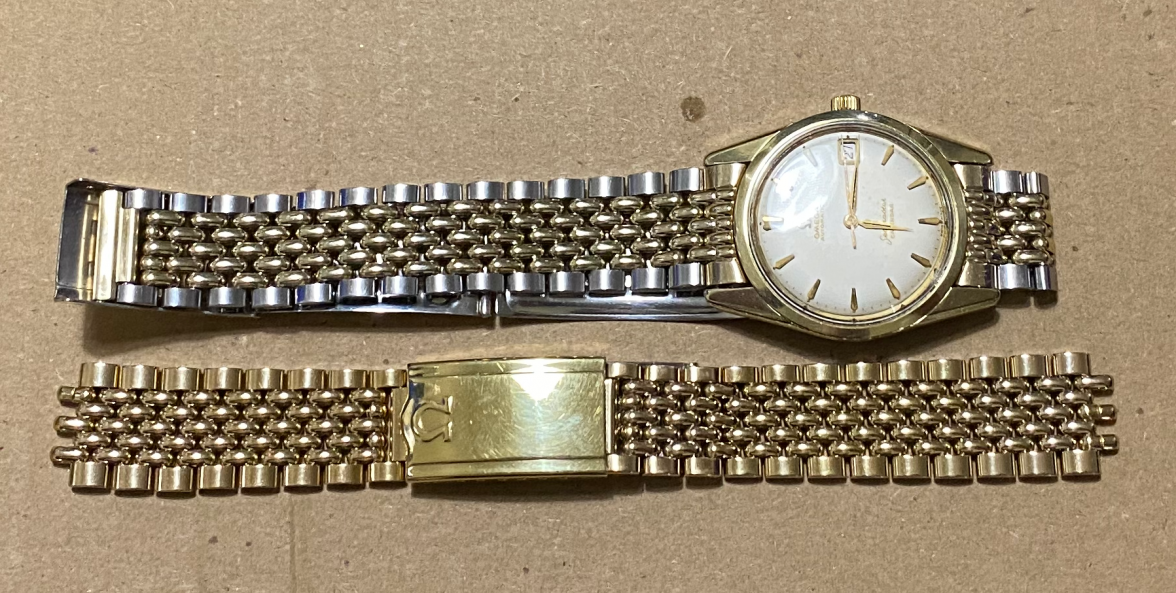
Came out looking clean and shiny. But it didn't match the gold of the case and endlinks, nor even its own clasp!

Compared to my 1917 Omega trench, crap! 9K "gold". Must've been made to match 9K UK watches.

Pic because it happened! Daylight-balance bulb (all my bulbs are daylight), iPhone pic.
 
Posts
123
Likes
72
Love this statement from Google, the fount of all knowledge:
"9ct gold is gold which has 9 out of 24 parts gold and 15 parts of another metal (usually copper, zinc, silver, palladium or platinum)."

So basically 9ct is more not gold than gold, so not surprising its not very consistent in colour 🙁 Guess even Omega has variation over time.
 
Posts
1,325
Likes
1,870
Any makers marks on it though? Was it make by a UK maker or Omega ?
 
Posts
5,636
Likes
5,810
Any makers marks on it though? Was it make by a UK maker or Omega ?
SAD in a box followed by 00 84. Date code of 11-70. Don’t know what that correlates to.
 
Posts
16,307
Likes
44,994
This is always fascinating. Only thing I can think (as @Sherbie was getting at I believe) is that different contractors used different alloys- much like hands and dial lume not always matching due to different formulas used by different contractors.
I think we are far pickier now that our grandfather’s generator was when it comes to matchy-matchy and fit & finish ( endlink fit on most 60’s bracelet- you are lucky if the gap is narrower than a Index card).
 
Posts
5,636
Likes
5,810
This is definitely the 9K color... it's not even yellow. That's why I surmise it's a UK-market bracelet (and useless for me).
 
Posts
1,325
Likes
1,870
But how do you know its 9K?

All UK gold would be hallmarked with the mandatory assay mark, date letter, 9K and 375 ( to indicate 9/24 purity)

if not from UK, other countries had similar conventions
 
Posts
5,636
Likes
5,810
Sorry, I think you're not aware that the vast majority of Omega gold bracelets are gold-filled or gold plated. This is a 9K-plated steel bracelet to match 9K gold cases.

Didn't mean to mislead you....
 
Posts
1,325
Likes
1,870
Sorry, I think you're not aware that the vast majority of Omega gold bracelets are gold-filled or gold plated. This is a 9K-plated steel bracelet to match 9K gold cases.

Didn't mean to mislead you....
Ah, gothcha now. Thanks for the clarification
 
Posts
13,192
Likes
22,932
But how do you know its 9K?

All UK gold would be hallmarked with the mandatory assay mark, date letter, 9K and 375 ( to indicate 9/24 purity)

if not from UK, other countries had similar conventions

Also, full hallmarks in the UK only became mandatory from 1972 onwards as a result of the UK hallmarking Act. Prior to this it could simply be stamped 9CT (although for heavy items such as watch cases and bracelets I’d still expect to see hallmarks in many cases for a 60’s bracelet)
 
Posts
1,325
Likes
1,870
Agree, but the new laws came in in 1974. Before this, you would still expect to see various marks as I described above
 
Posts
1,325
Likes
1,870
This is definitely the 9K color... it's not even yellow. That's why I surmise it's a UK-market bracelet (and useless for me).
But, sorry, I still can’t see how you can determine the K level based on colour - as colour is not governed by gold content - it’s governed by the ratio of the other metals used - esp copper
 
Posts
13,192
Likes
22,932
But, sorry, I still can’t see how you can determine the K level based on colour - as colour is not governed by gold content - it’s governed by the ratio of the other metals used - esp copper

Im not disagreeing for the sake of it here but you certainly can tell the approximate carat weight based on colour, certainly if we’re talking the main UK gold purities of 9, 18 and 22/24 carat.
I’m from a family of jewellers (now mostly retired) and it’s fairly easy to differentiate 9, from 18. 18 from 22 is slightly harder and obviously if you’re also looking at 14 or 15 carat things aren’t as easy.
 
Posts
1,325
Likes
1,870
33
Im not disagreeing for the sake of it here but you certainly can tell the approximate carat weight based on colour, certainly if we’re talking the main UK gold purities of 9, 18 and 22/24 carat.
I’m from a family of jewellers (now mostly retired) and it’s fairly easy to differentiate 9, from 18. 18 from 22 is slightly harder and obviously if you’re also looking at 14 or 15 carat things aren’t as easy.
but you can get 9K rose and 9K white gold, so still struggling to see how
 
Posts
13,192
Likes
22,932
Compared to 18ct, 9ct yellow is paler (due to high levels of silver) and more of a copper colour (due to the extra copper) so it simply lacks the lustre and bright golden hue you get with higher carat gold. It’s basically redder and less ‘gold’ than 18ct IMO. 18ct on the other hand looks very similar to the colour associated with gold bullion

Obviously screen brightness, colour balance of photos etc plays a part but I’d be fairly confident of picking out the 9 and 18ct bracelets out of a line up.

Rose is different altogether and has more variety depending on the metals used I believe so it isn’t as easy to distinguish.

White gold is usually rhodium plated so again, it’s not anywhere near as easy to identify 9 from 18.
 
Posts
16,307
Likes
44,994
Compared to 18ct, 9ct yellow is paler (due to high levels of silver) and more of a copper colour (due to the extra copper) so it simply lacks the lustre and bright golden hue you get with higher carat gold. It’s basically redder and less ‘gold’ than 18ct IMO. 18ct on the other hand looks very similar to the colour associated with gold bullion

Obviously screen brightness, colour balance of photos etc plays a part but I’d be fairly confident of picking out the 9 and 18ct bracelets out of a line up.

Rose is different altogether and has more variety depending on the metals used I believe so it isn’t as easy to distinguish.

White gold is usually rhodium plated so again, it’s not anywhere near as easy to identify 9 from 18.
They rhodium plated wife’s antique 14k white gold wedding ring when it was being sized and cleaned up. I kind of wished they hadn’t. Although it’s really shiny- it lost that warmth that white gold has and is a colder color now.
 
Posts
13,192
Likes
22,932
They rhodium plated wife’s antique 14k white gold wedding ring when it was being sized and cleaned up. I kind of wished they hadn’t. Although it’s really shiny- it lost that warmth that white gold has and is a colder color now.

Completely agree. My partner has a few pieces of vintage white gold jewellery that wasn’t/isn’t rhodium plated. It’s no where near as shiny as modern white gold and retains a slight yellow tinge but much warmer and has wonderful character.
 
Posts
5,636
Likes
5,810
But, sorry, I still can’t see how you can determine the K level based on colour - as colour is not governed by gold content - it’s governed by the ratio of the other metals used - esp copper
Because I compared it to my 9K gold-filled case from Canada and the 9K gold buckle that David Boettcher in the UK will sell you with his trench watch case. All three matched. It ain't rocket surgery.

Aside from the aforementioned trench watch, all of my other 14K gold, whether filled or plated or capped, is all the same bright yellow color. The bracelet might well be anything else, but the point is that it wasn't the 14K bright yellow I wanted and expected... it's that 9K color instead.

So maybe someone from UK can use it with a locally-produced case, who knows?