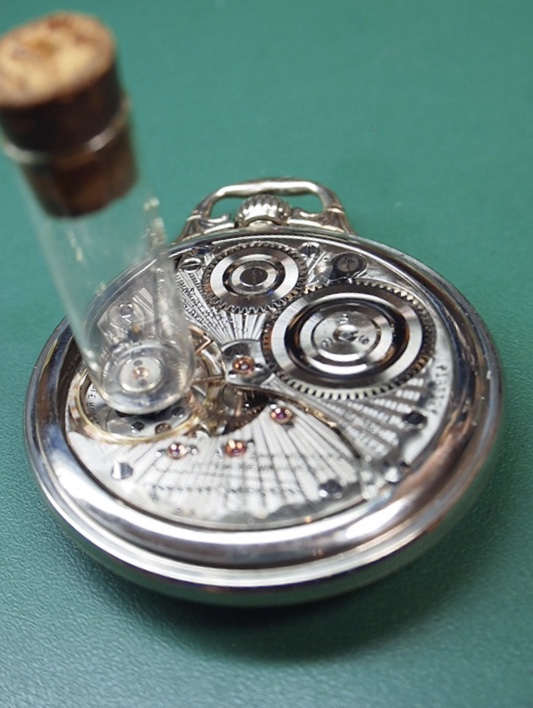
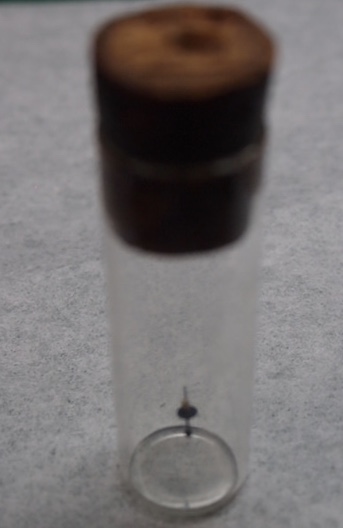
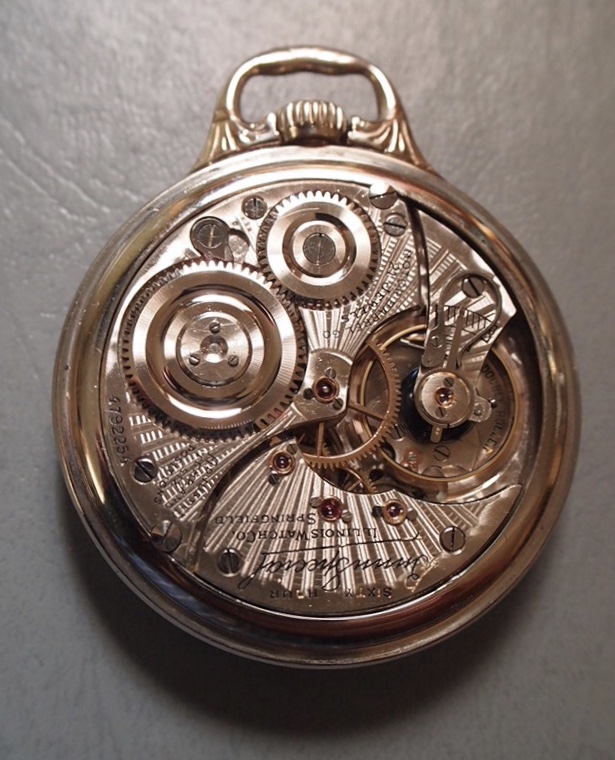
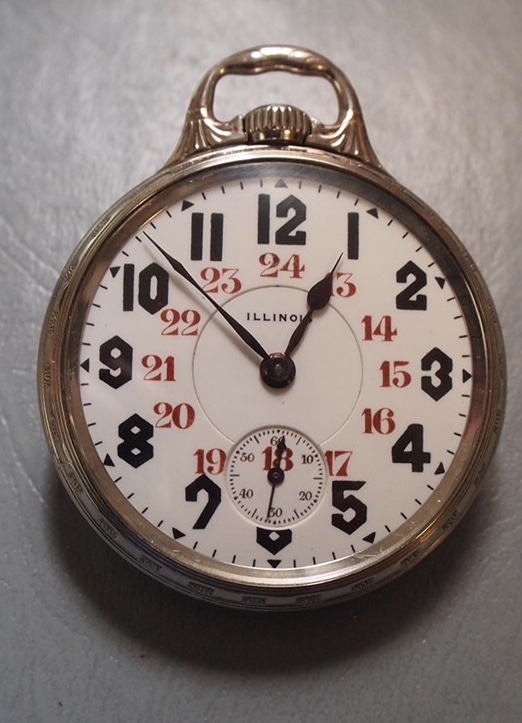
I wasn’t going to show you an old, Depression Era trick re: magnetized watches, but I will. My late father was a watchmaker for 56 years. From 1920 until 1976. He worked through the Depression as a watchmaker. This trick was used a lot back in those years. It is a small glass phial with a cork stopper. Using a small steel seconds hand suspended in the phial on a strand of silk, position the phial on the movement as shown. While I’m at it, I’ll show you an Illinois Bunn 60-hour watch I just serviced for a friend.
I thought it might be of interest. This one has 21-jewels, centre, third, and fourth wheels are gold. Three cap jewels in gold settings, three hole jewels in gold settings, gold balance screws, runs over 60-hours on a winding. Other US watchmakers had tried to produce a 60-hour movement, but only Illinois succeeded. After Hamilton bought Illinois circa 1929, they continued manufacturing Illinois watches. Particularly the 60-hour model Illinois.
While we're on the subject of magnetism Al , could it cause a watch to lose time, ie ten minutes an hour?
A guy on WUS says he's heard of a couple examples with ETA C07 movements that sped up when magnetized. It was speculated that they mainspring actually stuck together, reducing the power.
A guy on WUS says he's heard of a couple examples with ETA C07 movements that sped up when magnetized. It was speculated that they mainspring actually stuck together, reducing the power.
I would be very surprised if the mainspring in these calibers could be magnetized. Most modern alloy mainsprings are anti-magnetic.
Here are three mainsprings I tested for you to show you - the top one is from an 1861 I think, the next one down is from an 1120, and the third one is a vintage spring:
It would make no sense at all for ETA (who would clearly use Nivarox FAR for the springs using some Nivaflex alloy - NO or if COSC grade likely NM) to use a alloy that could be magnetized. Unless someone can pull a spring out of one of these and show that it can be picked up with a magnet, I would take this theory with a very large grain of salt.
I see that Nivarox CT is much closer to Invar at 54% Fe hence the magnetic tendencies of a hairspring.
Do you know of the reason behind "Antimagentic" on the caseback of every watch made from the forties through sixties save Rolex? Was it the incorporation of Nivaflex? It seems to me that they weren't very antimagnetic and still are not.
It seems to me that they weren't very antimagnetic and still are not.
Comparing it to properties of materials that we have today doesn't make sense. In the time frames you mention, compared to the blued steel mainsprings an blued steel balance springs that were in wide spread use, these new materials were very much anti-magnetic.
I did a little research and answered my own question. The bottom line is by the '50s, the name brands were using Nivarox hairsprings and alloy balance wheels that allowed the watch to pass ISO 764 or, more likely, it's predecessor. Over the years, putting "Antimagnetic" on the caseback was no longer a differentiator so it got dropped.
I found one reference that inferred that makers started using Nivaflex in 1965 so it didn't have anything to do with the designation.
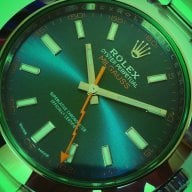
Oh, and by "weren't very antimagnetic", I was just reflecting on the number of posts we read just like this one. If they all were Milgausses, we wouldn't read much about it.