- Posts
- 428
- Likes
- 1,448
Helvetia History
·Hello all,
Thought I'd post some pictures of my latest project. A couple of weeks ago I stumbled upon a post from a year ago on another forum where someone was asking for information on a Borgel watch, in pieces, with a Helvetia cal 81 movement. The movement had been identified but had been dated to the 1940s and the case to WW1 so it was dismissed as a marriage.
From movement markings I knew it dated from about 1930 and that Helvetia were still using Borgel cases sometimes then even though they had brought out their own waterproof case in 1929. The very blurry hallmark also looked to be from 1930. The Wilderness catalogue of 1931 illustrates one as well as Helvetia's new waterproof watch.

I let him know that his watch was correct and also sent a DM in the hope he still had the watch and would be interested in selling. He still had the pieces though had to do some digging, we did a deal and I received it yesterday.
All the parts appear to be there and although the watch is filthy the movement isn't too bad and it runs.

The screw ring was still in the case and the movement seemed to have been removed without the case screws being undone.

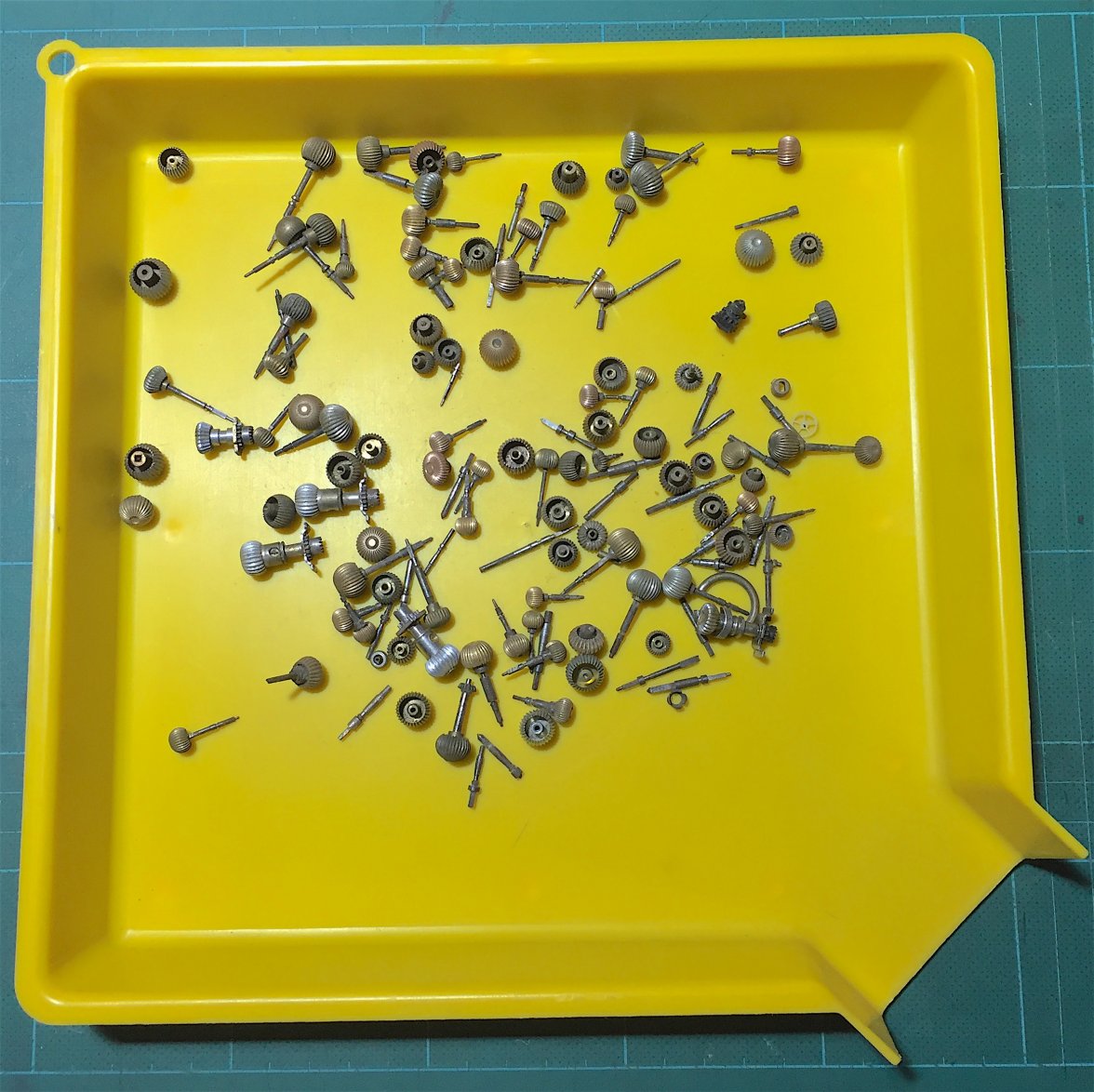
The hands are mismatched and almost certainly replacements. There also seems to be an extra case screw and I know the brass coloured bar is for the pin set I'm not sure what the black folded tube is? The crown, what's left of it, needs changing. Is there anything special about these crowns? It needs to cover the end of the tube but not down too far as to not be able to be pulled away from the screw keeping the stem assembly in place.

The dial has also seen better days, cracked and dirty.

Here is an example from a couple of years of years earlier with a non luminous dial so possibly one of the hands could be right if the dial was supplied without luminous paint originally.

The reason the pin set on the watch above, and on the illustration, is below the stem and not above is because at this time, 1928, Helvetia were using adapted FHF movements for their shock protected watches, they introduced the cal 81 in 1929 and it must have meant the position of the pin setting mechanism needed moving.
So quite a job but I think it's salvageable. It's interesting to me as it is an early example of Helvetia producing shock and water protected watches.
Thanks. Carl.
Thought I'd post some pictures of my latest project. A couple of weeks ago I stumbled upon a post from a year ago on another forum where someone was asking for information on a Borgel watch, in pieces, with a Helvetia cal 81 movement. The movement had been identified but had been dated to the 1940s and the case to WW1 so it was dismissed as a marriage.
From movement markings I knew it dated from about 1930 and that Helvetia were still using Borgel cases sometimes then even though they had brought out their own waterproof case in 1929. The very blurry hallmark also looked to be from 1930. The Wilderness catalogue of 1931 illustrates one as well as Helvetia's new waterproof watch.
I let him know that his watch was correct and also sent a DM in the hope he still had the watch and would be interested in selling. He still had the pieces though had to do some digging, we did a deal and I received it yesterday.
All the parts appear to be there and although the watch is filthy the movement isn't too bad and it runs.
The screw ring was still in the case and the movement seemed to have been removed without the case screws being undone.
The hands are mismatched and almost certainly replacements. There also seems to be an extra case screw and I know the brass coloured bar is for the pin set I'm not sure what the black folded tube is? The crown, what's left of it, needs changing. Is there anything special about these crowns? It needs to cover the end of the tube but not down too far as to not be able to be pulled away from the screw keeping the stem assembly in place.
The dial has also seen better days, cracked and dirty.
Here is an example from a couple of years of years earlier with a non luminous dial so possibly one of the hands could be right if the dial was supplied without luminous paint originally.
The reason the pin set on the watch above, and on the illustration, is below the stem and not above is because at this time, 1928, Helvetia were using adapted FHF movements for their shock protected watches, they introduced the cal 81 in 1929 and it must have meant the position of the pin setting mechanism needed moving.
So quite a job but I think it's salvageable. It's interesting to me as it is an early example of Helvetia producing shock and water protected watches.
Thanks. Carl.