Heel and Toe

Posts
3,999
Likes
6,846
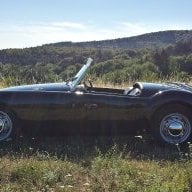
I have to double clutch into first and second with the mga as the gears are not synchronized. Heel toe on downshifts is fun, but sometimes if there is enough room I just blip it to make the shift smoother and brake afterwards.

Anyone has experience with left foot breaking though?
 
Posts
4,787
Likes
24,330
Man I wish I would have been alive for group b.
That is just another level.
 
Posts
1,303
Likes
4,389

Impressive video of Walter! Very humble and nice guy btw, met him a few times.


Is there a reason to use left food breaking in a non turbo car? From what I understand it was a technique used to keep the revs up high to decrease lag of the turbo.

Anyone with a classic car converted the gearbox to a more modern 5 speed like the common ford gearbox kits that are out there?
I‘m thinking of doing it for quite some time now.
I could still heel toe for the fun of it but it would eliminate the reason to double clutch and would make cruising on the highway much more enjoyable and less stressful on the engine with the addition of a fifth gear.
 
Posts
3,999
Likes
6,846
Revs are not going to be any different left or right footed braking. I believe the idea was to keep the throttle open so you do not lose turbo boost pressure.
 
Posts
337
Likes
451
Growing up with an old Alfa it has become second nature to me. It can't be done with every car though. Correct placement of the pedals is mantatory. If you get a car with this issue, sell it immediately 😁

Left foot braking is essential in rallying qand loose surfaces. While your foot is planted to the gas pedal, you use the brake with your left to disturb the weight balance of the car and slide it to the exact angle so that to take the turn the fastest possible way
 
Posts
4,787
Likes
24,330
Impressive video of Walter! Very humble and nice guy btw, met him a few times.


Is there a reason to use left food breaking in a non turbo car? From what I understand it was a technique used to keep the revs up high to decrease lag of the turbo.

You are correct about brake boosting. Not necessarily to do with the revs but as @Vercingetorix said it allows you to build (or hold boost) so you do not experience any (or as much) turbo lag.
In a NA car this sort of works as well because it will sort of feel like the car surges out of the corner once the brakes are released.

A reason for left foot braking is to build up pressure in the lines, or get the pads back in their proper spot.
In the F50 video I posted on the last page you will see the driver tapping on the brakes with his left foot while on the straight before coming into a hard braking zone.
Edited:
 
Posts
447
Likes
2,890
I double clutch every downshift in my ‘77 911S to get around some synchro issues on the first fork - those gear boxes are finicky, but getting in the habit on every shift really helps (and the downshifts on the highway are smooth and powerful). Heel-toe shifting on this car is almost impossible for me given how far apart the pedals are (in depth). Would need a spaghetti foot for sure!
 
Posts
29,917
Likes
77,361
Some newer cars with automatic (pdk) transmissions do the throttle blips, not the actual driver. So great-sounding blips are not always from good drivers.

Manual cars also - my M2 (6 speed manual) has auto blip of the throttle on downshifts. You can get it coded out if you don't want it, but I'm lazy so haven't bothered...
 
Posts
447
Likes
2,890
Manual cars also - my M2 (6 speed manual) has auto blip of the throttle on downshifts. You can get it coded out if you don't want it, but I'm lazy so haven't bothered...

Have you invested in one of the ODB cables and bimmercode? Was thinking about it to disable the “agree screen” when my car starts up.
 
Posts
29,917
Likes
77,361
Have you invested in one of the ODB cables and bimmercode? Was thinking about it to disable the “agree screen” when my car starts up.

No I haven't, but that would be nice to get rid of one screen - then I would just have to select what driver it is...

I know when I had my first Z4 (the 3.0) the first thing I would do every time I started the car was press the sport button, as it helped with the steering, and provided better throttle response. I had read on forums back in the day that people were able to code it to have the sport button "always on" but I only had the car for a year before I got the Z4M, and then I didn't need to press the sport button unless I was doing some very aggressive driving...
 
Posts
3,552
Likes
8,949
I have to double clutch into first and second with the mga as the gears are not synchronized. Heel toe on downshifts is fun, but sometimes if there is enough room I just blip it to make the shift smoother and brake afterwards.

Anyone has experience with left foot breaking though?

Are you sure about that 2nd gear synchro? I had a close-ratio MGA 'box in my Lotus Elite and 2nd did have synchromesh. First was good for over 60mph so It was bit slow off the line but beautifully geared for twisty roads. Of course it could be that the old cone synchro BMC used was simply worn out.

As to left foot braking I use it driving automatics (normally rented, I've never owned one), but not on loose surfaces. I find the handbrake does the job if it's reachable.

My Elite and the Cooper S that was mine until I sold it to the boyfriend of the lady in red.
Edited:
 
Posts
766
Likes
7,492
Double clutching on the downshift is second nature to me. That learned skill is especially helpful in getting a car into the next lowest gear when the road speed of the car is close to the top of the road speed range of the gear you are descending into. You are simply lightening the wear load on the gearbox synchros, and speeding the downshift simultaneously.

That double clutching skill might not be as necessary when just Rolling up to a stoplight.

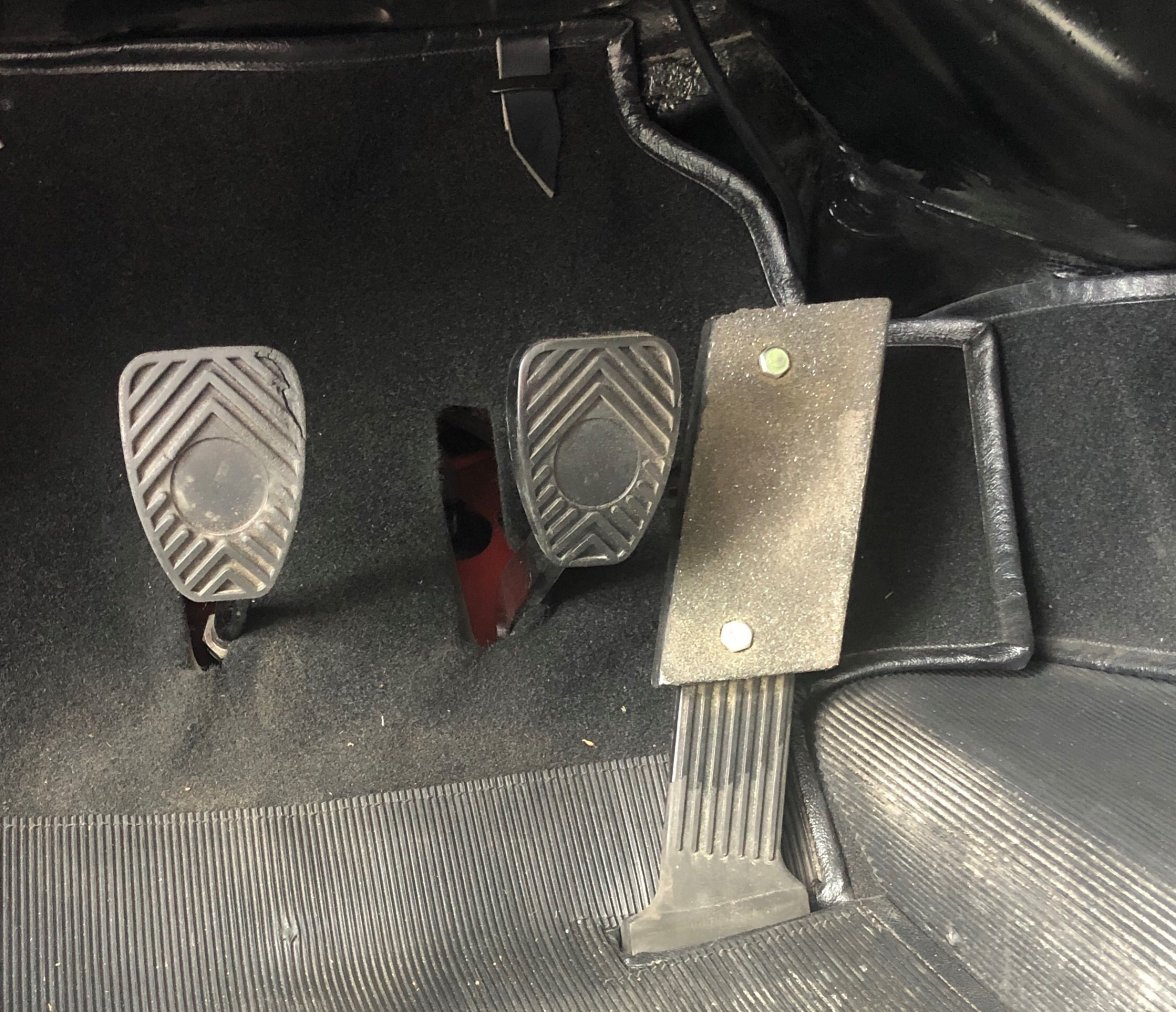
Getting the brake and throttle pedal ergonomics is a big part of this. Personally I use the ball of my R foot on the brake pedal, and the side of my R foot rolls onto the throttle. I find the ball of my R foot is well-conditioned to brake pedal feel just by sheer usage, and a slight roll of my R ankle will goose the revs to where they need to be while simultaneously keeping consistent/needed pressure on the brake. I know two of my sons do it the same way I described above, but one other does it differently- truly using his heel. Whatever works...

Pix below of a home made throttle pedal extension on my '73 911 E/RSR. It is a simple piece of wood, bolted to the stock throttle pedal, with a layer of anti-skid tape applied to the top surface. this does two things: first the thickness of the wood raises the plane of the throttle pedal to roughly the same plane where the brake pedal lies with firm engagement of the brakes. Second it moves that throttle pedal closer to the brake so that I can massage both pedals as easily as one.

Coincidentally, the motor in this car has a lightweight flywheel, so the revs drop quickly without throttle- the reduced rotating mass and consequent lower inertia causes the revs to drop quickly. I find I goose the throttle on quickly-made upshifts as well in order to keep the revs up.
 
Posts
3,552
Likes
8,949
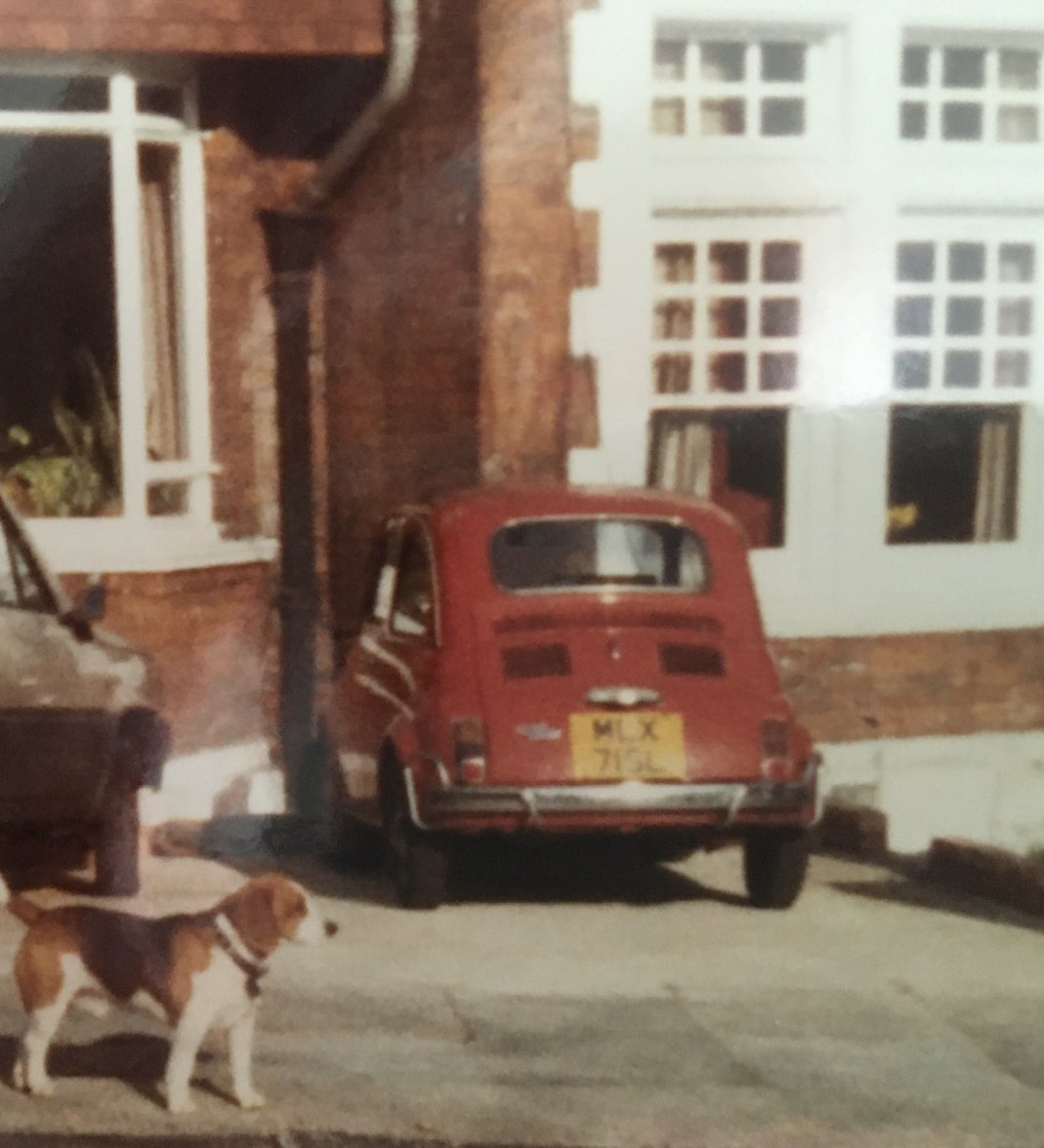
Last car I had to double de-clutch was my original (not heritage) Fiat 500 (Cinquecento).


There's one local to me. I'm pretty sure the Lancia Fulvia I mentioned upthread lives at the same place -- I've certainly seen them parked there together. A friend of mine once sawed a Ford BDA engine in half to make it two cylinders and installed it into a "Fiat 500" 😁 Car still exists https://www.yorkshiremotorsportfestival.co.uk/festival-news/medcalf-fiat-500/ To be honest I don't think much of that car originated in Turin.
 
Posts
905
Likes
2,488
That is the practice of changing gear with a blip of the throttle with one side of the foot while maintaining steady pressure on the brakes with the other side of the foot. https://en.wikipedia.org/wiki/Heel-and-toe_shifting

Not often seen or heard nowadays, but yesterday I saw it in (on?) what I think was a Ferrari. As it approached me from behind I thought it was a motorbike at 8-10,000 rpm, but no it was a 12 cylinder at about 3,000. As it came up to a traffic island the brake lights stayed on and the driver changed down twice blipping the throttle both times, Then I enjoyed the howl of the engine as it powered away out of the island.

There have been lots of classics out and about recently in this nice weather we've been having, E-type, Lancia Fulvia, Alfa-Romeo "boat-tail", MGA all in the last week, but I haven't heard anyone changing gear like that Ferrari driver.

I do it in in any Lotus because the pedals are in the right place and it's smoother on the car, no bobbing up & down as in the IAM method, but my (now scrapped) Mazda runabout had the pedals too far apart. Shame, otherwise it was a fun little thing.

So my question is: who else does this?
Definitely, always whenever in a manual sports car.
Most fun (and audible) cars to heel and toe is the Porsche 911 GT3 and GT3RS’s, no matter what model year.
 
Posts
905
Likes
2,488
Impressive video of Walter! Very humble and nice guy btw, met him a few times.


Is there a reason to use left food breaking in a non turbo car? From what I understand it was a technique used to keep the revs up high to decrease lag of the turbo.

Anyone with a classic car converted the gearbox to a more modern 5 speed like the common ford gearbox kits that are out there?
I‘m thinking of doing it for quite some time now.
I could still heel toe for the fun of it but it would eliminate the reason to double clutch and would make cruising on the highway much more enjoyable and less stressful on the engine with the addition of a fifth gear.
Yes, definitely for shifting weight and balancing the weight transfer as well as traction on gravel and snow.
 
Posts
2,039
Likes
7,171
Some newer cars with automatic (pdk) transmissions do the throttle blips, not the actual driver. So great-sounding blips are not always from good drivers.
I agree, most modern cars do this automatically, even with a manual gearbox (which Ferrari no longer offers anyway...).
I will also say that the heel and toe practice is not always easy to practice at regular speeds, as you typically need to apply quite some pressure on the brake pedal to be able to really blip the throttle.Most of my cars, and especially my track car still allow me to practice this skill... and this is also why I am hoping to add a GT3 with manual transmission (over the RS with PDK).
 
Posts
3,552
Likes
8,949
Yes, definitely for shifting weight and balancing the weight transfer as well as traction on gravel and snow.

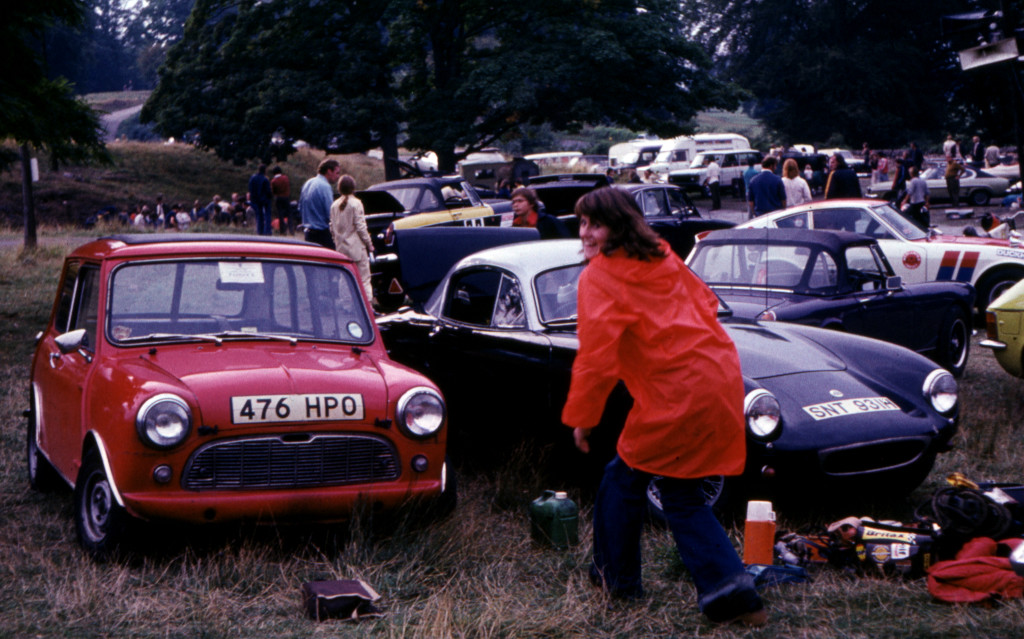
But do it much and it's hell on the brakes & transmission. In my days of spannering on the home International rallies I was damned glad our driver didn't do it. He never was a car-breaker and got good placings by always being there at the finish. His wife appreciated that too -- he used her "shopping car" on several outings, and I believe it was the last traditional Mini to compete on an International. Edit: some digging later :- 1984 with Malcolm Oxborrow as co-driver, 52nd overall on the R.A.C.
Edited:
 
Posts
905
Likes
2,488
But do it much and it's hell on the brakes & transmission. In my days of spannering on the home International rallies I was damned glad our driver didn't do it. He never was a car-breaker and got good placings by always being there at the finish. His wife appreciated that too -- he used her "shopping car" on several outings, and I believe it was the last traditional Mini to compete on an International.
Yes, on tarmac. On gravel or snow it’s more like giving the car a “nudge” so it’s not that bad at all.
 
Posts
12,140
Likes
40,415
The Honda S2000, for all its wonderful racy behavior, does not have a pedal box (or a flywheel, for that matter) particularly conducive to heel-and-toeing unless you're deeep into the brakes. I'll try it here and there but it doesn't rev freely enough to be able to blip the throttle with just a little tap.
 
Posts
1,533
Likes
3,238
Double clutching and heel and toe shifting are two different processes that serve different purposes. I am a licensed automotive technician and was a factory service trainer for Ford back in the early 1990's and then spent 6 years as a technical trainer with Nissan Canada before getting into automotive education in the college system where I work today. I am also on a service crew for a team that runs a pair of Mini Coopers, and a pair of BMW M3s at Targa Newfoundland, each year.

In the old days, of "crash box" transmissions in cars, there were no synchronizer cones between the gears and the shift collars to help these two members smoothy engage together during upshifts or downshifts. Back then, double clutching allowed the driver to change the input shaft rpm of the transmission by releasing the clutch pedal once the transmission was in neutral and the pressing or releasing the throttle (depending on whether you are upshifing or downshifting) to change the rpm of the members to the correct range before engaging the gear. By synchronizing the two members, the shift collar can engage the gear freely with no clashing or grinding as it slides to engage the splines. Double clutching was one method used to shift smoothly but good drivers could learn the rev splits between gears and shift up or down at the correct RPM without the need for double clutching.

In the early days of synchronized transmissions, they often had no synchro cones in 1st but generally had sychro cones for 2nd, 3rd, etc. That is where the rule came in that you only shift into 1st gear when fully stopped. Sometime in the 1960's some manufacturers started putting synchronizers in all forward gears and by the 1970's just about everyone did. With that said, in modern transmissions, 1st gear us often just a single cone, and 2nd and higher are double or triple cones which have much higher capacity and will take more abuse. Because of improper downshifting, the snynchros on many cars wear out in 1st and 2nd, and to avoid an expensive repair, you can get by quite nicely with double clutching.

Heel and toe shifting is used in performance driving during braking upon entry into a corner. As you are braking and downshifting 2 or 3 gears lower, at allows you to keep the RPM up and the turbo spooled to have decent power when the clutch is released. By properly matching the rpm to the gear, there is less shock through the driveline and the rpm of the engine is kept in the power band for hard acceleration out of the corner. It has become quite popular lately but it can be brutal on the transmission and clutch. You can wear both out pretty quickly and if you are paying a shop or dealer to do the repair, it can be quite expensive. Only one of the 4 drivers on our Targa Newfoundland team uses this technique but he has won the Modern class in this event with his E46 M3 the past two years. He is not worried about the wear and tear, as he drives to win and the milliseconds on each corner in the tight, technical stages add up to make the difference between first place and second. Newer performance cars have a feature called rev-matching, which completely eliminates the need to do this. The engine's computer determines whether you are accelerating and upshifting, or decelerating and downshifting and matches the engine speed to the gear that is selected.