Healthy amplitudes for Silver Snoopy and Ed White 321?

Posts
2,360
Likes
2,541
Doesn't the spe1 on those mean it is reading in coaxial mode? So the reading on the ed-white would be completely invalid, right? Perhaps someone with one of those machines can do better to answer that?

2 degrees of lift angle isn't too far off, so the numbers are 'effectively' right. "Low" lift angle will read too low is my understanding, but only a little (Google AI claims 5 degrees is 10% error?). So 2 degrees is 'about accurate readings).

Looks like your Snoopy is good to go. I'm not sure we can trust that EW reading based on the above, but the positional delta is out of Spec IIRC (Archer has the real 'spec' and will come along at one point i presume).

 
Posts
44
Likes
93
Others will chime in who know much more about the nuances here than I. But from a general perspective: the 321 results, to my eye, are close enough to beg the question as to whether it’s worth it to tear into the watch for a minor improvement. Just a thought…
Thanks for your comment. I do understand what you're saying. I don't know what the proper tolerances
Doesn't the spe1 on those mean it is reading in coaxial mode? So the reading on the ed-white would be completely invalid, right? Perhaps someone with one of those machines can do better to answer that?

2 degrees of lift angle isn't too far off, so the numbers are 'effectively' right. "Low" lift angle will read too low is my understanding, but only a little (Google AI claims 5 degrees is 10% error?). So 2 degrees is 'about accurate readings).

Looks like your Snoopy is good to go. I'm not sure we can trust that EW reading based on the above, but the positional delta is out of Spec IIRC (Archer has the real 'spec' and will come along at one point i presume).
Thanks Erich, I am concerned about the readings from my Ed White as well. I sent a follow up question to Omega on their website as to whether I should send the watch for readjustment. Th OB on Fifth Avenue in NYC did not seem to think it needed servicing.
 
Posts
30,017
Likes
77,536
Doesn't the spe1 on those mean it is reading in coaxial mode? So the reading on the ed-white would be completely invalid, right? Perhaps someone with one of those machines can do better to answer that?

2 degrees of lift angle isn't too far off, so the numbers are 'effectively' right. "Low" lift angle will read too low is my understanding, but only a little (Google AI claims 5 degrees is 10% error?). So 2 degrees is 'about accurate readings).

Looks like your Snoopy is good to go. I'm not sure we can trust that EW reading based on the above, but the positional delta is out of Spec IIRC (Archer has the real 'spec' and will come along at one point i presume).
Yes, he has it set for testing a co-axial watch. This will certainly affect the results in some way.

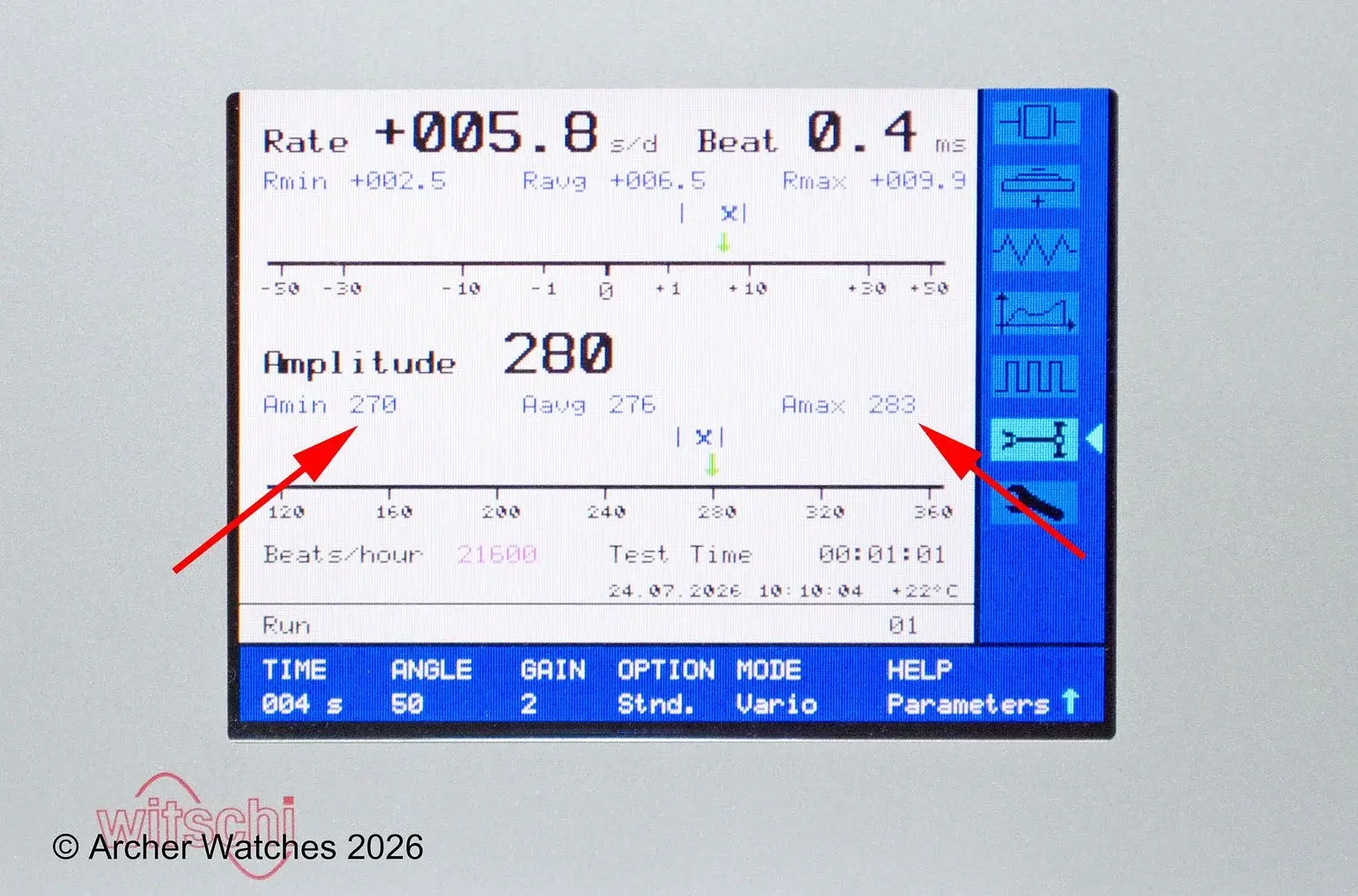
I have a lever escapement watch I wound and put on my timing machine, and used the Vario mode for about a minute - one test with the watch in standard mode for the lever escapement, and the other with it set to Spec1 for Omega co-axial movements. Here's the standard mode test:


So there's a bit of amplitude variation and rate variation (this in not uncommon) and this mode allows me to see the range of that variation, as well as the average. So the balance amplitude ranges from 270 to 283, so 13 degrees.

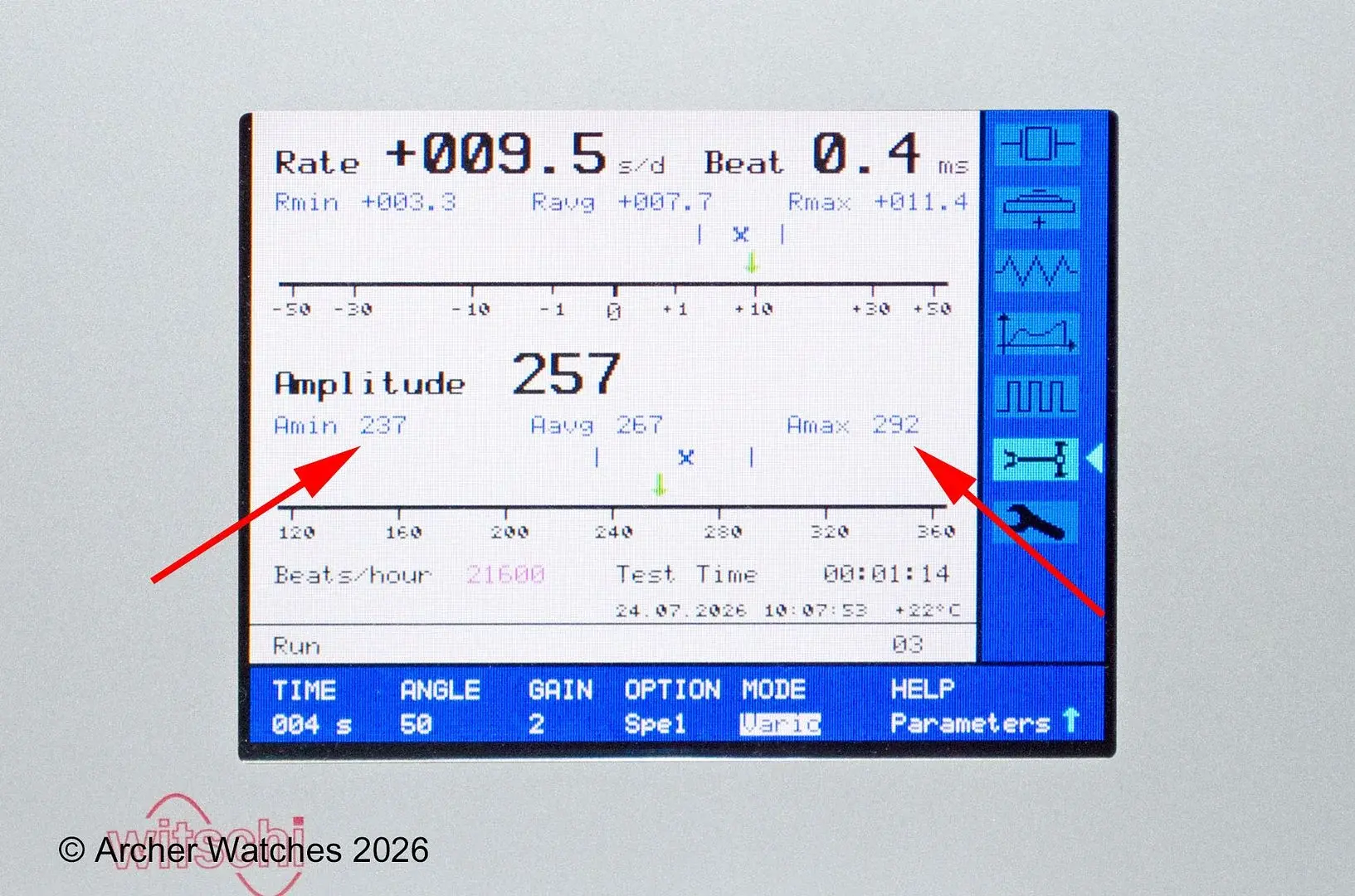
Here's the same watch with the mode set for co-axials:


Now the amplitude range measured is between 237 to 292, so 55 degrees.

So trying to measure a lever escapement with the co-axial setting will give you very unstable results, because the machine is looking for sounds in different places than it is when it's set for a lever escapement. Same reason why the opposite situation doesn't work as well.

So what does this all mean for the OP's test result...

As I've stated, the only amplitude readings Omega has a tolerance for is for 24 after fully winding it. In all positions it must be at least 180 degrees. Now with the lift angle set to 38 instead of 40, the amplitude readings are slightly understated, which works in the favour of saying this watch will meet or exceed that minimum amplitude after 24 hours. Even without that, I would not expect the amplitude to drop anywhere near enough to be below the minimum, so even using the wrong setting I think the amplitude is likely going to pass. It certainly would be better if whoever did this test used the correct setting and lift angle though - pretty poor customer service in my view, and likely a "I've done a test for you,,,it's fine...go away" kind of thing.

In terms of the timing results, Omega measures this movement over 5 positions, and the Delta should be no more than 25 seconds at full wind, and 30 seconds 24 hours after full wind. The OP's watch has a Delta of 14.5 seconds, so it more than passes. The average rate should fall between 0 and +12, and the OP's is 11.2 seconds, so it's just in range.
 
Posts
2,360
Likes
2,541
Yes, he has it set for testing a co-axial watch. This will certainly affect the results in some way.

I have a lever escapement watch I wound and put on my timing machine, and used the Vario mode for about a minute - one test with the watch in standard mode for the lever escapement, and the other with it set to Spec1 for Omega co-axial movements. Here's the standard mode test:


So there's a bit of amplitude variation and rate variation (this in not uncommon) and this mode allows me to see the range of that variation, as well as the average. So the balance amplitude ranges from 270 to 283, so 13 degrees.

Here's the same watch with the mode set for co-axials:


Now the amplitude range measured is between 237 to 292, so 55 degrees.

So trying to measure a lever escapement with the co-axial setting will give you very unstable results, because the machine is looking for sounds in different places than it is when it's set for a lever escapement. Same reason why the opposite situation doesn't work as well.

So what does this all mean for the OP's test result...

As I've stated, the only amplitude readings Omega has a tolerance for is for 24 after fully winding it. In all positions it must be at least 180 degrees. Now with the lift angle set to 38 instead of 40, the amplitude readings are slightly understated, which works in the favour of saying this watch will meet or exceed that minimum amplitude after 24 hours. Even without that, I would not expect the amplitude to drop anywhere near enough to be below the minimum, so even using the wrong setting I think the amplitude is likely going to pass. It certainly would be better if whoever did this test used the correct setting and lift angle though - pretty poor customer service in my view, and likely a "I've done a test for you,,,it's fine...go away" kind of thing.

In terms of the timing results, Omega measures this movement over 5 positions, and the Delta should be no more than 25 seconds at full wind, and 30 seconds 24 hours after full wind. The OP's watch has a Delta of 14.5 seconds, so it more than passes. The average rate should fall between 0 and +12, and the OP's is 11.2 seconds, so it's just in range.
Thats great info, and yeah, the 'wrong mode' bit on how it affects amplitude is about what I would have expected. Thank you for doing that experiment!

OP has been concerned about amplitude of course, so the ed-white results on amplitude are meaningless. Interesting that they have a 180 at all-orientations limit. I've definitely had watches on my bench where 180-200 was a VERY unhealthy watch.
 
Posts
30,017
Likes
77,536
Thats great info, and yeah, the 'wrong mode' bit on how it affects amplitude is about what I would have expected. Thank you for doing that experiment!

OP has been concerned about amplitude of course, so the ed-white results on amplitude are meaningless. Interesting that they have a 180 at all-orientations limit. I've definitely had watches on my bench where 180-200 was a VERY unhealthy watch.
That's 24 hours after a full wind...
 
Posts
2,360
Likes
2,541
That's 24 hours after a full wind...
Yep, understood! I typically find the amplitudes on the stuff I work on starts high for the first hour or so, then levels off to about 'flat' <maybe slight decrease?> for the next day +, then kinda 'divebombs' as it runs out. So in my VERY limited experience, I'd expect a watch that is 180 after 24 hrs to have started at 210-220 or so, which for other than seikos, is a darn sick movement.
 
Posts
44
Likes
93
Yes, he has it set for testing a co-axial watch. This will certainly affect the results in some way.

I have a lever escapement watch I wound and put on my timing machine, and used the Vario mode for about a minute - one test with the watch in standard mode for the lever escapement, and the other with it set to Spec1 for Omega co-axial movements. Here's the standard mode test:


So there's a bit of amplitude variation and rate variation (this in not uncommon) and this mode allows me to see the range of that variation, as well as the average. So the balance amplitude ranges from 270 to 283, so 13 degrees.

Here's the same watch with the mode set for co-axials:


Now the amplitude range measured is between 237 to 292, so 55 degrees.

So trying to measure a lever escapement with the co-axial setting will give you very unstable results, because the machine is looking for sounds in different places than it is when it's set for a lever escapement. Same reason why the opposite situation doesn't work as well.

So what does this all mean for the OP's test result...

As I've stated, the only amplitude readings Omega has a tolerance for is for 24 after fully winding it. In all positions it must be at least 180 degrees. Now with the lift angle set to 38 instead of 40, the amplitude readings are slightly understated, which works in the favour of saying this watch will meet or exceed that minimum amplitude after 24 hours. Even without that, I would not expect the amplitude to drop anywhere near enough to be below the minimum, so even using the wrong setting I think the amplitude is likely going to pass. It certainly would be better if whoever did this test used the correct setting and lift angle though - pretty poor customer service in my view, and likely a "I've done a test for you,,,it's fine...go away" kind of thing.

In terms of the timing results, Omega measures this movement over 5 positions, and the Delta should be no more than 25 seconds at full wind, and 30 seconds 24 hours after full wind. The OP's watch has a Delta of 14.5 seconds, so it more than passes. The average rate should fall between 0 and +12, and the OP's is 11.2 seconds, so it's just in range.
Hi Archer, thank you so much for taking the time to demonstrate the two different measurements (coaxial and lever escapement) and explaining the results. When I went to the OB, the receptionist just handed me the results and said that the watch passed. It was definitely lackluster customer service. I appreciate your time and effort in responding to my questions and I now feel more comfortable with the results. Although, I may go back to the OB or another OB and have them run the test at the proper lift angle for clarification.
 
Posts
30,017
Likes
77,536
Yep, understood! I typically find the amplitudes on the stuff I work on starts high for the first hour or so, then levels off to about 'flat' <maybe slight decrease?> for the next day +, then kinda 'divebombs' as it runs out. So in my VERY limited experience, I'd expect a watch that is 180 after 24 hrs to have started at 210-220 or so, which for other than seikos, is a darn sick movement.
This is the reality of what brands require...