Gold capping on vintage Seamasters

Posts
1,206
Likes
5,036
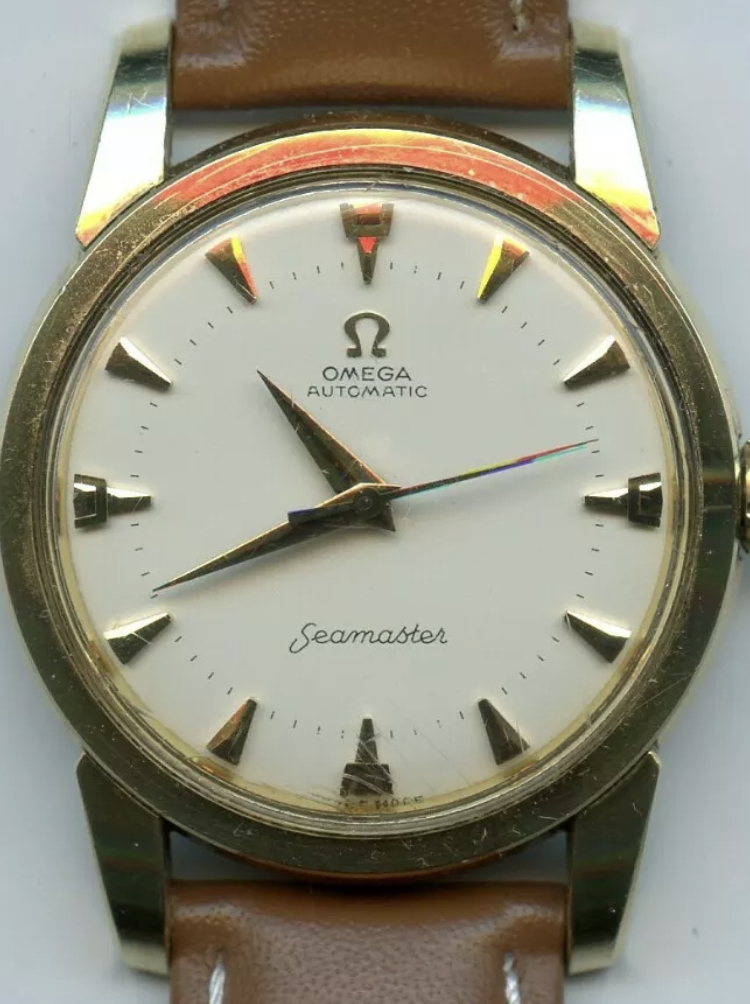
Gold capped cases will always look slightly softer than stainless or plated due to the capping being draped over the lugs etc and then bonded under pressure to the case.

It's hard to say how good this case is or isn't because of the poor quality of the photo.

I have to agree on the dial though.

I do agree steel cases are sharper but gold capped can be nice too. Just a few days ago this guy was on eBay (too bad they refused to ship to me here in Canada [no movement shot, and service needed though]).
From the photo provided, I can see the lugs have a mirror-like finish and the bezel rounded. Better pictures would help but if I had to, I'd bet it has seen a heavy polish.
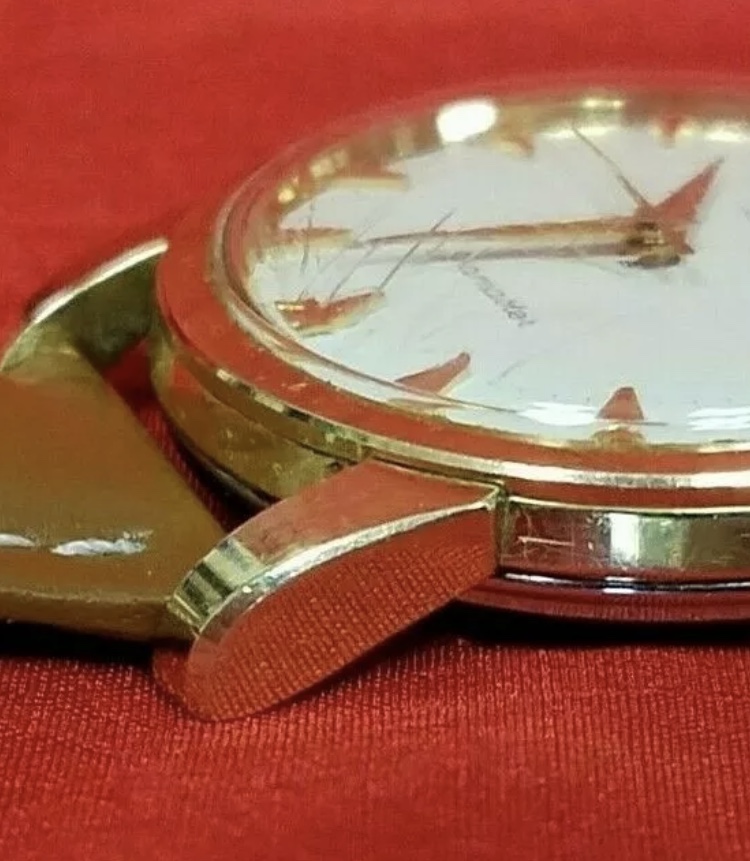
 
This website may earn commission from Ebay sales.
Posts
18
Likes
1
Hello all.
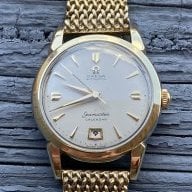
I'm thinking of adding a gold beads of rice bracelet to my Omega Seamaster 2849. I'm wondering what number endlinks do I need?
 
Posts
5,636
Likes
5,812
Hello all.
I'm thinking of adding a gold beads of rice bracelet to my Omega Seamaster 2849. I'm wondering what number endlinks do I need?
Most likey 511. You can buy them along with a 3010 bracelet from Omega.
 
Posts
25
Likes
19
According to the post above, gold-capped layers are at least 200 microns, while the CASE MATERIAL categories I posted show that gold-plated layers are 20 microns, and gold-filled layers are 80 microns. This is specific to Omega obviously. So it's a thicker layer than plated or filled, it is applied in a different way, and it is on a base of SS, instead of a "base metal". Notably, the gold caps don't extend over the bottom of the lugs, so you can see the stainless steel from the back side.
How about solid gold?
 
Posts
25
Likes
19
What about it?
Sorry, let me rephrase. How about solid gold? Sometimes I see solid gold with 10k, 14k and 18k. How solid gold differs from gold capping & gold plating? Does it mean the gold element is embedded with the base metal, unlike capping & plating where the gold is layered on top of base metal? Can I say solid gold will not lose the gold layer and exposed the base metal?
 
Posts
415
Likes
1,089
Can I say solid gold will not lose the gold layer and exposed the base metal?
I think you’re confusing a few things here but basically, yes.
 
Posts
617
Likes
2,975
Sorry, let me rephrase. How about solid gold? Sometimes I see solid gold with 10k, 14k and 18k. How solid gold differs from gold capping & gold plating? Does it mean the gold element is embedded with the base metal, unlike capping & plating where the gold is layered on top of base metal? Can I say solid gold will not lose the gold layer and exposed the base metal?

Solid gold in this case really means solid gold. If you were able to cut through part of the case or split it in half, you would see from the core interior to the outer layer only one material: gold.

If you get the chance, just try and hold a solid gold watch in your hand. It weights and feels very very different than gold capped.
 
Posts
24,428
Likes
54,344
"Solid gold" (9k, 10k, 14k, 18k) refers to gold alloys, which are essentially homogeneous materials for practical intents and purposes, where gold is mixed with other elements at a microscopic level.
Edited:
 
Posts
5
Likes
0
FWIW My (now cured) 1952 2446 bumper rolled gold is marked 80 microns.
That 3 thou, and is right around the thickness of a U.S. Dollar note ..or was.
14k was a universal purity in the EU.
Its rolled gold. That means 80 microns was bonded to the base metal under huge pressure, then forged into the shape of the frame.
I doubt very much that Omega would have or needed to have 200 microns on Constellations or anything else but hope to be corrected ..
Thats 0.2mm or two and a half times the 80 micron which was dropped soon after to 20 microns which everyone on here already knows but.
Rolled doesnt flake or crack.
I see many folks getting the types of gold bonding-applique mixed up.
A very interesting topic.
 
Posts
6,339
Likes
9,796
14k was a universal purity in the EU.
I doubt very much that Omega would have or needed to have 200 microns on Constellations or anything else but hope to be corrected ..

You make a couple of bold statements there @Peder888

14k is a defined purity - used throughout Europe and the world
18k is a defined purity - used throughout Europe and the world
9k is a defined purity - used in the UK and some commonwealth countries (although not globally accepted as 'gold' as it is below 10k)
Its difficult to understand what you mean by "14k was a universal purity in the EU"

Regarding the 14k, 200 micron, gold cap on Omega watches (usually with a solid 14k solid gold bezel) this is a matter of record
You might find Desmond's essay on the matter illuminating
http://omega-constellation-collectors.blogspot.com/2007/08/i-doff-my-gold-cap-to-ya.html

The 200 micron thickness was a minimum Swiss standard for 'gold cap' on watches.

Omega didn't 'need' to have 200 micron gold cap, they could have had rolled or filled watches but they did so to enhance the quality of their non-solid gold watches.