- Posts
- 6,832
- Likes
- 13,797
Nobel Prize
·That’s not correct as you can see from the chart, perhaps you would fix or refund customers who went to the wrong depth and had a watch fail
Please consider donating to help offset our high running costs.
That’s not correct as you can see from the chart, perhaps you would fix or refund customers who went to the wrong depth and had a watch fail
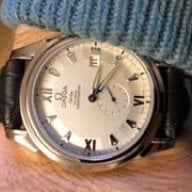
I am really confused reading this and coming from the Sales aspect every client I have personally dealt with have never been intrigued by the water resistance unless they know that they will be using it within water. Also its odd trying to understand your logic hotwheels and you have made it sound like you would be diving with a Speedmaster.... and those just don't go together, the Speedmaster moonwatch is designed with a water resistance of 50 meters, now does that mean you could dive with it? sure, do as you please, as the security of that timepiece is not equipped for the venture of an underwater excursion but again the consumer can do as they please as they own it. All of the DIVE pieces that omega produces meet the specifications of a Professional dive watch so you would use it for what its intended but no one ever does. Since you shop online you are your own sales person but you do have guidance, always feel free to call a boutique or come to the forums and get some questions you need answered, answered. You are fueling your logic with a "What If" scenario which is making you closed minded with a very broad open ended scenario where literally anything could be a response thus causing this debate to go pages and pages on the OP's thread.
That’s not what the chart says.........submerged in water does not mean you can dive to 100m for example.....confusing isn’t it!
Not confusing AT ALL!!!!!
The first section
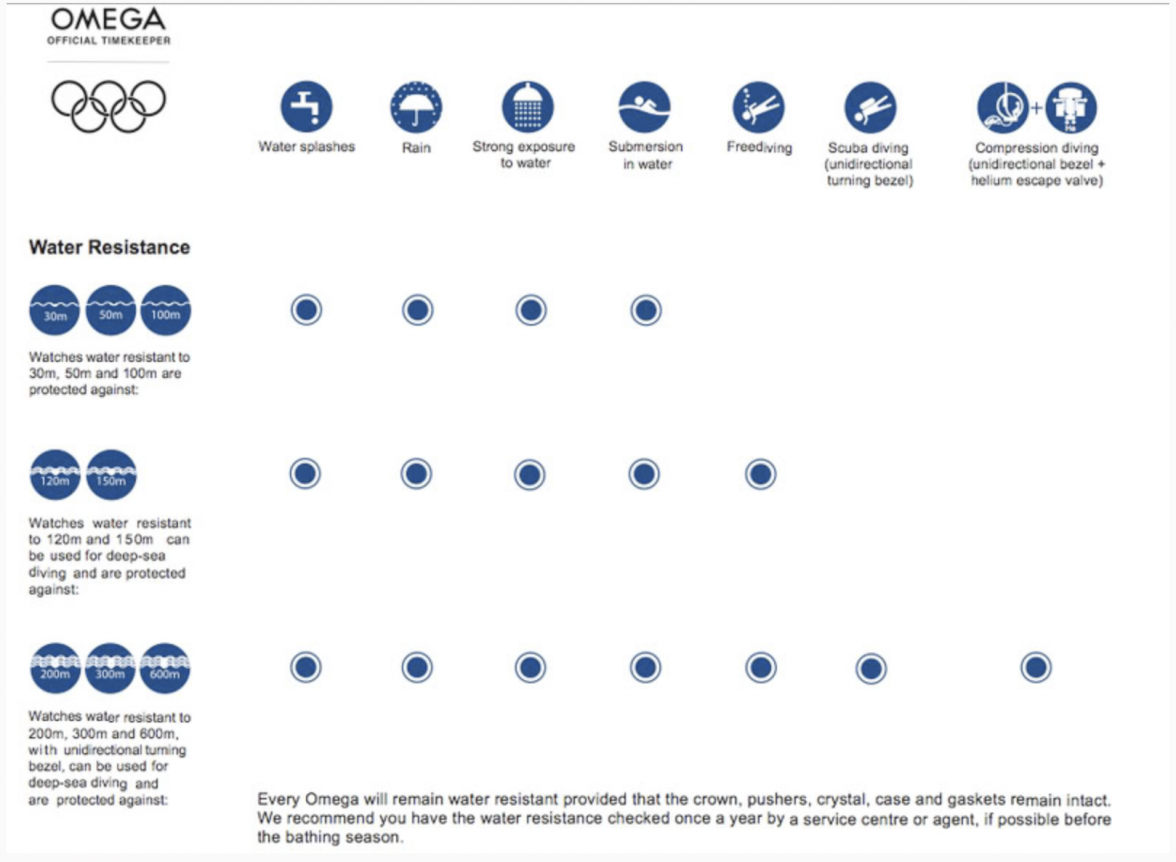
Water resistance 30/50/100...... good for water splashes, Rain, Strong exposure to water, submersion in water. Now YOU ASK, why doesn't it specify the depth in the submersion in water field? Simple....Because there are three different depth ratings in this category so mentioning one would exclude the other 2...so INSTEAD they START by giving you the actual depth. so read: Submersion in water to the depth rating specified in watch as long as it is 30/50/100
Second Section
120/150 It is good to those AND Free diving. Wy is it different? becasue free diving requires a couple of extra things. 1/ a deeper depth, 2/ more visibility Lume, numerals etc so it can be usable at a deeper depth. once again why does it not specify a depth rating there for submersion and free diving? Because specifying one would exclude the other so INSTEAD they place the depth rating on the left side so read (and I'll spell it again) Good for submersion and valid specs for deep free diving and the depth specified on watch. either 120 or 150
Third Section
I think you get the general idea on the depth being specified on the left side but add "watches certified for Scuba diving and/or compression diving to the depths specified in watch: either 200/300/600
NOWHERE IN THAT CHART DOES IT SAY THAT ANY OF THESE WATHES CANNOT BE SUBMERGED TO THE DEPTHS THEY ARE LABLED FOR. IT JUST DETERMINES THAT FUNCTION THEY SHOULD PROVIDE AT THEIR GIVEN DEPTH RATINGS!!!!!

Thank you, that explains it very well, so the non ticked up to 100m watches would be covered if they went wrong whilst that deep
If I have managed to clarify this one I am going to really have a drink to all your healths....and If I have not I'll still drink but blame @hotwheels
AND if I have somehow managed to help, or anyone else here....@hotwheels has to go back and "like" some of the responses here. Just because. At least Ione of mine!! 😀🍿
Err, just to add a little more interest to the thread for the newer members, Archer and ulackfocus both have posted great threads for more info in this matter:
1) https://omegaforums.net/threads/pressure-testing-a-watchco-sm300.45375/#post-537267
2) https://omegaforums.net/threads/horology-101-waterproofing.77470/#post-984959
Enjoy! 😀

I think he’s unlucky, I just believe it is not made clear that a watch that is advertised as 100m for example will not be recommended for that depth when you research it. The real dive watches will be fine I’m sure, it’s the ones that perhaps look like a dive watch, say 100m on but you shouldn’t use it that deep

NO ONE here has disputed that. But THE REASON(S) it's "not recommended" for that depth have nothing to do with it allowing water to penetrate the case. That's why this discussion can end now, as anything else is far beyond the pale of this topic/question in the first place. And again, NO ONE is using the types of watches in question for diving to depths nearly that deep, so it's a moot point. You seem to have started the dialogue out of a real concern. Your concerns have now been answered repeatedly. You should be happy that you have been reassured there is nothing to worry about. There's no reason to keep this going by splitting hairs about alleged marketing tactics or whatever, just so you can still attempt to "win" an internet debate that really should have never been an argument in the first place. Damn, dude LOL
Now that this discussion is over lets all chat about Omega vs rolex guys ......


My point from the start is that the industry use wording which I believe is misleading, so if I want to dive to 100m would my watch be waterproof at that depth if it says 100m, yes? But other factors would mean it may fail. And if I can’t dive to 100m how else would I be taking it 100m down......misleading

A few things actually movement might fail from temp or become inaccurate from temp below freezing. Pressure may cause impingement on hands and stop the watch.
Both of these are maintaining water resistance but the watch would fail.

Just wanted to talk about this subject of what would constitute a failure. While Omega's water resistance testing instructions don't mention timekeeping or stoppage of the watch, if either were significantly affected it would be considered a failure. Every Omega watch that is rated for 120 m or more is subjected to high pressure wet testing both in production and at factory service. Depending on the watch it will include testing in water up to the rated depth, or in the case of dive watches, up to the rated depth +25%
I can tell you that no modern Omega that I've ever subjected to high pressure wet testing has ever stopped during the testing. The only watches that have done that are either vintage watches, or watches made by smaller companies that look like dive watches, but are not certified or tested as such. In fact I've had vintage watches (Rolex Datejust comes to mind) that stopped in my dry testing machine because the crystal deflected so much that is pressed down on the seconds hand, and jammed it into the minute hand, and that was testing it to the depth it was supposed to be good for. But that's not going to happen on a modern diver - the crystals are generally sapphire and would shatter before the hands would suffer any impingement.
For the temperature concern, I don't think someone diving in water would expose the watch to lower temperatures than I would wearing it outside when it's -30 C, so really that is a non-issue with modern lubricants, in particular for short durations. There are specialized low temp lubricants available, but unless you are stationed in the Antarctic the regular lubricants used will be fine.
Cheers, Al