Fast speedmaster (is that why they call it a Speedy?)

Posts
873
Likes
1,048
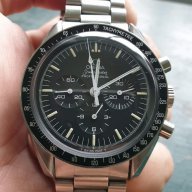
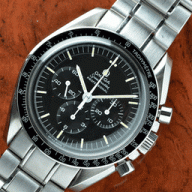
My speedmaster professional moonwatch sapphire sandwich that I bought about 3 months ago (and love it) runs fast all the time. Now, first of all, let me say that all of my mechanical watches run fast. There's gotta be something about my aura, or environment, or personal magnetism. My Rolexes seem to be the most accurate, but even those will consistently run a little fast.

So... I timed it, using the NIST web site and at roughly the same time each day, it was consistently running 10 seconds fast. I bought a demagnetizer and did the trick with that, and now it is about 14 seconds per day fast. Yeah, money well spent.

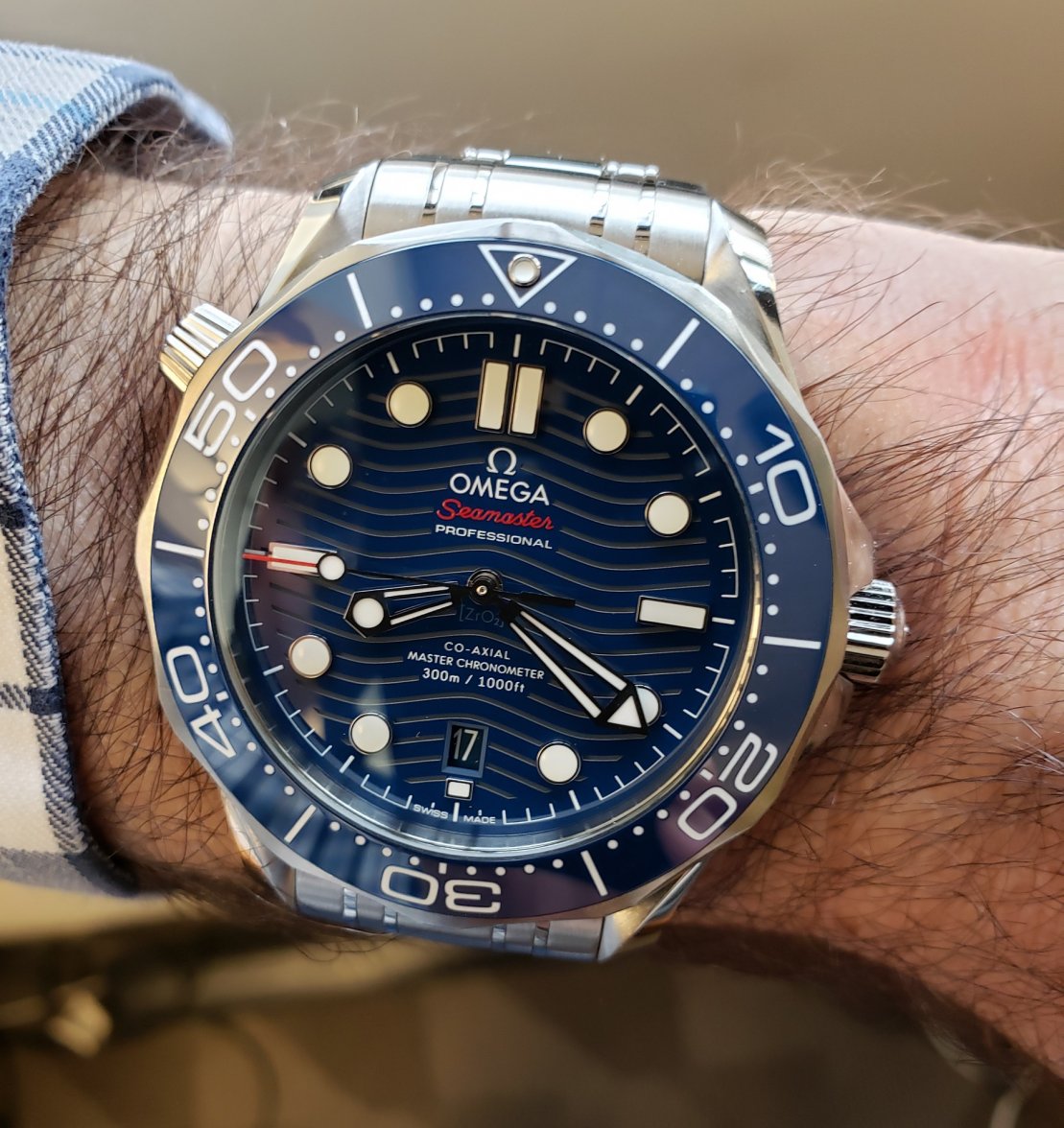
My Seamaster also runs about 4 seconds fast per day. I demagnetized it as well, but haven't timed it yet.

Now, this isn't a huge deal because I alternate watches fairly often and so I'm usually setting the time anyway. But I wonder.

On the back of these movements, there's a little lever that I presume is used to adjust the watch. Could I:

a) buy the proper tool to remove the back
b) tweak this setting
c) replace the back without boogering the gasket

or am I more likely to cause damage satisfying my OCD tendencies than if I just left it alone and get everywhere a minute or two early?

 
Posts
5,522
Likes
9,437
Your watches are probably not out of spec. And you are supposed to check each in multiple orientations. You should take a few minutes to search for the testing info for each of the calibers, and make sure you do all the tests.
 
Posts
15,489
Likes
45,892
Try that, and you may achieve the result that your watch(es) are dead on, twice a day, compared to NIST time.
 
Posts
873
Likes
1,048
Your watches are probably not out of spec. And you are supposed to check each in multiple orientations. You should take a few minutes to search for the testing info for each of the calibers, and make sure you do all the tests.

Yeah, I get that "within spec" thing. I sent my DSOTM watch in for repair, and Omega reported it (in barely legible scrawl) to be +5 which I assume is seconds per day. I get it that mechanical watches are not quartz-precise, and it can differ depending on how you wear it, in what position it rests, etc. but I was just wondering how close one could get it, assuming that one wore it and stored it consistently.
 
Posts
303
Likes
308
In what orientation, are you setting it down at night? Are you doing it consistent?
Since I got mine, I've collected this data:

You might want to try that and see if your watch has one orientation where it gains less seconds each night. Or even find one where you're losing a couple.
 
Posts
7,682
Likes
14,208
The 1861 is not known as a stellar timekeeper, you are probably within spec. The updated 3861 is far better and are Master Chronometer rated. I'm way past worrying about rate, just not worth it to me.
 
Posts
268
Likes
273
I think if you want to do any adjustments would be better done by a watchmaker.
Before you maybe ruin your expensive toy...
 
Posts
367
Likes
501
A Lepsi app on your phone will let you test for magnatizism. My Speedmaster Moonwatch was running +10 sec/day, my AD correctly diagnosed it as magnatized and corrected it. Now consistently +5sec/day which I think is acceptable. I gave in to my latent OCD, downloaded the Lepsi app bought a demagnetizer and a Timegrapher. My 38mm Coaxial runs about +1sec/day, using the NIST time widget as a reference, worn daily and left face up at night. Admittedly, you can make yourself a bit crazy over mechanical watch accuracy, might be worth having your AD (if you have one) check timing for you. My Speedmaster Pro is worn once or twice a week, wound once a day and resides face up in my watch box. Just as a comparison, both of my Omegas run a bit fast, my two Seikos both loose 5-10 sec/day. You can spend a lot of time and money trying to "tweak" a mechanical watch to what you think is an acceptable accuracy adjustment. If your Speedy is still running +10 after being demagnitized, I would check it again with a small, cheap compass or the Lepsi App, it may need another pass on the demagnetizer.
 
Posts
5,522
Likes
9,437
Here is one of several times Archer indicated the tolerance of the 1861 movement:

Omega specs for this movement are that the average daily rate should be between -1 and +11 seconds per day - note that hits is measured with the chronograph off.

So you were within spec until the damagnitization.
 
Posts
873
Likes
1,048
LOL, yeah, I'm a moron. Thanks all for the comments.

I do always put the watches away crown down, as Internet lore says that that's the best position to lose time, but I will try other positions too.

All measurements are take over the course of a week, with consistent everything. I know day-to-day can vary.

My AD is worthless, it's just a jewelry store in a mall. They couldn't even size the bracelet for me.
 
Posts
303
Likes
308
LOL, yeah, I'm a moron.
No you're not. Nothing wrong with trying to get the best out of it.
Just because the Omega spec is what it is, doesn't mean the watch can't run more precise.
I imagine them spending the least amount of time at the factory needed for the watch to fall in spec.
If someone knowledgeable with watches spends more time, I'm sure they can set it to do a lot better than -1 to +11.

Right now I'm testing position 12H, and it seems to actually lose a few seconds:
positions-1024x238.png
Edited:
 
Posts
29,675
Likes
76,836
I do always put the watches away crown down, as Internet lore says that that's the best position to lose time, but I will try other positions too.

It's nothing but internet lore - the positions that run fast or slow will vary, so the only way to know is to try them.

Fully wind the watch, note the time against a known good time base, and lay it dial up for 24 hours, then check the difference and note the gain or loss. Repeat for the other 6 positions, and at the end you will know what positions run fast and slow.
 
Posts
151
Likes
131
Fellow OCD person here.

I think we just need to make peace with the fact that Speedmasters are not going to be as precise and consistent compared to watches made with newer movement designs and materials.

Compared to my other watches, the Speedmaster shows more rate variability with my activity level and small shocks (e.g. slamming the car door, shaking a bottle etc).

For example, I have had days where the watch would gain 10 seconds in one day and then gradually settle back to a more baseline rate over a couple of days. The baseline rate on the other hand, is also higher than the rate of the watch just sitting face up.

I have had urges to take the watch to the OB to get it checked, but I think I am gradually learning the quirks of the watch and getting used to it.
 
Posts
367
Likes
501
Mine's been pretty consistent at +5sec/day since I learned about magnatizism, watches, and how many magnets surround my daily routine, ie: electronics and magnetic clasps. Have learned to avoid them, checking the watches for magnatizism and using a demagnetizer on a regular basis. Learned about this from a helpful and knowledgeable AD, furthered my knowledge here on the forum (Thanks Al!).
In truth, those of us that manifest our OCD by buying mechanical watches and constantly checking them should really just buy quartz, but I don't see that happening.
I have quartz, including a Bulova Precisionist and I do have a vintage Spaceview, but just have been in love with Omegas, Speedmasters in particular for years.
Edited:
 
Posts
151
Likes
131
I have my share of quartz.

It doesn't feel the same. Sure you have the precision, but you don't get the "Rube Goldberg machine on your wrist" kind of satisfaction.

I don't think we are here for precision, but it is hard for me to divorce myself from obsessing over precision when dealing with a measuring instrument.
 
Posts
367
Likes
501
I have my share of quartz.

It doesn't feel the same. Sure you have the precision, but you don't get the "Rube Goldberg machine on your wrist" kind of satisfaction.

I don't think we are here for precision, but it is hard for me to divorce myself from obsessing over precision when dealing with a measuring instrument.

You nailed it!
 
Posts
2,326
Likes
1,884
When your watch is 30 seconds ahead, reset it so it's 30 seconds slow. Repeat after two weeks (more or less).

Tom
 
Posts
873
Likes
1,048
Thanks again to all that made helpful comments. As an update, I am timing the SS Speedmaster as suggested, and we'll see how that works out. I am wearing the Seamaster this week, and I have been timing it by wearing it and putting it down every night the same as I always have, and it appears that the demagnetization did actually help. So far, it's only 2 seconds fast per day. Which is a huge improvement and certainly something that I can live with. Which is good, because I do like the watch.