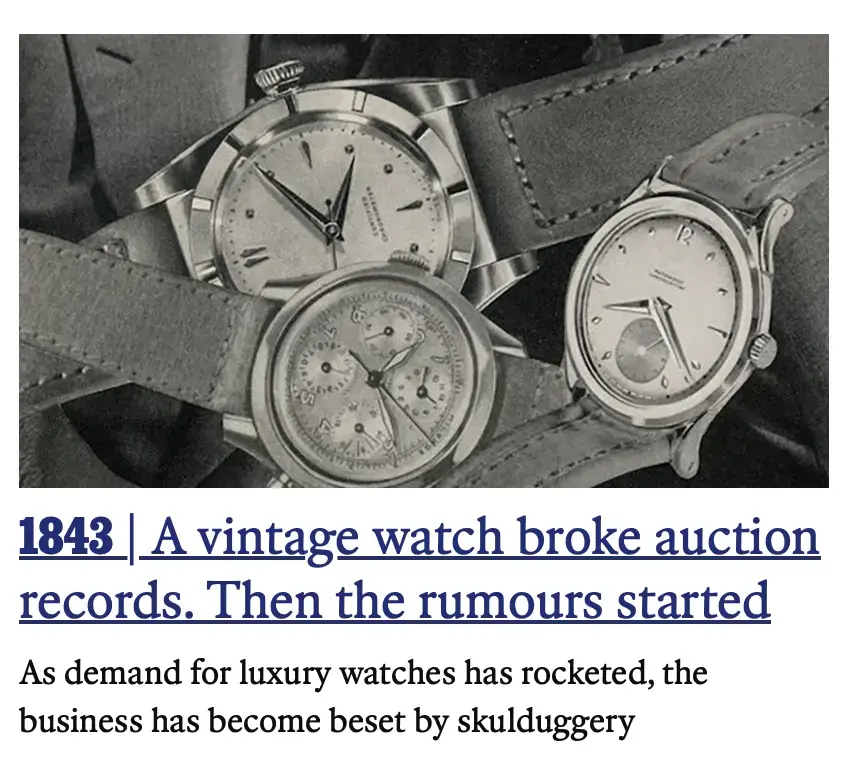
Economist article about Phillips $3.4M Speedmaster

Posts
24,022
Likes
53,432
Summary by Gemini below. I'll add that Jose Pereztroika was interviewed in the preparation of the article and is quoted extensively. Several other experts were also interviewed and quoted, mostly anonymous. Although Jeff Hess is quoted on the record.

--------------------------------------------------

This article from The Economist’s 1843 magazine explores the complex, high-stakes, and often opaque world of the vintage luxury watch market. It details how a hobby once reserved for eccentric scholars has transformed into a multi-billion-dollar global industry driven by "hype," investment speculation, and increasingly sophisticated fraud.

Here is a summary of the key themes and insights from the piece:

1. From Hobby to Asset Class​

The article tracks the evolution of vintage watch collecting. What was once a niche interest in the 1980s and 90s has become a mainstream "alternative asset class." Fueled by social media (especially Instagram) and the "Paul Newman" Rolex Daytona auction in 2017 (which sold for $17.8m), watches are now viewed by many as "financial instruments" rather than mere timepieces.

2. The "Frankenwatch" and Modern Forgery​

A significant portion of the article focuses on the rising danger of "Frankenwatches"—timepieces made of genuine parts from different watches—and outright fakes.

  • Technological Sophistication: Counterfeiters now use high-end CNC machines and 3D printing to replicate movements and cases so accurately that even seasoned experts are frequently fooled.
  • The "Tropical" Dial Scam: Because aged or "faded" dials can triple a watch's value, the article describes how some restorers use chemicals, ovens, or UV light to artificially age modern dials to look vintage.

3. The Role of Auction Houses​

The piece casts a critical eye on the role of major auction houses like Phillips, Christie’s, and Sotheby’s.

  • Conflict of Interest: Auction houses are incentivized to achieve record-breaking prices, which can sometimes lead to "loose" vetting processes or the omission of a watch’s restoration history in catalogs.
  • Market Manipulation: The article touches on "chandelier bidding" and the practice of collectors or dealers "bidding up" their own inventory to establish a higher market price for similar models they own.

4. The Omega Speedmaster Scandal​

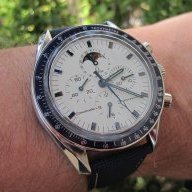
A central anecdote in the piece is the 2021 sale of a "Tropical" Omega Speedmaster for $3.4 million—the most expensive Omega ever sold. It was later revealed to be a "Frankenwatch" built from various parts, allegedly involving collusion by former Omega employees. This scandal serves as a warning for the entire industry regarding the lack of transparency in "museum-grade" pieces.

5. The Psychology of the "New Collector"​

The author notes a shift in the type of person buying these watches. The "new collector" is often younger, wealthier, and more interested in "virality" and status than horological history. This has led to a "winner-takes-all" market where a few specific models (Rolex Daytona, Patek Philippe Nautilus, Audemars Piguet Royal Oak) see astronomical price growth while the rest of the market remains stagnant.

Conclusion: "Buyer Beware"​

The article concludes that while the beauty and mechanical genius of vintage watches remain undeniable, the market has become a "minefield." For the average enthusiast, the barrier to entry is no longer just price, but the immense difficulty of verifying authenticity in an industry where "the truth is often the most expensive component."
Edited:
 
Posts
7,151
Likes
23,188
It’s a shame, really, that anytime there’s enthusiasm for a collectible that eventually translates into high prices, the shysters always come out looking to take advantage of those who’s passion makes them particularly vulnerable to deception.
 
Posts
7,662
Likes
14,168
If Omega's official view is as long as the parts of a made up watch are of the same period, it's ok, it shows how low the industry has fallen in understanding anything about their history, or the mindset of a collector. Not surprising, really, these companies are part of conglomerates whose purpose is to make money now, they'll piggyback on their glorious histories but not to the point of protecting their past production. Caveat emptor, always.
 
Posts
29,533
Likes
76,414
If Omega's official view is as long as the parts of a made up watch are of the same period, it's ok, it shows how low the industry has fallen in understanding anything about their history, or the mindset of a collector. Not surprising, really, these companies are part of conglomerates whose purpose is to make money now, they'll piggyback on their glorious histories but not to the point of protecting their past production. Caveat emptor, always.

There's sort of a cognitive dissonance I see with collectors about "original" parts. The fact is, with any vintage watch you purchase, you have no way of knowing if the parts on it are "original" meaning that these are the parts the watch left the production line with. Usually the best you can say if you are be truthful to yourself, is that they are of the correct period.

Even people who have owned the watch since it was new, and swear it's all original because it's "never been serviced" often forget things. I have serviced lots of watches where this claim has been made by the family or the original owner, yet there are watchmaker's marks inside the case back from multiple services.

Hands, crowns, pushers - these are all routinely replaced at service, so the chances of a watch having all these parts original, again meaning the parts they left the factory with, 50 or more years after it was made, are extremely slim. But people here talk about it like it's a common thing and to be expected as some sort of standard...
 
Posts
24,022
Likes
53,432
I think most experienced collectors would agree with you, Al, although newer enthusiasts are often more naive. It's obviously difficult to distinguish origins from period-correct, although the combination of deep knowledge and provenance can help. But either way, it's uncommon, which is why they bring good money.

Still, the events recounted in the article are different. We are talking about insiders deliberately assembling "rare" or "prototype" watches that never existed from parts of different watches, and using their influence to launder/legitimize them. And Omega refuses to acknowledge that these watches are anything other than legitimate, because the parts are all Omega from the same period.
 
Posts
29,533
Likes
76,414
I think most experienced collectors would agree with you, Al, although newer enthusiasts are often more naive. It's obviously difficult to distinguish origins from period-correct, although the combination of deep knowledge and provenance can help. But either way, it's uncommon, which is why they bring good money.
I guess the point I'm making here is that unless you have examples that are basically NOS (never been sold to an end user and are some dealer's left over stock or some sort of similar situation - there are some of those owned by members here) you have no way of knowing if parts have been replaced or not. It's essentially something that cannot be proven in 99.999% of the vintage watches out there, so people are paying up for something that is most likely just in their own heads. Collectors may all agree with each other that it is an "all original" watch, but that is not proof of anything.

It's easily provable if a watch has a replacement part that differs from what the original had, but nearly impossible to tell if the period correct replacement is on there is the same visually as the original parts.

Still, the events recounted in the article are different.
Of course - I wasn't even talking about that. That's why I highlighted the section of the post that I was replying to. My post isn't about the clear fraud that was perpetrated by Omega employees, but the "fraud" that collectors perpetrate on themselves paying up for what are mostly unprovable claims.
 
Posts
24,022
Likes
53,432
I guess the point I'm making here is that unless you have examples that are basically NOS (never been sold to an end user and are some dealer's left over stock or some sort of similar situation - there are some of those owned by members here) you have no way of knowing if parts have been replaced or not. It's essentially something that cannot be proven in 99.999% of the vintage watches out there, so people are paying up for something that is most likely just in their own heads. Collectors may all agree with each other that it is an "all original" watch, but that is not proof of anything.

It's easily provable if a watch has a replacement part that differs from what the original had, but nearly impossible to tell if the period correct replacement is on there is the same visually as the original parts.
I agree, Al. It's not provable, just likelihood. For example, I bought a 1966 Rolex 5513 from the original owner, and my watchmaker had serviced it 5 times since the 70s (based on case-back markings and his records). All the major identifiable parts were period-correct and both the owner and the watchmaker believed that they were original. The lume in hands and dial has the correct texture and UV response. The bezel insert is the correct variant, etc. That is not proof, but my feeling is that the important parts are likely to be original. Unfortunately, the crystal (correct original dome shape) was badly damaged and I had to replace it.
 
Posts
29,533
Likes
76,414
I agree, Al. It's not provable, just likelihood. For example, I bought a 1966 Rolex 5513 from the original owner, and my watchmaker had serviced it 5 times since the 70s (based on case-back markings and his records). All the major identifiable parts were period-correct and both the owner and the watchmaker believed that they were original. The lume in hands and dial has the correct texture and UV response. The bezel insert is the correct variant, etc. That is not proof, but my feeling is that the important parts are likely to be original. Unfortunately, the crystal (correct original dome shape) was badly damaged and I had to replace it.
If that watch ever went to another watchmaker (say Rolex under warranty or before your watchmaker worked on it) then it's just belief that they are original and nothing more. You may say that never happened, even the original owner may say that never happened, but people forget things.

To me, the claim of "original parts" should be something we only see on here in very rare cases.
 
Posts
24,022
Likes
53,432
If that watch ever went to another watchmaker (say Rolex under warranty or before your watchmaker worked on it) then it's just belief that they are original and nothing more. You may say that never happened, even the original owner may say that never happened, but people forget things.

To me, the claim of "original parts" should be something we only see on here in very rare cases.
Yep, I understand. As you know, I am a scientist, hence my description in terms of likelihood. There are also very important nuances for a collector, as the originality of some parts are very important for collectibility, whereas period-correctness for others (e.g. crown/crystal) are perfectly acceptable.

Anyway, still hoping to hear continued discussion about the article if folks have the chance to read it. 👍
 
Posts
737
Likes
1,366
As you know, I am a scientist
I wondered about the profile picture. (My PhD is in Mathematical Biology.)
 
Posts
24,022
Likes
53,432
I wondered about the profile picture. (My PhD is in Mathematical Biology.)
Physics originally, but have landed in Chemical/Biological Engineering as the career progressed.
 
Posts
2,433
Likes
7,004
I wondered about the profile picture. (My PhD is in Mathematical Biology.)
You might not guess from my avatar, but my PhD is in semiconductor lasers.
 
Posts
7,651
Likes
21,949
Thanks for posting the summary, now we don’t have to read the full article. Mind you I think the Economist gives about one article a month for free to the people who register so people might be able to access it if they want to read the whole thing.
 
Posts
29,533
Likes
76,414
The most astonishingly hilarious thing in that whole article:

"Rolex notes that it is “not authorised to intervene in the relationship” between these independent dealers and their customers)."

Rolex can set whatever policies they want, and control the AD's any way they want - they just choose not to.
 
Posts
82
Likes
164
Damn your conversation is on another level.(I‘m seriously stunned by your arguments)
 
Posts
24,022
Likes
53,432
Thanks for posting the summary, now we don’t have to read the full article.
I'm still not confident enough in the AI summary to make that leap. 😀
 
Posts
2,804
Likes
4,487
The article seems to be pretty much a rehash of what has been said before. Someone got caught with the hand in the cookie jar.

Not surprising in a world where "Fake it till you make it." Or "succeed at all costs" are the mantra of those who tend to feel pressured into conforming. Advertising seems to now tell people that things what are bad for the environment and society are the Ideal.

Sounds like Perez made it, Hiding out at a tropical resort, with the payout used to buy him off with. I have not see too much new fraud discovered by him lately.

It is also evident that things have calmed down a bit since 2022. That the machine is on cruse control.

Vintage watches are only another bullet point in the sales and marketing whitepapers. The focus on these companies is producing new watches for higher prices, while keeping the costs under control. The main focus is about the appearance and desirability.


There were a few things I found interesting especially the part about addiction.

Matt Hranek, a New York-based collector ..., told me. “Really we’re addicts,” Hammerschmidt said, grinning. “Just instead of being addicted to alcohol or cigarettes or drugs, we’re addicted to the chase of acquiring a new watch.”
The hunt, the chase that is what matters. For me this also includes technical info. As noted elswhere I would love to go at the old computer punch card records from the 1960s or so.

If anything I am addicted to information overload. Sometimes I just want to crawl in a hole and study some complex subject.

The event looked less like a luxury convention than a treasure hunt for children on a sugar high.
Back in the 1990s This would be a good description of the NAWCC marts. There was also a lot of complaints that one could slip a watch into a pocket and not pay the sales tax. Where the clock people had these large pieces of furniture to carry about. My interest was purely about automata (mechanical dolls birds, clockwork music devices.) There was also a difference in the older members who at the time were in their 70 and 20 to 30 years older than myself. My contemporaries were more about the 'colectability.' Not to mention the financial benefits.

I was also part of the music box group. Those collectors were after somthing no one else could have. Technical info was hard to come by. Some of the collectors even would not let me study some of the interesting items. There responce was 'I do not like fakes."

The dolls were at the upper end of the spectrum. There a broken doll could be worth more for the doll itself than a restored one. Some of the older collectors though did encourage me, and passed on some pieces at what they had paid years before.

I suspect this is how a lot of the really collectors pieces get swapped about.

Serious collectors tend not to focus on Auctions. So many time the chandelier or the mirror in the back of the room bids. Even in the auction world there are the 'regulars.' who know how the system works.

In some ways I miss the sociability of the clubs. That the 'group' would go out to lunch afterword.

In a lot of ways it does come down to who one knows to learn the what of knowing is all about.


Yau, the authenticator and dealer in Hong Kong, thought that AI-powered systems could be trained to recognise the characteristics of authentic watches and use them to flag discrepancies, like Perez’s work but on a much wider scale. There’s no guarantee that this technology would work, however—or that, as is true today, this information will stop anyone from buying a fraudulent watch.

Interesting how AI is a panacea for everything. I have a hard time feeling what parameters could be used to grade a watch for collectability. Most of the online images are of two low resolution, with too many compression artifacts to give a good feeling for the item.

My understanding is AI does remain brute force in the training. Where the cost are in having human workers subject the data sets to the AI and give it the basic parameters (error correction factor.) The resulting nets can then be cloned.

That is a daunting sysaphean task when one thinks about it. I have older books on Image processing and statistics. Even taking something like the bestfit catalog which has optical comparator silhouettes of the 'signature' parts would take a few months to code.

This stuff though is what does keep me away at night. Or cause me to drift off for an afternoon nap.