Diver 300 8800 erratic time keeping

Posts
261
Likes
201
It's likely just changes in wearing habits, and how much time it spends in various positions through the day. The change isn't all that significant when you take into account that the 8800 is allowed to have positional variation of as much as 14 seconds over 6 positions at full wind, and 16 seconds at 24 hours after full wind.

In contrast the old tried and true 1120 was allowed to have from -1 to +6 second average rate, with the positional variation over 5 positions to be 12 seconds at full wind, and 15 and 24 hours after full wind. I haven't done any sort of serious analysis on the difference here, but the 8800 is certainly not a particularly tightly tolerance movement. Not as bad as the 8700 series (the loosest in term of timing tolerances), but no where near as good as the 8900.

And as I've noted many times, the "0 to +6" range is for the average rate, so individual positions can definitely be well outside that range, and if your watch is spending more time in a slow position, you will get a slow overall rate. Also, be sure you are checking it to a known good time source.

Cheers, Al
Thanks Al. I was hoping you’d pop up. I always use time.is to check the time, but my wearing habits haven’t changed. It’s not so far off that I’m going to hulk smash it with a hammer, just thought it weird that it’s slow since it hasn’t been for almost a year. It’s just that the timegrapher is giving me different readings than real world rest positions. When I rest it fully wound in all positions over 7 days, it’s slow in every position. But the timegrapher is showing +2 dial down. Thanks as always for you input. If it slows down more than it is now I may send it in for regulation.
 
Posts
1,578
Likes
2,690
It's likely just changes in wearing habits, and how much time it spends in various positions through the day. The change isn't all that significant when you take into account that the 8800 is allowed to have positional variation of as much as 14 seconds over 6 positions at full wind, and 16 seconds at 24 hours after full wind.

In contrast the old tried and true 1120 was allowed to have from -1 to +6 second average rate, with the positional variation over 5 positions to be 12 seconds at full wind, and 15 and 24 hours after full wind. I haven't done any sort of serious analysis on the difference here, but the 8800 is certainly not a particularly tightly tolerance movement. Not as bad as the 8700 series (the loosest in term of timing tolerances), but no where near as good as the 8900.

And as I've noted many times, the "0 to +6" range is for the average rate, so individual positions can definitely be well outside that range, and if your watch is spending more time in a slow position, you will get a slow overall rate. Also, be sure you are checking it to a known good time source.

Cheers, Al
Out of curiosity, what are the timing tolerances for the 8900?
 
Posts
29,875
Likes
77,285
Out of curiosity, what are the timing tolerances for the 8900?

Average rate of between 0 and +5, with positions variation at full wind of 12 seconds over 6 positions., That becomes 15 seconds at 24 hours after full wind.
 
Posts
261
Likes
201
Average rate of between 0 and +5, with positions variation at full wind of 12 seconds over 6 positions., That becomes 15 seconds at 24 hours after full wind.
My 8900 AT is probably my most accurate watch. I love that piece
 
Posts
2,808
Likes
8,339
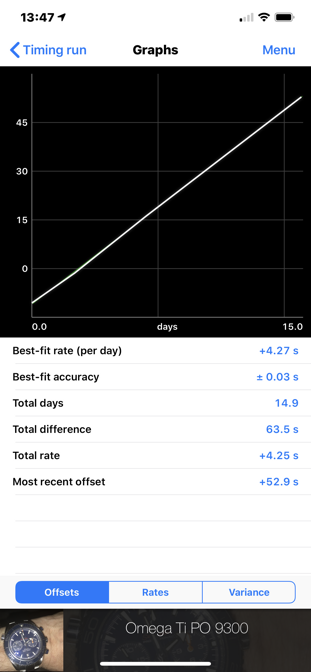
I had a similar changes in timekeeping with my Ti Planet Ocean 9300, out of the blue, without banging or dropping the watch, and not related to magnetism (per my watchmaker).

When I bought it in March 2016 it was consistently running +4 to +5 sec/day, but by September was just under +6 sec/day. I had it regulated at Omega in November after it gradually got just over + 6 sec/day. It came back in November 2016 running a very stable and consistent +3 sec/day for 5 months until April 2017.

Then through June - October 2017 it bumped itself up again to consistently run in the +5.5 sec range, and by November 2017 it was back up to running just over 6 sec/day again. Strange.

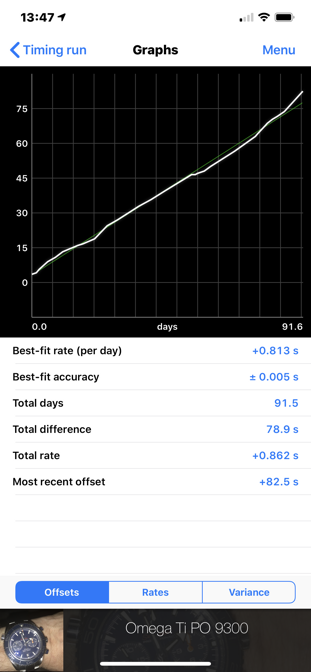
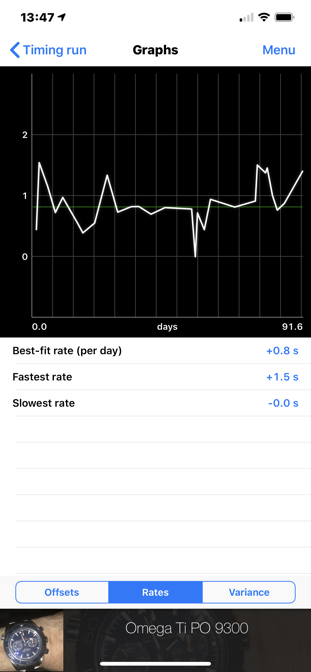
So Omega regulated it a second time in Dec 2017, and for the next 90 days after it came back it consistently ran between -0.0 sec/day and +1.5 sec/day on average EVERYDAY for just over 3 months, with an average of +0.86 sec/day during that time! I was in love with the incredible accuracy and stability of the rate with such little variation day to day.


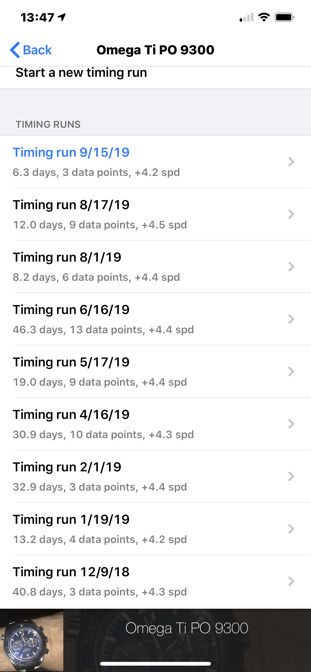
Then, after 92 days of bliss, in March 2018 overnight it was running a very consistent average of +4.3 sec/day (anywhere from +2.8 to +4.9 sec/day for the next several months), and it's been like that for the past 18 months. No more climbing to +6 sec/day over a few months time, and with a very small variation in average daily rate from day to day.


It looks good on the watchmaker's timegrapher, and it's not due for a service for another 18 months, so I'm just wearing it every day and resetting the time every couple of weeks after it has gained a minute.

But I do track the average rate regularly using WatchTracker, watching for a sudden change, just in case. Since March 2018, when it started to run at about +4.3 sec/day, it has not had any aberrations in that average daily rate except for a 2 month period between Sept - Nov 2018 when it only gained 8 seconds in 68 days!

Here is the past 2 weeks:
Edited:
 
Posts
261
Likes
201
I had a similar changes in timekeeping with my Ti Planet Ocean 9300, out of the blue, without banging or dropping the watch, and not related to magnetism (per my watchmaker).

When I bought it in March 2016 it was consistently running +4 to +5 sec/day, but by September was just under +6 sec/day. I had it regulated at Omega in November after it gradually got just over + 6 sec/day. It came back in November 2016 running a very stable and consistent +3 sec/day for 5 months until April 2017.

Then through June - October 2017 it bumped itself up again to consistently run in the +5.5 sec range, and by November 2017 it was back up to running just over 6 sec/day again. Strange.

So Omega regulated it a second time in Dec 2017, and for the next 90 days after it came back it consistently ran between -0.0 sec/day and +1.5 sec/day on average EVERYDAY for just over 3 months, with an average of +0.86 sec/day during that time! I was in love with the incredible accuracy and stability of the rate with such little variation day to day.


Then, after 92 days of bliss, in March 2018 overnight it was running a very consistent average of +4.3 sec/day (anywhere from +2.8 to +4.9 sec/day for the next several months), and it's been like that for the past 18 months. No more climbing to +6 sec/day over a few months time, and with a very small variation in average daily rate from day to day.


It looks good on the watchmaker's timegrapher, and it's not due for a service for another 18 months, so I'm just wearing it every day and resetting the time every couple of weeks after it has gained a minute.

But I do track the average rate regularly using WatchTracker, watching for a sudden change, just in case. Since March 2018, when it started to run at about +4.3 sec/day, it has not had any aberrations in that average daily rate except for a 2 month period between Sept - Nov 2018 when it only gained 8 seconds in 68 days!

Here is the past 2 weeks:
That’s great man! I also use watch tracker. I wouldn’t mind if it sped up a little. I just hate slow watches, and since it was running slightly fast then bam, slow, it kind of threw me off