Did the Moonwatch need hesalite?

Posts
194
Likes
67
Probably not, but remember … the Speedmasters used in the Apollo missions were off the shelf watches and those watches only came with hesalite. In fact, most sports watches (even those by Omega, Rolex, Heuer, etc) were only offered with acrylic crystals.

It would have been difficult to find a chronograph with a sapphire crystal in the 1960s.
True, but they never said that the original moonwatch with a sapphire crystal was hard to find so they went with the hesalite. They said only hesalite for the shatterproof ability.
 
Posts
194
Likes
67
I can say from personal experience that fragments of sapphire glass are no joke. I still have some pieces lodged under my thumbnail when that damn Spiralwinder caseback shattered 6 weeks ago. Now imagine no gravity and that stuff flying around the cabin ....
Ok but why are they letting a sapphire crystal watch on board now?
 
Posts
6,194
Likes
21,200
NASA did the best they could. Those were some tough requirements.

Is acrylic really shatterproof? Nope. Neither is mineral or sapphire. Some are harder to shatter or break into smaller or larger pieces, but they can be shattered.

Mineral was more common during the tests. Mineral is more glass than sapphire, so maybe the requirements could have meant no mineral crystals? Or maybe they were just happy any watch survived the grueling tests and overlooked the shatterproof requirement. My opinion is that we watch nerds care about it more than NASA.

As to why they allow sapphire on the ISS, that should say something about the myth of being nervous about sapphire shattering.

The Speedmaster is worn on EVAs because it passed the tests and it works. No need to pay for more tests.
 
Posts
1,725
Likes
3,370
As to why they allow sapphire on the ISS, that should say something about the myth of being nervous about sapphire shattering.
Good point. I remember seeing photos of NASA astronaut Jonny Kim wearing a Seamaster Pro and a GMT Master on board the ISS. Both those watches had sapphire crystals.
 
Posts
194
Likes
67
What I think is acrylic was widely used as the crystal of most watches back then so that is what came with the watch. Most watches back then came with something other Sapphire. I think then, because the classic watch kept the Hesalite, people came up with a story and it stuck. If they didn't want Sapphire on a watch back then because of shatter abilities, then you would think that would still hold true today. However, Sapphire is widely used on this mission and most missions ever since. Sure for EVA the moonwatch is the only approved watch, but that is outside the capsule where it matters less.
 
Posts
6,194
Likes
21,200
Sure for EVA the moonwatch is the only approved watch, but that is outside the capsule where it matters  more.
FIFY
 
Posts
3,879
Likes
8,398
. I think then, because the classic watch kept the Hesalite, people came up with a story and it stuck

Not exactly, but yes....Military and professional organizations had already had experience with mineral glass and rock crystal watch faces shattering in situations where that wasn't great.

As acrylics became more and more available, it was a natural replacement for something hard to cut, machine, and polish- and that scratched somewhat often.

The specification for a "shatterproof" crystal wasn't specifically adopted by NASA, the specification predates NASA. It really didn't take much consideration to stick with an existing decision in much less strenuous environments.

Since Sapphire has become so much more common, the policy has changed a bit.
 
Posts
925
Likes
494
But they use the x33 now. It has sapphire
Yes.
That's why i mentioned that experience or time will tell.
NASA are only one bad event away from finding out if Saphire crystals are entirely suitable or preferable over Hesalite.
Having said that. The crystal on the X-33 is largely protected by the bezel as opposed to the crystals on watches back in the day protruding, which which placed them at greater risk of impact damage.
I imagine that NASA may have looked at the risk factors with using the X-33 and considered them to be miniscule in the modern age when balanced with any perceived practical advantage.
Besides.
It's not like they're going on any excursions on Artemis II.
 
Posts
925
Likes
494
NASA did the best they could. Those were some tough requirements.

Is acrylic really shatterproof? Nope. Neither is mineral or sapphire. Some are harder to shatter or break into smaller or larger pieces, but they can be shattered.

Mineral was more common during the tests. Mineral is more glass than sapphire, so maybe the requirements could have meant no mineral crystals? Or maybe they were just happy any watch survived the grueling tests and overlooked the shatterproof requirement. My opinion is that we watch nerds care about it more than NASA.

As to why they allow sapphire on the ISS, that should say something about the myth of being nervous about sapphire shattering.

The Speedmaster is worn on EVAs because it passed the tests and it works. No need to pay for more tests.
Then again. The ISS is not on par with Mercury or Apollo programs all things considered.
 
Posts
6,875
Likes
12,633
We're talking 1960s here !
Hesalite = synthetic transaprent thermoplastic
In other words a trade name like we know plexiglas for the same thing, acrylic "glass" !

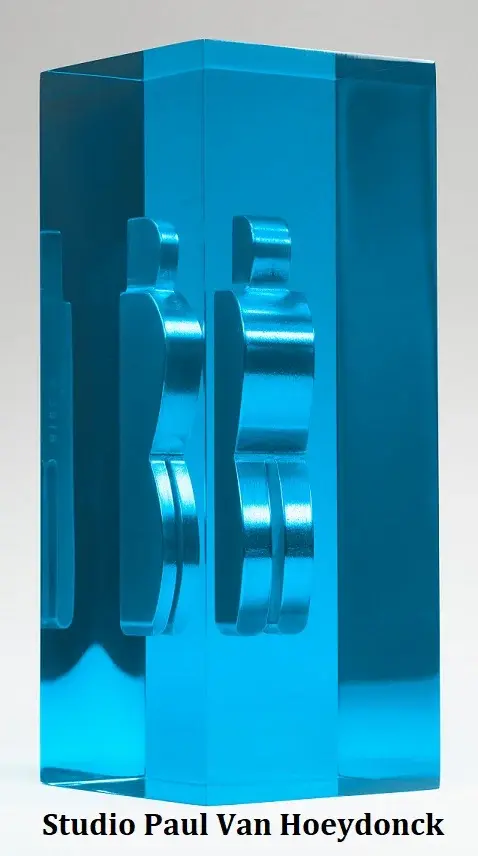
While talking to Belgian artist Paul Van Hoeydonck ( 1925-2025 ), he explitcitly mentioned that his original artwork was representing a human figure floating up towards a blue sky... it sat in a block of acrylic (Hesalite) but NASA at the time did not allow such a large piece of hesalite due to fire hazard.
So PVH had to make a loose " Fallen Astronaut " figurine to be put beside a plaque on the Moon by Apollo 15 Commander David Scott.
In 2019, PVH decided to make a limited series of the orginal artwork as intended in the 1970s.
These were presented during VIP events, with Apollo 15 astronaut Alfred Worden prsent...
(Photo: Studio Paul Van Hoeydonck)
.
 
Posts
194
Likes
67
Yes.
That's why i mentioned that experience or time will tell.
NASA are only one bad event away from finding out if Saphire crystals are entirely suitable or preferable over Hesalite.
Having said that. The crystal on the X-33 is largely protected by the bezel as opposed to the crystals on watches back in the day protruding, which which placed them at greater risk of impact damage.
I imagine that NASA may have looked at the risk factors with using the X-33 and considered them to be miniscule in the modern age when balanced with any perceived practical advantage.
Besides.
It's not like they're going on any excursions on Artemis II.
I don't think this was a factor. The reason because other sapphire crystal watches have gone into space like Rolex GMT, Seiko and Breitling Navitime. I have to believe they have no standards for watch crystal