Crazy Speedmaster chronograph error

Posts
9
Likes
0
Hi guys! I'm a new member and seasoned lurker here with a question regarding the chronograph on my Omega.

I just had a strange incident yesterday with my one year old Speedmaster Pro (ref 31130423001005).

When starting the chronograph, the chronograph hand and the second hand both stopped moving after one second. I stared at the watch in disbelief for a short while before pressing the start/stop button again. I'm not sure if I had to press the start button one or twice, but both hands started moving again.

The watch had been wound the same day it happened.

Does anyone have any idea what might cause such behaviour? I have not been able to reproduce the error, but I'm wondering if I should return the watch for service. It was bought from a local AD, but I'm not too keen on returning it to Bienne when it is under a year old.

Should I worry if I cannot reproduce the error during the next few days? Or is this a no-brainer - just return it and get it checked out by the pros?

 
Posts
733
Likes
1,457
Welcome to the forums.

How does the watch work in regards to the other functions?
Does it wind smoothly? Is the power reserve up to par? Does it keep good time?

Assuming the answers to the above questions are positive, you cannot replicate the malfuntion and it hasn't reappeared, I would personally wait and wear it. If it starts to malfuntion more often or there are other issues I'd take it in as it is under warranty.

Just my 2 cents.
 
Posts
9
Likes
0
Welcome to the forums.

How does the watch work in regards to the other functions?
Does it wind smoothly? Is the power reserve up to par? Does it keep good time?

Assuming the answers to the above questions are positive, you cannot replicate the malfuntion and it hasn't reappeared, I would personally wait and wear it. If it starts to malfuntion more often or there are other issues I'd take it in as it is under warranty.

Just my 2 cents.

It winds smoothly, the power reserve is fine and it keeps good time. I will keep an eye on it the next weeks, that's for sure.
 
Posts
29,903
Likes
77,340
When starting the chronograph, the chronograph hand and the second hand both stopped moving after one second. I stared at the watch in disbelief for a short while before pressing the start/stop button again. I'm not sure if I had to press the start button one or twice, but both hands started moving again.

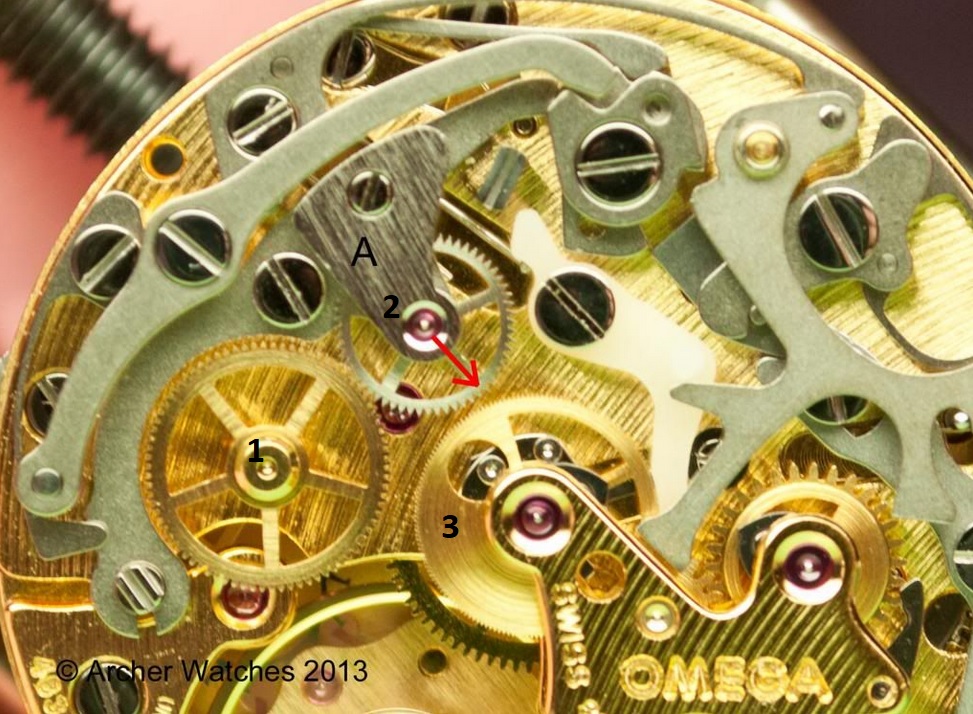
In a horizontally coupled chronograph like this, there is a part called the coupling yoke (A in the photo below) that moves when you press the start button for the chronograph. The small wheel on this yoke is driven by the movement and is constantly turning. The teeth on this wheel, which again are turning so are not in a known position, must mesh with the stationary wheel at the center of the movement - this is the chronograph wheel, and what the large central chronograph seconds recording hand is attached to.


These teeth must mesh with each other, and they are very pointed teeth as you can see in this photo:


The reason they are pointed is that there's a chance that the peak of one tooth on the wheel in the coupling yoke may land on the peak of a tooth on the chronograph wheel. The pointed shape means that the chances of this happening are greatly reduced compared to a more traditional gear tooth form, but it can still happen. It's rare, but what you describe is sounds to me like that happening, and it momentarily jammed the chronograph.

You pressed the start/.stop button twice, once to disengage these two wheels as the yoke moved back, and then when you pressed it a second time, the yoke moved back in and everything meshed fine.

It's not a fault that would require any correction, as it's just the nature of the mechanism.

That's my educated guess, and if it doesn't happen again, I would say it's nothing to worry about.

Cheers, Al
 
Posts
9
Likes
0
In a horizontally coupled chronograph like this, there is a part called the coupling yoke (A in the photo below) that moves when you press the start button for the chronograph. The small wheel on this yoke is driven by the movement and is constantly turning. The teeth on this wheel, which again are turning so are not in a known position, must mesh with the stationary wheel at the center of the movement - this is the chronograph wheel, and what the large central chronograph seconds recording hand is attached to.


These teeth must mesh with each other, and they are very pointed teeth as you can see in this photo:


The reason they are pointed is that there's a chance that the peak of one tooth on the wheel in the coupling yoke may land on the peak of a tooth on the chronograph wheel. The pointed shape means that the chances of this happening are greatly reduced compared to a more traditional gear tooth form, but it can still happen. It's rare, but what you describe is sounds to me like that happening, and it momentarily jammed the chronograph.

You pressed the start/.stop button twice, once to disengage these two wheels as the yoke moved back, and then when you pressed it a second time, the yoke moved back in and everything meshed fine.

It's not a fault that would require any correction, as it's just the nature of the mechanism.

That's my educated guess, and if it doesn't happen again, I would say it's nothing to worry about.

Cheers, Al

Thanks, Archer! I've read your posts in many threads before, and was kind of hoping you would take the time to reply in mine. Your educated guess certainly makes sense. Hopefully it's not a malfunction then, but I'll keep any eye on it.

When what you describe happens, both the second hand and chronograph hand stop, right?
 
Posts
1,670
Likes
5,917
Thanks, Archer! I've read your posts in many threads before, and was kind of hoping you would take the time to reply in mine. Your educated guess certainly makes sense. Hopefully it's not a malfunction then, but I'll keep any eye on it.

When what you describe happens, both the second hand and chronograph hand stop, right?

Correct.

From Archer's picture.

1 is the small constant seconds hand and 3 is the central chronograph hand. 1 is always turning when the movement is running, and since it is always in contact with 2, that is also always turning. When you push the pusher to start the chronograph, 2 moves to contact with 3 but 2 also continues to stay in contact with 1. So if 1 or 3 stop turning then everything stops.

 
Posts
9
Likes
0
Correct.

From Archer's picture.

1 is the small constant seconds hand and 3 is the central chronograph hand. 1 is always turning when the movement is running, and since it is always in contact with 2, that is also always turning. When you push the pusher to start the chronograph, 2 moves to contact with 3 but 2 also continues to stay in contact with 1. So if 1 or 3 stop turning then everything stops.


Thank you! It all makes sense now.😀
 
Posts
197
Likes
156
I assume this is why I've had 7750/3300 movements stop when starting the chrono. If this repeats occasionally, can it be fixed/improved to reduce the frequency?
 
Posts
29,903
Likes
77,340
I assume this is why I've had 7750/3300 movements stop when starting the chrono. If this repeats occasionally, can it be fixed/improved to reduce the frequency?

Possibly could be reduced by changing the engagement depth of the oscillating pinion with the chronograph wheel...
 
Posts
2
Likes
0
Sorry to be reviving this old thread, and thanks to @Archer for the excellent explaination on what might be causing this.

My new watch does the same and it happens once in a while (maybe 1 in 50 or so). Do you think this is a problem that might solve itself as the watch is used more? Maybe lubricants spreads and friction lessens? Can it be "helped" by for example running the chrono over an extended time? Or is this an issue that will always be there and should be fixed?

(Edit: I guess what I'm asking is if it is foolish of me to hope it will go away by itself and not just use the warranty right away 😀 )
 
Posts
2
Likes
0
I also forget to mention, when this happens I can tap or shake my watch and it gets going again. It also happens that it gets going by itself after a few seconds. I suppose this also fits with Archer’s description of what happens.
Edited: